


Will your business have to pay to leave an energy contract early, or can you challenge the supplier’s exit figure? Business energy contract exit fees aren’t set by a universal tariff. Whether a charge applies, and how it’s calculated, depends on the agreement, the timing of your request and the circumstances behind it. A move, closure or change in operations can make the decision more urgent, but doesn’t automatically determine what you owe.
Unclear contract wording can make it difficult to assess the cost or check a supplier’s calculation. Before deciding what to do, identify the terms that govern early termination and keep a clear record of the circumstances behind your request.
This guide explains what to look for in your contract, which notice periods and supporting evidence may matter, and how to compare an exit figure with the terms you signed. You’ll also learn how to weigh the cost of leaving against staying or negotiating, and how to document a considered decision about your next step.
Key Takeaways
- Business energy contract exit fees depend on the wording of your agreement, so identify the clauses that determine when and how a charge may apply.
- Review your signed contract alongside renewal letters, amendments and supplier communications to build a complete picture of your obligations.
- Compare staying, negotiating a change and requesting an early exit against your business needs, timing and documented costs.
- If you dispute a charge, ask for its written basis, compare it with your terms and keep a clear record of your evidence and correspondence.
- Procurement support and bill validation can help you assess your options and plan your next energy contract decision.
What are business energy contract exit fees, and when might they apply?
A business energy contract exit fee is a charge specified in the contract for ending the agreement before its end date. Whether a fee applies, and how the supplier calculates it, depends on the terms you accepted. There’s no single fee or calculation for every business energy contract. The wider context of UK energy policy can help explain how the market is structured, but your agreement sets out the obligations that apply to your account.
Start by confirming the contract end date and noting why you’re considering an exit. A supplier change, relocation, closure or change in energy requirements could each raise different questions under the agreement. For example, if your business is moving premises, establish whether the contract applies to a specific site, the named customer or both. A closure may also require notice and a final account. Neither circumstance automatically removes an exit fee.
The signed terms, timing and circumstances determine the next steps. Check the relevant clauses before requesting a termination or arranging a new contract. Keep records that explain the reason for the proposed change.
Which contract events can prompt an early-exit question?
A business might consider leaving early because it has found a different supplier, is moving to a new site, is ceasing operations or no longer needs the same volume of energy. The agreement may explain how a change of premises or customer details is handled. A supplier issue may involve separate complaint or contract provisions. Treat each event on its own facts: record dates, site details and relevant correspondence rather than assuming the event itself cancels the agreement.
How are exit fees different from other business energy charges?
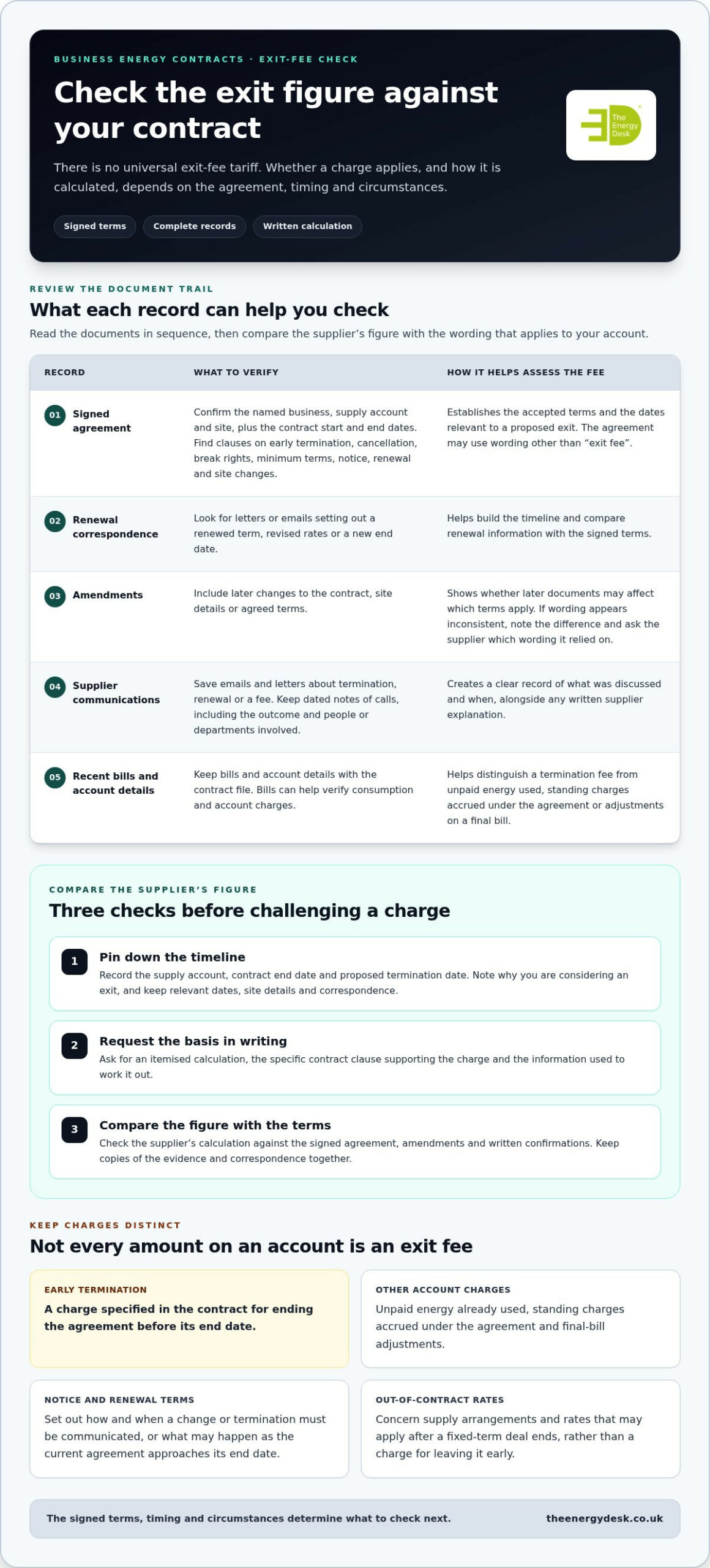
An exit fee relates to ending a contract early. It’s separate from unpaid charges for energy already used, standing charges accrued under the agreement, and adjustments on a final bill. Notice requirements serve a different purpose: they set out how and when a party must communicate a change or termination. Renewal terms determine what may happen as the current agreement approaches its end date.
Out-of-contract rates are another issue. They concern the supply arrangements and rates that may apply after a fixed-term deal ends, rather than a charge for leaving that deal early. If your contract has ended or you’re unsure what rates apply, read the site’s guide to identifying and exiting out-of-contract energy rates. Keeping these categories separate makes it easier to question a specific charge and check whether it relates to termination, consumption or the account’s status.
How to check a business energy contract for exit-fee terms
Before challenging a proposed charge, build a clear record of what was agreed and what changed afterwards. Review the documents in sequence, then compare the supplier’s calculation with the wording that applies to your account. This helps distinguish a charge supported by the contract from a figure that needs further explanation.
- Find the signed agreement. Confirm the named business, supply account and site, then note the contract start and end dates.
- Check renewal correspondence. Look for letters or emails setting out a renewed term, revised rates or a new end date.
- Review amendments. Include any later changes to the contract, site details or agreed terms.
- Gather supplier communications. Save emails, letters and notes of calls that refer to termination, renewal or a fee.
As you review the file, locate clauses on early termination, cancellation, break rights, notice periods, minimum terms, renewal and site changes. Search for alternatives to the phrase “exit fee”, as the agreement may use another term for a termination charge. Ofgem’s information on business energy contract rules provides wider context on contract information and protections, but your own agreement remains central to checking a proposed charge.
What wording should businesses locate in the agreement?
Check whether the contract explains when a charge may apply, how it’s calculated and whether it changes according to timing or circumstances. Compare the signed terms with amendments and written supplier confirmations. If two documents appear inconsistent, note the difference and ask the supplier to explain which wording it has relied on. Don’t assume a later email changes the contract unless its effect is clear.
Record the relevant supply account, the contract end date and the proposed termination date. Then request an itemised calculation in writing, including the specific clause supporting the charge and the information used to work it out. This gives you a clear basis for comparing the supplier’s position with the documents.
What evidence helps check the supplier’s calculation?
Keep the signed terms, relevant correspondence, recent bills and account details together. Note the date and outcome of each call, the names or departments involved, and copies of emails or formal complaints. Bills can help verify consumption and account charges, while the contract and correspondence establish the terms and timeline. Bill validation can also help businesses compare billed energy charges with relevant records.
Before disputing a fee, keep the signed terms, the supplier’s itemised calculation and a dated record of relevant correspondence together. If you need support assessing contract and procurement options, The Energy Desk’s business energy procurement support can help inform your next decision.
Should a business pay an exit fee, negotiate or stay in contract?
There isn’t one best answer for every business. Compare the practical and financial impact of staying, asking for a contract change or seeking early termination. Use the supplier’s documented calculation and your own contract figures, not generic estimates of what business energy contract exit fees might be.
Before deciding, weigh four factors:
- Timing: How long remains on the agreement, and when must you act on renewal?
- Operational urgency: Does a move, closure or change in energy use make an early change necessary?
- Exit terms: What charge has the supplier calculated, and which contract clause supports it?
- Supply continuity: How would a change affect the premises and arrangements for ongoing energy supply?
Then compare the confirmed cost of leaving with the cost and operational implications of remaining until the end date. Include new contract figures only when they’re available and applicable to your business. A lower rate alone doesn’t settle the question if an early exit creates other costs or complications.
When could staying until renewal be the simpler option?
Waiting may be more practical if the end date is close and the business can operate under its current terms. Compare the supplier’s documented exit charge with the implications of remaining for the time left, using your agreement and account information. Check renewal correspondence and notice dates early so you have time to review options before the next decision point.
Staying isn’t automatically the lowest-cost choice. Consider whether the current terms remain suitable for your expected operations, and whether waiting could affect your ability to arrange supply at the right time. Record the assumptions behind your comparison so you can review the decision if circumstances change.
When might a business ask the supplier to review or negotiate?
Ask for a review if the supplier’s calculation appears inconsistent with a clause, a relevant amendment or the dates on record. You can also explain a documented change in circumstances, such as a site move or closure, and ask what options the contract allows. Set out the issue clearly in writing and include the relevant documents.
A discussion with the supplier may clarify whether a contract change, revised arrangement or other route is available. It doesn’t guarantee that a fee will be waived or reduced, particularly if the charge follows the agreed terms. Ask for any proposed change and its effect on charges, end dates and supply arrangements in writing before deciding. That gives you a clear basis for choosing whether to stay, negotiate further or proceed with an exit request.
How to handle energy supplier exit fee disputes
A clear written record makes it easier to separate a disagreement about contract terms from a query about the account balance. If you challenge business energy contract exit fees, first ask the supplier to explain the basis of the charge and its calculation. Then compare the response with your agreement and records for the relevant supply account.
How should a business raise a written challenge?
Use the supplier’s formal complaints process and set out the issue concisely and factually. Identify the disputed charge, the contract clause you believe applies and any mismatch between that wording and the supplier’s calculation. Attach relevant evidence, such as the signed agreement, amendments, bills, dated correspondence or documents showing a change in circumstances.
Ask the supplier to confirm in writing how it reached its figure, which terms it relied on and how it will handle the issue. Keep a dated copy of your complaint and every response. Record any calls, including when they took place and what was agreed. If the amount is actually for unpaid consumption, standing charges or a final-bill adjustment, make that clear. An account-balance query may need to be assessed separately from a dispute over the right to terminate early.
For billed consumption or other charges, compare the supplier’s figures with bills, meter information and account records. The Energy Desk’s guide to commercial utility bill validation explains how to check billed amounts against relevant records.
What if the supplier does not resolve the issue?
Follow the supplier’s published complaints process and note any response dates or escalation steps it gives you. External routes and eligibility can depend on the business category and current rules, so check the latest supplier and regulatory guidance before escalating. The Energy Ombudsman may be available to eligible businesses if a complaint remains unresolved after eight weeks or the supplier issues a deadlock letter. Confirm that your business and complaint meet the current criteria before relying on this route.
Keep the dispute moving without losing sight of supply arrangements. Check the end date of the existing contract and any start date for a replacement agreement, and clarify with the supplier how the account will be treated while the complaint is under review. Don’t assume that raising a dispute changes the contract, pauses charges or guarantees a particular outcome.
Retain the complete file: the agreement, itemised calculation, bills, complaint, supporting evidence and the supplier’s final response. For help checking energy charges against your records, explore commercial bill validation support.
How The Energy Desk can help businesses plan an energy contract exit
Deciding what to do about a contract is easier when you consider the exit terms alongside energy use, account charges and operational priorities. The Energy Desk is an independent energy consultancy serving businesses across the UK. It supports businesses with energy procurement and management, helping them assess contract timing and plan renewal or supplier-change decisions.
Business energy contract exit fees are only one part of that assessment. Procurement support can help a business compare available options with its objectives, such as moving premises, closing a site or preparing for renewal. This supports a more informed decision about timing and next steps, without assuming that leaving early is always the right choice.
What support can help clarify the decision?
A structured review can bring together contract information, account records and the business’s stated priorities. Bill validation can help examine billed charges against available documentation, while an energy audit can provide a clearer view of usage. These checks can help distinguish a disputed account charge from the separate question of what the contract says about ending early.
For broader context on procurement support, see the article comparing strategic energy procurement consultants. Consider how procurement, contract timing and ongoing energy management fit together before deciding whether to stay, negotiate or plan a change.
What information should a business prepare?
Gather the current agreement, renewal correspondence, amendments, supplier communications, recent bills and relevant account details. Then summarise why you’re considering an exit and note any operational deadlines, such as a planned relocation or closure. A clear record helps keep the discussion focused on the terms, the account and the business’s requirements.
With those documents ready, it’s easier to assess the decision in context and identify what further information may be needed. The Energy Desk can support businesses in reviewing energy management and procurement considerations as they plan their next steps.
Request a free energy audit from The Energy Desk to build a clearer picture of your energy use and inform your contract planning.
Make your next energy contract decision with confidence
Before acting on business energy contract exit fees, check the signed terms, confirm the relevant dates and ask for a written explanation of any charge. Then weigh the evidence against your operational needs. Staying, discussing a change with the supplier or requesting an early exit may each suit different circumstances. Keep contract charges distinct from billed energy and account balances, and retain records if you need to challenge a calculation.
The Energy Desk supports UK businesses with energy procurement and management. Its bill validation and energy auditing services can help build a clearer picture of charges and energy use as you plan renewal or a supplier change.
Take a practical first step: request a free business energy audit and make your next decision with a more informed view of your energy requirements.
Frequently Asked Questions
Are business energy contract exit fees always enforceable?
No. Whether a fee can be applied depends on the contract wording and the circumstances of the proposed exit. Check that the supplier’s calculation follows the relevant clause and that the dates and account details are correct. If the basis is unclear or appears inconsistent with the agreement, request an explanation in writing and use the supplier’s complaints process if needed. Business contracts generally don’t have a mandatory cooling-off period.
How much is a business energy contract exit fee?
There’s no standard amount for business energy contract exit fees. The supplier and the terms of the individual agreement determine whether a fee applies and how it’s calculated. Ask for an itemised figure and the clause supporting it, then compare the calculation with your signed terms and any later amendments. Avoid relying on generic estimates: assess the charge against your own contract and account information.
Can a business leave an energy contract early without paying a fee?
Sometimes. The contract may allow an exit in particular circumstances, and businesses can switch without an exit fee during the final 49 days of a fixed-term contract. A business on an out-of-contract or deemed tariff can typically switch with 28 days’ notice and no exit fee. Check your agreement and supplier guidance before acting, as the contract status and proposed switching date matter.
What happens if a business closes before its energy contract ends?
Closing a business doesn’t automatically end its energy contract or remove a possible exit fee. Notify the supplier, check the termination and site-change terms, and ask how the account should be closed. Keep evidence of the closure date and any relevant meter readings, and request a final account statement. The agreement may still set out charges or notice requirements, so confirm the supplier’s position in writing.
Can a business dispute an energy contract exit fee?
Yes. Ask the supplier to explain the fee in writing, including its calculation and the contract clause relied on. Compare the response with the signed agreement, amendments and relevant correspondence, then submit any evidence that supports your position. Follow the supplier’s formal complaints process and retain copies of all communications. Eligible businesses may be able to escalate an unresolved complaint to the Energy Ombudsman after eight weeks or a deadlock letter.
Is an exit fee the same as an out-of-contract energy rate?
No. An exit fee is a charge that may apply for ending a fixed-term agreement early, according to its terms. An out-of-contract rate is a supply rate that may apply after a fixed-term deal ends, when no new fixed contract is in place. They relate to different situations. Check whether your contract has ended and what rates apply, separately from any early termination charge.
What documents should I check before leaving a business energy contract?
Start with the signed agreement, then review renewal letters, amendments and supplier communications. Locate the termination, notice, minimum-term, renewal and site-change terms. Note the supply account, contract end date and proposed termination date. Recent bills and account records can help check billed charges, whilst written correspondence may clarify later changes. If the supplier quotes a fee, request an itemised calculation and compare it with the relevant clause.