

Could the meter itself be the least complicated part of your commercial gas project? The commercial gas meter installation cost depends on more than the equipment. A new gas connection, meter exchange or relocation can each involve different work, site conditions and arrangements. Before committing, it helps to understand exactly what a quote covers, particularly if pipework or infrastructure work could affect the project scope.
This guide explains the main factors that shape an installation quote and why a new connection is different from fitting a meter to an existing supply. You’ll learn how meter requirements, site access and connection work can affect costs, what information to prepare for an assessment, and how supplier, transporter and metering arrangements fit into the process. The Energy Desk supports UK businesses with utility connection coordination and commercial gas procurement, helping bring project dependencies into view as you plan next steps.
Key Takeaways
- The commercial gas meter installation cost depends on the work included, so a universal price may not provide a reliable budget.
- Separate installation and connection work from ongoing gas supply charges when reviewing a quote.
- Identify whether the project is a new connection, meter exchange or relocation, as each has a different scope.
- Prepare premises details, expected gas demand, current meter information and your intended operational date for an assessment.
- Utility connection coordination can clarify project dependencies and align meter planning with your wider commercial gas requirements.
Commercial gas meter installation cost: what businesses are paying for
Businesses need a project budget based on the work at their premises, not a generic figure for a different job. The commercial gas meter installation cost depends on the existing supply, the operation’s gas requirements and the work needed to complete the project. A useful quote describes the specific work included instead of treating every meter project as identical.
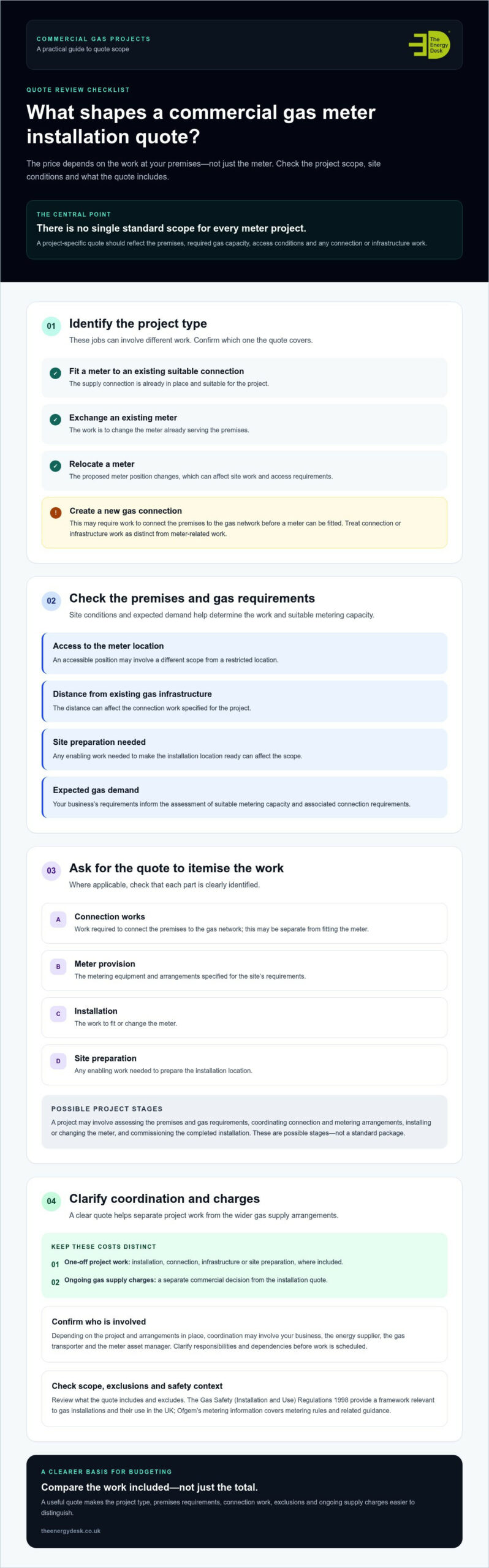
Start by identifying the project type. Fitting a meter to an existing, suitable connection differs from exchanging an existing meter or moving it to a new position. A new gas connection is a separate, potentially broader project: work may be needed to connect the premises to the gas network before a meter can be fitted. Ask for connection or infrastructure work to be identified separately from meter-related work.
What does commercial gas meter installation include?
Depending on the project, the work may include assessing the premises and gas requirements, coordinating connection and metering arrangements, installing or changing the meter, and commissioning the completed installation. These are possible stages, not a standard package. The agreed scope and site conditions determine which apply. For a new connection, network-related work may sit alongside the meter installation rather than being included in it.
Gas work must be planned with safety in mind. The Gas Safety (Installation and Use) Regulations 1998 provide a framework relevant to gas installations and their use in the UK. Review the project scope to understand what installation work is included and how the required activity will be addressed.
Why is there no single commercial gas meter installation price?
Premises differ. Access to the proposed meter location, the distance from existing gas infrastructure and the amount of site preparation needed can all affect the scope. Required capacity matters too: expected gas demand informs meter and connection requirements, so a small premises and a higher-demand operation may need different work.
Keep the installation quote separate from ongoing gas supply charges. A gas supply contract is a distinct commercial decision, even when supply and metering arrangements need to be coordinated as part of the wider project. Check that the quote identifies what is included, any connection or infrastructure work, and any exclusions. Comparing these details gives your team a clearer basis for budgeting and assessing the proposed scope.
A project-specific quote reflects the premises, required gas capacity, access conditions and whether connection or infrastructure work is needed beyond the meter.
The Energy Desk’s utility connection assistance helps businesses understand project scope and dependencies, while linking meter planning with wider commercial gas procurement.
Which factors shape a commercial gas meter installation quote?
A useful quote does more than state a total. It sets out the work included and separates one-off project costs from ongoing gas supply charges. That distinction helps you budget for the installation without confusing it with the cost of the gas your business will use.
How do site conditions and capacity affect the quote?
The premises and project type influence how much work is needed. A meter in an accessible position at a site with an existing suitable connection may involve a different scope from a new-build site or a meter that needs relocating. Restricted access, distance from existing infrastructure and preparation needed at the site can all affect the work specified.
Expected gas demand also matters. The business’s requirements inform the assessment of suitable metering capacity and associated connection requirements. A quote should reflect current project details rather than an assumed specification. For regulatory context, Ofgem’s metering information covers metering rules and related guidance. Technical requirements should be considered in relation to the project’s circumstances.
Which project and coordination elements should be itemised?
Ask for the quote to distinguish the main elements, where applicable:
- Connection works: Work required to connect the premises to the gas network, which may be separate from fitting the meter.
- Meter provision: The metering equipment and arrangements specified for the site’s requirements.
- Installation: The work to fit or change the meter.
- Site preparation: Any enabling work needed to make the installation location ready.
These elements may involve coordination between your business, the energy supplier, the gas transporter and the meter asset manager. Their roles depend on the project and the arrangements in place. Clarifying responsibilities helps identify dependencies before work is scheduled. Ofgem’s guidance provides context for metering arrangements, while the quote should explain the actual scope for your premises.
Include supply procurement in the wider project plan, but assess it separately from installation work. The commercial gas procurement guide explains how to approach the wider supply decision. The Energy Desk’s utility connection assistance helps businesses understand project scope and coordination needs. Discuss your gas meter project as part of planning the next steps.
New connection, meter exchange or relocation: how project scope changes
“Meter installation” can describe several different jobs, and they do not share one standard scope. A new connection, an exchange and a relocation each start with a different site requirement, so the work and coordination can differ. Identify the project type early so you can assess the quote against the task, rather than assume every meter-related job has the same cost or timeline.
| Project type | Purpose | Typical scope to assess |
|---|---|---|
| New connection | Bring gas to premises without an existing suitable connection. | Network connection work may be needed, alongside meter arrangements, installation and any site preparation. |
| Meter exchange | Replace an existing meter, for example as part of a planned change or project requirement. | Assess the existing installation, the reason for replacement and the work and coordination required to fit the new meter. |
| Relocation | Move a meter to a different position within the premises. | Consider the new location, access, any associated site work and the arrangements needed to complete the move. |
What changes when a business needs a new gas connection?
A new connection can involve more than fitting a meter. The project may require work to connect the site to the gas network, with the scope shaped by the premises, existing infrastructure and expected gas demand. Assess these factors together: the meter requirement alone does not describe all the work involved in bringing a new supply route to the premises.
Connection planning also involves dependencies between the business, network and supply arrangements. For a closer look at the planning considerations, read the new commercial gas connection guide.
When might a meter exchange or relocation be required?
An exchange may be needed when a meter requires replacement. A relocation may form part of premises alterations or a change to the site layout. Equipment changes can also prompt a review of wider gas requirements. The reason for the work helps define which parties need to coordinate and which stages are relevant. Even where a gas connection is already in place, a replacement or move may require site-specific checks.
For a reliable view of the commercial gas meter installation cost, state whether you need a new connection, an exchange or a relocation. Then assess the work against the premises and agreed project scope. This makes it easier to understand why quotes and delivery plans differ, without relying on a generic figure or assuming an existing meter means a straightforward job.
How to prepare for a commercial gas meter installation quote
A clear brief helps turn an initial request into a project scope your business can assess. Define what you need, gather available site and meter information, then review the proposed work and its dependencies before planning around an operational date.
What information should a business gather first?
Prepare these details before requesting an assessment. If something is unavailable, mark it as unknown rather than making an assumption.
- Premises: Record the site address, how the business uses the premises, and any relevant site plans or access details.
- Project type: State whether you need a new connection, an existing meter exchanged or a meter relocated.
- Gas demand: Provide expected or current gas use, along with planned changes to equipment or business operations that could affect demand.
- Existing meter: If there is one, gather available meter details and information about its position and condition.
- Timing and constraints: Note the intended operational date, preferred timeframe, site access restrictions and periods when work could disrupt operations.
Accurate information helps identify what may need coordinating, including connection arrangements, meter work, access and site preparation. It also gives the project assessment a clearer basis. A preferred timeframe is useful for planning, but it is not a confirmed installation date until the requirements and dependencies are understood.
How should businesses review a project quote?
Read the scope alongside the information you supplied. Check that the quote describes the work included and separates meter-related activity from gas connection or site-preparation work. Review the stated assumptions and exclusions, and note any dependencies or responsibilities involving your business and the parties coordinating the project.
Compare quotes for equivalent work, not headline figures alone. One proposal may cover only meter activity, while another includes connection or enabling work. If the scopes differ, the totals are not a like-for-like comparison. Make sure the project documentation clearly defines the boundary of the quoted work so you can plan the budget and next steps.
This preparation gives you a stronger basis for understanding the commercial gas meter installation cost for your project, without relying on generic estimates. For help coordinating utility connection requirements and aligning the project with wider business energy needs, discuss your business energy requirements.
Plan the installation with The Energy Desk and manage the next steps
Once the project type and requirements are clear, turn them into an agreed scope and a practical sequence of actions. Confirm what the quote covers, which parties have responsibilities and what needs to happen before installation can proceed. This keeps the commercial gas meter installation cost in context alongside the dependencies that can affect delivery.
The Energy Desk supports UK organisations with utility connection assistance, helping businesses understand and coordinate energy requirements associated with a gas meter project. This can connect the project scope with wider commercial gas supply planning, while keeping meter work and a supply contract as separate decisions.
How does meter planning fit into business gas procurement?
Consider installation arrangements and gas supply planning together because the site needs suitable supply arrangements for its operational requirements. However, installing or changing a meter does not automatically change the business’s supply contract or tariff. Keep the decisions linked in your project plan, but review each on its own terms. For more on metering responsibilities, see the commercial meter operator contracts guide.
What should happen after the project scope is agreed?
Before work is scheduled, establish who is responsible for each stage and record dependencies between the business, supplier, gas transporter and metering arrangements. Set out the sequence of project milestones and the information needed at each point. This gives your team a clearer view of what must be in place before the next step can proceed.
After the work, keep commissioning details and relevant project records with your site documentation. Review subsequent gas bills against the account and consumption information available to your business. If a charge or reading appears inconsistent, a structured invoice review can help identify what needs attention. The commercial utility bill validation guide explains how businesses can approach post-installation invoice checks.
A disciplined process moves from identifying the project type to establishing requirements, agreeing the scope and managing the follow-through. For support planning and coordinating your business energy requirements, discuss your commercial gas meter project with The Energy Desk.
Move your commercial gas meter project forward with a clear plan
A reliable commercial gas meter installation cost assessment starts by defining the job: a new connection, meter exchange or relocation. Site conditions, gas requirements and any network or preparation work shape the scope. Review what the quote includes and how it differs from ongoing supply charges.
Prepare premises and meter details, expected demand and your intended operational date before planning next steps. Coordinating installation requirements with gas supply arrangements can also clarify project dependencies, without assuming the meter work will change your contract or tariff.
The Energy Desk is an established UK energy consultancy founded in 2003, supporting businesses nationally with energy and utility connection requirements. Discuss your commercial gas meter project with The Energy Desk to plan the project scope and coordination. With the right information and a clear plan, your business can move forward with greater confidence.
Frequently Asked Questions
How much does commercial gas meter installation cost in the UK?
There is no single reliable price for every business project. The commercial gas meter installation cost depends on whether you need a meter fitted, exchanged or moved, or a new gas connection, as well as site conditions and required capacity. Ask for a project-specific quote that sets out the work included and separates meter or connection work from ongoing gas supply charges. This makes the proposed budget easier to assess against your requirements.
What factors affect the cost of installing a commercial gas meter?
Key factors include the project type, site access, distance from existing gas infrastructure, expected demand and any site preparation or connection work. Meter and connection requirements may differ between premises with an existing suitable supply and sites needing a new connection. Coordination arrangements can also affect the project scope. Review the itemised work, assumptions and exclusions rather than comparing headline totals alone.
Does a new commercial gas meter installation include a new gas connection?
Not necessarily. Fitting a meter and connecting premises to the gas network are distinct parts of a project, and a meter installation may relate to an existing connection. If the site needs a new connection, network-related work may be required in addition to meter provision and fitting. Check that the quote identifies connection work separately, so you can see whether the premises connection, meter work and site preparation are included.
Who is responsible for arranging a commercial gas meter installation?
The business should define its requirements and initiate project planning, but the parties involved can vary according to the work and existing arrangements. A project may require coordination between the business, its energy supplier, the gas transporter and a meter asset manager. The Energy Desk provides utility connection assistance to help businesses understand and coordinate related requirements. Establish responsibilities and dependencies early rather than assuming one party manages every stage.
How long does commercial gas meter installation take?
Timing depends on the project scope, site conditions and coordination required. A straightforward meter exchange or relocation may have a different programme from a new gas connection, which can involve network-related work. A new business connection can take 3 to 9 months, depending on complexity. Treat this as a guide for connection projects, not a guaranteed installation timeframe. Confirm the milestones and dependencies for your project before planning around an operational date.
Can a business change or relocate an existing gas meter?
Yes, a business can plan a meter exchange or relocation, subject to project-specific assessment and coordination. A replacement may be needed as part of a metering project, while premises alterations or a changed site layout could prompt a relocation. The reason for the work, proposed meter position, access and existing installation inform the scope. Record the current meter details and intended change so the project requirements can be assessed accurately.
What information is needed for a commercial gas meter installation quote?
Provide the site address, business use and whether the project involves a new connection, meter exchange or relocation. Include available details about the existing meter, expected gas demand, relevant site plans, access conditions and operational constraints. Note your intended operational date or preferred timeframe, without treating it as a confirmed lead time. Clear information helps identify the proposed work, potential dependencies and responsibilities before the project is scheduled.