
What could your business lose by fixing its energy price for several years? A long-term contract can make budgeting more predictable, but it may also leave your organisation paying above market rates if prices fall. These are among the risks of long term fixed energy contracts, and they can be harder to manage if your sites, consumption or operating needs change during the term.
Price certainty has clear value, particularly when energy costs are difficult to forecast. The key is understanding what the contract actually fixes. Some charges may still change, while exit and renewal terms can limit your options. A fixed rate is not automatically the best fit for every business.
This guide explains the financial and operational trade-offs of committing for longer, including exposure to market movements, changing energy requirements and contract restrictions. It also outlines what to review in the terms, and how to use your organisation’s consumption data and priorities to compare fixed and flexible purchasing approaches. The aim is to help you identify risks before signing and choose an agreement that supports your business throughout its term.
Key Takeaways
- A long-term fixed contract commits your business for the period set out in the agreement, but a fixed rate does not necessarily mean every part of your bill is fixed.
- Assess the risks of long term fixed energy contracts against your consumption, changing operational needs and exposure to market movements.
- Compare fixed and flexible purchasing by weighing price certainty against flexibility, market exposure and the management each approach requires.
- Before signing, review consumption forecasts, contract and exit terms, plausible business scenarios and the objective you want the contract to meet.
- The Energy Desk can relate contract terms to your business requirements and consumption data. Bill validation reviews billing accuracy, not guaranteed savings.
What are the main risks of long-term fixed energy contracts for businesses?
A long-term fixed business energy contract commits an organisation to a supplier’s agreed pricing structure for a defined period. What counts as “long-term”, and the precise duration, rates and conditions, depend on the agreement. A longer commitment can support budgeting, but it may also leave a business less able to respond if market prices fall or its energy requirements change.
Predictable prices are not the same as a guaranteed total bill. A fixed unit rate can make the cost of each unit more predictable, but total consumption can rise or fall. Standing charges and other bill components may also be treated differently under the agreement. The risks of long term fixed energy contracts can therefore include market exposure, changing demand, restrictive exit terms, limited flexibility and uncertainty about which charges can still vary.
Household tariff comparisons need careful handling. The domestic Ofgem Price Cap applies to household customers, not business contracts, so it does not establish what protections or pricing terms a business receives. Assess the actual commercial agreement rather than assuming household rules or comparisons apply.
What does a fixed business energy contract actually fix?
The contract sets out its own pricing structure. It may specify a fixed unit rate, a standing charge, or both, while other applicable charges may be handled separately. The word “fixed” alone does not tell you which components are protected from change. The concept of a Fixed bill can help distinguish a set bill amount from a fixed energy price, but the contract wording determines how your business is charged.
Read the pricing schedule and the clauses covering charges that may change. Check whether the agreement treats network costs, taxes or levies as fixed or pass-through items, and how any adjustments are applied. Do not rely on a sales description or headline unit rate. Use the contract documents to understand the full pricing structure.
Why can a longer term create a bigger trade-off?
A business’s circumstances can shift during a multi-year commitment. It might expand, reduce operating hours, add or close a site, or change its equipment. If consumption moves substantially from the forecast used to arrange the contract, the agreed pricing may no longer fit the organisation’s needs. Exit provisions and site-change terms can affect how easily the business adapts.
Contracted pricing can provide a stable basis for planning, but it can also limit the opportunity to respond if market prices later fall. A business that prioritises flexibility may, in turn, have greater exposure to price movements. Future market prices are uncertain, so compare scenarios rather than relying on a single forecast.
Price certainty is not total cost certainty: a fixed rate can steady one part of your energy budget while usage, other charges and business needs continue to change. Before committing, identify the priority the contract is meant to serve, then check that its duration, pricing components and exit terms support that objective.
How can a long-term fixed energy contract expose a business?
A fixed contract can expose a business in several ways. Market-price risk arises if market prices fall below the contracted rate. Operational risk emerges when sites, opening hours or equipment change. Contract risk relates to the agreement’s rules for adjusting volumes, ending the contract or changing site details. Forecasting risk appears when the consumption estimate used during procurement no longer reflects actual demand.
These risks can compound. For example, a business might reduce its operating hours while remaining committed to terms based on a higher consumption forecast. The agreement may not automatically adjust to match that change. Whether this creates additional charges or limits options depends on the contract, so do not assume every supplier handles changes in the same way.
Future wholesale prices are uncertain. Scenarios can help assess exposure, but they cannot establish what the market will do or prove in advance that one purchasing decision will be cheaper. Consider the risks of long term fixed energy contracts against your organisation’s tolerance for price movement and its ability to adapt during the term.
What if market prices fall after the contract starts?
If market prices fall, a business may remain on a contracted rate that is higher by comparison. That difference represents a potential opportunity cost, not a guaranteed financial loss: actual bills also depend on consumption, applicable charges and contract terms. Pros and Cons of Long-Term Electricity Contracts discusses the general trade-off of missing lower prices and facing termination fees. For a UK business, the signed agreement determines the relevant conditions.
How can changing business needs increase contract risk?
Closures, expansions, site moves, new premises and altered operating hours can all change energy demand. Actual consumption may then diverge from the forecast used during procurement, making the original commitment less suited to the business. Review clauses covering volume tolerances, termination and site changes, and establish who will monitor changes and manage contract decisions.
Before signing, consider how the agreement would work under plausible changes, not just the expected operating plan. For example, map which sites may open or close and whether planned equipment or opening-hour changes could alter usage. Then identify the relevant contract wording for each scenario. This turns broad concerns into specific questions about obligations, available options and decision-making responsibilities.
A fixed unit rate can stabilise the price per unit, but it does not fix total energy spend when consumption and other charges can change. Keep that distinction central to your assessment. Reviewing the terms alongside consumption information, with support from an energy audit for your business, can help clarify whether the commitment fits your operating profile.
Long-term fixed vs flexible energy buying: which risks matter most?
Fixed and flexible purchasing manage uncertainty differently. A fixed arrangement can make agreed pricing more predictable for a defined period, while flexible purchasing may allow energy to be bought at different times or in stages. Neither approach guarantees the lowest overall cost. Compare them against your organisation’s budget priorities, consumption profile and capacity to manage decisions, rather than trying to predict which will be cheapest.
| Consideration | Fixed purchasing | Flexible purchasing |
|---|---|---|
| Price certainty | Greater certainty for the components fixed by the agreement. | Prices may vary according to purchasing decisions and market conditions. |
| Flexibility | May limit opportunities to adjust the agreed arrangement during its term. | Can offer more opportunities to time or stage purchases, subject to the structure. |
| Market exposure | May miss lower market prices, but can reduce exposure to increases in fixed components. | May benefit from favourable movements, but also leaves the business exposed to adverse ones. |
| Management demands | Generally centres on reviewing the agreement and monitoring business needs. | Can require more active oversight, decision-making and governance. |
These are broad distinctions, not standard terms. Contract labels and available structures vary by supplier and agreement. “Flexible” can describe different purchasing arrangements, while “fixed” may apply only to specified price components. Read the contract details alongside the pricing structure and responsibilities for managing purchases. A wider commercial energy risk management approach can connect the purchasing decision to budget controls, business forecasts and internal decision-making.
When might a fixed term align with business priorities?
A fixed term may suit an organisation that values budget predictability and has limited appetite for price variation. Stable, forecastable consumption can make it easier to plan against an agreed pricing structure. Before committing, consider how much of the bill is fixed and whether the term aligns with budget cycles. Treat predictability as a planning benefit, not a guarantee that the total bill will remain unchanged.
When might flexibility deserve greater weight?
Flexibility may matter more if demand is difficult to forecast, sites may change or operational plans are in motion. It can provide different ways to manage purchasing, but those choices bring their own commercial and management considerations. Assess whether your organisation can monitor decisions, set approval responsibilities and respond to changing conditions. Flexible purchasing does not automatically reduce costs or remove risk.
To compare approaches, document the outcome the business wants first: steadier budgeting, room to adapt, or another priority. Then test each structure against realistic scenarios, such as a change in consumption or a shift in operating plans. Consider the potential consequences as well as the oversight required, and record who will review performance and make decisions. This gives procurement discussions a practical basis and helps ensure the selected approach fits the organisation’s priorities rather than relying on a market prediction.
How should a business assess a long-term fixed contract before signing?
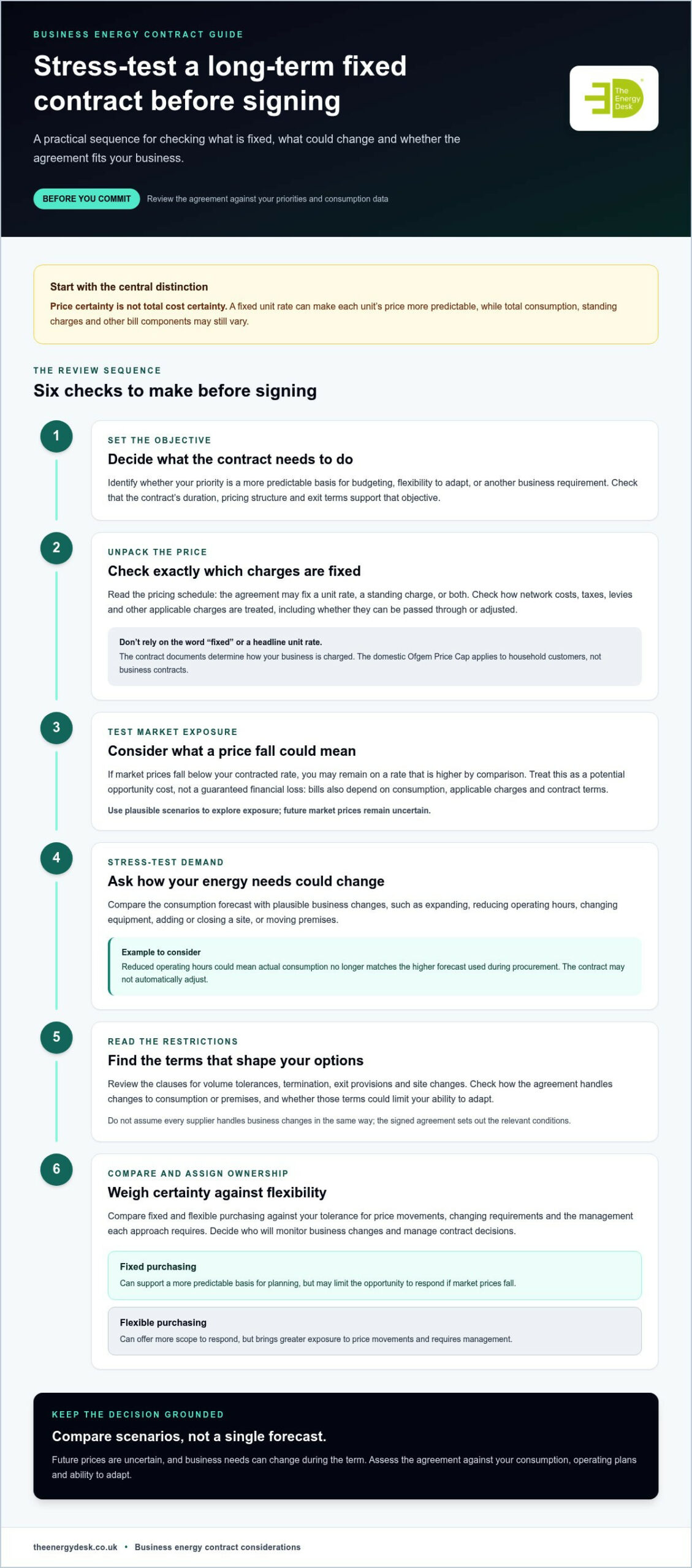
A structured review turns the risks of long term fixed energy contracts into specific questions your organisation can answer before committing. Start by recording the business objective: is the priority budget certainty, flexibility or another operational need? Then test the proposed terms against current consumption records and plausible changes. Treat these as scenarios for assessing resilience, not forecasts of future market prices.
What contract details should the review cover?
Read the agreement alongside the pricing schedule and consumption information. Check the dates, renewal process, termination provisions and any site-specific wording. Confirm which components are fixed, variable or passed through, and how the contract describes any changes. Compare the volume assumptions used in procurement with available bills and meter records. Unexplained differences deserve attention before the agreement is signed.
How can a business test whether the commitment remains workable?
Use a short pre-signing review to assess both the proposed terms and the organisation’s ability to manage them over time. A wider business energy portfolio management approach can help place one contract decision in the context of sites, consumption and other energy requirements.
- 1. Document the objective. Record whether the business is prioritising budget certainty, flexibility or another outcome. Note how the decision supports its wider operating and financial plans.
- 2. Check consumption assumptions. Compare the volumes in the proposal with available consumption records. Identify unusual periods, planned changes in operating hours, equipment or site use, and any gaps in the data.
- 3. Review the terms. Map the agreement’s term dates, renewal process, termination provisions and site-change wording. List the charges that are fixed, variable or passed through under the contract.
- 4. Test plausible scenarios. Consider how the commitment would fit if consumption increased or decreased, a site opened or closed, or market rates moved in either direction. These scenarios test the decision; they do not predict what will happen.
- 5. Set governance. Name the people responsible for monitoring the contract, agree internal approval thresholds for decisions and schedule review dates. Make sure relevant teams can report operational changes in time for those reviews.
Keep the conclusion with the evidence: record the objective, data reviewed, assumptions tested and reasons for accepting or rejecting the proposed terms. A sound contract review connects each commitment to a documented business objective, consumption evidence and plausible operating scenarios. This record also gives colleagues a clear basis for monitoring whether the agreement remains suitable as circumstances change.
For a structured review of your business energy position, an energy audit can consider contract suitability alongside procurement and consumption information.
How can The Energy Desk help assess fixed energy contract risks?
Assessing the risks of long term fixed energy contracts means looking beyond the headline rate. The Energy Desk supports UK organisations with business gas and electricity procurement, relating contract terms to business requirements and consumption information. This structured review can help clarify whether the proposed arrangement fits the organisation’s priorities and operating profile.
Bill validation can also help review whether energy bills appear accurate against the relevant information and contract terms. It checks billing accuracy; it is not a guarantee of savings or a promise that every discrepancy will result in a change to the bill. Used alongside procurement information, it can help businesses build a clearer picture of their energy position.
Be clear about how procurement placement works. Supplier commissions may apply to successful contract placements. Understanding this commercial arrangement is part of an informed procurement discussion, alongside the terms being considered and the organisation’s needs.
What does a business energy audit contribute to contract review?
An energy audit can bring available bills and usage data into the contract review. Examining consumption patterns helps compare the business’s actual energy profile with the assumptions behind a proposed agreement. For instance, different patterns across sites or operating periods may prompt a closer look at volume assumptions or contract structure. Findings should be evidence-led and tailored to the organisation, without presuming a particular outcome.
That context can support more focused procurement discussions. It may help identify which information is current, where assumptions need further review and how the organisation’s stated priorities relate to its consumption. The audit provides a basis for assessment, not a forecast of future market prices or a guarantee that one contract type will be preferable.
What happens after a business reviews its contract position?
Next steps can include clarifying the organisation’s objective, reviewing relevant terms and comparing procurement approaches against business requirements and consumption data. The Energy Desk supports business gas and electricity procurement and ongoing energy management, helping organisations consider contract suitability as part of their wider energy position.
As a contract approaches expiry, planning ahead matters. Review key dates and renewal arrangements so the business can consider its options in good time. Include the possibility of out-of-contract energy rates in that planning, and assign responsibility for monitoring the next decision point.
A practical review can leave the organisation with a clear record of its priorities, the terms assessed and the consumption information considered. The Energy Desk offers a free energy audit for businesses reviewing their energy position. Arrange a free energy audit to bring available bills, usage data and contract requirements into the discussion.
Build a stronger basis for your next energy decision
Make contract review part of your organisation’s ongoing planning, rather than a task that begins only when a renewal is approaching. Set a date to revisit your energy priorities and assign someone to flag material changes to operations or procurement assumptions. That creates an opportunity to respond deliberately as the business evolves, instead of allowing an old decision to shape future choices by default.
The risks of long term fixed energy contracts cannot be removed by choosing a particular contract label. A clear decision process can help your organisation understand what it is committing to, why that approach fits and when it should be reviewed. Keep the reasoning accessible to the people responsible for budgets and operations, so future decisions build on the same agreed priorities.
For a practical starting point, request a free business energy audit. Use the discussion to bring your organisation’s energy position into focus and plan its next procurement decision with greater clarity.
Frequently Asked Questions
What are the main risks of a long-term fixed energy contract?
The main risks are paying a contracted rate that later compares poorly with market offers, remaining bound by terms after business needs change, and misunderstanding which charges are fixed. For example, a new site may have different usage patterns from those assumed at signing. To assess the risks of long term fixed energy contracts, connect each concern to relevant evidence, such as the pricing schedule, site details or meter data, before approving the agreement.
Can a business leave a fixed energy contract early?
Possibly, but early exit depends on the signed agreement and the circumstances. Do not assume a move or closure automatically releases the business. Find the termination clause and note any notice requirements, permitted reasons, applicable charges and whether sites or meters are treated separately. If the contract has started, gather the agreement, supply details and relevant correspondence before assessing the business’s options.
Does a fixed energy contract mean my business energy bill cannot change?
No. A fixed contract fixes only the components specified in its terms, and the invoice total may still change as consumption varies or other items are applied. Compare an invoice with the contract pricing schedule: check the unit rate, standing charge, billing period and meter readings. If an unexpected adjustment appears, refer to the relevant contract wording and retain the bill and calculation together for a clear audit trail.
Is a three-year fixed energy contract riskier than a one-year contract?
Not automatically. A three-year term generally commits the business for longer, but suitability depends on its circumstances as well as duration. An organisation with stable sites and budgets may value continuity, while one planning a relocation or major equipment change may need more room to adapt. Compare the contract dates with lease, investment and business-plan milestones, then assess whether the commitment fits the organisation’s planning horizon.
What happens if my business uses less energy than forecast?
Lower-than-forecast consumption may mean the business uses fewer units, but it does not by itself show whether the agreement remains suitable. If a site reduces production but keeps its meter, for example, a standing charge may continue while usage falls. Check how actual readings are reflected on bills, whether volume tolerances apply and whether the original forecast represented normal operations rather than an unusual closure or shutdown.
How can a business reduce the risks of a long-term fixed energy contract?
Make oversight part of the procurement decision. Assign a contract owner to track key dates, compare invoices with agreed pricing and record changes to sites, operating hours or equipment. At planned review points, compare actual consumption with the original assumptions and raise material differences internally. These steps will not prevent market movements, but they can help the organisation spot mismatches and consider its options before important contract dates pass.
Are business fixed energy contracts covered by the household Price Cap?
No. Ofgem’s domestic Price Cap applies to household customers and should not be used to infer the terms of a business contract. Commercial agreements have their own wording and pricing arrangements. Treat household tariff comparisons as background on domestic energy only, not as evidence of a protection for your organisation. For a specific question, refer to the signed business contract and official guidance that applies to commercial customers.