
A higher business energy bill isn’t always a billing error, but you shouldn’t have to guess why the amount has changed. Knowing how to dispute a business energy bill starts with pinpointing the charge or reading in question and gathering evidence before asking your supplier to investigate.
It’s understandable to be cautious about paying an amount you believe is wrong, especially when the bill doesn’t explain the difference clearly. Keep a record of the bill, meter readings, contract details and correspondence. Then describe the discrepancy and the outcome you’re seeking in writing. A clear evidence trail makes it easier to follow the issue through each stage.
This guide explains how to check the figures, raise a formal complaint and track the supplier’s response. If your complaint remains unresolved after eight weeks, or your supplier sends a deadlock letter, you may be able to escalate it to the Energy Ombudsman if your business is eligible. You’ll also learn how structured bill validation and ongoing monitoring can help identify recurring issues and maintain clearer energy records.
Key Takeaways
- Match each charge you question to a record, such as the signed contract, invoice period or meter reading.
- Separate possible discrepancies into meter and consumption errors, account details, contract terms and unexplained adjustments.
- To understand how to dispute a business energy bill, state the specific issue, provide supporting evidence and request a clear investigation outcome.
- Use the supplier’s formal business complaints channel and keep written confirmation and a dated record of each response.
- Structured bill validation and ongoing monitoring can help identify recurring issues and maintain clearer energy records.
How to tell when a business energy bill may be wrong
An unusual charge deserves a closer look, but it doesn’t automatically mean the supplier has made an error. A business energy bill is worth disputing when you have a clear, evidence-based reason to challenge a particular charge or calculation. The aim is to identify what doesn’t match your records, not to assume the whole invoice is incorrect.
First, distinguish a possible billing error from a change that may be valid under your agreement or reflect actual use. A higher total could result from increased consumption, a different contract rate or applicable charges. By contrast, a duplicated standing charge, an incorrect meter identifier or a reading that doesn’t align with your meter record gives you a specific point to investigate.
Which business energy bill entries deserve a closer look?
Compare the invoice with your account records and contract documents. Check the billed dates and supply address, then confirm that the meter identifiers match the meters serving your premises. An incorrect identifier can make it difficult to establish whether the readings relate to your site.
Look for estimated readings, repeated line items, unexplained credits or adjustments, and consumption that differs sharply from comparable periods. Treat a difference as a prompt to investigate, not proof of error. Longer opening hours, new equipment, seasonal demand or a site closure can all change energy use.
- Estimated reads: Compare the reading and date shown on the bill with a meter reading you recorded or submitted.
- Repeated charges: Check whether the same charge appears more than once for the same billing period.
- Adjustments or credits: Look for an explanation and compare the entry with earlier invoices or supplier correspondence.
- Unusual consumption: Compare like-for-like periods and note any operational changes that could explain the difference.
Is an unexpected charge always a billing mistake?
No. A higher bill may reflect changed usage, the rates or terms in your contract, or applicable taxes and other charges. Check the relevant contract period and any renewal documents before concluding that a rate or fee is incorrect. A charge that matches the agreement may be valid, even if it’s unexpected.
A useful challenge names the invoice item, billing period, amount or reading in question, and why it appears wrong. Then identify the record that supports your view. For example, you might query an estimated consumption figure because a dated meter reading shows a different value. This precision helps distinguish a genuine discrepancy from a charge explained by the contract.
Note what you’ve checked and what remains unclear. If the invoice includes several concerns, separate them instead of describing the entire bill as wrong. This gives you a clearer basis for deciding how to dispute a business energy bill and explaining the issue to the supplier.
What to check on a business energy bill before disputing it
Before contacting the supplier, put the invoice beside the records that should support it. Check one disputed item at a time so you can distinguish a mismatch from a charge with a valid explanation. A simple comparison table keeps the review focused and shows how each concern relates to the account evidence.
| Invoice item | Record to compare | What to check |
|---|---|---|
| Billing period | Signed agreement and renewal documents | Do the invoice dates fall within the agreed supply and contract period? |
| Rates and standing charges | Contract and documented amendments | Do the rates and charge dates match the applicable terms? |
| Meter readings | Meter records and submitted readings | Are the values, dates and reading type consistent? |
| Consumption and total charges | Previous bills and operational records | Can changes in usage, hours or equipment explain the difference? |
| Supply details | Account records and meter information | Does the invoice identify the correct supply and meter? |
Match contract terms to the charges shown
Use the signed agreement as your reference for the agreed unit rates, standing charges and contract dates. Check renewal paperwork and any written amendments too, since these may affect the terms that apply to the invoice. Confirm that the bill covers the right meter and supply period. Don’t treat a charge as incorrect until you’ve checked its contractual basis and the dates it applies to.
Pay particular attention to the boundary between contract periods. If an invoice spans a renewal or another documented change, compare the dates and charges against each relevant set of terms. A rate that differs from an earlier bill may be consistent with a new agreement, while a charge applied outside its stated period may need an explanation.
Build a reliable evidence pack
Keep the documents together in a clear order: the invoice in question, the relevant contract and renewal records, account correspondence, and meter readings with their dates. Add earlier bills if they help show how the charge or consumption has changed. Label each item so the supplier can see which disputed line it relates to.
For phone conversations, record the date, the name or team you spoke to, any reference number, what was discussed and any action the supplier said it would take. Keep follow-up emails and letters with the same file. This creates a dated account of the issue and reduces the risk of losing important details between contacts.
A structured commercial utility bill validation guide can help you organise a systematic review of invoice charges and supporting records. If you need a more consistent process across bills, The Energy Desk’s business energy bill validation can support clearer checks and records. With your evidence assembled, you’ll be better prepared to explain how to dispute a business energy bill and what needs investigating.
Which business energy billing discrepancies should you challenge?
A discrepancy is worth raising when you can point to a specific invoice item and a record that appears inconsistent with it. Classify the issue before deciding what remedy to request. A meter error may call for a reading review, while an unexplained adjustment may need a breakdown or correction. Until you’ve compared the records and contract terms, treat the issue as a question to investigate, not proof that the supplier is at fault.
- Meter or consumption errors: A billed reading that conflicts with a dated reading you submitted, or consumption that cannot be reconciled with the available meter records, may support a challenge. An estimate may be reasonable if no actual reading was available, or a later bill may already have reconciled it. Check the reading type and subsequent invoices before disputing the amount.
- Account or supply details: A meter identifier, supply address or billing period that doesn’t match the business account could indicate that a charge has been assigned to the wrong supply or dates. Account records or meter details that match the invoice may disprove this concern, even if the charge itself needs further explanation.
- Contract interpretation: A rate or standing charge that differs from what you expected may warrant a query. The signed agreement or a documented variation may show that the billed term is correct. A disagreement about contract terms is not automatically a calculation error.
- Unexplained adjustments or balances: A new debit, credit or carried-forward balance without a clear description gives you grounds to request an itemised explanation. Previous invoices or correspondence may show that it relates to an earlier correction or payment, so trace the entry before treating it as an error.
Meter readings, consumption and account details
Compare the reading on the bill with the relevant meter record and any reading submitted for that date. Confirm whether the invoice labels it actual, customer-provided or estimated. If an estimate was later replaced or reconciled, the updated bill may explain the difference. Also match the meter identifier and supply dates to the business account. A mismatch is more persuasive when account records show which details are correct.
Contract terms, adjustments and disputed balances
For a questioned charge, check whether it appears in the signed contract or a documented variation. Then ask the supplier to explain how it was calculated and which period it covers. If the supplier provides a clear contractual basis, the matter may be a disagreement about interpretation rather than a billing mistake. If the amount or dates still don’t reconcile, identify the specific calculation or document that remains inconsistent.
An unclear line doesn’t always mean the invoice needs correcting. Sometimes the appropriate first outcome is a clear explanation of what the charge represents and how it was calculated. Once you understand the supplier’s reasoning, you can decide whether the evidence supports challenging the amount, the contractual basis, or neither. This distinction helps you explain how to dispute a business energy bill accurately and keeps the discussion focused on what needs resolving.
How to dispute a business energy bill step by step
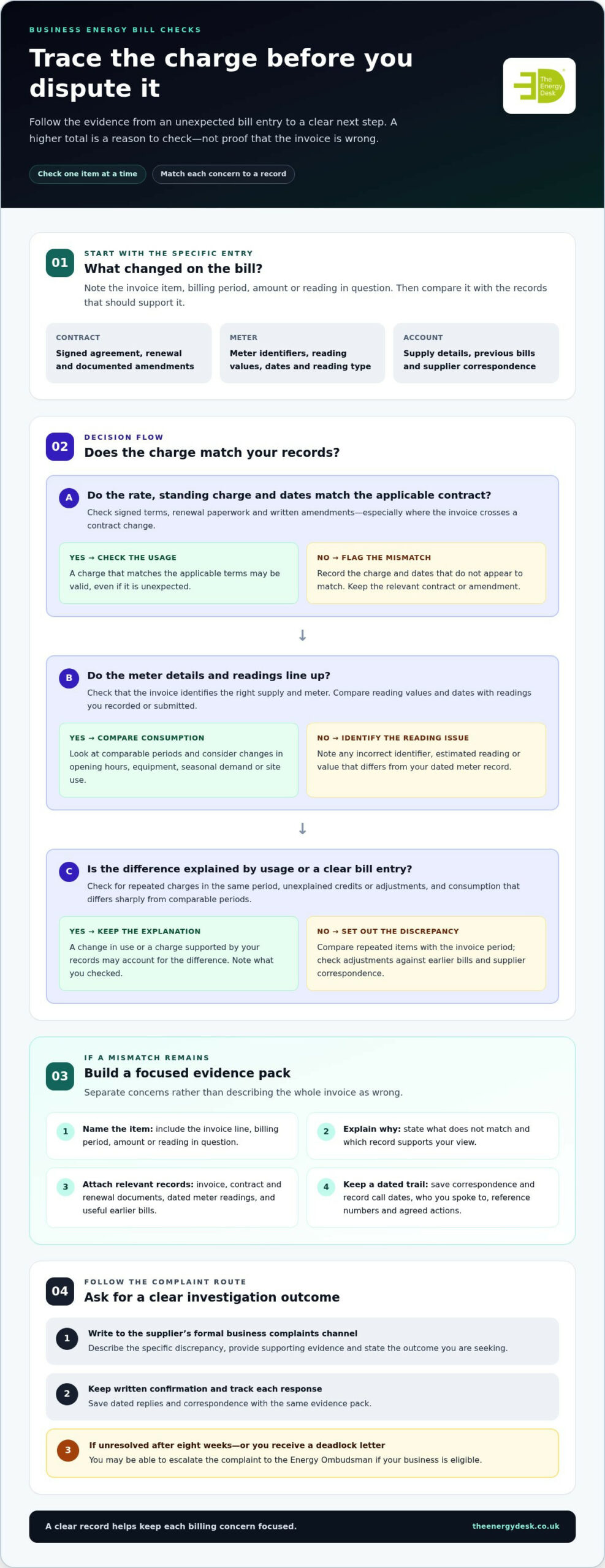
Once you’ve identified a discrepancy, follow a clear process so the supplier can investigate the exact issue. Keep communication factual, attach relevant records and retain a copy of everything you send. These steps explain how to dispute a business energy bill while keeping track of your evidence and the supplier’s response.
- 1. Isolate the issue. Identify the invoice, billing period and specific charge, reading or account detail you’re querying. If several items appear wrong, list them separately and explain each concern in turn.
- 2. Assemble the evidence. Gather the relevant bill, contract terms or documented changes, account records and dated meter readings. Select records that support each point instead of sending unrelated paperwork.
- 3. Contact the supplier in writing. Use the supplier’s formal business complaints channel and follow its published procedure. Ask for a complaint reference and written confirmation that the issue has been logged.
- 4. Request an investigation and explanation. Ask the supplier to check the named invoice items, explain the calculation and billing period, and confirm the outcome in writing. If a correction is needed, request a revised invoice and an explanation of what changed.
- 5. Track the response and next step. Record the date you complained, replies received, reference numbers and actions the supplier promised. If the issue remains unresolved, check the appropriate escalation route for your business and location.
Write a clear complaint the supplier can investigate
Include your business account details, invoice number and the exact line or period in dispute. State why the charge appears incorrect and refer to the evidence you’ve attached, such as a dated meter reading or contract clause. Be specific about what you want the supplier to do: investigate the calculation, provide a written explanation or issue a revised invoice if its review finds an error.
Keep the tone measured. A concise complaint that connects each disputed item to a record is easier to assess than a general statement that the whole bill is wrong. Save your sent message and attachments, along with any automated acknowledgement or complaint reference.
Track responses and check the correct escalation route
In Great Britain, eligible microbusinesses can generally take an unresolved supplier complaint to the Energy Ombudsman after eight weeks, or sooner if the supplier issues a deadlock letter. Eligibility and applicable complaint requirements matter, so check the current Ombudsman guidance before referring a case. Ofgem sets rules for suppliers but doesn’t resolve individual complaints.
Northern Ireland has different energy institutions and escalation arrangements, so don’t assume the Great Britain route applies. Check the current guidance for your jurisdiction and supplier. If you’re unsure whether to withhold payment, review the contract and seek appropriate advice first. Distinguish the amount you’re disputing from any undisputed balance, and keep records of payments and communications.
The Energy Desk’s business energy bill validation can help you review charges and supporting records systematically. It can help structure the review and improve record-keeping, without guaranteeing a particular supplier decision or dispute outcome.
How bill validation support can help resolve repeat billing issues
A single unclear charge may be resolved with a focused question to the supplier. If similar discrepancies appear across several invoices or sites, a systematic review can help identify recurring patterns, such as readings that aren’t being reconciled or charges that need clearer supporting records. The aim is to improve oversight and clarify what needs investigating, not to guarantee a refund or a particular supplier decision.
What a structured business bill review can examine
Specialist bill validation can compare invoices with contract terms, account details, meter readings and available consumption data. Findings can be organised by disputed item, the evidence reviewed and any clarification required from the supplier. This makes it easier to see which points need action and which have a documented explanation. Consistent records also give your team a repeatable basis for checking later invoices.
The Energy Desk provides bill validation and energy audit services for UK organisations. A structured review can bring billing information into one clear record, making recurring issues easier to spot and discuss. Ongoing monitoring can add continuity by drawing attention to unusual entries across successive bills, rather than relying on an occasional check to uncover a pattern.
- For one unclear charge: identify the invoice item, assemble the relevant records and submit a focused complaint to the supplier.
- For recurring concerns: consider a broader review of invoices, contract information, readings and account details to establish whether the same type of discrepancy is appearing repeatedly.
- For multiple sites: organise records by supply and billing period so that a potential issue can be traced to the right account and supporting evidence.
Keep review findings separate from assumptions about the cause. A pattern may point to an issue that needs supplier clarification, but consider the contract, readings and supplier response before reaching a conclusion. If the review identifies a possible overcharge, seeking recovery is a separate step from checking the bill itself. The guide to recovering business energy overcharges covers that process.
Choose a practical next step for your organisation
Match the level of review to the problem. For a one-off charge, prepare the supporting evidence and ask the supplier a precise question. For repeated discrepancies or a wider portfolio, bill validation can help organise checks across invoices and supplies. Either way, retain the findings with your account records so future checks start from a clearer baseline.
Understanding how to dispute a business energy bill also means improving the process that follows: record what you queried, what the supplier explained and whether the same issue appears again. That history can help your organisation distinguish an isolated query from a pattern worth reviewing more broadly.
Make clearer energy oversight your next step
A well-documented challenge can resolve one billing question, while a consistent review process can make future invoices easier to assess. Record what you query, the supplier’s explanation and any changes made, then use those findings to strengthen your routine checks. Each issue can inform better oversight instead of becoming a recurring source of uncertainty.
If you’re still considering how to dispute a business energy bill, The Energy Desk can support your organisation with bill validation, energy auditing and ongoing monitoring. Operating since 2003, the team helps businesses review energy information and maintain clearer records, without promising a particular supplier decision or dispute outcome.
Take a practical next step by requesting a free business energy audit. A clearer view of your energy records can help you move forward with confidence.
Frequently Asked Questions
Can I dispute a business energy bill if the meter reading is estimated?
Yes. An estimated reading gives you a reason to ask the supplier to review how it calculated the charge, especially if you can provide a later meter reading. Note the date and value, and whether your reading is actual or estimated. If you’re deciding how to dispute a business energy bill, ask the supplier to confirm whether the estimate has since been replaced and how any revised reading affects the account balance.
Should I pay a business energy bill while disputing it?
Don’t assume that raising a dispute suspends payment obligations. Check your contract and ask the supplier in writing how it expects you to handle the disputed sum and any amount you accept is due. Keep the supplier’s reply with your account records. If withholding payment could have serious consequences for your organisation, get appropriate professional guidance before deciding how to proceed.
How long does a business energy bill dispute take?
There isn’t one timeframe for every case. The supplier’s process, the evidence needed and the complexity of the account can all affect progress. Ask the supplier to set out its complaint stages and expected response dates, then follow up against those dates. In Great Britain, an eligible microbusiness can generally escalate to the Energy Ombudsman if the supplier hasn’t resolved the complaint within eight weeks, or has issued a deadlock letter.
Can a business dispute an energy bill after changing supplier?
Yes. You can raise a query with the former supplier about charges for the period it supplied your business. For example, if a final invoice appears to include usage after your supply moved, compare its dates with your switch records and final meter reading. Keep the old agreement and correspondence, and check the complaint and escalation requirements that apply to your circumstances before taking the matter further.
What happens if my energy supplier rejects my business bill complaint?
Ask the supplier for its final position in writing, including how it considered your evidence and arrived at the amount. If you’re a microbusiness, check the current Energy Ombudsman eligibility rules and complaint requirements. The service is free for eligible microbusinesses, and its decision is binding on the supplier. Businesses in Northern Ireland should check the relevant local escalation arrangements, as Great Britain’s route may not apply.
Can I challenge a business energy bill for an incorrect meter reading?
Yes. If a billed reading doesn’t match your meter records, send the supplier the reading, the date it was taken and the relevant invoice reference. A clear photograph may help show the meter display, provided its identifier is visible where practical. Ask which readings were used to calculate the bill and whether the account will be reviewed. Then check the next invoice to see whether any agreed change appears.