


Most UK organisations are unknowingly paying for energy they never consumed, simply because the complexity of modern invoices makes errors almost impossible to spot. Between opaque non-commodity charges and the persistent issue of estimated readings, relying on supplier accuracy is a high-risk strategy for any finance department. Implementing a robust programme of commercial utility bill validation is no longer just a clerical task; it’s a forensic necessity for protecting your bottom line.
It’s frustrating to manage multi-site estates whilst dealing with budget volatility and time-consuming manual data entry. You deserve total transparency over your organisation’s energy expenditure. This guide outlines how to identify hidden billing errors, recover historic overpayments, and secure accurate budgeting for 2026. We’ll explore the mechanics of forensic auditing, the impact of levies and taxes, and how to eliminate discrepancies across your entire portfolio for good.
Key Takeaways
- Understand why forensic verification is essential for identifying the high volume of UK business energy invoices that contain billing errors.
- Learn how commercial utility bill validation acts as a strategic safeguard against supplier system discrepancies and contract rate inconsistencies.
- Identify the crucial difference between commodity and non-commodity costs to better manage the impact of levies on your total expenditure.
- Explore why expert-led forensic auditing outperforms standard automated software by providing a nuanced interpretation of complex UK energy regulations.
- Discover how a free energy audit serves as a vital first step for recovering historic overcharges and establishing accurate budget forecasts for 2026.
What is Commercial Utility Bill Validation?
Commercial utility bill validation is a forensic examination that extends far beyond simple arithmetic checks. Whilst a standard accounts payable department ensures the supplier name and total amount match the expected invoice, specialist validation cross-references every line item against contractual agreements, physical meter data, and the latest regulatory levies. It’s a precise methodology designed to ensure you only pay for the energy your organisation actually consumes. This process is essential for identifying hidden overcharges that standard accounting software often overlooks.
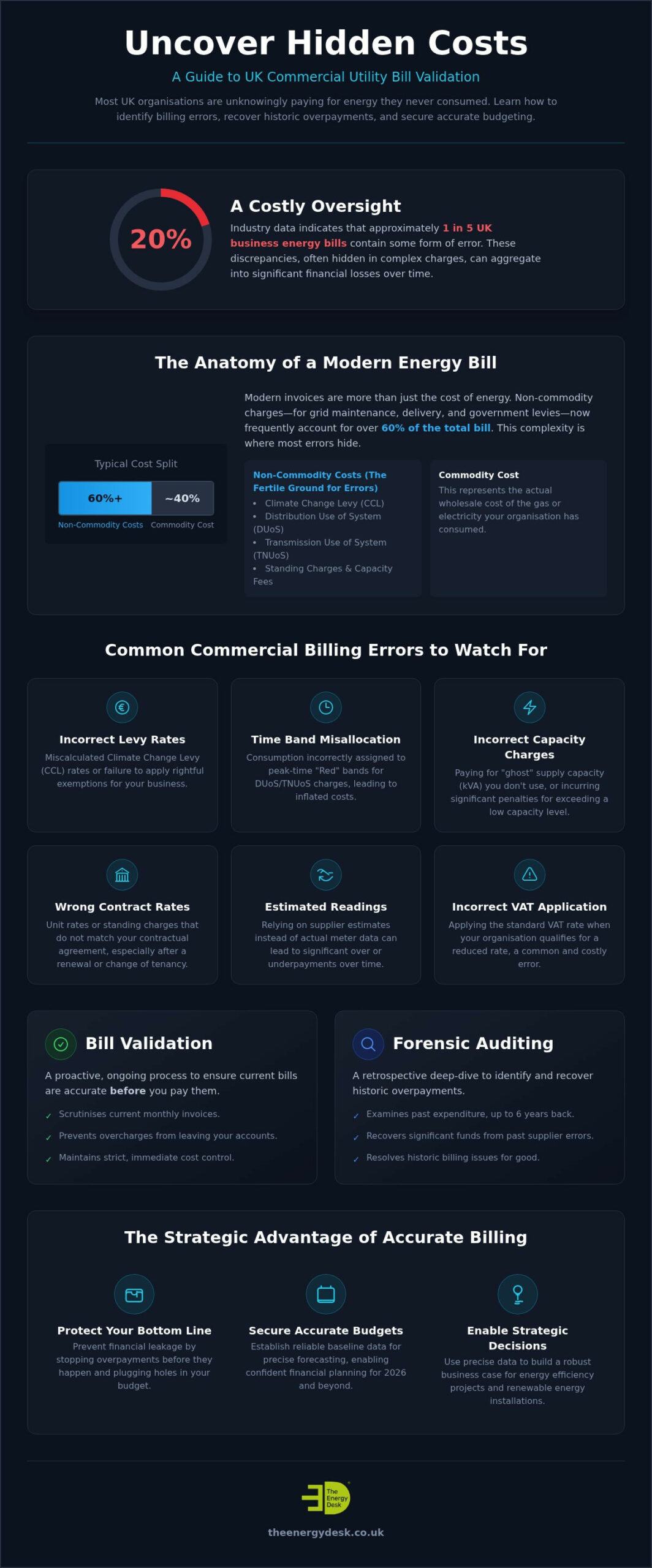
Industry data consistently indicates that approximately 20% of UK business energy bills contain some form of error. These discrepancies aren’t always obvious. They often hide within complex non-commodity charges, incorrect VAT applications, or miscalculated Climate Change Levy (CCL) rates. For organisations managing multiple sites or operating high-voltage connections, commercial utility bill validation is the only reliable way to prevent these small inaccuracies from aggregating into significant financial leakages over time. High-usage sites are particularly vulnerable because even a fractional error in a unit rate can result in thousands of pounds of unnecessary expenditure.
The Distinction Between Validation and Forensic Auditing
It’s vital to distinguish between ongoing validation and retrospective forensic auditing. Validation is a proactive, monthly process that scrutinises current billing cycles before payment is authorised. This prevents overcharges from leaving your accounts in the first place. Conversely, forensic auditing is a retrospective deep-dive into historic expenditure. In the UK, businesses can typically recover overpayments dating back up to six years. Combining both approaches ensures you resolve past errors whilst maintaining strict cost control over future budgets.
The Role of Data Accuracy in 2026
The transition from manual, paper-based checks to automated data feeds is essential for modern utility management. Smart meter data and Half-Hourly (HH) readings allow for the identification of phantom energy usage, where power is consumed during unoccupied hours. This level of granular insight is a prerequisite for building a robust business case for commercial renewable energy UK. Without accurate baseline data, it’s impossible to calculate the true ROI of solar or CHP installations. By 2026, data precision will be the primary differentiator between organisations that merely pay bills and those that strategically manage energy as a controllable asset.
The Anatomy of a UK Business Energy Bill
To perform effective commercial utility bill validation, you must first understand that a modern energy invoice is a composite of diverse charges. These are broadly categorised into commodity and non-commodity costs. Whilst the commodity portion represents the actual wholesale cost of the gas or electricity consumed, the non-commodity elements cover the infrastructure, delivery, and various government-mandated levies. In many cases, these third-party costs now account for more than 60% of the total invoice value, making them the most fertile ground for billing errors.
Wholesale market volatility has fundamentally changed how suppliers structure their agreed contract rates. Even on a “fixed” contract, many non-commodity elements are passed through at cost, meaning your monthly expenditure can fluctuate based on national demand and regulatory shifts. Standing charges are another frequent source of supplier error; these are often applied at incorrect rates following a change of tenancy or a contract renewal. Beyond the obvious unit rates, you must also monitor hidden elements such as reactive power charges and capacity penalties. If your agreed supply capacity (kVA) is set too low, you’ll face significant financial penalties, yet if it’s too high, you’re paying for “ghost” capacity you never use. Working with specialist energy procurement consultants can help your organisation navigate these complexities and ensure your contract structure genuinely reflects your operational requirements.
Non-Commodity Charges: CCL, DUoS, and TNUoS
The Climate Change Levy (CCL) is a tax on energy delivered to non-domestic users. It’s vital to check that your supplier is applying the correct rates and recognising any exemptions your business may be entitled to. Understanding how to secure a climate change levy exemption for business can represent a significant reduction in your non-commodity costs, particularly as CCL rates continue to rise. Distribution Use of System (DUoS) and Transmission Use of System (TNUoS) charges relate to the maintenance of the regional and national grids. These are often billed using “Red, Amber, Green” time-of-use periods. Errors frequently occur when suppliers misallocate consumption to the wrong time band, leading to inflated peak-time charges that don’t reflect your actual operational behaviour. A forensic review of these components is often the first step in a free energy audit to identify immediate savings.
The Importance of DC/DA and MOP Agreements
Accurate validation is impossible without high-quality raw data. This is where MOP contracts for business become essential. A Meter Operator (MOP) agreement ensures your physical hardware is maintained and providing legal-grade data. Similarly, Data Collection (DC) and Data Aggregation (DA) services ensure this information is retrieved and processed correctly. Relying on supplier-led data collection is a common pitfall; independent DC/DA services provide an unbiased “single source of truth” that often uncovers discrepancies that suppliers would otherwise miss. When your internal records match the meter data exactly, your commercial utility bill validation process becomes significantly more robust and difficult for suppliers to dispute.
Common Commercial Billing Errors to Watch For
Billing inaccuracies in the UK energy market are rarely the result of simple typos; they’re typically systemic failures within a supplier’s billing engine. For organisations with extensive property portfolios, duplicate invoicing and “ghost” meters are frequent occurrences. These ghost meters represent supply points that should have been disconnected or transferred but continue to accrue standing charges and estimated consumption costs. Similarly, incorrect VAT application remains a persistent issue. Whilst the standard rate is 20%, many organisations qualify for the reduced 5% rate or CCL exemptions, yet suppliers often default to the higher tariff unless challenged through a formal commercial utility bill validation process.
Contract rate discrepancies also pose a significant risk. It’s common for suppliers to fail to update their internal systems following a contract renewal or a change of tenancy. This results in businesses being billed at punitive out-of-contract rates, which can be double or triple the agreed price. Catching these errors early prevents the erosion of operational margins and ensures that the financial benefits of your procurement strategy are actually realised. Without proactive oversight, these discrepancies can go unnoticed for months, leading to substantial financial leakage.
Estimated vs. Actual Consumption Data
Relying on estimated readings is the primary cause of budget volatility and sudden “catch-up” bills that can derail financial planning. Suppliers often generate “plausible” totals based on historic data when they lose connection to a meter, but these rarely reflect current operational changes. Half-Hourly (HH) data provides the forensic evidence required to dispute these estimates and force a reconciliation based on actual usage. Understanding the full scope of half hourly metering requirements UK businesses must comply with is critical, as a thorough business energy consumption analysis can reveal patterns of invisible waste — such as significant loads recorded during unoccupied hours — that estimated readings will never expose. Contractual tolerance levels often allow suppliers to charge based on estimated volumes within a specific percentage, which can frequently lead to hidden costs for the consumer.
Recovering Historic Overcharges
Under UK law, businesses have a six-year window to identify and recover energy overcharges. This statute of limitations means that a retrospective audit can often uncover significant sums of capital that can be returned to the business as either a credit note or a direct cash refund. Securing a cash refund is often preferable for liquidity, though it requires more rigorous negotiation with the supplier’s finance department. Integrating these findings into a broader strategic electricity procurement review ensures that the root causes of these errors are eliminated, protecting your organisation from future overcharges whilst commercial utility bill validation maintains ongoing oversight.
Manual vs. Automated Validation: Which is Best?
Choosing the right methodology for commercial utility bill validation depends on the volume of your data and the complexity of your contracts. Internal manual checks are often perceived as a low-cost solution, yet they carry a high risk of human error. Standard finance teams rarely have the technical capacity to verify intricate network charges or seasonal levy adjustments whilst managing their daily workload. Conversely, automated software solutions excel at processing bulk data but often lack the expert interpretation required to challenge a supplier’s legal team. They might flag a discrepancy, but they won’t necessarily understand the regulatory nuance behind why it occurred.
The inherent complexity of business gas procurement frequently necessitates external support to ensure every therm and standing charge is accounted for correctly. Relying solely on software can lead to “false negatives” where errors are missed because they fall within a pre-set tolerance level. A forensic approach requires both algorithmic speed and human expertise to ensure total fiscal accuracy. This is precisely why many organisations are turning to dedicated energy procurement consultants who combine market intelligence with forensic billing oversight to deliver a genuinely strategic service.
The Bureau Service Advantage
Outsourcing to a bureau service provides a hybrid approach that combines technology with human forensic expertise. This model removes the burden of supplier dispute management from your internal staff. Instead of your team spending hours on hold with energy firms, dedicated experts handle the negotiation to secure credit notes or cash refunds. Bureau services also offer consolidated billing; this simplifies a portfolio of 100 or more invoices into a single, validated report. This level of oversight provides the foundation for accurate budget forecasting and effective risk management based on validated historic data.
When to Switch to Professional Validation
Certain operational triggers indicate it’s time to move toward professional commercial utility bill validation. Rapid expansion, high vacancy rates in property portfolios, or sudden, unexplained cost spikes are clear signals that internal processes are no longer sufficient. The ROI of professional validation is often immediate; the service frequently pays for itself through the recovery of historic overcharges that would otherwise remain hidden. Implementing these checks as part of a wider energy efficiency audit ensures your organisation isn’t just using energy more wisely, but also paying the correct price for every unit consumed.
To ensure your organisation isn’t overpaying for its utilities, you can request a free energy audit from our specialist team today.
Strategic Utility Management with The Energy Desk
The Energy Desk (TED) functions as a strategic ally, simplifying the technical complexities of the UK energy market for corporate clients. By operating as an independent consultancy, we provide a level of transparency that direct suppliers simply cannot match. Our commercial utility bill validation services ensure that every pound spent is verified against actual consumption and contractual obligations. This validated data serves a dual purpose; it protects your immediate bottom line whilst providing the accurate evidence base required for Net Zero reporting, SECR, and ESOS compliance. Without this forensic foundation, your carbon footprint calculations and environmental disclosures risk being based on flawed or estimated supplier data.
We treat energy as a controllable asset rather than a fixed overhead. A free energy audit serves as the essential starting point for this process, allowing our team to conduct a preliminary review of your accounts to identify obvious overcharges or tax misapplications. This initial assessment often uncovers significant opportunities for cost recovery that have been overlooked by standard accounting practices. By establishing a “single source of truth” through forensic auditing, your organisation gains the confidence to make long-term infrastructure investments based on verified financial data.
A Holistic Approach to Energy Costs
We integrate validation into a broader suite of energy management services to maximise your operational efficiency. For instance, combining billing oversight with CHP system installation for businesses allows you to track the real-world performance of onsite generation against grid-supplied power accurately. TED manages the entire utility lifecycle, from securing new connections to the final forensic audit of your annual spend. This proactive monitoring is essential whilst navigating a volatile market, as it allows for agile adjustments to your procurement strategy based on verified usage patterns rather than supplier projections.
Next Steps: Securing Your Business Margins
To begin the process of cost recovery, organisations should gather at least 12 months of historic invoices along with their current contract terms. When selecting a commercial utility bill validation partner, look for specialists who understand the nuances of DC/DA and MOP contracts, as these provide the legal-grade data required for successful supplier disputes. A bespoke forensic review will not only identify past errors but also establish the rigorous oversight needed to prevent future leakages. You can contact The Energy Desk today to arrange a comprehensive review of your utility portfolio and begin reclaiming capital that belongs back in your business.
Secure Your Financial Resilience Through Forensic Oversight
Effective commercial utility bill validation is no longer an optional administrative task; it’s a critical component of strategic financial management. By scrutinising the intricate split between commodity and non-commodity charges, your organisation can eliminate budget volatility and protect its margins from supplier system errors. Recovering historic overcharges from the past six years provides an immediate capital injection whilst establishing a “single source of truth” for your 2026 budgeting and Net Zero compliance reporting.
The Energy Desk is an independent UK-based energy consultancy with over 20 years of industry experience. We specialise in multi-site forensic auditing, ensuring that complex portfolios remain transparent and cost-efficient. Our expert team simplifies technical market complexities to ensure you never pay for more energy than you consume. Request your free energy audit from The Energy Desk today to begin the process of reclaiming your overpaid utility spend. You don’t have to navigate the volatile energy market alone; we’re here to ensure your fiscal interests are protected for the long term.
Frequently Asked Questions
What is the difference between bill validation and an energy audit?
Bill validation is a fiscal process that verifies the accuracy of invoices against contracts and meter data. An energy audit typically refers to a technical assessment of physical on-site consumption to identify efficiency improvements. Whilst validation focuses on cost recovery and ensuring you only pay for what you use, an audit identifies ways to reduce the total amount of energy your organisation requires to operate.
How much can a business typically save through utility bill validation?
Savings vary depending on the complexity of your portfolio and the frequency of historical errors. Since approximately 20% of UK commercial bills contain inaccuracies, the potential for recovery is high. By identifying overcharges in non-commodity levies, VAT misapplications, and standing charges, organisations often recover significant sums. These recoveries frequently exceed the cost of the service, making it a self-funding exercise for many businesses.
Can I recover energy overcharges from previous years?
Yes, under UK law, organisations can typically recover energy overcharges dating back up to six years. This retrospective forensic process allows for the identification of historic billing errors that may have gone unnoticed by standard accounting teams. Reclaiming these funds involves a formal dispute process with the supplier to secure either a credit note or a direct cash refund for the total overpaid amount.
Does bill validation cover water and telecoms as well as energy?
The Energy Desk specialises in the forensic auditing of gas and electricity contracts. Whilst some providers offer broad utility management across water and telecoms, our core expertise lies in navigating the technical complexities of the UK energy market. We focus on verifying MOP contracts and DC/DA services to ensure your power and gas invoices match actual consumption and agreed unit rates with forensic precision.
What documents are required to start the validation process?
To begin a thorough commercial utility bill validation, you generally need to provide 12 months of historic invoices and your current energy contracts. A Letter of Authority (LOA) is also required to allow your consultancy to communicate directly with suppliers and data collectors. Having access to your Half-Hourly (HH) data and recent meter readings will significantly accelerate the initial forensic review process.
How long does it take to see results from a forensic utility audit?
Initial findings from a preliminary review are often available within a few weeks. However, the full process of recovering funds from suppliers can take several months. This timeline depends on the supplier’s responsiveness and the complexity of the specific dispute. Once discrepancies are proven, your consultancy manages the negotiation until the credit or refund is successfully applied to your business account.
Is automated validation software enough for a large industrial site?
Automated software is efficient for processing bulk data but often lacks the nuance required for complex industrial sites. Large operations deal with intricate network charges and site-specific levies that standard software might overlook. Professional commercial utility bill validation combines technology with human expertise to interpret regulatory changes and ensure that every technical line item on a high-voltage invoice is fiscally accurate.
What happens if the validation process identifies a meter fault?
If a meter fault is suspected, the validation team cross-references your billing data with independent DC/DA records to confirm the discrepancy. We then coordinate with your Meter Operator (MOP) to arrange a technical inspection or recalibration. Once the fault is verified, we lead the negotiation with the supplier to secure a rebill based on corrected consumption estimates, protecting your business from paying for unconsumed energy.