

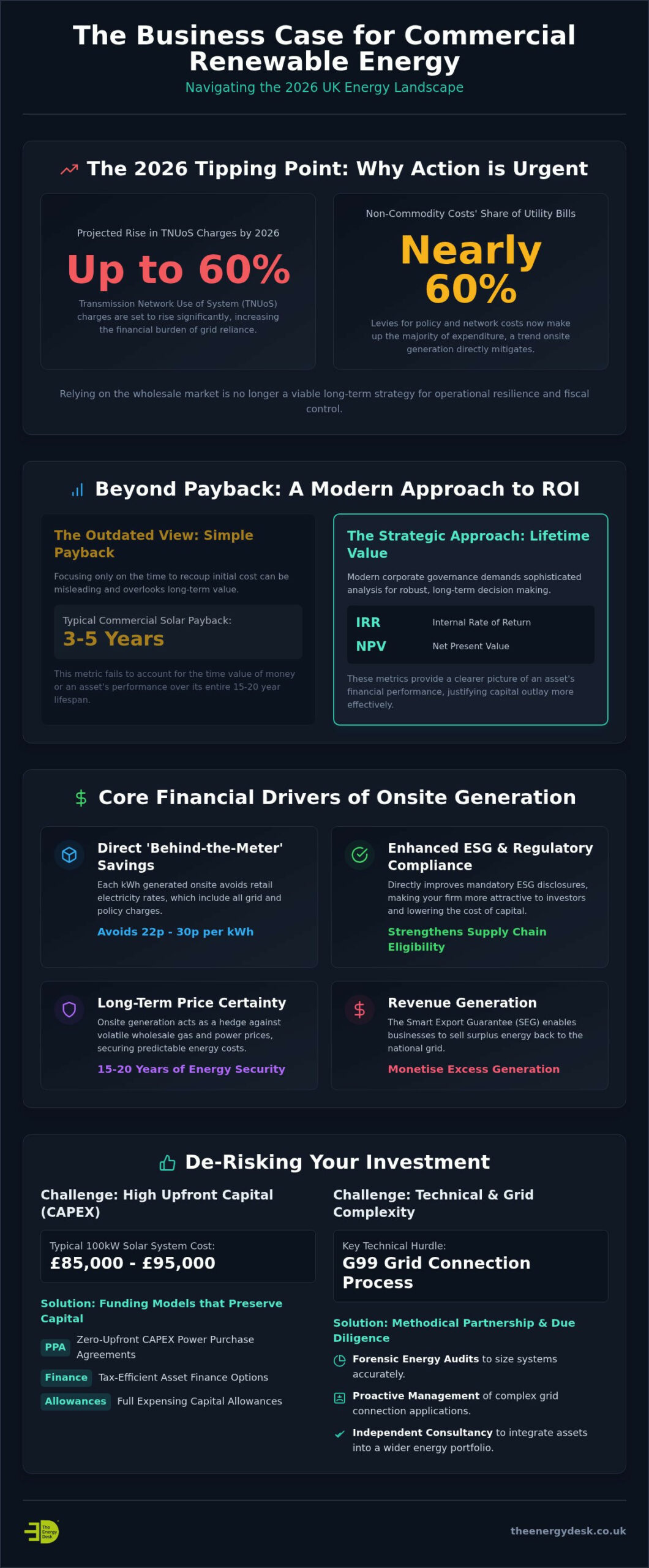
With Transmission Network Use of System (TNUoS) charges projected to rise by up to 60% in 2026, the financial burden of traditional energy procurement has reached a critical tipping point for British industry. Relying solely on the wholesale market is no longer a viable long-term strategy when non-commodity levies now comprise nearly 60% of your total utility expenditure. Developing a robust business case for commercial renewable energy UK is therefore no longer just an environmental goal; it’s a fundamental requirement for operational resilience and fiscal control.
We understand that high CAPEX requirements for solar PV and CHP systems, coupled with complex G99 grid connection hurdles, often stall even the most well-intentioned infrastructure projects. This article provides a clear financial framework to justify these investments without depleting your working capital. You’ll learn how to leverage strategic procurement and government incentives, such as full expensing capital allowances, to de-risk your transition. We’ll also examine how a methodical partnership approach simplifies technical oversight whilst ensuring your renewable assets deliver a predictable, market-leading return on investment through 2026 and beyond.
Key Takeaways
- Understand why the 2026 energy landscape demands a shift from subsidy-reliant models to procurement-led strategies that mitigate rising non-commodity costs.
- Learn how to construct a robust business case for commercial renewable energy UK by prioritising Internal Rate of Return (IRR) and Net Present Value (NPV) over simple payback.
- Explore funding mechanisms that preserve your working capital, including zero-upfront CAPEX Power Purchase Agreements (PPAs) and tax-efficient asset finance.
- Discover how to de-risk your investment through forensic energy audits and proactive management of complex G99 grid connection processes.
- Identify the strategic advantages of an independent consultancy approach to ensure your renewable infrastructure is fully integrated into a wider energy portfolio.
The 2026 Landscape: Why the Business Case for Renewables is Urgent
The 2026 utility market represents a fundamental shift in how British firms approach infrastructure. We’ve moved beyond the era of subsidy-chasing; projects must now stand on their own financial merits within a merchant risk environment. With non-commodity charges now accounting for nearly 60% of electricity bills, the business case for commercial renewable energy UK has transitioned from a sustainability “nice-to-have” to a critical defensive shield against market volatility. Businesses that fail to secure their own generation capacity remain exposed to the unpredictable fluctuations of wholesale gas prices, which continue to dictate power costs across the national grid. Strategic investment now serves as a hedge, providing price certainty for the next fifteen to twenty years.
Regulatory Pressures and ESG Mandates
UK mid-caps and larger entities now face stringent ESG reporting requirements that demand granular carbon footprint transparency. By 2026, these disclosures aren’t just for marketing; they’re mandatory financial filings that influence your credit rating and supply chain eligibility. Integrating onsite assets like solar PV or CHP systems directly improves your business’s favourite ESG metrics, making your firm more attractive to institutional investors. This alignment often results in a lower cost of capital, as lenders increasingly favour organisations with de-risked, sustainable energy strategies. The current trajectory of Renewable energy in the United Kingdom indicates that while generation capacity is expanding, the regulatory bar for corporate participation has never been higher.
The Shift to Merchant Risk and Market Parity
The 2026 landscape is defined by market parity. This means renewable projects are self-sustaining without the safety net of government Feed-in Tariffs. Success in this environment requires forensic data analysis and precise long-term energy price forecasting. You can’t rely on guesswork when evaluating the internal rate of return for a 100kW solar installation or a complex CHP unit. Instead, firms must use bill validation and historical consumption audits to size systems accurately. This methodical approach ensures that the business case for commercial renewable energy UK remains robust even as grid connection timelines (G99) and location-based TNUoS charges introduce new variables into the project appraisal. By integrating onsite generation with smart procurement, businesses can insulate themselves from the 60% year-on-year rise in transmission costs projected for some regions.
Quantifying the ROI: Financial Drivers of Commercial Renewables
Relying on simple payback periods is no longer sufficient for modern corporate governance. In 2026, a business case for commercial renewable energy UK requires a sophisticated analysis of Internal Rate of Return (IRR) and Net Present Value (NPV). These metrics provide a clearer picture of an asset’s lifetime value, especially when typical payback periods for commercial solar now range between three and five years. By treating renewable infrastructure as a financial instrument, businesses can better justify the initial capital outlay, which typically sits between £85,000 and £95,000 for a 100kW solar system.
A Carbon Trust analysis of the business case for renewables reinforces that the primary driver is now cost control rather than just carbon reduction. Onsite generation doesn’t just lower your unit rate; it significantly reduces standing charges and non-commodity levies. These levies, including policy and network costs, can account for nearly 60% of your total bill. By generating power at the point of use, you bypass these escalating grid-related expenses entirely. This operational independence improves your long-term energy security, shielding your facility from the price spikes that characterise the volatile wholesale market.
Direct Savings vs. Revenue Generation
“Behind-the-meter” savings offer the highest financial impact. Every kilowatt-hour (kWh) generated onsite avoids the retail electricity rate, which currently averages between 22p and 30p for most UK businesses. Beyond these direct savings, the Smart Export Guarantee (SEG) allows you to sell surplus energy back to the grid. While export rates vary between 4p and 15p per kWh, they provide a secondary revenue stream that improves the overall project IRR. This onsite capacity also acts as a buffer against peak-time DUoS and TNUoS charges, protecting your bottom line during periods of high grid demand.
The Role of Bill Validation in ROI Accuracy
You can’t build an accurate ROI model without a forensic baseline of your current utility spend. Commercial utility bill validation is the first step in this process. It identifies historical overcharges and billing errors that often go unnoticed. In many cases, recovered funds from these errors can help finance the initial project feasibility study. Using precise data collection ensures that your business case for commercial renewable energy UK is built on fact, not estimates. This level of detail is essential when presenting the transition plan to board-level stakeholders who require data-driven certainty before approving major CAPEX. We recommend starting with a professional energy audit to establish your true avoided cost potential.
Financing Models: How to Fund Your 2026 Renewable Project
Securing the necessary capital for a commercial solar PV installation or a large-scale CHP system shouldn’t lead to cash depletion. In 2026, the business case for commercial renewable energy UK is often made or broken by the choice of financing model. Whilst some organisations prefer to use internal reserves to take advantage of the 50% first-year capital allowance for solar panels, others require a more liquid approach. Modern funding structures allow businesses to spread costs or avoid them entirely whilst still benefiting from lower unit rates and improved energy security.
Power Purchase Agreements (PPAs) in Depth
Power Purchase Agreements have become the favourite choice for UK businesses with capital constraints. Under a PPA, a third-party developer finances, installs, and maintains the renewable asset on your site at no upfront cost to you. In exchange, you sign a long-term contract to purchase the electricity generated at a predetermined rate, which is typically lower than the standard grid price. These agreements often span 10 to 25 years, providing long-term price certainty in a volatile market. Because the developer owns the asset, they also bear the responsibility for all maintenance and operational performance, removing the technical risk from your balance sheet.
De-risking the Project for Lenders
If you choose to retain ownership through asset finance or hire purchase, the project’s bankability depends on the strength of your energy offtake strategy. Lenders in 2026 require a “bankable” business case that demonstrates a guaranteed return. This is where an expert energy broker provides a critical advantage. By negotiating supply contracts that align your procurement strategy with your debt repayment schedule, we create the financial stability that banks demand. A guaranteed offtake price for surplus energy serves as the security that de-risks the loan for the provider.
The UK Government’s Clean Power 2030 Action Plan underscores the national commitment to a clean electricity system, which has bolstered lender confidence in green infrastructure. For mid-market firms, this means access to specialised green loans with rates typically ranging between 5.5% and 7.5%. Using forensic bill validation to prove your historical consumption patterns further strengthens your application, as it provides lenders with data-backed evidence of your project’s future savings. This methodical approach ensures your business case for commercial renewable energy UK is robust enough to secure the most competitive financing terms available.
Technical Due Diligence and Implementation Strategy
Technical due diligence is what transforms a theoretical plan into a bankable asset. Without independent technical verification, your business case for commercial renewable energy UK lacks the substance required by lenders and internal stakeholders. A professional energy audit serves as the foundation, allowing you to establish your precise load profile and identify the optimal system capacity. This data-driven approach prevents the common mistake of installing an oversized system that fails to deliver its projected ROI because of restricted grid export limits or seasonal demand fluctuations. Ensuring your half hourly metering requirements UK are correctly managed through an independent Meter Operator contract is equally critical, as accurate consumption data underpins every financial projection in your business case.
The Critical Path: Grid Connections and Planning
In 2026, grid capacity remains the most significant hurdle for UK commercial infrastructure. The G99 application process is often the longest lead-time item in a project schedule; starting this process early is essential to lock in your project’s viability. If you’re managing a new-build commercial site, your utility connection strategy must account for the local network’s constraints before you finalise your equipment orders. Securing an early connection offer ensures that the local District Network Operator (DNO) can accommodate your generation without requiring prohibitively expensive network reinforcements. Proactive management of these utility connections is the only way to avoid the delays that typically plague national infrastructure projects.
Selecting the Right Technology Mix
Industrial sites often benefit from a hybrid approach. Whilst commercial solar PV installation is excellent for reducing daytime load, CHP system installation for businesses provides the 24/7 thermal energy required for manufacturing processes. Combining these technologies creates a resilient energy profile that addresses both heat and power needs simultaneously. This synergy is particularly effective for sites with high baseloads that don’t shut down during evening hours. It ensures that your thermal and electrical requirements are met with maximum efficiency, reducing your overall carbon intensity.
As the UK transitions toward electric transport, integrating EV charging infrastructure into your renewable business case adds further value. This allows you to use your onsite generation to power your fleet, further reducing your reliance on volatile retail energy rates. However, a strategic export plan is vital if you intend to generate more than you consume. Without it, “oversizing” your system will lead to poor capital efficiency. Success depends on aligning these technical choices with your wider procurement goals. To establish your site’s technical potential, book a comprehensive energy audit with our specialist engineering team today.
Partnering for Success: The Energy Desk Consultancy Advantage
Approaching a bank directly for green finance often restricts your organisation to traditional debt products that might not align with your specific load profile. In contrast, an independent consultant provides access to a comprehensive range of multi-supplier finance options, including complex off-balance-sheet structures like Power Purchase Agreements. This market-wide perspective is essential when constructing a business case for commercial renewable energy UK. It ensures that the chosen funding model supports your operational goals rather than just your balance sheet. Our expertise, established since 2003, allows us to act as a bridge between technical installation and market-leading utility contracts.
Holistic Energy Management and Portfolio Strategy
Maximum fiscal efficiency is found at the intersection of onsite generation and flexible energy procurement. We don’t view a solar or CHP installation as a standalone asset; instead, we treat it as a core component of your 2026 energy portfolio. Whilst your renewable system reduces your primary grid demand, our strategic brokerage ensures your remaining utility requirements are met at the most competitive rates available. Ongoing commercial utility bill validation further de-risks the project during its operational phase, identifying billing errors that could otherwise erode your projected ROI. This methodical oversight ensures your financial framework remains robust throughout the entire life of the asset. For organisations that also operate a vehicle fleet, this level of digital oversight can be extended through Fleetalyse to automate remote tachograph downloads and monitor driver hours in real-time.
The transition toward sustainable infrastructure requires a proactive and methodical approach to succeed in the current merchant risk environment. Turnkey management simplifies this process by handling everything from the initial technical audit to the final G99 grid connection and MOP contracts. This end-to-end oversight ensures that the empirical data used to win board-level approval translates into real-world performance. For any CFO or Director, a free energy audit represents the essential first step in establishing project feasibility without upfront commitment. We provide the disciplined, analytical mindset needed to navigate the complexities of modern utility solutions.
Securing your business case for commercial renewable energy UK requires a partner that understands both the technical requirements of the grid and the fiscal expectations of stakeholders. We provide the data-driven certainty needed to justify major CAPEX whilst protecting your long-term operational success. Contact The Energy Desk today to establish your site’s potential and begin your decarbonisation journey with a strategic ally you can depend on.
Securing Your Energy Future in 2026
The shift toward onsite generation represents a fundamental change in British industrial strategy. By 2026, the business case for commercial renewable energy UK has moved beyond simple carbon reduction to focus on long-term fiscal stability and energy security. Success requires a methodical integration of technical due diligence, strategic procurement, and forensic data auditing to ensure every project is bankable and resilient against grid volatility. We’ve seen that the most robust cases are those that align infrastructure investment with market-leading offtake contracts.
Established in 2003, The Energy Desk provides national expertise in commercial solar and CHP project management. We act as your strategic ally; we use forensic utility bill validation and data auditing to uncover the empirical evidence needed for board-level approval. Whether you’re navigating complex G99 connection hurdles or comparing multi-supplier PPA structures, our independent consultancy ensures your infrastructure delivers a measurable return over its entire lifecycle. We bridge the gap between technical engineering and professional utility management.
Take the first step toward operational resilience today. Request a free energy audit to build your business case and secure your organisation’s energy future. We look forward to helping you optimise your utility portfolio and achieve lasting cost efficiency.
Frequently Asked Questions
What is the most common way to finance large-scale commercial solar in the UK for 2026?
Power Purchase Agreements (PPAs) are the most prevalent financing method for large-scale solar in 2026. This model allows businesses to host a system installed by a third party who remains responsible for maintenance and performance. It’s particularly effective for companies prioritising cash flow over asset ownership. Alternatively, many firms use asset finance to spread the capital cost whilst utilising capital allowances to offset taxable profits, creating a balanced and sustainable financial structure.
Can my business get 100% funding for a renewable energy project without CAPEX?
Yes, you can achieve 100% funding through a Power Purchase Agreement (PPA) or an operating lease. These models remove the need for upfront capital expenditure entirely. In a PPA, the developer funds the entire installation and ongoing maintenance, whilst an operating lease allows you to use the equipment for a fixed period. Both options help build a strong business case for commercial renewable energy UK by preserving your working capital for core operations.
How does a Power Purchase Agreement (PPA) differ from a standard business loan?
A PPA is an offtake agreement where you only pay for the electricity generated, whereas a business loan is a debt obligation requiring fixed repayments regardless of system performance. With a PPA, the third-party developer owns and maintains the equipment, removing technical risk from your business. A loan allows you to own the asset and claim tax reliefs like full expensing, but it requires you to manage operational maintenance and performance risks yourself.
Will installing renewables affect my current business energy supply contract?
Onsite renewables will reduce the volume of energy you need to purchase from your supplier, but they won’t typically invalidate your existing contract. However, you must notify your supplier to ensure your agreed capacity and volume tolerances are adjusted correctly. Integrating onsite generation with a flexible procurement strategy is essential to avoid penalties if your consumption drops significantly below your contracted forecast. Professional brokerage helps manage this transition smoothly between technical and commercial teams.
How long does the G99 grid connection process typically take in 2026?
The G99 grid connection process currently takes between three and nine months, depending on local network capacity and the complexity of the installation. For larger projects requiring significant network reinforcement, timelines can extend further. It’s vital to submit your application as early as possible to secure a connection offer. This early engagement prevents project delays and ensures that your technical due diligence aligns with the District Network Operator’s specific infrastructure requirements.
What is the role of bill validation in building a business case for renewables?
Bill validation provides the forensic data required to accurately size your renewable system and calculate avoided costs. By identifying historical billing errors and overcharges, you establish a precise baseline of your true energy expenditure. This data ensures your business case for commercial renewable energy UK is built on empirical evidence rather than estimates. Recovered funds from billing discrepancies can also be redirected to fund initial feasibility studies or technical audits for your site.
Are there still government grants available for UK commercial renewable projects?
Are there still government grants available for UK commercial renewable projects?
Direct government grants are rare in 2026; however, significant tax incentives serve as the primary financial support. The Full Expensing scheme and the Annual Investment Allowance (AIA) allow companies to deduct qualifying costs from taxable profits in the year of purchase. For organisations managing these incentives across multiple jurisdictions, specialised assistance from cidatax.it can ensure full compliance with international tax regulations. Additionally, the 0% VAT rate on solar installations remains in effect until March 2027. These mechanisms provide substantial fiscal relief, making self-funded projects more attractive for businesses with taxable profits to offset.
Onsite generation primarily reduces your unit consumption charges, but it can also lower specific non-commodity standing charges related to peak demand. By reducing your reliance on the grid during peak periods, you can lower your Transmission Network Use of System (TNUoS) and DUoS costs. Whilst some fixed standing charges remain for your grid connection, the overall reduction in policy levies and network charges significantly improves your total utility cost efficiency and project ROI. For businesses also planning fleet electrification, understanding the full commercial EV charger installation process is an essential next step in maximising the value of your onsite renewable generation.