


What if your next infrastructure investment became a liability because of a single overlooked grid capacity constraint? For UK businesses looking toward 2030, the commercial EV charger installation process is no longer just about mounting hardware on a wall. It’s a complex integration of energy procurement, regulatory compliance, and strategic load management. You likely recognise the pressure to decarbonise whilst managing high upfront capital expenditure and navigating the technicalities of DNO applications. It’s a difficult balance to maintain, especially when trying to future-proof your site against evolving building regulations.
This article provides a comprehensive, step-by-step framework to help you navigate these complexities with confidence. We’ll examine the essential technical requirements for 2026, including smart charging protocols and the latest OZEV standards, to ensure your infrastructure remains efficient. By following this strategic roadmap, you’ll gain a clear project timeline and learn how to reduce energy costs through intelligent management. We’ll guide you through the transition from the initial energy audit to a fully operational, compliant charging network that supports your long-term commercial objectives.
Key Takeaways
- Align your infrastructure investment with corporate decarbonisation targets by establishing clear operational objectives before beginning the technical phase.
- Navigate the end-to-end commercial EV charger installation process with a structured framework that manages everything from DNO applications to final commissioning.
- Minimise grid capacity risks through forensic site audits and strategic load management, ensuring your electrical supply remains stable and efficient.
- Select hardware that balances AC and DC requirements whilst ensuring full OCPP compliance for future-proofed interoperability.
- Optimise long-term operational costs by integrating charging data with wider energy procurement strategies, including solar PV and CHP solutions.
Strategic Alignment: Why Your Installation Process Starts with Energy Management
Successful infrastructure begins with a clear definition of purpose. Before breaking ground, you must determine if your electric vehicle charging station network is intended for heavy-duty fleet electrification, a staff benefit, or a customer-facing perk. Each objective dictates vastly different power requirements and usage patterns. Aligning these goals with your corporate decarbonisation strategy ensures that the commercial EV charger installation process isn’t a reactive purchase, but a proactive asset. When you treat EV charging as an extension of your energy portfolio, you can better manage the impact on your operational overheads.
Developing a robust business case for commercial renewable energy UK necessitates the inclusion of EV charging. As transport shifts to the grid, your electricity demand will increase significantly. Strategic energy procurement plays a vital role here. By negotiating tailored contracts and validating bills, you can offset these rising costs and maintain operational margins whilst meeting sustainability targets. It’s about viewing the charger not just as a piece of hardware, but as a new component of your total energy spend that requires active oversight.
Assessing Future Demand and Scalability
Short-term planning often leads to expensive retrofitting. You need to calculate your charging requirements on a five-year and ten-year horizon to avoid the dangers of “under-speccing” your initial utility connection. If your connection capacity is too low from the start, expanding your fleet later will require costly grid upgrades and new DNO applications. In 2026, modularity is essential. Designing an infrastructure that allows for “plug-and-play” expansions ensures you can scale without repeating the entire commercial EV charger installation process from scratch as your requirements grow.
The Synergy Between EV and On-Site Generation
Relying solely on the grid for high-demand charging hubs is often inefficient and expensive. Integrating EV chargers with solar PV systems allows you to utilise generated energy during daylight hours, significantly reducing your reliance on volatile market prices. For sites with consistent thermal and electrical needs, CHP system installation for businesses provides a reliable base load that supports rapid charging without triggering excessive peak demand charges. This integrated approach transforms your site into a self-sustaining energy hub, improving both your long-term resilience and fiscal responsibility.
Phase 1: Technical Site Audits and Navigating DNO Capacity
Before any hardware arrives on site, the commercial EV charger installation process requires a forensic site audit. This is not a cursory visual inspection; it’s a technical evaluation of your existing switchgear, transformer capacity, and cabling infrastructure. You must determine if your current electrical system can sustain the high-current demands of rapid charging without compromising your primary operations. Utilising a technical EVSE installation guide during this phase helps your engineering team establish the baseline requirements for service entry and site-wide safety protocols.
Your project’s feasibility is ultimately governed by your local Distribution Network Operator (DNO). These organisations manage the regional infrastructure that brings power to your premises. For large-scale installations, you’ll need to navigate G99 or G100 applications. A G99 application is mandatory for systems that may impact the wider grid or involve complex generation, whilst G100 applications focus on export limitation. If the audit reveals that your current supply is insufficient, you must factor in the lead times and costs for a new utility connection or a dedicated substation upgrade. To avoid costly delays, it’s wise to arrange a professional grid capacity audit at the earliest opportunity.
Managing Grid Capacity Constraints
Grid capacity is often the primary bottleneck for ambitious electrification projects. Available Capacity is the limit of power your site can draw from the grid. When the local network is at its limit, the DNO may require significant financial contributions for grid reinforcement. Instead of paying for expensive external upgrades, many businesses opt for on-site energy storage. Battery systems allow you to store power during periods of low demand, which can then be deployed to support rapid charging hubs during peak times without exceeding your site’s allocated capacity.
Regulatory Compliance and Planning Permissions
Navigating the legal landscape is a critical component of the commercial EV charger installation process. Most installations are covered by Permitted Development Rights, which simplifies the planning process. However, specific restrictions apply to the height of the units and their proximity to public highways. You must also ensure strict adherence to the latest UK Wiring Regulations (BS 7671), which govern everything from earthing arrangements to circuit protection. For public-facing infrastructure, your design must prioritise health and safety, including adequate lighting, clear signage, and ease of access for drivers with disabilities.
Phase 2: Hardware Selection and Smart Load Management Strategies
Selecting the correct hardware is a pivotal step in the commercial EV charger installation process. You must match the equipment to the specific dwell-time of your vehicles and the operational rhythm of your site. AC charging (typically 7kW to 22kW) is ideal for employee car parks where vehicles remain stationary for several hours. Conversely, DC rapid charging is essential for high-turnover environments or logistics fleets that require a fast turnaround. Beyond power output, prioritise hardware with an IK10 impact rating and IP54 or higher ingress protection to withstand the rigours of high-traffic commercial use.
Compliance with the Open Charge Point Protocol (OCPP) is non-negotiable in 2026. This standard ensures interoperability between different hardware brands and software platforms, preventing “vendor lock-in” and allowing you to switch management providers without replacing your physical assets. You must also decide between tethered cables, which offer convenience but are susceptible to physical wear, and untethered sockets, which reduce long-term maintenance costs by requiring drivers to provide their own cables. These decisions directly affect your long-term operational efficiency and user satisfaction.
Active vs. Passive Load Management
Active load management is the most effective way to protect your site’s electrical integrity. Unlike passive systems that use fixed, conservative limits, active management monitors your building’s total demand in real-time. If a lift or heavy machinery starts, the system automatically throttles the EV chargers to prevent a site-wide outage. This capability allows you to prioritise fleet charging for early shifts whilst maintaining essential business operations. From a fiscal perspective, “peak shaving” through smart charging software ensures you avoid expensive kVA over-capacity charges by shifting high-demand charging to off-peak hours.
Choosing the Right Software Platform
Your back-end management system is the operational brain of your infrastructure. It handles everything from automated billing and user access to detailed usage reporting. Integrating this data with your business electricity procurement strategy allows for more accurate forecasting of your future energy requirements. You should also consider the user interface. RFID cards provide a reliable, low-friction solution for employees, whereas app-based access offers greater flexibility for visitors and allows for dynamic pricing models. Selecting a platform that offers real-time analytics ensures you can refine your commercial EV charger installation process as your fleet scales.
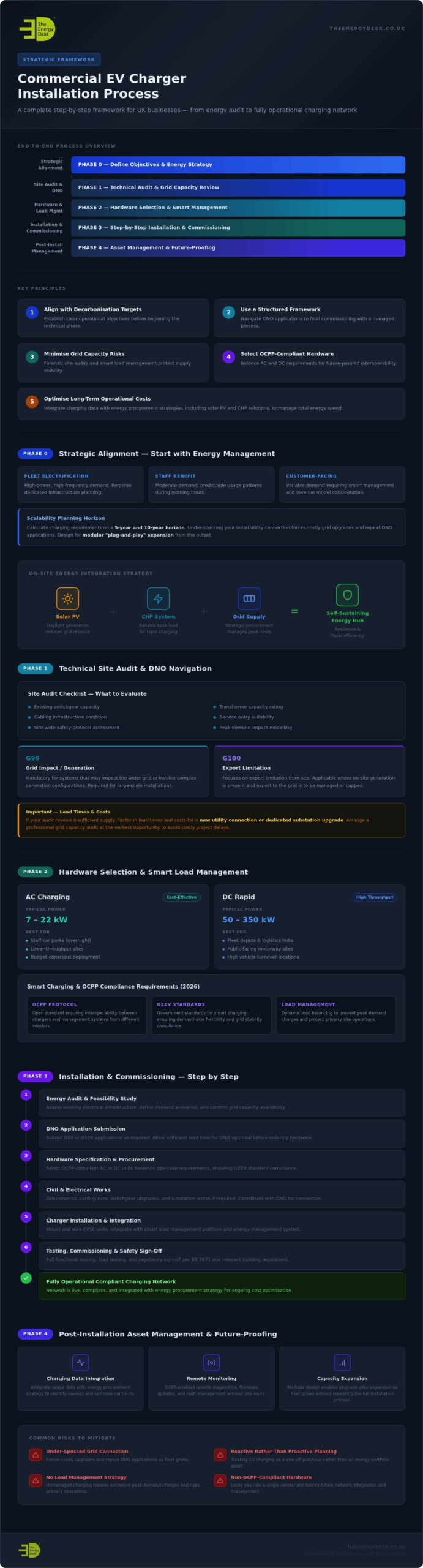
Phase 3: The Step-by-Step Commercial EV Charger Installation Template
A successful commercial EV charger installation process relies on a repeatable, structured framework that ensures technical precision and safety. Moving from the planning phase to physical implementation requires a disciplined project management approach. By following this five-step template, you can maintain oversight of the technical requirements whilst ensuring the infrastructure remains scalable for future demand.
- Step 1: The Initial Energy Audit and Feasibility Study. This forensic review identifies your site’s current electrical load and assesses the physical suitability of proposed charging locations.
- Step 2: DNO Application and Utility Connection Approval. Secure the necessary permissions from your local Distribution Network Operator to ensure your site can draw the required power without impacting the wider grid.
- Step 3: Civil Works and Infrastructure Preparation. This phase includes trenching, groundworks, and the installation of underground ducting to house high-voltage cabling.
- Step 4: Hardware Installation and Electrical Commissioning. Professional mounting of the charging units and the completion of final electrical terminations by qualified engineers.
- Step 5: Software Integration and Staff Training. Finalising the back-end connection to the management platform and providing operational training for your facilities team.
To ensure your project begins with accurate data and a clear feasibility roadmap, request a free commercial energy audit before commencing any physical works.
Minimising Operational Disruption
Groundworks and cabling are inherently intrusive. To maintain operational continuity, you should organise civil works during weekend windows or off-peak hours when vehicle traffic is at its lowest. Managing parking bay closures in stages, rather than all at once, prevents total site blockage. Close coordination with your facilities teams is essential during the final electrical tie-ins to avoid unplanned downtime for your primary business operations. A phased approach ensures that the commercial EV charger installation process remains a benefit to your business rather than a logistical burden.
The Commissioning and Testing Protocol
Technical verification is the final safeguard before your infrastructure goes live. Mandatory electrical testing must be completed to issue an Electrical Installation Certificate (EIC) in accordance with UK regulations. This process includes testing RCD functionality and earth loop impedance to ensure user safety. User acceptance testing follows, where engineers verify that the hardware and back-end software communicate correctly across the network. The final handover should include a comprehensive documentation pack containing warranties, O&M manuals, and emergency shutdown protocols for your site managers.
Post-Installation: Asset Management and Future-Proofing Your Infrastructure
Completing the physical commercial EV charger installation process marks the beginning of a long-term infrastructure management phase. To ensure the longevity of your investment, you must establish a methodical preventative maintenance programme. Charging units in high-traffic environments are subject to physical wear and environmental stressors that can lead to hardware failure if left unchecked. Regular inspections, cable health checks, and firmware updates ensure your network remains reliable for users and compliant with the latest electrical safety standards.
Monitoring energy consumption is essential for refining your broader utility strategy. By analysing charging patterns, you can better inform your business gas procurement and electricity contracts, ensuring your total energy spend remains optimised. Bill validation plays a critical role here. It allows you to verify that electricity costs are correctly allocated to the EV infrastructure rather than being absorbed into general building overheads. Without this oversight, businesses often struggle to calculate the true operational cost of their fleet or accurately recover expenses from third-party users.
Future-proofing means designing for growth from the outset. If you followed the modular principles established during the initial commercial EV charger installation process, adding additional points becomes a streamlined technical task rather than a full-scale construction project. You can scale your network incrementally, utilising the existing ducting and switchgear capacity prepared during the first phase of groundworks. This avoids the need for repeated civil works and minimises future capital expenditure as your charging demand increases.
Ongoing Data Analysis and Optimisation
Your charging data is a powerful tool for negotiating more competitive commercial energy contracts. By identifying underutilised charging points, you can reconfigure your site layout to better serve high-demand zones or adjust your load management settings. Comprehensive data-driven insights maximise the ROI of EV infrastructure by aligning power consumption with the most cost-effective tariff windows. This level of analytical oversight ensures that your infrastructure remains an asset rather than a growing operational liability.
The Strategic Advantage of Professional Management
An independent energy consultancy offers a distinct advantage over hardware vendors by providing objective, long-term oversight of your entire utility portfolio. Whilst a vendor focuses primarily on equipment sales, a consultant ensures your EV infrastructure evolves in line with changing UK energy regulations and market volatility. This proactive approach protects your business from regulatory non-compliance and helps you meet the 2030 and 2035 decarbonisation targets with a structured, fiscally responsible plan. A comprehensive business carbon footprint reduction UK strategy is an essential complement to your EV infrastructure investment, ensuring your electrification efforts translate into measurable, reportable emissions savings.
Contact The Energy Desk for a free audit and start your EV journey today.
Securing Your Competitive Edge in the 2026 Energy Landscape
Transitioning to electric transport is a significant undertaking that requires more than just mounting hardware. The commercial EV charger installation process is a comprehensive energy management project that demands precise technical oversight and proactive grid coordination. Success depends on navigating complex DNO applications early and integrating smart load management to protect your site’s operational integrity. By treating EV infrastructure as a core component of your broader utility portfolio, you can mitigate rising costs whilst meeting 2030 decarbonisation targets with confidence.
With over 20 years of UK energy consultancy expertise, The Energy Desk provides end-to-end management of DNO and utility connections through a national network of qualified installation partners. Our methodical approach ensures your infrastructure is modular, compliant, and ready to scale alongside your business. Taking the first step today protects your operations from future grid limitations and volatile energy prices. Request a Free Commercial Energy Audit to Plan Your EV Infrastructure and ensure your site is prepared for the future of commercial mobility.
Frequently Asked Questions
How long does the commercial EV charger installation process take?
The duration of the commercial EV charger installation process typically ranges from 8 to 12 weeks for standard projects. However, timelines can extend to 6 months if significant grid reinforcement or a new substation is required. The most time-consuming phase is often the DNO application and utility connection approval. Commencing the technical site audit early allows you to identify potential bottlenecks and manage your project timeline with greater precision.
Do I need planning permission for commercial EV chargers in 2026?
Most workplace installations fall under Permitted Development Rights, meaning formal planning permission is not required. There are specific caveats: the charger must not exceed 2.3 metres in height or be located within two metres of a public highway. If your premises is a listed building or situated in a conservation area, you must consult your local planning authority. Always verify the latest 2026 regulations before commencing civil works to ensure full legal compliance.
What is a DNO application and why is it necessary for my business?
A Distribution Network Operator (DNO) application is a formal request to connect high-demand equipment to the regional power grid. It is necessary because EV chargers draw significant current, which could destabilise the local network if not managed correctly. The DNO assesses your site’s Available Capacity and determines if upgrades are needed. Securing this approval is a mandatory step in the commercial EV charger installation process for any large-scale workplace or fleet deployment.
Can I install EV chargers if my site has limited electrical capacity?
Yes, you can deploy charging infrastructure even on sites with constrained supply by utilising active load management software. This technology throttles charging speeds in real-time to prevent exceeding your site’s power limit. Alternatively, integrating on-site battery storage or solar PV solutions can provide the additional “boost” needed for rapid charging hubs. These strategies allow you to expand your infrastructure without the immediate need for expensive and time-consuming grid reinforcement projects.
Are there grants available for commercial EV charger installation in the UK?
The Workplace Charging Scheme (WCS) remains a primary source of financial support, providing vouchers that cover a portion of purchase and installation costs per socket. Eligibility in 2026 is often tied to specific criteria, such as being a registered business, charity, or public sector organisation. Whilst grant levels fluctuate, they significantly reduce the initial capital expenditure. You should also explore commercial EV charger installation grants UK and regional decarbonisation funds and capital allowance tax incentives to further offset your project costs.
What is the difference between 7kW, 22kW, and Rapid DC chargers for business?
A 7kW AC charger is a single-phase unit suited for long-stay employee parking, whilst 22kW AC chargers require a three-phase supply for faster turnaround. Rapid DC chargers (50kW to 350kW) bypass the vehicle’s on-board converter to provide ultra-fast charging, making them essential for logistics fleets and public hubs. Selecting the correct power output depends on your specific dwell-time requirements and the available electrical infrastructure identified during your initial feasibility study and site audit.
How does smart load management reduce my business energy costs?
Smart load management reduces costs by automatically shifting charging sessions to off-peak hours when electricity tariffs are lower. By “peak shaving,” the system ensures your total site demand never exceeds its agreed capacity, avoiding expensive penalty charges from your supplier. It also allows you to prioritise essential fleet vehicles, ensuring they are ready for operation without requiring a costly upgrade to your primary utility connection or switchgear.
Should I choose tethered or untethered chargers for my workplace?
Tethered chargers include a permanent cable, offering a more convenient “plug-and-play” experience for fleet drivers and staff. However, they are more susceptible to physical damage and wear. Untethered chargers feature a socket only, requiring users to provide their own cables. This option is often preferred for public-facing sites or visitor car parks, as it reduces maintenance overheads and ensures compatibility with various vehicle types that may use different connector standards.