
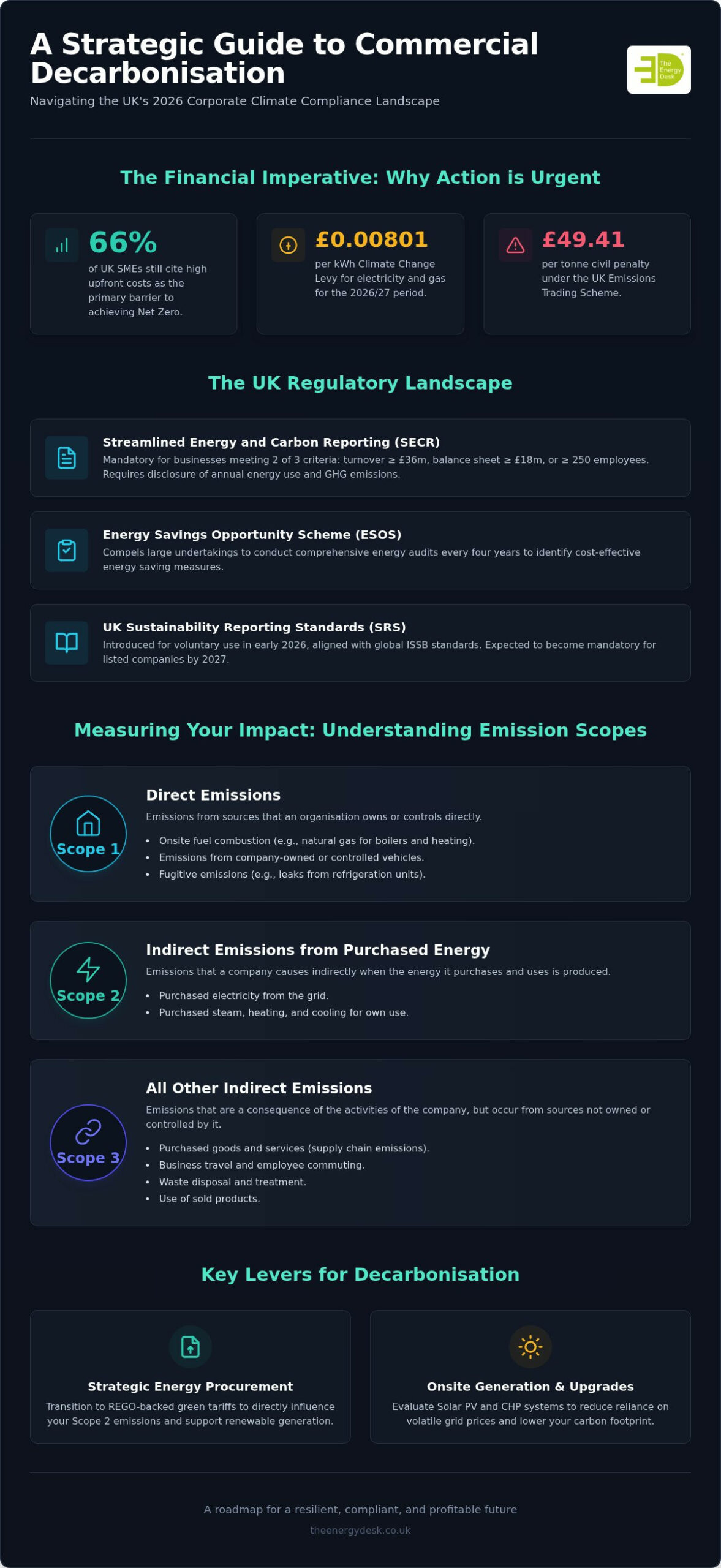
Did you know that 66% of UK small and medium-sized enterprises still cite high upfront costs as the primary barrier to achieving Net Zero? While the financial hurdle is real, the cost of inaction is rising. With the Climate Change Levy for electricity and gas set at £0.00801 per kWh for the 2026/27 period, and the UK Emissions Trading Scheme civil penalty price reaching £49.41 per tonne, business carbon footprint reduction UK is no longer just a corporate social responsibility goal. It’s a critical financial imperative for any resilient organisation.
We understand that navigating complex reporting requirements like SECR or the new UK Sustainability Reporting Standards feels like a distraction from your core operations. It’s difficult to distinguish between superficial greenwashing and genuine, impactful change. This strategic guide provides a clear roadmap to help you develop a robust commercial decarbonisation strategy that reduces environmental impact whilst protecting your profit margins. We’ll examine how onsite generation, such as solar PV and CHP systems, can lower your energy overheads and ensure your business remains compliant with evolving UK environmental regulations.
Key Takeaways
- Identify why 2026 is a pivotal year for UK corporate climate compliance and how systematic GHG reduction safeguards your commercial viability.
- Learn how to accurately measure and categorise Scope 1, 2, and 3 emissions to replace generic estimates with precise, data-driven insights.
- Discover how strategic energy procurement and the 2026 green tariff market serve as essential levers for business carbon footprint reduction UK.
- Evaluate the financial ROI of transitioning to onsite generation solutions, such as Solar PV and CHP, to reduce reliance on volatile grid prices.
- Develop a comprehensive roadmap that aligns your procurement, infrastructure, and organisational behaviour with a credible Net Zero strategy.
The Business Case for Carbon Footprint Reduction in 2026
Effective business carbon footprint reduction UK strategies now require a shift from passive observation to active intervention. At its core, this process involves the systematic measurement and lowering of Greenhouse Gas (GHG) emissions across every facet of your operations. In 2026, this is no longer a peripheral concern for Corporate Social Responsibility departments. It has become a fundamental component of fiscal risk management. The UK government’s June 2026 agreement on the Seventh Carbon Budget, which targets an 87% emissions reduction by 2042, has accelerated the transition from voluntary reporting to mandatory compliance.
Decarbonisation directly influences your bottom line by reducing exposure to rising environmental levies. For the 2026/27 period, the Climate Change Levy (CCL) stands at £0.00801 per kWh for both electricity and gas. Organisations that fail to optimise their consumption face higher standing charges and increased procurement risks. Conversely, businesses that implement robust Carbon accounting frameworks can identify inefficiencies that, when corrected, significantly lower commercial electricity and gas expenditure. Transitioning to a low-carbon model is the most effective way to hedge against the volatility of the global energy market.
The UK Regulatory Landscape: SECR and ESOS
The regulatory framework in 2026 is more stringent than ever. Streamlined Energy and Carbon Reporting (SECR) remains a mandatory requirement for businesses meeting two of three criteria: a turnover of £36 million or more, a balance sheet total exceeding £18 million, or 250 or more employees. These organisations must disclose their annual energy use and GHG emissions in their directors’ report. Similarly, the Energy Savings Opportunity Scheme (ESOS) compels large undertakings to carry out comprehensive energy audits every four years.
A significant shift in early 2026 is the introduction of the UK Sustainability Reporting Standards (SRS) for voluntary use. Aligned with global ISSB standards, these will likely become mandatory for listed companies by 2027. Staying ahead of these requirements is vital. Failure to comply doesn’t just result in fines; it can lead to civil penalties under the UK Emissions Trading Scheme, where the 2026 price for civil penalties is £49.41 per tonne of CO2 equivalent.
Supply Chain Pressure and the “Green Premium”
Your carbon footprint is now a competitive variable. As large corporations and public sector bodies work toward their own Net Zero targets, they’re increasingly auditing the emissions of their suppliers. This “Scope 3” pressure means that your ability to win tenders often hinges on your environmental credentials. Decarbonisation is becoming a prerequisite for securing commercial finance and insurance, as lenders seek to de-risk their portfolios against future carbon taxation. This commitment can also be demonstrated through circular procurement; for example, sourcing high-quality, pre-owned furniture from Nicholas Wells Antiques helps reduce the embodied carbon of your physical assets. Businesses that cannot demonstrate a clear roadmap to Net Zero may find themselves excluded from lucrative contracts or facing higher borrowing costs. Investing in business carbon footprint reduction UK is therefore an investment in your future market share.
Accurate measurement is the cornerstone of any credible business carbon footprint reduction UK programme. Without a precise baseline, your organisation risks setting targets that are either unachievable or insufficiently ambitious. Many firms fall into the trap of using generic industry averages for their calculations. However, the UK government environmental reporting guidelines emphasise the need for primary data collection to satisfy modern auditing standards. Establishing this baseline requires a granular understanding of the Greenhouse Gas (GHG) Protocol’s three scopes.
Scope 1 and 2: Direct and Indirect Energy Emissions
Scope 1 accounts for the direct emissions your business generates through activities it controls. This typically includes onsite fuel combustion, such as natural gas for heating systems, and emissions from company-owned vehicle fleets. Scope 2 covers indirect emissions from the generation of purchased electricity, steam, or heat consumed by your organisation. These two categories are often the easiest to measure because the data is readily available through your utility providers.
The way you manage your business electricity procurement directly impacts your Scope 2 profile. Transitioning to a REGO-backed green tariff is a common starting point, but accurate reporting requires more than just a certificate. Forensic bill validation is the essential first step here. By cross-referencing meter data with utility invoices, you ensure that your carbon baseline is built on verified consumption figures rather than estimated readings. If you’re unsure where your data gaps lie, requesting a professional energy audit can provide the technical clarity needed to proceed with confidence.
The Scope 3 Challenge: Supply Chain and Logistics
Scope 3 encompasses all other indirect emissions that occur in your business’s value chain. This includes upstream activities like the production of purchased goods and services, as well as downstream activities such as waste disposal and business travel. For the majority of UK commercial operations, Scope 3 represents the largest portion of their total footprint, often exceeding 70% of total emissions. It is the most complex area to track but also offers the greatest opportunity for long-term impact.
Hidden sources frequently include water treatment processes, employee commuting patterns, and the lifecycle of leased assets. Addressing these requires active supplier engagement whilst maintaining operational efficiency. Start by requesting carbon data from your top-tier suppliers and including environmental criteria in your future procurement tenders. This collaborative approach ensures that your business carbon footprint reduction UK efforts aren’t undermined by carbon-intensive partners; for example, evaluating the durability and health benefits of equipment from ekobor.com.hk can inform a more sustainable approach to office fit-outs. Measuring these “hidden” emissions is complex, but it is vital for a holistic Net Zero roadmap.
Strategic energy procurement is often the most immediate lever available for business carbon footprint reduction UK. Many organisations view energy purchasing as a simple cost-minimisation exercise, yet the structure of your supply contracts determines your Scope 2 emissions profile. In 2026, the UK energy market has reached a significant milestone. Renewable generation accounted for 53.1% of total electricity in the first quarter of the year. This shift in the grid mix means that the carbon intensity of standard electricity is falling, but proactive procurement remains essential for businesses aiming for high-integrity Net Zero claims.
Effective portfolio management requires a move away from generic “green” labels toward contracts that offer transparency and additionality. While electricity is the primary focus for many, business gas procurement is equally critical. Natural gas remains a significant source of Scope 1 emissions. Managing this transition through phased volume purchasing or exploring green gas alternatives allows your business to balance immediate operational needs with long-term decarbonisation targets.
Green Tariffs vs. Power Purchase Agreements (PPAs)
The UK “green tariff” market has evolved significantly. In 2026, businesses are increasingly distinguishing between standard renewable tariffs and high-integrity additionality contracts. Standard green tariffs often rely on Renewable Energy Guarantees of Origin (REGO) certificates to match consumption with renewable generation. While compliant, these don’t always result in new renewable capacity being built.
Corporate Power Purchase Agreements (PPAs) offer a more robust alternative. By entering into a PPA, your organisation agrees to purchase electricity directly from a specific renewable asset, such as a wind farm or solar park. This provides long-term price certainty and demonstrates “additionality” by proving your investment supported a specific green project. PPAs are becoming the preferred choice for UK corporates seeking to hedge against market volatility whilst securing a verifiable zero-carbon energy source.
Optimising Consumption via Bill Validation and Audits
You cannot manage what you do not accurately measure. Strategic procurement must be paired with rigorous oversight of consumption data. commercial utility bill validation is a vital tool in this process. Billing errors are surprisingly common in the commercial sector, and they often mask underlying energy waste. When a bill is validated forensically, discrepancies between meter readings and invoices are identified, often revealing “phantom” energy use during out-of-hours periods.
Utilising half-hourly data allows your organisation to pinpoint peak demand periods. These are often the most carbon-intensive times to draw from the grid. By shifting operational tasks to periods of high renewable penetration, you reduce both your costs and your carbon impact. This methodical approach ensures that your business carbon footprint reduction UK strategy is built on a foundation of operational efficiency and financial oversight.
Onsite Generation and Infrastructure Upgrades
Transitioning from purchasing renewable energy to generating it onsite represents the next phase of a mature business carbon footprint reduction UK strategy. While procurement hedges against market volatility, physical infrastructure provides long-term energy independence. The business case for commercial renewable energy UK has strengthened in 2026, driven by higher carbon penalties and the phased reduction of fossil fuel subsidies. Investing in hardware allows your organisation to capitalise on the “clean flexibility” trend, balancing grid demand whilst lowering operational overheads. This shift from “buying green” to “making green” energy effectively decouples your growth from rising grid costs.
Solar PV and CHP: The Industrial Powerhouse
For many industrial and commercial sites, commercial solar PV installation is the most accessible route to onsite generation. With renewable electricity generation reaching record levels in 2026, solar remains a predictable asset with a clear ROI. However, for organisations with high heat and power demands, CHP system installation for businesses serves as a critical transitional tool. Combined Heat and Power (CHP) captures the heat produced during electricity generation, reaching efficiencies that far exceed traditional boilers. This technology provides essential energy resilience during periods of grid instability or peak pricing, ensuring your facility remains operational whilst minimising its carbon intensity.
Fleet Electrification and EV Charging
Addressing transport emissions is vital for reducing Scope 1 and 3 footprints. The commercial EV charger installation process is now a strategic priority for UK firms. From April 2026, the Workplace Charging Scheme grant increased to £500 per socket, allowing businesses to claim for up to 40 sockets. To understand how to maximise this funding before the March 2027 deadline, our definitive guide to commercial EV charger installation grants UK provides a comprehensive roadmap for navigating the updated scheme. Integrating these chargers with your onsite solar arrays creates a closed-loop system where vehicles are powered by self-generated green energy. This synergy maximises carbon savings and prevents a sudden surge in electricity demand from overwhelming your existing utility connections. Managing this increased demand requires a methodical approach to infrastructure that balances fleet requirements with building loads.
To evaluate which hardware solutions offer the best ROI for your specific site, book a free energy audit with our technical team today.
Developing Your 2026 Commercial Decarbonisation Strategy
Moving from measurement to meaningful action requires a shift in organisational mindset. A successful business carbon footprint reduction UK strategy isn’t a one-off project but a continuous cycle of optimisation. This involves balancing three pillars: strategic procurement, behavioural changes, and technological investment. To ensure your team has the technical expertise to handle these new systems, check out Square Skills for accredited IT and career development training. By integrating these elements, you create a resilient framework that adapts to the 2026 energy market’s complexities. Professional energy consultants act as vital partners here, providing the technical oversight needed to navigate fluctuating carbon prices and evolving grid flexibility requirements.
A professional energy audit is the essential starting point for any implementation phase. It provides a granular breakdown of consumption patterns that a standard utility bill cannot reveal. Once you identify inefficiencies, prioritisation is key. Projects should be ranked based on their carbon abatement potential versus their financial payback period. To secure board-level buy-in, frame these initiatives as essential risk management. Reducing your reliance on the grid isn’t just an environmental choice; it’s a way to protect the organisation against future utility price shocks and carbon taxation. A phased approach allows for the reinvestment of savings from early energy efficiency wins into larger infrastructure projects.
For UK firms seeking global credibility, aligning with the Science-Based Targets initiative (SBTi) is the recognised standard. This framework ensures your reduction targets are consistent with the latest climate science and the 1.5°C goal of the Paris Agreement. Setting these targets provides a clear, long-term trajectory for your decarbonisation journey, moving beyond short-term fixes to systemic change. It demonstrates to investors and customers that your commitment is grounded in rigorous, verified methodology.
Continuous Improvement and Reporting
Transparency is the antidote to greenwashing. Annual carbon reporting is now a standard expectation for stakeholders, but real-time monitoring offers more significant advantages. Utilising DC/DA and data collection services allows you to track progress against your baseline continuously. This data-driven approach enables you to identify and rectify performance drifts before they impact your annual targets. It also provides the evidence needed for compliance with SECR and other regulatory frameworks.
Communicating your successes to stakeholders must be handled with precision. Focus on verified data and specific milestones achieved rather than vague environmental claims. Clear, evidence-based reporting builds trust with customers, investors, and employees, reinforcing your position as a leader in business carbon footprint reduction UK. Regular reviews of your strategy ensure it remains aligned with both technological advancements and the shifting UK regulatory landscape.
Securing Your Low-Carbon Commercial Future
The transition to a Net Zero economy presents both a regulatory challenge and a significant commercial opportunity. Achieving effective business carbon footprint reduction UK requires a methodical alignment of your procurement strategy, physical infrastructure, and data oversight. The foundation of any robust strategy lies in moving from generic estimates to forensic measurement. By integrating onsite generation like Solar PV and CHP systems with high-integrity procurement models, your organisation can effectively hedge against market volatility whilst meeting stringent 2026 compliance standards.
Expertise is essential when navigating these technical markets. The Energy Desk provides over 20 years of energy consultancy experience, and we’ve got specialists in both procurement and renewable infrastructure. We deliver independent advice tailored to specific UK industrial and commercial needs, ensuring your strategy remains both fiscally responsible and environmentally impactful. Request your free energy and carbon audit from The Energy Desk today to identify immediate efficiency gains. Taking proactive steps now ensures your business remains resilient, compliant, and competitive in an increasingly decarbonised environment.
Frequently Asked Questions
What is the most cost-effective way to reduce my business carbon footprint?
Energy efficiency and behaviour change are the most cost-effective starting points. Addressing waste through utility bill validation and implementing simple operational changes, such as adjusting heating setpoints or installing LED lighting, requires minimal capital expenditure. These actions provide immediate savings that can be reinvested into more substantial business carbon footprint reduction UK projects. A professional energy audit will identify these “low-hanging fruit” opportunities specific to your site’s operational profile and consumption patterns.
Is carbon offsetting a valid strategy for UK businesses in 2026?
Carbon offsetting should only be used as a last resort for residual emissions that cannot be eliminated through direct action. In 2026, UK regulatory bodies and stakeholders increasingly scrutinise offsetting claims to prevent greenwashing. High-integrity strategies prioritise actual decarbonisation through procurement and onsite generation. If your organisation chooses to offset, ensure the credits are verified by recognised standards and are part of a broader, transparent Net Zero roadmap rather than a standalone solution.
How does SECR reporting affect my small or medium-sized enterprise?
Most SMEs are currently exempt from mandatory Streamlined Energy and Carbon Reporting (SECR) unless they exceed specific thresholds. These include a turnover of £36 million, a balance sheet of £18 million, or 250 employees. However, many smaller firms are now required to provide carbon data to larger clients as part of Scope 3 supply chain requirements. Voluntarily adopting these reporting standards early can provide a competitive advantage when tendering for public sector or large corporate contracts.
Can I reduce my carbon footprint whilst staying on a standard energy contract?
You can reduce your footprint through demand-side management and efficiency measures, but your Scope 2 emissions will remain tied to the grid’s average carbon intensity. A standard contract lacks the “additionality” of a Corporate Power Purchase Agreement (PPA) or a high-quality green tariff. To achieve significant business carbon footprint reduction UK, you must combine efficiency with a strategic procurement approach that supports renewable generation. Without a green supply, your total impact remains limited by your provider’s fuel mix.
What grants or tax incentives are available for UK business decarbonisation?
Several incentives remain active in 2026, including the Boiler Upgrade Scheme, which offers grants of up to £7,500 for low-carbon heating. The Workplace Charging Scheme provides up to £500 per EV charging socket for up to 40 sockets. Additionally, businesses with Climate Change Agreements (CCAs) can access significant discounts on the Climate Change Levy. These financial levers are designed to reduce the payback period for capital-intensive projects like heat pumps and EV infrastructure whilst supporting your sustainability goals.
How much does a commercial energy audit cost for a typical UK site?
The cost of a commercial energy audit varies depending on the size and complexity of the facility. Factors such as the number of sites, the types of industrial processes involved, and the depth of technical analysis required will influence the final price. Some consultancies, including The Energy Desk, offer free initial energy audits to help businesses identify potential savings. A comprehensive audit is an investment that typically pays for itself through the identification of significant energy and carbon waste.
What is the difference between Net Zero and Carbon Neutral for a business?
Carbon Neutrality allows a business to balance its emissions by purchasing offsets, often without requiring an overall reduction in actual output. In contrast, Net Zero is a more rigorous standard that requires an organisation to reduce its absolute emissions by at least 90% across all Scopes. Only the remaining 10% of unavoidable emissions can be neutralised through carbon removal technologies. Net Zero is the preferred target for businesses seeking alignment with the Paris Agreement and long-term commercial sustainability.
How long does it typically take to see an ROI on commercial solar PV?
Most UK businesses currently see a return on investment for commercial solar PV within five to eight years. This timeline depends on factors such as your site’s self-consumption rate, current electricity prices, and available roof space. With the record renewable generation levels seen in early 2026, the business case has become increasingly stable. Onsite solar not only reduces your carbon footprint but also provides a long-term hedge against the volatility of the wholesale energy market and rising standing charges.