
Why is your business receiving energy bills when nobody signed a contract? If you’re asking “what is a deemed energy contract”, it may explain why a supplier can charge for gas or electricity used at your premises even when you haven’t expressly agreed a contract with that supplier. That doesn’t mean you should ignore the bill or assume its terms are right for your business.
Deemed rates may differ from negotiated terms, so it’s worth establishing how the arrangement began and checking the supplier’s terms and billing details. Once you know the account status, you can decide whether to query a charge, discuss contract options or arrange a new agreement.
This 2026 guide explains when deemed supply can apply, how it differs from out-of-contract and rollover arrangements, and what to review on your account. You’ll also learn how to move towards an agreed supply arrangement that better suits your business. The Energy Desk provides bill validation to review supplier charges and account details, and procurement support to assess contract options in light of your circumstances and energy use.
Key Takeaways
- Learn what is a deemed energy contract and why a business may be supplied without an agreed contract.
- Check whether your supplier’s terms describe deemed supply, an agreed contract or an arrangement following contract expiry.
- Review your account status, supplier records and bill details before deciding whether to query charges or consider other options.
- Keep copies of relevant agreements and notices, and record communications with your supplier.
- See how bill validation and procurement support can help you review account information and assess contract options suited to your business.
What is a deemed energy contract for a UK business?
A deemed energy contract is an arrangement under which a supplier provides gas or electricity to a business taking supply at its premises without an express agreement with that supplier for the premises. The supplier’s applicable deemed terms govern the supply, including how charges are calculated. The precise circumstances and terminology depend on the type of supply, the supplier’s terms and the account’s history.
For example, a business might move into premises and start using the existing electricity supply before arranging a contract. The supplier may treat the business as being on deemed terms while supply continues. A change of occupier is one possible scenario, but it doesn’t determine the status in every case. The business’s records and the supplier’s terms help establish what applies.
Deemed status alone doesn’t show that a supplier has acted improperly or that its charges are wrong. It indicates that supply is being provided under terms that haven’t been expressly negotiated with the current business. The key is to identify the arrangement that applies to the account and check whether the supplier’s charges and records reflect it.
How can a business end up on deemed terms?
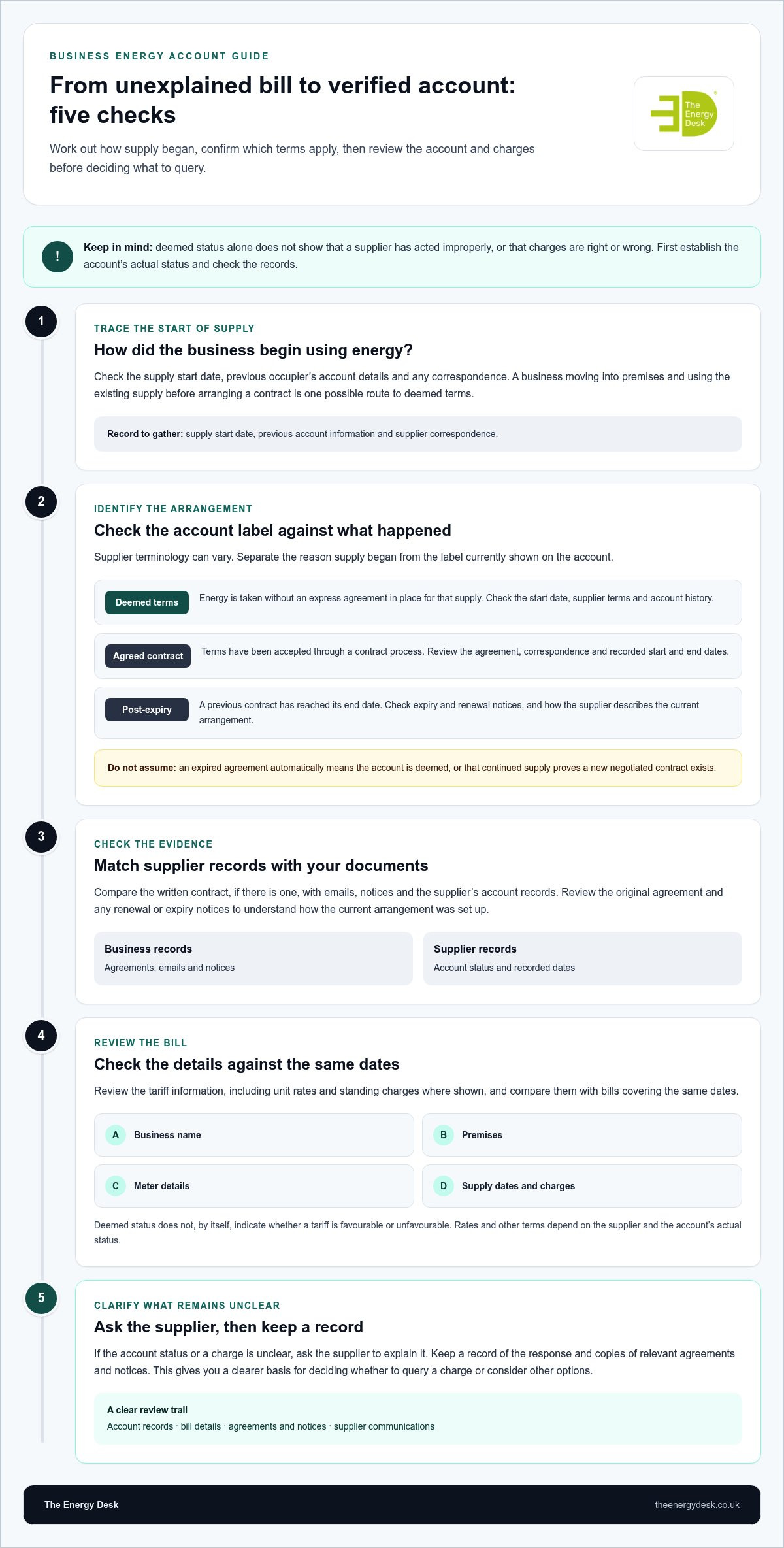
A deemed arrangement may arise when a business takes gas or electricity at premises without first agreeing an express contract with the supplier responsible for that supply. One possible scenario is a change of occupier: the incoming business begins using energy while it is still establishing its supplier arrangements. Check the supply start date, the previous occupier’s account details and any correspondence to understand how the account was set up.
A contract ending can also lead to continued supply on terms described by the supplier as deemed, out-of-contract or something else. These labels aren’t interchangeable, and suppliers’ terminology can vary. Don’t assume that an expired agreement automatically means the account is deemed. Review the original agreement, any renewal or expiry notices, and the supplier’s current description of the account.
What does deemed supply mean for the customer?
The supplier continues providing energy under the terms it applies to the account, so the business should understand the basis of its bills. Deemed status doesn’t, by itself, show whether the tariff is favourable or unfavourable. Rates and other terms depend on the supplier and the account’s actual status, and may differ between businesses.
Start with the supplier’s account records and terms. Review the tariff information, including unit rates and standing charges where shown, and compare these with your bills for the same dates. Check that the business name, premises, meter details and supply dates are correct. If the account status or a charge is unclear, ask the supplier to explain it and keep a record of the response. This gives you a clearer basis for deciding what to do next.
How deemed energy contracts arise, and how they differ from other arrangements
To establish what is a deemed energy contract in a particular case, separate the reason supply began from the label now shown on the account. A business might take over premises and use energy before agreeing terms with the supplier. An agreed contract follows a contract process, while an arrangement after expiry relates to an agreement that was already in place. Continued energy supply doesn’t, by itself, mean a new negotiated contract has been made.
For electricity, Schedule 6 of the Electricity Act 1989 includes provisions relating to deemed contracts. The relevant framework and details depend on the type of supply and circumstances. Treat the supplier’s terminology as a starting point, then check the documents and account records to establish the actual status.
| Arrangement | Typical trigger | Agreement status and review action |
|---|---|---|
| Deemed terms | Energy is taken without an express agreement in place for the supply. | Check the supply start date, supplier terms and account history. |
| Agreed contract | Terms are accepted through a contract process. | Review the agreement, correspondence and recorded start and end dates. |
| Post-expiry terms | A previous contract reaches its end date. | Check expiry and renewal notices, and how the supplier describes the current arrangement. |
Deemed contract versus an agreed business energy contract
With deemed terms, the business may be taking supply without expressly agreeing a contract with the supplier. An agreed business energy contract, by contrast, has terms accepted through a contract process. To identify which applies, compare the written contract with emails, notices and the supplier’s account records. Don’t assume that a bill or continued supply alone proves a new negotiated agreement exists.
Deemed terms versus out-of-contract or rollover rates
A deemed arrangement is commonly associated with supply where no express agreement was made for the account. Out-of-contract terms may apply after an agreed contract ends, while rollover describes a contract continuing or renewing under its terms. Suppliers don’t always use these labels in the same way, so check the agreement and notices rather than relying on the label alone. For a closer look at post-expiry arrangements, read this guide to out-of-contract energy rates.
If the documents and bills don’t make the status clear, The Energy Desk’s bill validation service can review supplier charges and account information. Procurement support can help you assess contract options against your business’s circumstances. Find out more about business energy procurement support.
What can a deemed energy contract mean for your business bill?
Contract status affects which supplier terms you need to use when checking a bill. Contract status matters because it identifies which rates and conditions should be used to assess the charges on your business energy account. If you’re asking what is a deemed energy contract in relation to your bill, the label alone won’t tell you whether the charges are correct or how they compare with another arrangement.
Rates and terms depend on the supplier and the account’s actual status. The total bill also reflects how much energy the business uses, the unit rates applied, standing charges and the period covered. A change in consumption or a part-month bill can affect the total even when the tariff hasn’t changed. Review each element separately rather than judging the account from the overall amount.
Which bill details should you review?
Start with the basics: check the supply address, account holder, meter details and billed period. Then compare the consumption shown with meter readings and any usage data available to your business. If the bill is estimated, note that and check how the supplier has calculated the reading or adjusted it later.
Review the charges individually. Compare the unit rates and standing charges with the supplier’s terms for the account and relevant dates. Check taxes and any adjustments as separate line items, and keep the bill alongside the applicable tariff information and account correspondence. If a detail doesn’t match, ask the supplier to explain the calculation and retain its response.
Could the business be paying out-of-contract rates?
Possibly, but check the account label and the supplier’s current terms before drawing a conclusion. Deemed terms and out-of-contract terms can relate to different circumstances, and supplier terminology may vary. Don’t assume that a high total proves the account is out of contract, or that deemed terms are always the most expensive. Check the agreement, any expiry or renewal notices, account records and bill together.
For a more detailed process for checking charges, see this commercial utility bill validation guidance. A methodical review can help distinguish an incorrect account detail or billing-period issue from charges that follow the supplier’s stated terms. The Energy Desk’s bill validation support can help review supplier charges and account information.
What should you do if your business is on a deemed energy contract?
If you’ve established that your business may be on deemed terms, work through the account methodically before deciding whether to challenge a bill or arrange a different contract. The answer to “what is a deemed energy contract” helps identify the arrangement, but your next steps depend on the supplier’s terms, your account history and the circumstances of the supply.
- Establish the account status. Ask the supplier to confirm the current contract status, the terms being applied and the date they took effect. Record when your business took responsibility for the premises and supply account.
- Gather the relevant records. Collect recent bills, supply and meter details, previous contract documents, and any notices or correspondence about a change of occupier, contract expiry or renewal.
- Review the charges. Compare the bill’s rates and charges with the supplier’s stated terms for the billed period. Check that the account details and consumption information are consistent with your records.
- Discuss the available options. Once you understand the account position, ask the supplier about the contract options it can offer. Compare them against your organisation’s energy use, budget priorities and procurement requirements before agreeing a change.
Confirm the account and contract position
Keep a clear record of each supplier conversation, including the date, the person or team you spoke with and what they explained. Save copies of bills, agreements, notices and written responses together. If the supplier’s account label doesn’t match the documents you hold, ask it to clarify the discrepancy in writing. This creates a useful record for reviewing the account and discussing next steps.
Review charges and agree a forward plan
Check charges against the supplier’s applicable terms and the period covered by each bill. If you’re considering a new agreement, compare options in light of your consumption profile and procurement priorities, not just the headline rate. Before treating a change as agreed, obtain written confirmation of the terms, effective date and any instructions affecting the account.
Switching processes, notice requirements and the rights that apply can depend on the contract, supplier and business circumstances. Confirm these details for your account before acting, particularly if a contract has expired or the supplier says notice is required. Procurement advice can help assess available options, while bill validation can support a review of supplier charges and account information. Review your business energy options with The Energy Desk.
How The Energy Desk can help you move from deemed terms to a managed plan
Once you understand what is a deemed energy contract and have clarified your account position with the supplier, assess the options for your business. The Energy Desk provides commercial energy procurement and bill validation support, helping businesses review charges and consider supply arrangements suited to their circumstances. Using your energy data and priorities can make this review more useful than relying on a tariff label alone.
From bill review to informed procurement
A free energy audit can bring billing, available energy data and procurement priorities together in one review. Bill validation focuses on supplier charges and account information, helping you examine whether the details on your bills align with the records and terms you hold.
Procurement support can then help you compare suitable commercial contract options. Relevant considerations may include your consumption profile, contract timing, operational requirements and preferences around managing energy costs. A business with predictable usage may assess options differently from one with changing operating patterns. Any decision depends on the organisation’s circumstances and the terms available; no particular saving, supplier outcome or rate can be assumed.
This creates a structured review: understand the billing, identify priorities, then assess options before agreeing a forward plan. The Energy Desk has supported business energy procurement since 2003, with advice tailored to each organisation’s consumption and circumstances.
What to prepare before discussing next steps
Having key information ready can make a review more focused. Gather recent bills, meter details, supplier correspondence and any current or previous contract documents. It also helps to summarise:
- Which sites are included and how each is used.
- Typical operating patterns, including any seasonal changes that affect consumption.
- Expected energy requirements and the organisation’s procurement priorities.
- Known contract dates, notices or supplier instructions that may affect timing.
These details give the review a practical foundation. They help connect the supplier’s account information with how your business operates and support a more informed discussion of contract options. Keep responsibility for confirming contractual terms and agreeing any changes with the supplier. Procurement advice can inform your assessment, but it doesn’t replace the supplier’s documents or account instructions.
To review your business’s energy data, billing and procurement priorities, request a free energy audit.
Turn your account review into a clear next step
Knowing what is a deemed energy contract helps you understand why a supplier may be billing your business without an expressly agreed contract. Verify the account’s actual status, check the supplier’s terms and compare the charges with your records. Deemed, out-of-contract and rollover arrangements can differ, so confirm which terms apply before deciding how to proceed.
Keep bills, notices and supplier correspondence together, and record discussions about your account. Once the current position is clear, assess commercial contract options against your energy use, timing and business priorities.
The Energy Desk is an independent UK business energy consultancy providing commercial energy procurement and bill validation support. A free energy audit can help you review energy data, billing and procurement priorities as you consider your next steps.
Request a free business energy audit to review your account and consider a practical energy plan.
Frequently Asked Questions
What is a deemed energy contract?
A deemed energy contract is a supply arrangement that may apply when a business takes gas or electricity without an agreed contract in place. The supplier’s terms and the circumstances of the supply determine how the arrangement applies, so the label alone may not establish your account’s status. Check recent bills, account records and the supplier’s information, including any contract documents or notices, before deciding which terms apply to your business.
When does a business energy deemed contract start?
Deemed terms may apply when a business takes energy without having agreed a contract with the supplier, including in some changes of occupier. The precise position depends on the circumstances, the supplier’s terms and the rules that apply to the supply. Establish the date your business became responsible for the premises and energy account, then ask the supplier to confirm the account status and the terms being used to calculate charges.
Are deemed energy rates always more expensive?
No general conclusion applies to every business account. Rates depend on the supplier’s applicable terms and the account’s actual status. Review the bill alongside your consumption, billed period, unit rates and standing charges, then compare the charges with relevant business contract options. This gives you a clearer basis for deciding whether to discuss a different arrangement. Avoid assuming a particular saving: the result depends on the terms available and your business’s circumstances.
Can a business leave a deemed energy contract?
A business may have options to agree a contract or change its supply arrangements, but the process and timing aren’t identical in every case. Account details, supplier terms and current rules can affect what steps are available. Ask the supplier to explain the applicable process, including any notice requirements, before making changes. Keep written records of the response, relevant correspondence and any agreement, including its terms and effective date.
What is the difference between a deemed contract and an out-of-contract rate?
The labels aren’t always used consistently by suppliers. A deemed arrangement may relate to a business taking supply without an express agreement, whereas “out-of-contract” may describe supply after an agreed contract ends. The account’s history is important: review previous agreements, expiry or renewal notices, bills and supplier records. Ask the supplier to explain how it uses the label on your account rather than relying on terminology alone.
Can a landlord or new occupier be responsible for a deemed energy contract?
Responsibility depends on who occupied the premises, the supply arrangements and the relevant dates, so there’s no single answer for every landlord or occupier. Keep tenancy or ownership records and establish when your business took responsibility for the premises and energy supply. Check whose name appears on the supplier account and ask the supplier to clarify who it is billing, using the dates and documents relevant to the occupancy.
What should I do if I think a deemed energy bill is wrong?
Check the supply address, account details, billed period and meter readings, then compare recorded consumption with available usage information. Review unit rates and standing charges against the supplier’s applicable terms, and examine taxes or adjustments separately. Ask the supplier to explain any discrepancy and keep copies of bills and correspondence. If the charges or account information are complex, The Energy Desk’s bill validation service can help review them, though it can’t guarantee an error will be found.
Request a free energy audit from The Energy Desk to review your business’s energy data, billing and procurement priorities.