

Could your organisation be subject to SECR even if it doesn’t consider itself a large energy user? The SECR reporting requirements for UK companies depend on factors such as quoted status, company size and group structure. If you’re in scope, your disclosures need to be supported by reliable energy and emissions data.
It’s easy to confuse these statutory disclosures with broader, voluntary carbon reporting. Treat SECR as a defined annual reporting process, not a substitute for wider carbon disclosure. First establish which rules apply to your organisation, then check that your annual report contains the required information.
This 2026 guide explains how to assess whether your organisation is in scope for the relevant financial year, including the large-company tests, group reporting and low-energy-user exemption. It also covers what to report, where disclosures belong and how to build a repeatable process for collecting, checking and retaining energy records. Consistent utility data and clear calculations make reporting more dependable from one year to the next.
Key Takeaways
- Use the SECR reporting requirements for UK companies to assess your organisation’s position for the relevant financial year, including its size, quoted status and group structure.
- Identify which disclosures apply to your organisation, from energy use and associated emissions to intensity ratios and efficiency actions.
- Check whether the low-energy-use exemption may apply, and understand what your annual report must say if it does.
- Build a repeatable reporting workflow using evidence such as utility bills, meter records, fuel data and records of organisational changes.
- Use bill validation and energy monitoring to spot inconsistencies and improve the reliability of consumption data before reporting.
SECR reporting requirements for UK companies: who must report?
Streamlined Energy and Carbon Reporting (SECR) requires certain organisations to include energy use and greenhouse gas information in their annual reporting. The Streamlined Energy and Carbon Reporting scheme (SECR) forms part of the UK’s wider energy conservation framework, but reporting duties apply to specific organisation types. To assess the SECR reporting requirements for UK companies, start by checking your organisation’s status and reporting period, rather than relying on its energy bills alone.
Broadly, SECR covers UK quoted companies, large unquoted companies and large LLPs. Quoted companies are in scope regardless of size. For unquoted companies and LLPs, the large-organisation test is central. Energy consumption doesn’t determine whether an organisation meets that test, although a separate low-energy-user exemption may apply.
Which organisation types fall within SECR?
A quoted company is generally one whose shares meet the relevant statutory criteria for quotation or trading on specified markets. This distinction matters: a company doesn’t need to meet the large-company thresholds to fall within SECR if it is quoted. Large unquoted companies and qualifying LLPs must also assess their reporting obligations.
Group structures can affect how disclosures are prepared. A parent may be able to report for a group, and a subsidiary may be covered by a compliant group report, subject to the applicable conditions. Don’t assume a parent’s disclosure automatically covers every entity. Map the group, identify which entities are included and check the reporting boundary for the relevant period.
How do company size thresholds affect SECR eligibility?
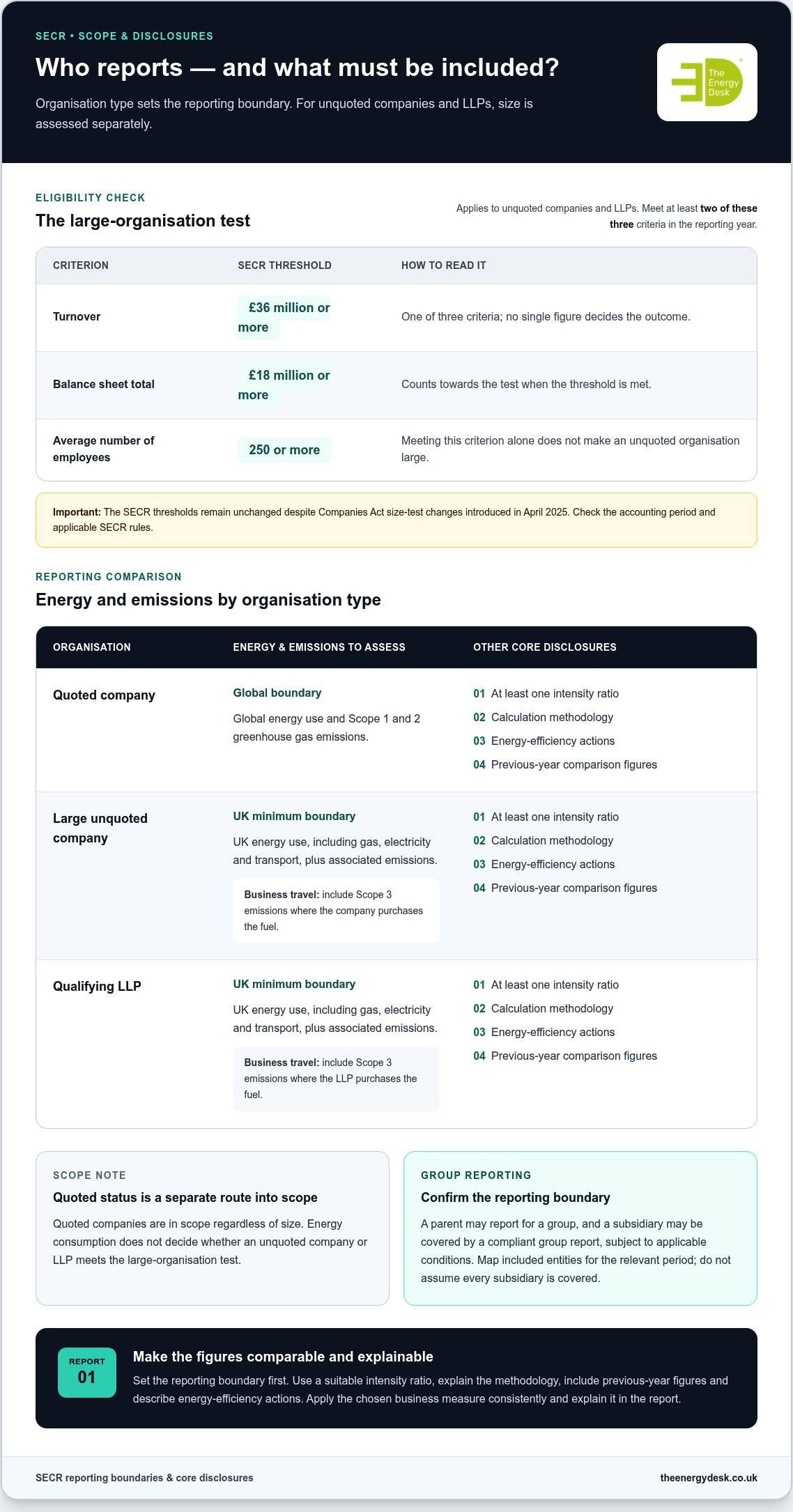
An unquoted company or LLP is generally considered large for SECR if it meets at least two of these three criteria in the reporting year:
| Criterion | SECR threshold |
|---|---|
| Turnover | £36 million or more |
| Balance sheet total | £18 million or more |
| Average number of employees | 250 or more |
No single figure decides the outcome. For example, meeting the employee threshold alone doesn’t make an unquoted company large under this test. It must meet at least one other criterion as well.
These SECR thresholds remain unchanged despite the Companies Act size-test changes introduced in April 2025. Assess the accounting period in question, and don’t assume newer company-size thresholds automatically replace the SECR figures. Financial-year start dates can affect which general company-size rules apply, so confirm the relevant period and SECR rules before deciding whether an organisation is in scope. For listed groups and subsidiaries, assess both the size test and the reporting boundary rather than relying on an individual entity’s figures alone.
What must UK companies include in an SECR report?
SECR disclosures vary by organisation type. Quoted companies report global energy use and Scope 1 and 2 emissions. Large unquoted companies and qualifying LLPs report at least UK energy use and associated emissions, with an additional requirement for certain business-travel emissions. The table summarises the main distinctions.
| Organisation type | Energy and emissions to assess | Other core disclosures |
|---|---|---|
| Quoted company | Global energy use and Scope 1 and 2 greenhouse gas emissions. | At least one intensity ratio, calculation methodology, energy-efficiency actions and previous-year comparison figures. |
| Large unquoted company | UK energy use, including gas, electricity and transport, and associated emissions. Include Scope 3 emissions from business travel where the company purchases the fuel. | At least one intensity ratio, calculation methodology, energy-efficiency actions and previous-year comparison figures. |
| Qualifying LLP | UK energy use, including gas, electricity and transport, and associated emissions. Include Scope 3 emissions from business travel where the LLP purchases the fuel. | At least one intensity ratio, calculation methodology, energy-efficiency actions and previous-year comparison figures. |
How do SECR disclosures differ by organisation type?
Set the reporting boundary before calculating totals. Quoted companies disclose global energy use, while large unquoted companies and LLPs have a UK energy-use minimum. For groups, align the figures with the entities included in the report and make the boundary clear. Don’t assume every subsidiary has identical requirements or that one entity’s data represents the whole group.
The disclosures are intended to show both performance and context. Include the prior year’s energy and emissions figures for comparison, explain the methodology used and describe energy-efficiency actions taken. The Department for Energy Security and Net Zero’s evaluation of SECR regulations provides official context on how the reporting framework operates.
Which energy and emissions figures should you prepare?
Gather the applicable electricity, gas and transport-fuel consumption records, then calculate associated emissions using the relevant government conversion factors. An intensity ratio expresses energy use or emissions against a suitable business measure, such as turnover or another metric that reflects the organisation’s activity. Choose a measure you can apply consistently and explain it in the report.
For large unquoted companies and LLPs, most other Scope 3 emissions are voluntary under SECR. Wider carbon disclosures can still be useful, but they’re distinct from the scheme’s required information. Keep that distinction clear in the report. Accurate bills, meter data and fuel records support dependable calculations. Bill validation and ongoing energy monitoring can help identify inconsistencies before figures are finalised. Explore business energy data support as part of a more organised reporting process.
SECR exemptions and reporting boundaries: what companies often misunderstand
SECR is a defined statutory reporting duty, not a requirement to publish every part of an organisation’s carbon footprint. Wider voluntary reporting may cover additional Scope 3 emissions, but it doesn’t replace the disclosures required under SECR. Preparing broader carbon data doesn’t automatically mean the statutory requirements have been met either. Check the organisation type and reporting boundary first.
When can the low-energy-use exemption apply?
An in-scope company or LLP may use the low-energy-user exemption if its total energy use is 40 megawatt-hours (MWh) or less over the reporting period. If relying on the exemption, the organisation must include a statement in its report confirming that it is a low energy user. The exemption concerns SECR reporting; it doesn’t change the organisation’s underlying scope assessment.
Calculate the total across the relevant organisation and reporting period. Don’t base the assessment on one site, one meter or electricity alone. Check the applicable energy sources and records, including gas and transport fuel where relevant, so the decision reflects the full reporting boundary.
How do subsidiaries and group reporting affect SECR?
A subsidiary may be able to rely on a parent’s group-level disclosure where the parent prepares the required reporting and the subsidiary is included within its scope. This isn’t a blanket exemption for every subsidiary. Confirm that the group report covers the relevant entity and information, and document the basis for relying on it.
Keep a record of the group structure, included entities, sites and reporting period. Review it annually, particularly after acquisitions, disposals or changes to operational control. These checks help distinguish an entity covered by group reporting from one that may need to report separately.
Geography matters too. Quoted companies report global energy use and relevant emissions, while large unquoted companies and LLPs have a minimum UK energy-use and emissions boundary. Overseas operations may therefore be treated differently depending on the organisation type. Define the boundary clearly rather than assuming every entity follows the same approach.
| Situation | What to investigate |
|---|---|
| Total energy use is 40 MWh or less | Confirm the total for the reporting period and include the required low-energy-user statement. |
| A subsidiary is part of a reporting group | Check that the parent’s disclosure includes the entity and satisfies the relevant conditions. |
| The organisation has overseas operations | Apply the correct global or UK boundary for its organisation type. |
| Wider carbon data is being prepared | Separate voluntary disclosures from the statutory SECR information required for that entity. |
Document the reasoning behind each decision. A clear audit trail makes it easier to apply the SECR reporting requirements for UK companies consistently as group structures, energy use or reporting boundaries change.
How to prepare SECR data and complete the annual reporting cycle
A reliable SECR process starts before the annual report is drafted. Assign responsibility for data collection, agree the reporting boundary and record how each figure was produced. This makes the information easier to review and helps explain changes from one reporting year to the next.
What records help build a reliable SECR data set?
Bring together utility invoices, meter readings, transport-fuel records and site information for the relevant period. Reconcile each source against the organisation’s sites and reporting boundary. Note changes such as a site opening or closure, an acquisition or a change in how a building is used, as these may affect year-on-year comparisons.
Keep a calculation record alongside the raw data. Include units, billing periods, any estimates, and the conversion factors and methodology used. The UK Government publishes greenhouse gas conversion factors annually, so record the factor set applied to each reporting period. If a bill covers dates outside the financial year, document how consumption was apportioned.
How should the annual SECR review be organised?
Give each data source an owner. Facilities or site teams can supply meter and building records; finance can reconcile invoices and reporting periods; sustainability or energy teams can coordinate calculations and draft disclosures. Set internal deadlines that leave time for review and approval before the annual report is finalised.
- Confirm scope: Recheck the organisation’s SECR status, reporting period and group boundary.
- Collect evidence: Gather bills, meter readings, transport-fuel data and records of site or organisational changes.
- Reconcile and check: Standardise units and periods, investigate missing data, compare totals with previous records and document estimates.
- Calculate and draft: Apply the appropriate methodology and conversion factors, then prepare the required figures and narrative.
- Review, approve and retain: Record reviewer comments, resolve discrepancies and retain source evidence, calculations and the approved disclosure for future cycles.
SECR information is included in the annual Directors’ Report. The filing deadline is generally six months after the accounting reference period for public companies, and nine months for private companies and LLPs. Build these statutory dates into the reporting calendar and align internal sign-off with the organisation’s wider accounts timetable.
Consistent checks matter. Explore commercial utility bill validation to identify discrepancies in energy records as part of a dependable data process. A documented workflow turns the SECR reporting requirements for UK companies into a repeatable annual task, with clear evidence behind the reported figures.
Build a dependable SECR process with better energy data
Reliable SECR reporting depends on more than completing a disclosure at year end. Start with clear organisational and geographical boundaries, complete energy records and checks you can repeat each reporting cycle. Energy management can improve the quality and visibility of the information behind the figures. Statutory preparation and approval remain the organisation’s responsibility, with support from its appointed reporting professionals where relevant.
How can energy management support SECR preparation?
Utility bills are a useful starting point, but check them against meter records, sites and reporting dates. Bill validation can help teams spot mismatched periods, gaps, unusual consumption changes or records that don’t align with expected usage. Investigate differences before they flow into calculations, and note the explanation or correction.
Ongoing energy monitoring can give teams a clearer view of consumption across business operations between reporting dates. Metering data may help identify shifts in use that invoices alone don’t make obvious. Where meter operator arrangements affect access to that data, include them in the review of available records. An energy audit can also help examine consumption patterns and identify practical energy-management opportunities.
What practical next step should an in-scope company take?
Before the next reporting cycle, map the sites and entities included in the reporting boundary, then assign an owner to each energy-data source. Review bills and consumption records early enough to investigate missing or inconsistent information before sign-off.
- Match invoices and meter records to the correct site and reporting period.
- Check that units are consistent and investigate unexpected changes in consumption.
- Record data gaps, estimates, calculation assumptions and who reviewed them.
- Retain the supporting evidence so next year’s figures can be compared on a consistent basis.
This disciplined approach turns the SECR reporting requirements for UK companies into a more manageable annual process. Bill validation and energy monitoring can support better-organised records, while an energy audit offers a practical way to review business consumption and identify areas for further attention.
If you’re preparing for an upcoming reporting cycle, request a free energy audit as a practical starting point for reviewing your energy use and records.
Make your next SECR reporting cycle more reliable
Getting SECR right starts with confirming which rules apply to your organisation, setting clear reporting boundaries and keeping complete, consistent evidence for energy and emissions figures. A repeatable review process helps distinguish statutory disclosures from wider voluntary carbon reporting and supports a more confident approach each year.
The SECR reporting requirements for UK companies are easier to manage when energy records are organised throughout the year, rather than assembled at the last minute. Bill validation and ongoing energy monitoring can help identify inconsistencies, whilst an energy audit can give you a clearer understanding of consumption and potential efficiency opportunities.
The Energy Desk has supported UK organisations since 2003 with energy audits, bill validation, data collection, and ongoing monitoring and reporting. These services can help improve the quality of your energy information, whilst statutory reporting decisions and approvals remain with your organisation and its appointed professionals.
Request a free energy audit to review your business energy data and take a practical step towards a more dependable reporting process.
Frequently Asked Questions
Which UK companies have to comply with SECR?
SECR applies to UK quoted companies, large unquoted companies and large limited liability partnerships (LLPs). Quoted companies are in scope regardless of size. An unquoted company or LLP generally meets the large-organisation test if it satisfies at least two of the three size criteria: turnover, balance sheet total and employee numbers. Group reporting arrangements may affect where disclosures appear, so assess the organisation’s status and reporting boundary for each financial year.
What are the SECR size thresholds for a UK company in 2026?
For SECR, an unquoted company or LLP is generally large if it meets at least two of these criteria: annual turnover of £36 million or more, a balance sheet total of £18 million or more, or 250 or more employees. None is a standalone test. Quoted companies are covered regardless of size. These SECR thresholds remain unchanged despite Companies Act size-test changes introduced in April 2025.
What information must a company include in its SECR report?
In-scope organisations report greenhouse gas emissions, energy use, at least one intensity ratio, the calculation methodology, energy-efficiency actions and previous-year comparison figures. Quoted companies report global energy use and Scope 1 and 2 emissions. Large unquoted companies and LLPs report at least UK gas, electricity and transport energy use with associated emissions. They must also include relevant business-travel emissions where the organisation purchases the fuel.
Is Scope 3 emissions reporting required under SECR?
Most Scope 3 reporting isn’t a core SECR requirement. However, large unquoted companies and LLPs must report Scope 3 emissions from business travel where the organisation purchases the fuel. Other Scope 3 categories are voluntary under SECR, although organisations may report them as part of wider carbon disclosures. Keep voluntary reporting distinct from statutory SECR disclosures, and apply the specific requirements relevant to your organisation type.
Can a company be exempt from SECR because it uses little energy?
Yes. An otherwise in-scope company or LLP may qualify for the low-energy-user exemption if its total energy use is 40 megawatt-hours (MWh) or less over the reporting period. It must include a statement in its report confirming that it is a low energy user. Base the assessment on the organisation’s applicable reporting boundary and total use, not just one site, meter or energy source.
Do subsidiaries need to prepare a separate SECR report?
Not always. A subsidiary may be covered by a parent’s group-level disclosure if the report includes that entity and meets the applicable conditions. This isn’t an automatic exemption for all subsidiaries. Document which entities and operations are included, and review the group structure each year, particularly after acquisitions or disposals. If a subsidiary isn’t properly covered by the group report, it may need to meet its reporting duties separately.
Where should a company publish its SECR disclosures?
SECR disclosures are included in the annual Directors’ Report, which forms part of the company’s annual reporting. Companies file the report with Companies House as part of their annual accounts. The general filing deadline is six months after the accounting reference period for public companies and nine months for private companies. LLPs also generally have a nine-month deadline. Coordinate SECR review and approval with the organisation’s reporting timetable.