

The UK government has committed over £2.3 billion to EV infrastructure, yet many businesses remain hesitant due to the perceived high upfront costs of electrification. As of April 2026, the Workplace Charging Scheme (WCS) has been enhanced to offer £500 per socket, allowing your organisation to claim up to £20,000 in commercial EV charger installation grants UK. While the SME infrastructure grant closed in March, this expanded WCS funding represents a critical window for firms to future-proof their operations before the March 2027 deadline.
You’re likely concerned about how these new installations will impact your grid capacity and monthly energy bills. We understand that securing the grant is only the first step in a complex utility management puzzle. This reference guide provides a definitive roadmap to navigating the new “Find a Grant” service whilst ensuring your charging network is truly cost-effective. You’ll discover how to maximise your funding and integrate chargers with on-site generation like solar or CHP systems to protect your bottom line from rising electricity costs.
Key Takeaways
- Secure up to £20,000 in funding by leveraging the Workplace Charging Scheme before the March 2027 extension expires.
- Navigate the updated eligibility rules for commercial EV charger installation grants UK, focusing on the increased £500 per socket allocation for 2026.
- Learn why integrating EV infrastructure with solar or CHP systems is essential for managing grid capacity and reducing long-term operational costs.
- Ensure compliance by using only OZEV-approved hardware and authorised installers for all grant-funded projects.
- Implement a strategic energy audit to determine your site’s capacity and prevent billing errors through professional validation services.
The 2026 UK Commercial EV Grant Landscape: An Overview
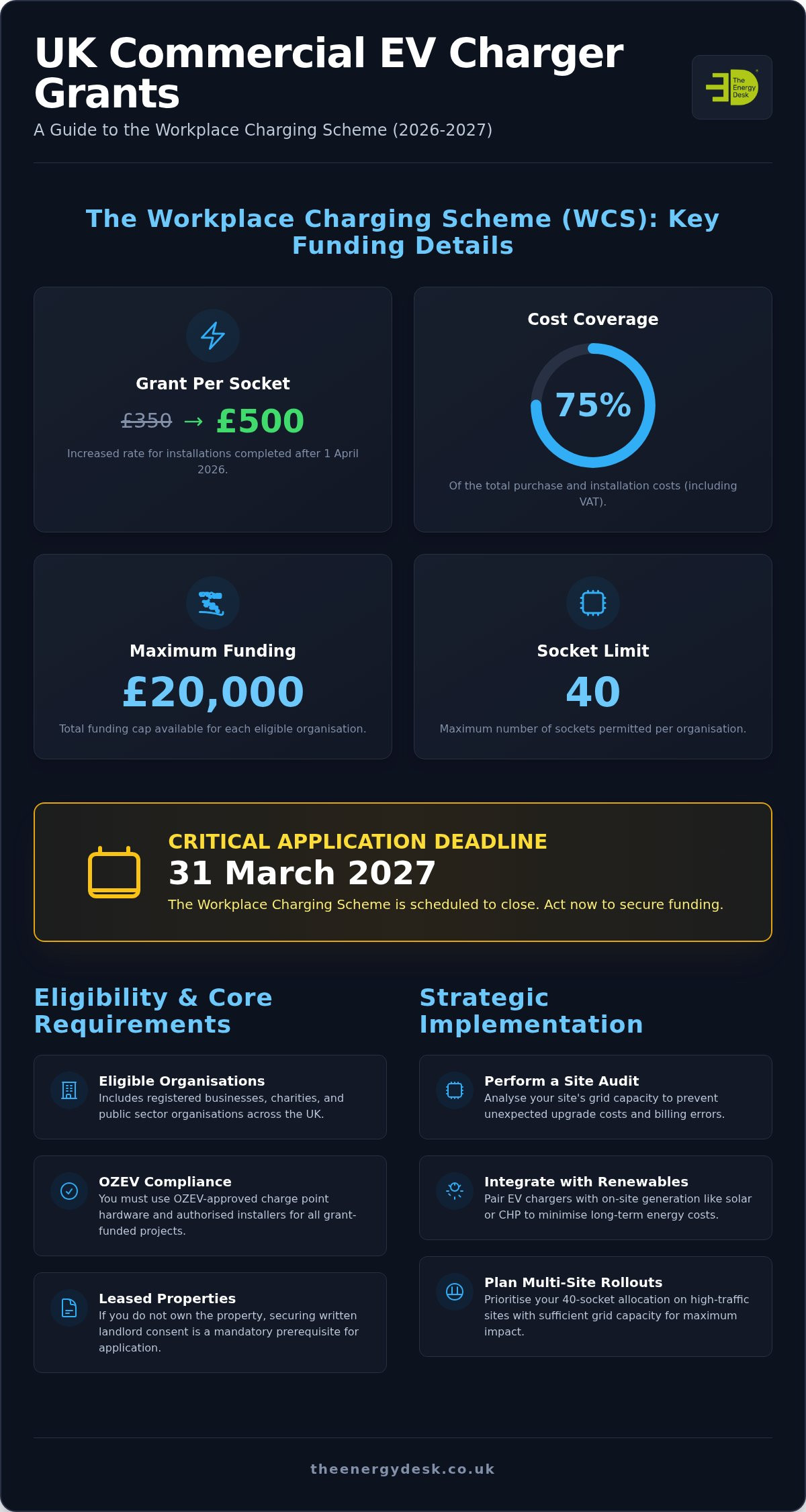
The Office for Zero Emission Vehicles (OZEV) remains the primary architect of the UK’s transition to electric transport. In 2026, the funding landscape has shifted significantly. Whilst some targeted schemes for SMEs and landlords closed in March, the government has consolidated its focus on the Workplace Charging Scheme (WCS). This strategic pivot includes a substantial increase in financial support for those who act quickly. For installations completed after April 1, 2026, the grant rate rose from £350 to £500 per socket. This change directly impacts the viability of commercial EV charger installation grants UK, making the current financial year the most lucrative period for infrastructure investment to date.
Key Funding Bodies and Regulatory Frameworks
The Department for Transport (DfT) oversees the broader net-zero targets that drive these incentives. By streamlining the grant portfolio in 2026, OZEV has simplified the application process through the new “Find a Grant” digital service. Understanding the history of UK EV grants reveals a clear trend toward rewarding early adopters before subsidies eventually taper off. These grants don’t exist in isolation; they are a fundamental component of the business case for commercial renewable energy UK. By subsidising the initial hardware and installation, the government is encouraging firms to integrate electric transport into their wider energy strategy alongside other low-carbon technologies.
Corporate Decarbonisation and the 2026 Deadline
Strategic timing is essential for fiscal responsibility. Delaying your installation past the current cycle carries significant financial risk, as many of these schemes are currently scheduled to conclude in early 2027. The Workplace Charging Scheme is a voucher-based programme providing up to £20,000 in funding for eligible organisations, and it currently accepts applications until its scheduled closure on March 31, 2027. Beyond the immediate capital injection, these installations are becoming mandatory for robust ESG and carbon reporting. State-funded educational institutions can still access a specific grant, though this was reduced to £2,000 per socket in April 2026. Firms investigating commercial EV charger installation grants UK must also consider the closure of the SME infrastructure grant in March 2026, which leaves the WCS as the primary route for funding. Securing your allocation now ensures your infrastructure is funded by the government rather than your own capital reserves.
The Workplace Charging Scheme (WCS): Maximising Your Allocation
The Workplace Charging Scheme (WCS) is now the cornerstone of the UK’s fleet electrification strategy. It provides a voucher-based system that covers 75% of the total purchase and installation costs, capped at £500 per socket. This 2026 rate is a notable increase from the previous £350 limit, reflecting the government’s push to accelerate infrastructure growth before the March 2027 deadline. Eligibility is broad, encompassing registered businesses, charities, and public sector organisations. However, if your business operates from a leased property, securing written landlord consent is a mandatory prerequisite. This step ensures that the hardware installation aligns with your lease terms and building safety standards whilst protecting you from future disputes regarding property alterations.
Financial Caps and Multi-Site Strategy
Every organisation is entitled to a maximum of 40 sockets, which translates to a total funding ceiling of £20,000. For companies managing a national portfolio, this 40-socket limit requires a methodical approach to distribution. You shouldn’t simply spread your allocation thin across every site. It’s more effective to prioritise locations where the local grid can support rapid charging without expensive upgrades. Focusing your commercial EV charger installation grants UK on high-traffic hubs ensures that your fleet downtime is minimised and your investment is utilised effectively. When budgeting, ensure you account for the total project cost including VAT. Whilst the grant covers 75% of the gross cost, your business may still reclaim the VAT through standard accounting practices. A professional utility audit can clarify these financial nuances and help you select the most viable sites for immediate rollout.
Scotland-Specific Funding: Energy Saving Trust (EST)
Businesses operating in Scotland must navigate a slightly different landscape. The Energy Saving Trust (EST) provides additional support that often complements the Official UK government grants available elsewhere. In 2026, EST funding continues to focus on specific regional needs, such as supporting businesses in more remote areas where grid connection costs might be higher. It’s important to note that stacking grants, which involves using both OZEV and EST for the same individual socket, is typically prohibited. However, you can strategically use different funding bodies for separate sites or distinct phases of your rollout. Given that Scottish funding cycles often close early once the budget is exhausted, prompt application is essential to secure your share of the available commercial EV charger installation grants UK. Planning your submission well in advance of the March 2027 deadline will help you avoid the end-of-year rush that often leads to processing delays.
Infrastructure Requirements and Technical Eligibility
To successfully claim commercial EV charger installation grants UK, your project must adhere to rigid technical specifications. OZEV mandates the use of approved hardware and authorised installers. Failure to comply with these lists results in the immediate rejection of grant vouchers. Additionally, the installation site must have dedicated off-street parking that’s clearly associated with the business premises. Publicly accessible chargers on the street don’t qualify for the Workplace Charging Scheme. You must prove the parking is for staff or fleet use to maintain eligibility.
Smart charging functionality is now a legal requirement for all grant-funded units. Your chargers must be capable of data reporting and adjusting power draw in response to grid signals. This ensures your infrastructure supports rather than strains the local network. Understanding the commercial EV charger installation process involves more than just mounting units. It requires a comprehensive technical survey to confirm your site meets these regulatory benchmarks before any hardware is purchased.
Power Supply and Grid Connection Challenges
Most commercial buildings weren’t designed for the high simultaneous load of multiple EV chargers. Before applying for a grant, you must assess your existing building load against the projected demand of your fleet. If your current supply is insufficient, you may require a new utility connection or even a substation upgrade. This is where strategic business electricity procurement becomes vital. Managing these new loads effectively prevents peak-time surcharges and ensures your operational costs remain predictable as your fleet expands. We often find that a site’s capacity is the single biggest hurdle to maximising grant allocation.
Hardware Standards and Future-Proofing
Choosing between tethered and socketed units depends on your fleet’s specific needs. Tethered units offer convenience for dedicated fleet vehicles with permanent cables, whilst socketed units provide flexibility for staff and visitors who carry their own. Regardless of the physical interface, ensure your hardware uses the Open Charge Point Protocol (OCPP). This software standard allows you to switch network providers without replacing physical hardware, preventing vendor lock-in. Looking ahead, selecting hardware compatible with vehicle-to-grid (V2G) technology can turn your fleet into a strategic asset. This allows vehicles to discharge power back to the building during peak demand, further enhancing the financial return on your commercial EV charger installation grants UK investment.
Strategic Integration: Beyond Simple Grant Funding
Securing commercial EV charger installation grants UK provides the necessary capital for hardware, but the long-term operational success depends on your broader energy strategy. Treating EV infrastructure as an isolated asset often leads to inflated utility bills and grid capacity issues. A more effective approach involves integrating your charging network with your wider energy portfolio to ensure every kilowatt is utilised efficiently. This prevents your new infrastructure from becoming a financial burden during periods of peak demand.
Integrating a commercial solar PV installation allows you to charge your fleet using zero-carbon electricity generated on-site. This significantly reduces your reliance on volatile wholesale markets and lowers your total cost of ownership. For organisations with high heat and power demands, a CHP system installation for businesses provides a reliable base load of low-cost electricity that can support 24/7 charging requirements. These technologies work in tandem to create a resilient, self-sustaining energy ecosystem.
The Role of On-site Generation
By generating electricity at the point of use, you can mitigate the impact of peak-time triads and distribution charges. Battery storage systems further enhance this setup by capturing excess solar or CHP output during periods of low demand and releasing it when your fleet returns to base. Generating power on-site allows your business to bypass the costly grid capacity constraints that often prevent the installation of high-speed charging sockets. This proactive infrastructure management ensures your transition to electric transport doesn’t compromise your existing operational capacity or require expensive substation upgrades from the DNO.
Tariff Optimisation and Demand Side Response
Your choice of electricity contract must reflect the new load profile created by your EV charging network. Standard commercial tariffs often penalise the sudden spikes in demand associated with rapid charging. We recommend reviewing your MOP (Meter Operator) contracts to ensure you have access to accurate, half-hourly data. This transparency is essential for participating in Demand Side Response (DSR) schemes. By adjusting your charging schedule in response to grid signals, your business can actually generate revenue whilst providing essential balancing services to the National Grid.
Following any major infrastructure rollout, it’s common for metering errors to occur as new connections are registered. Our bill validation service identifies these discrepancies, ensuring you only pay for the energy you actually consume. This holistic oversight is central to The Energy Desk’s methodology, transforming a simple project funded by commercial EV charger installation grants UK into a strategic financial asset. To ensure your infrastructure is optimised for maximum return, speak with our utility management experts today.
Navigating the Application Process and Execution
Securing commercial EV charger installation grants UK requires a methodical approach that begins long before you access the digital application portal. Success depends on technical readiness and administrative precision. Following a structured roadmap ensures that your application is approved without delays and that your infrastructure is commissioned effectively. At The Energy Desk, we simplify this journey by managing the complex utility connections and project requirements on your behalf, allowing you to focus on your core operations.
Step 1: Conduct a professional energy audit. Before committing to hardware, you must determine your site’s current electrical capacity. An audit identifies whether your existing supply can support additional EV load or if a grid upgrade is necessary. Step 2: Secure OZEV-approved quotes and landlord permissions. You must use authorised installers and hardware from the government’s approved lists. If you lease your premises, obtaining formal written consent from your landlord is a mandatory requirement for the Workplace Charging Scheme. Step 3: Manage the online application. Use the “Find a Grant” service introduced in April 2026 to submit your request. Once approved, you’ll receive a voucher valid for six months. Step 4: Installation and redemption. Your authorised installer completes the work and redeems the voucher, which deducts the grant value directly from your final invoice.
Evidence Required for a Successful Claim
OZEV requires specific documentation to validate your eligibility. You’ll need your Company House registration number or VAT registration details to prove your status as a legitimate organisation. Proof of site ownership or a long-term lease agreement is also essential. One common reason for application rejection is failing to document the “need for charging” for your fleet or staff. You must provide a clear justification, such as a fleet transition plan or staff surveys, to demonstrate that the sockets will be utilised. Additionally, ensure your parking area is private and off-street, as public-facing or on-street installations will lead to an immediate rejection of your commercial EV charger installation grants UK claim.
Post-Installation Management
Your responsibilities don’t end once the hardware is in the ground. To remain compliant with grant terms, you must ensure the chargers are maintained in good working order. Monitoring energy consumption via DC/DA services is highly recommended. This provides the half-hourly data needed for accurate bill validation and helps you identify any anomalies in power draw. If your organisation reaches the 40-socket limit, you should begin planning your next phase of infrastructure. Whilst current grants may be exhausted, your initial 2026 rollout provides the data needed to justify further capital expenditure or to explore private financing options for a broader network expansion. Professional oversight ensures that your charging network remains a high-performing utility asset rather than a maintenance burden.
Securing Your Infrastructure for a Net-Zero Future
The 2026 landscape for commercial EV charger installation grants UK offers a distinct financial advantage for organisations that act before the March 2027 deadline. By leveraging the enhanced £500 per socket rate under the Workplace Charging Scheme, your business can significantly offset the capital expenditure of electrification. However, true operational efficiency requires moving beyond simple hardware installation. Integrating your charging network with on-site solar or CHP systems, whilst ensuring your utility contracts are optimised, is essential for protecting your margins against rising energy costs.
With over 20 years of energy consultancy expertise, The Energy Desk serves as an independent national brokerage specialising in complex industrial utility connections. We help you navigate the entire project lifecycle, from initial site capacity audits to post-installation bill validation. Don’t leave your grant allocation to chance or risk grid capacity issues that could stall your fleet transition. Request a free energy audit to start your EV infrastructure project and ensure your business is powered for the long term. Taking these proactive steps today will establish a resilient, cost-effective foundation for your corporate decarbonisation journey.
Frequently Asked Questions
Can I apply for the Workplace Charging Scheme if I rent my office?
Yes, tenants can apply for the Workplace Charging Scheme, provided they have written consent from the property owner. This permission is a mandatory requirement for the OZEV application process to ensure all hardware installations comply with lease agreements and building safety standards. If you occupy a shared commercial space, you must also confirm that the designated parking bays are for your exclusive use, as public-facing or on-street chargers aren’t eligible for funding.
What is the maximum amount my business can receive in 2026?
In 2026, the maximum funding available per organisation is £20,000. This is calculated based on the current rate of £500 per socket, with a total limit of 40 sockets across all your business sites. The grant covers up to 75% of the total purchase and installation costs, including VAT. To secure the full allocation of commercial EV charger installation grants UK, you must ensure all hardware is installed by an OZEV-authorised professional before the March 2027 deadline.
Does the grant cover the cost of upgrading my electricity supply?
No, the Workplace Charging Scheme doesn’t cover the costs associated with upgrading your grid connection or installing new substations. The funding is strictly allocated to the purchase and installation of the charging units themselves. If your site requires a more robust utility connection to support multiple rapid chargers, these costs must be managed independently. We recommend conducting a professional energy audit to determine your site capacity before proceeding with a grant application to avoid unexpected infrastructure expenses.
Is there a specific grant for installing chargers at state-funded schools?
Yes, state-funded educational institutions can access a dedicated grant, though the rate was reduced to £2,000 per socket as of April 1, 2026. This scheme is designed to help schools and colleges provide charging infrastructure for staff and fleet vehicles. Like the WCS, this funding is open until March 31, 2027. Applicants must use OZEV-approved installers and hardware to remain eligible, ensuring the equipment meets the necessary smart charging and data reporting standards.
Can I use the grant for horded or second-hand charging units?
No, the grant is exclusively for new, OZEV-approved equipment. Second-hand or refurbished charging units aren’t eligible for any government funding schemes in 2026. The hardware must be listed on the official approved list to ensure it meets current smart charging regulations and data security requirements. Using unapproved or used equipment will result in the immediate rejection of your claim, even if the installation is performed by an authorised contractor. Always verify hardware compatibility before making a purchase.
How long does the application process typically take for businesses?
The initial voucher application through the Find a Grant service is often processed within five working days. Once you receive your voucher, it remains valid for six months, providing a window for your authorised installer to complete the work. However, the total project timeline often depends on site readiness and hardware lead times. We suggest starting the process at least three months before you intend to go live to allow for technical surveys and any necessary landlord negotiations.
Are there different EV charger grants available in Scotland compared to England?
Yes, businesses in Scotland can access additional support through the Energy Saving Trust (EST). Whilst the core commercial EV charger installation grants UK apply nationally, EST often provides regional top-up funding or specific loans for Scottish organisations. You cannot typically stack these grants for the same individual socket, but you can use different schemes for separate phases of a rollout. It’s vital to check the current EST budget status, as Scottish funding cycles frequently close earlier than the national OZEV programmes.
What happens if my business exceeds the 40-socket limit?
If your infrastructure requirements exceed the 40-socket limit, you’ll be responsible for the full cost of any additional units. The government cap is firm at 40 sockets per organisation, not per site. For larger rollouts, we recommend prioritising your most high-traffic locations for grant funding first. Once your allocation is exhausted, you might consider private financing or integrating the remaining chargers with on-site generation like solar or CHP to reduce long-term operational costs without direct government subsidies.