
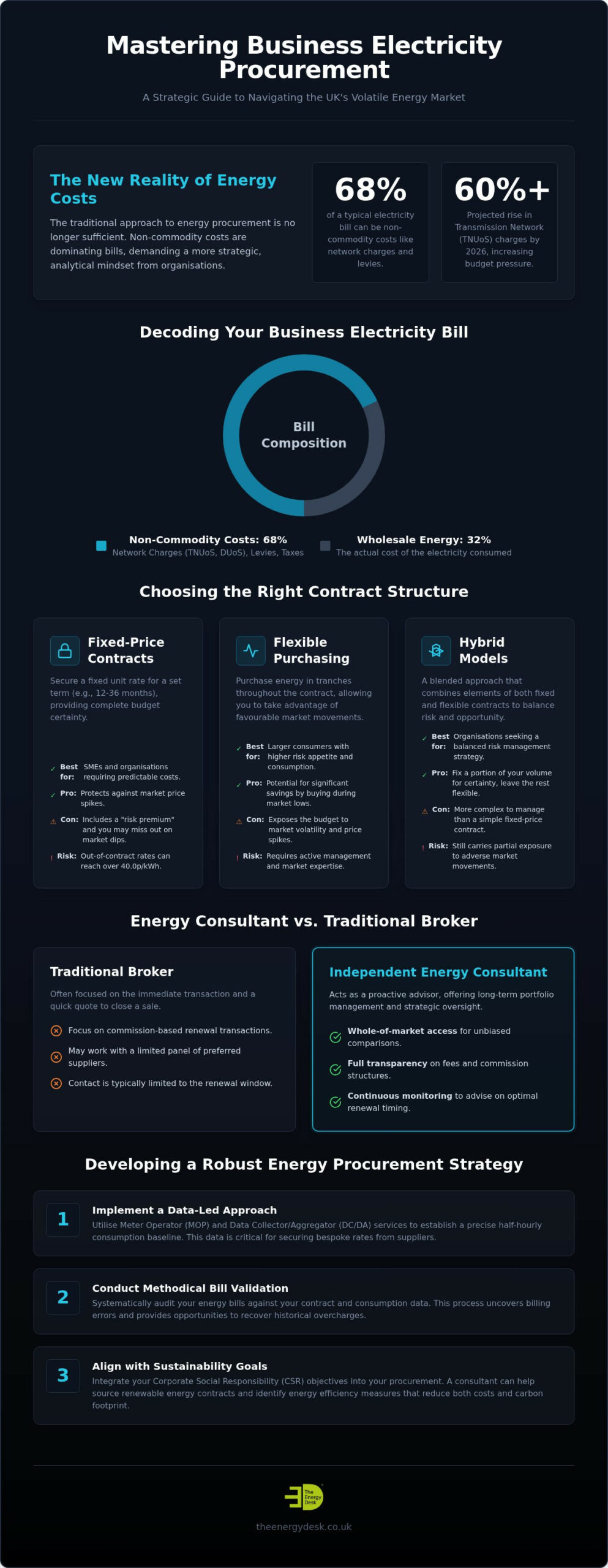
Did you know that non-commodity costs, including network charges and environmental levies, now account for up to 68% of a typical organisation’s power bill? With transmission network (TNUoS) charges rising by over 60% in April 2026, the traditional approach to business electricity procurement is no longer sufficient to protect your bottom line. Relying on simple year-on-year renewals often leaves firms exposed to volatile spot market prices and opaque broker commissions that eat into tight margins.
It’s understandable to feel frustrated by the lack of transparency in billing and the complexity of modern utility management. However, procurement shouldn’t be a one-off transaction; it’s a strategic management process that requires a disciplined, analytical mindset. This article will show you how to master these market complexities to secure competitive rates and ensure long-term price stability for your organisation.
We’ll explore how to achieve budget predictability for the 2026 fiscal year whilst aligning your energy strategy with corporate sustainability goals. By the end of this guide, you’ll understand how to identify hidden costs and leverage data-led insights to reduce your total energy expenditure effectively.
Key Takeaways
- Understand the fundamental difference between simple switching and strategic business electricity procurement to navigate the complex UK commercial market effectively.
- Evaluate fixed, flexible, and hybrid contract models to determine which structure best supports your organisation’s budget predictability and risk appetite.
- Identify the significant impact of non-commodity costs, such as TNUoS and DUoS, which now constitute over half of a typical commercial electricity bill.
- Implement a data-led strategy by utilising MOP and DC/DA services to establish a precise consumption baseline for long-term cost reduction.
- Discover how a methodical approach to bill validation and energy audits can recover overcharges and align your procurement with corporate sustainability goals.
What is Business Electricity Procurement in the Modern UK Market?
Effective business electricity procurement is the strategic process of sourcing energy supply contracts that align with an organisation’s operational needs and financial objectives. It’s far more than a simple price comparison. Unlike domestic energy switching, which is largely governed by price caps and standardised tariffs, commercial procurement requires a deep understanding of market volatility, technical consumption profiles, and risk management.
In the UK’s volatile market, energy shouldn’t be viewed as a static, fixed cost. Instead, treat it as a managed business overhead. The timing of your contract signature is often as important as the supplier you choose. Securing a competitive unit rate depends on identifying ‘dips’ in the wholesale market, which is heavily influenced by the UK’s energy market history and the shift towards a more fragmented, competitive landscape.
The Core Components of Commercial Energy Sourcing
Wholesale electricity prices are highly sensitive to global gas supply and geopolitical stability. For large organisations, volume-based pricing is essential. Suppliers offer bespoke rates based on your specific load profile; this is a detailed map of how and when you use power. If your operations peak during off-peak hours, you can leverage this data to secure lower rates that a standard broker might overlook.
Strategic risk mitigation also depends on contract length. While a 12-month contract offers flexibility, 24 or 36-month agreements provide long-term budget certainty. Choosing the right duration requires an analysis of current wholesale trends and future price forecasts to ensure you aren’t locked into high rates when the market softens.
The Role of an Energy Consultant vs. a Traditional Broker
Many businesses confuse traditional brokers with energy consultants, but their functions differ significantly. A broker often focuses on the immediate transaction, finding a quick quote to close a sale. In contrast, an independent energy consultant acts as a proactive advisor, offering long-term portfolio management and strategic oversight. Working with a consultant ensures that business electricity procurement is data-led rather than reactive.
A specialist consultant provides several key advantages:
- Whole-of-market access: Providing unbiased comparisons across all available suppliers rather than a limited panel.
- Transparency: Clearly defining commission structures or professional fee arrangements before any contract is signed, ensuring compliance with Ofgem’s evolving transparency standards.
- Continuous monitoring: Tracking market movements to advise on the optimal time to renew or switch, rather than waiting for a renewal window.
This consultative approach shifts the focus from a simple renewal to an ongoing optimisation strategy that protects your margins and supports fiscal responsibility.
Contract Structures: Fixed, Flexible, and Hybrid Models
Selecting the appropriate contract structure is a fundamental pillar of successful business electricity procurement. In the face of 2026 market volatility, where geopolitical tensions and infrastructure shifts continue to influence wholesale costs, organisations must choose between the security of a guaranteed price and the potential savings of market-linked purchasing. This decision often dictates whether an energy budget remains stable or fluctuates with global trends.
Fixed-Price Contracts: Stability for SMEs
Small and medium-sized enterprises (SMEs) typically favour fixed-price contracts for their unparalleled budget certainty. By locking in a unit rate for 12, 24, or 36 months, you protect your organisation’s margins from sudden wholesale price spikes. However, it’s essential to recognise that these contracts include a “risk premium.” Suppliers charge this additional margin to cover the potential cost of market increases during your term.
Timing remains critical in this model. If you miss your renewal window, you risk being moved to “out-of-contract” rates. As of July 2026, these rates reached as high as 40.0p per kWh for electricity, which can devastate a business’s operational budget. For more information on your rights during the renewal process, you can consult Ofgem’s advice for businesses.
Flexible Procurement: Strategies for Large Energy Users
For organisations with high consumption levels, fixed contracts can be unnecessarily restrictive. Flexible procurement allows businesses to buy energy in “tranches” or blocks throughout the year. This method enables you to “buy on the dips” in the wholesale market. For instance, when spot market wholesale electricity costs hovered around £98 per MWh in July 2026, flexible buyers could secure volume at more advantageous rates than those locked into older, higher-priced fixed deals.
Success in flexible purchasing relies on access to half-hourly data and a disciplined risk management framework. Without a clear strategy, your organisation could be exposed to price peaks that exceed your fiscal limits. This model requires constant oversight but offers the greatest potential for long-term cost reduction.
Hybrid models are also gaining traction, allowing businesses to fix a percentage of their core load whilst leaving the remainder open to market fluctuations. This provides a safety net of budget certainty alongside the opportunity to benefit from falling prices. If you are uncertain which model aligns with your operational goals, conducting a comprehensive energy audit is a logical first step to determine your risk appetite and consumption profile.
Decoding Your Bill: Non-Commodity Costs and Hidden Fees
Many organisations focus solely on the unit rate during business electricity procurement, yet the actual cost of power often accounts for less than 50% of the total invoice. In 2026, non-commodity costs-comprising network charges, environmental levies, and supplier margins-are expected to make up approximately 60-68% of a typical business electricity bill. These charges are often non-negotiable at the point of origin, but their impact on your bottom line can be managed through strategic consumption and forensic oversight.
Transmission Network Use of System (TNUoS) charges, which cover the cost of transporting electricity over the high-voltage network, saw a significant increase of over 60% in April 2026. Alongside this, Distribution Use of System (DUoS) charges vary based on your geographic location and the specific time of day you consume energy. Understanding these variables is crucial for accurate budgeting, as they represent a growing portion of your total expenditure.
Government-mandated levies also contribute to the complexity. For the 2026/27 period, effective from 1 April 2026, the main rate for the Climate Change Levy (CCL) is £0.00801 per kWh. Whilst these are statutory taxes, certain business types or those with specific energy-intensive processes may qualify for exemptions or reductions that are frequently overlooked by standard billing systems.
The Impact of Non-Commodity Costs on Your Bottom Line
Peak-time usage significantly influences transmission costs, particularly during Triad periods when the National Grid is under maximum stress. By shifting heavy operations away from these high-demand windows, you can lower your exposure to peak-level system charges. It’s also vital to verify your VAT status; whilst most businesses pay the standard 20%, some charities or low-use sites qualify for the 5% reduced rate. Without regular bill validation, these small errors can compound into significant financial losses over a multi-year contract.
Forensic Utility Bill Validation as a Recovery Tool
Bill validation is the methodical process of cross-referencing your signed energy contracts and actual meter data against supplier invoices to identify discrepancies. Historical audits frequently uncover thousands of pounds in past overcharges caused by incorrect tariff applications, duplicated standing charges, or reliance on estimated readings. The Energy Desk provides ongoing monitoring and cost control to catch these errors in real-time. This proactive approach ensures you only pay for the energy you’ve actually consumed at the rates you’ve legally agreed.
Developing a Robust Energy Procurement Strategy for 2026
A robust strategy begins with a comprehensive energy audit. Without a baseline, you cannot measure the efficacy of your business electricity procurement efforts. This audit should identify consumption patterns across multiple sites and highlight areas where energy is being wasted during non-operational hours. By establishing this foundation, you move from reactive purchasing to proactive portfolio management.
KPIs must be established to track both fiscal performance and carbon reduction. For the 2026 fiscal year, these targets should account for the rising Climate Change Levy (CCL), which increased to £0.00801 per kWh in April 2026. Aligning your procurement with broader corporate sustainability goals ensures that your energy strategy supports both the balance sheet and the environment.
The Importance of Metering and Data Accuracy
Accurate data collection is the cornerstone of modern procurement. Many organisations rely on supplier-provided data, but choosing your own Meter Operator (MOP) and Data Collection/Data Aggregation (DC/DA) agreements provides superior oversight. This independence allows for more precise half-hourly data analysis, which is essential for flexible purchasing.
Smart meters and DC/DA services help identify energy wastage before you enter contract negotiations. If your data shows significant base-load consumption during weekends or nights, addressing this inefficiency can lower your volume requirements. Reducing your total load profile makes your business more attractive to suppliers, often resulting in more competitive unit rate offers.
Integrating Renewables into Your Procurement Mix
Procurement is now a primary tool for decarbonisation. Securing REGO-backed (Renewable Energy Guarantees of Origin) tariffs allows your organisation to report zero-carbon electricity usage for Scope 2 emissions. Whilst these tariffs sometimes carry a small premium, they are essential for meeting Environmental, Social, and Governance (ESG) targets.
Beyond the grid, your strategy should consider onsite generation. Technologies like Solar PV and Combined Heat and Power (CHP) systems reduce grid reliance and provide a hedge against future price spikes. Integrating EV charging infrastructure into your electricity strategy also allows you to manage the additional load efficiently. To start building your data-led strategy, you can request a free energy audit to identify immediate cost-saving opportunities.
Optimising Your Energy Portfolio with The Energy Desk
The Energy Desk acts as a strategic ally for UK organisations, moving beyond the limitations of traditional brokerage to provide comprehensive utility management. Successful business electricity procurement requires a partner that understands the long-term operational impact of every energy decision. Our independent consultancy, founded in 2003, combines technical expertise with a methodical approach to ensure your portfolio remains optimised against market shifts.
A zero-risk entry point for any organisation is our free energy audit. This process establishes a clear consumption baseline and identifies immediate opportunities for cost recovery and efficiency. By integrating procurement with forensic bill validation and infrastructure projects, such as Solar PV or EV solutions, we create a unified strategy that supports both fiscal responsibility and decarbonisation targets. For firms looking to extend these efficiencies to their transport costs, Fleetmaxx Solutions offers comprehensive fleet management services. It’s time to move from reactive buying to a proactive management model that protects your bottom line.
Why a Managed Service Beats a Simple Brokerage
Traditional brokers often disappear once a contract is signed, leaving businesses to handle complex billing issues or supplier disputes alone. In contrast, a managed service provides ongoing support throughout the entire lifecycle of the agreement. We actively manage supplier queries and facilitate new utility connections, ensuring that technical hurdles don’t disrupt your core operations.
Our proactive oversight ensures your business never defaults to expensive out-of-contract rates. We monitor the market continuously, identifying the most advantageous windows for renewal. This disciplined management means your business electricity procurement isn’t just a transaction; it’s a continuous cycle of optimisation and risk mitigation. We handle the technical complexities so your team can focus on operational success.
Next Steps: Securing Your 2026 Energy Future
Effective energy management requires foresight rather than last-minute decisions. We recommend engaging with the market at least 12 months before your current contract expires. This early engagement allows you to track wholesale trends and secure rates when the market dips, rather than being forced to sign during a period of peak volatility. Engagement at this stage is critical for securing budget predictability for the 2026 fiscal year.
Start by reviewing your current contract end dates and gathering your consumption data. A proactive shift in how you manage your utilities will provide the stability needed to navigate the evolving UK energy landscape. Don’t wait for a renewal notice to arrive before considering your options.
Request your free, no-obligation energy audit from The Energy Desk today and take control of your organisation’s energy future.
Securing Your Organisation’s Energy Future
Transitioning from reactive to proactive management is essential for long-term stability in the UK commercial market. We’ve explored how understanding contract structures and decoding non-commodity costs provides a competitive edge. Effective business electricity procurement now requires a data-led approach, utilising MOP contracts and DC/DA services to gain full visibility over consumption patterns. This precision allows you to identify wastage and negotiate from a position of strength.
With over 20 years of industry expertise, The Energy Desk serves as a trusted advisor, offering independent whole-of-market access to ensure unbiased results. Our specialists in bill validation and recovery help reclaim historical overcharges whilst aligning your utility strategy with 2026 fiscal goals. By integrating these forensic audits with renewable solutions, you can achieve both significant cost reduction and meaningful progress toward carbon neutrality. It’s an opportunity to transform a standard overhead into a managed strategic asset.
Contact our expert team for a free energy audit and bespoke procurement strategy to start optimising your portfolio today. Taking control of your utilities now ensures your organisation remains resilient against future market volatility.
Frequently Asked Questions
How far in advance should I start the business electricity procurement process?
You should ideally begin the business electricity procurement process 6 to 12 months before your current agreement expires. Engaging the market early allows you to monitor wholesale price fluctuations and secure a new rate during a market dip. This proactive approach prevents the need for rushed decisions during periods of high volatility, ensuring you maintain budget stability for the upcoming fiscal year.
Is it better to choose a fixed or flexible electricity contract in 2026?
The choice depends on your organisation’s size and risk appetite. Fixed contracts provide absolute price certainty, which is often preferable for SMEs with strict budgeting requirements. Flexible contracts allow larger energy users to buy in tranches, potentially capitalising on lower spot market prices. Given the market volatility seen in early 2026, many organisations are opting for hybrid models to balance security with market opportunity.
What are out-of-contract energy rates and how can I avoid them?
Out-of-contract rates are significantly higher prices charged by suppliers when a fixed-term agreement ends without a new contract in place. In July 2026, these rates reached approximately 40.0p per kWh for electricity. You can avoid these costs by maintaining an accurate contract diary and ensuring your renewal or switch is finalised at least 30 days before your current term concludes.
Can a broker really get better electricity rates than I can directly?
How does half-hourly data collection (DC/DA) affect my electricity costs?
Half-hourly data collection provides a granular view of your consumption, which is essential for accurate billing and flexible procurement. By utilising DC/DA services, you can identify specific periods of high demand and shift operations to cheaper, off-peak windows. This data also allows consultants to build a more accurate risk profile, often resulting in lower risk premiums from suppliers during the tendering process.
What is the Climate Change Levy (CCL) and does my business have to pay it?
The Climate Change Levy is a government tax on commercial energy use designed to encourage energy efficiency. For the 2026/27 period, the rate is set at £0.00801 per kWh for electricity. Most businesses must pay this levy, though exemptions or reductions are available for charities, low-use sites, and businesses with Climate Change Agreements (CCAs). Bill validation services can confirm if your organisation is eligible for these savings.
What information do I need to provide for a business electricity quote?
To receive an accurate quote, you must provide a recent copy of your energy bill, your contract end date, and your annual consumption data. Crucially, you’ll need your MPAN (Meter Point Administration Number). This allows consultants to pull your technical load profile from the national database, ensuring that the quotes provided by suppliers are bespoke to your organisation’s specific usage patterns and peak-time requirements.
Can I switch electricity suppliers if I am currently in a contract?
You can secure a new contract for a future start date whilst in your current term, but you cannot physically switch suppliers until your existing agreement ends. Most commercial contracts are legally binding for the full duration. However, engaging with a consultant early allows you to “lock in” future rates up to a year in advance, protecting your business from price rises that may occur before your current contract expires.