

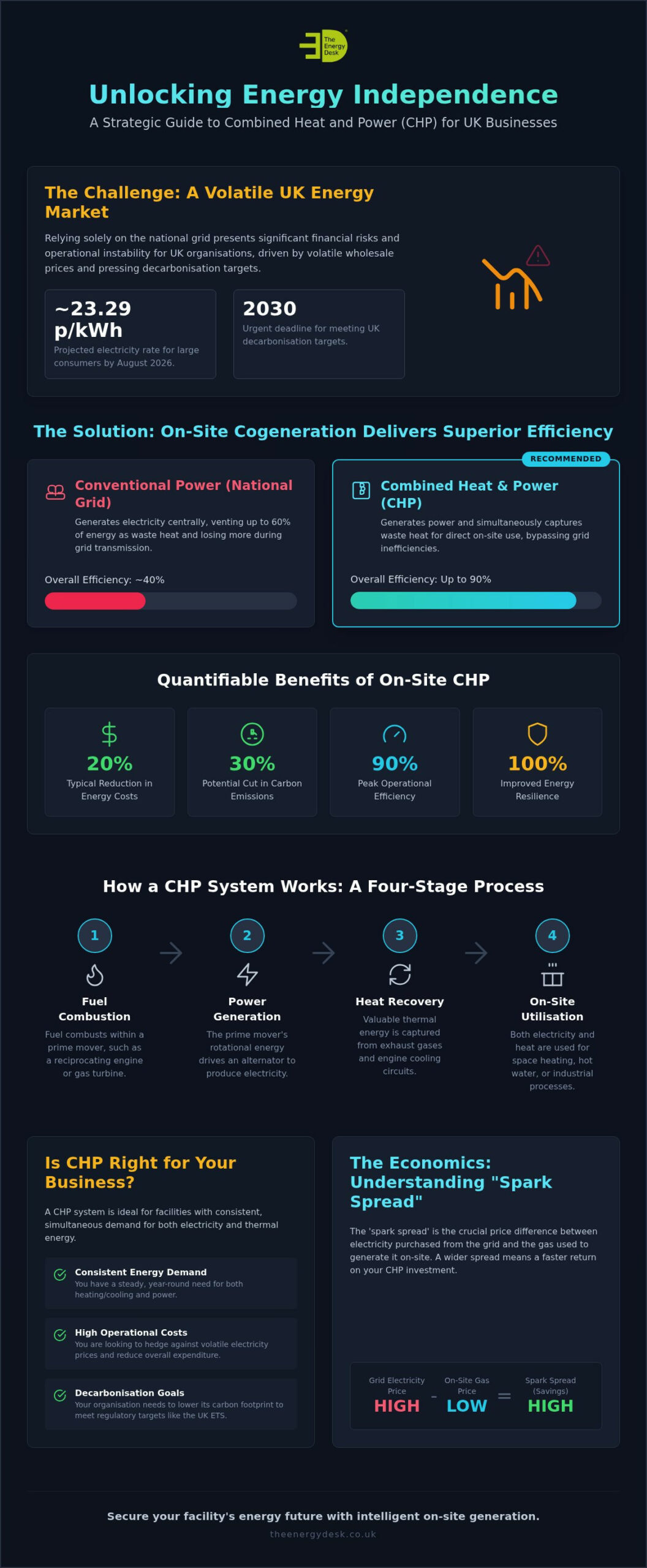
With UK business electricity rates for large consumers reaching approximately 23.29 p/kWh in August 2026, relying solely on the national grid has become a significant financial risk. You’re likely facing the dual pressure of volatile wholesale markets and the urgent need to meet 2030 decarbonisation targets. A strategic CHP system installation for businesses provides a methodical solution to these challenges by generating power and heat simultaneously on-site.
We understand that managing high thermal energy requirements whilst keeping operational expenditure under control is a complex task for any leader. This guide demonstrates how cogeneration can reduce your organisation’s energy costs by 20% and lower carbon emissions by 30% through superior onsite efficiency. We will explore the 2026 regulatory landscape, including the latest CHPQA standards and updated Climate Change Levy rates, to provide a clear roadmap for improving your grid resilience. You’ll gain a comprehensive understanding of how to secure your facility’s energy future whilst maintaining strict fiscal responsibility and long-term operational stability.
Key Takeaways
- Discover how capturing waste heat allows cogeneration systems to reach efficiency levels of up to 90% compared to the 40% average of the national grid.
- Learn why a CHP system installation for businesses serves as a critical financial hedge against the ongoing volatility of the UK wholesale electricity market.
- Understand the “spark spread” and how the price difference between gas and electricity dictates the speed of your return on investment.
- Evaluate your facility’s suitability by identifying consistent thermal and electrical base loads that justify the transition to on-site power generation.
- Gain insights into the end-to-end procurement process, from the initial viability audit to the strategic management of your utility infrastructure.
What is a CHP System and Why is it Essential for UK Industry?
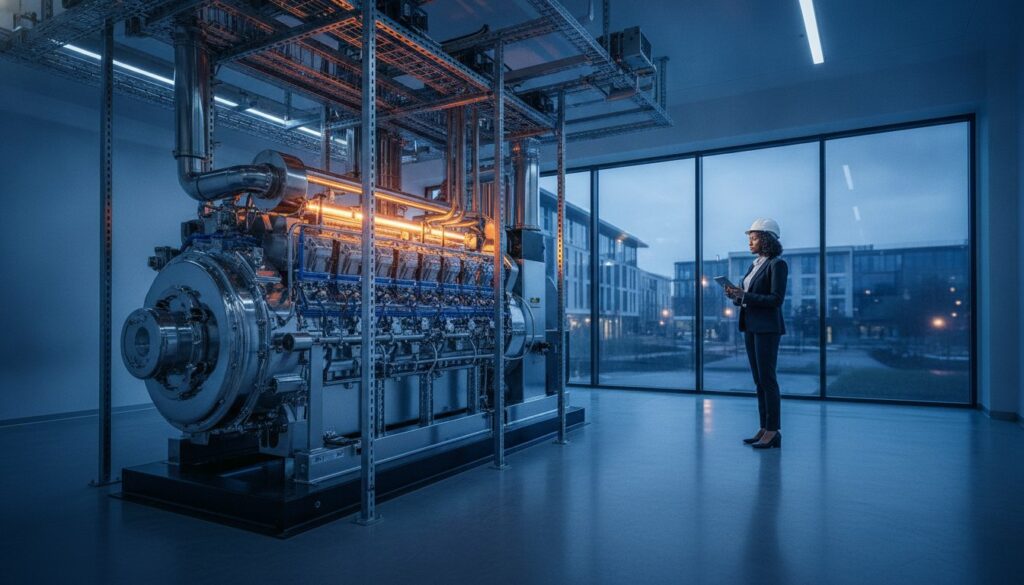
Combined Heat and Power (CHP), frequently termed cogeneration, represents a highly efficient method of energy production that generates electricity and thermal energy simultaneously from a single fuel source. Unlike conventional power plants that treat heat as a waste product, a CHP unit captures this thermal energy for use in space heating, hot water, or steam for industrial processes. This Cogeneration technology explained in technical detail demonstrates how capturing what would otherwise be lost energy transforms the efficiency profile of a facility. For many organisations, a CHP system installation for businesses serves as a localised power station that operates directly where the energy is required.
Traditional centralised power generation in the UK is inherently inefficient. Large power stations often vent up to 60% of their energy into the atmosphere through cooling towers; additional losses occur as electricity travels through miles of transmission lines. By generating power onsite, businesses bypass these systemic inefficiencies. As wholesale electricity prices for Winter 2026 delivery sit around 12.5 p/kWh, the ability to extract maximum value from every unit of fuel is no longer just an environmental goal. It is a financial necessity for maintaining competitive operational margins.
The Evolution of Cogeneration in the UK
The UK market has seen a significant shift from massive, bespoke industrial installations to modular, “packaged” CHP units. These compact systems allow smaller commercial entities and SMEs to access the same efficiency benefits previously reserved for heavy industry. Modern infrastructure is also evolving to meet 2026 sustainability standards. Many newer units are designed to be hydrogen-ready, allowing a seamless transition from natural gas to low-carbon fuels as they become more widely available in the UK’s decentralised energy networks.
Key Benefits for Commercial and Industrial Users
A CHP system installation for businesses provides a robust hedge against energy market volatility and grid instability. By producing power onsite, facilities gain a layer of protection against potential brownouts and grid fluctuations that can disrupt sensitive industrial processes. The strategic advantage extends to decarbonisation. Because these systems use less primary fuel to meet total energy demand, they can reduce an organisation’s carbon footprint by up to 30%. This efficiency is vital for businesses navigating the UK Emissions Trading Scheme and the increasing costs associated with carbon output.
How CHP Systems Work: The Engineering Behind the Efficiency
Modern cogeneration units operate through a methodical four-stage process that maximises the utility of every unit of fuel. The cycle begins with fuel combustion within a prime mover, which then drives an alternator to facilitate power generation. Simultaneously, heat recovery systems capture thermal energy from exhaust gases and cooling circuits, which is then distributed for onsite heating or industrial processes. This integrated approach allows a CHP system installation for businesses to reach total efficiencies of 80% to 90%. In contrast, the UK national grid typically operates at around 40% efficiency because the thermal energy produced at centralised power stations is vented into the atmosphere as waste.
Reciprocating Engines vs. Gas Turbines
A prime mover is the mechanical component, such as a reciprocating engine or a gas turbine, that converts fuel into rotational energy to drive an electrical generator. Choosing between these technologies depends on your site’s specific load profile and thermal demand. Reciprocating engines are often favoured for smaller to medium-scale operations because of their high electrical efficiency and ability to handle frequent start-stop cycles. Gas turbines are better suited for large-scale industrial sites with high, constant steam requirements. Modern hardware is built for longevity, with reciprocating engines often providing a reliable lifespan of 15 to 20 years when supported by a structured maintenance regime.
Heat Recovery and Utilisation
The true value of cogeneration lies in capturing thermal energy from exhaust gases and engine cooling jackets. This recovered heat can be deployed as steam or hot water for complex industrial processes. Some advanced configurations use absorption chillers to convert heat into cooling, effectively transforming the system into Combined Cooling, Heat, and Power (CCHP), or trigeneration. This versatility ensures that energy isn’t just produced but is strategically optimised for every operational requirement. According to UK government guidance on CHP, these systems are essential for businesses looking to reduce carbon emissions by up to 30% through onsite efficiency.
Seamless integration with existing Building Management Systems (BMS) allows for real-time monitoring and automated load balancing. This oversight ensures the CHP unit responds dynamically to fluctuations in demand, maintaining peak performance whilst reducing reliance on the grid. If you’re unsure which technology aligns with your current infrastructure, you might consider a professional energy audit to evaluate your specific thermal-to-power requirements and potential savings.
The Economics of CHP: Calculating ROI and the “Spark Spread”
Transitioning from the technical engineering of cogeneration to its financial performance requires a deep understanding of the “spark spread.” This metric defines the gross margin between the cost of the fuel used for generation and the value of the electricity produced onsite. As of August 2026, average business electricity rates for large consumers are approximately 23.29 p/kWh, whilst industrial gas prices range between 6.5 p/kWh and 9.0 p/kWh. This significant price differential creates a favourable economic environment for onsite generation, allowing businesses to bypass the high retail costs and associated levies of grid-supplied power.
A CHP system installation for businesses acts as a strategic financial hedge against the inherent volatility of the UK wholesale market. Beyond the immediate reduction in unit costs, cogeneration offers “hidden” savings by eliminating distribution losses and reducing exposure to network charges. By generating power at the point of use, your organisation avoids the transmission costs that typically inflate a standard utility bill. These operational savings, combined with the capture of “free” thermal energy, often result in a reduction of total energy expenditure by 20% compared to traditional boiler and grid configurations.
The Spark Spread Explained for Finance Directors
The financial viability of a CHP system installation for businesses is primarily dictated by the spark spread, as a wider margin between the price of gas and electricity ensures a faster recovery of capital expenditure. When the cost of grid electricity rises relative to natural gas, the ROI for a CHP project accelerates. Finance teams must monitor these fuel prices to optimise run-times, ensuring the unit operates during peak tariff periods to maximise the displacement of expensive grid power. This methodical approach transforms energy from a variable overhead into a controlled, predictable asset. Since the system’s economics are so closely tied to your fuel costs, a robust business gas procurement strategy is essential to maintaining a healthy spark spread throughout the project’s lifetime.
Available Incentives and Funding in 2026
Strategic fiscal management of a CHP project involves leveraging current UK government incentives to improve the bottom line. The Combined Heat and Power Quality Assurance (CHPQA) programme remains a cornerstone of this strategy. According to UK Government Guidance on Combined Heat and Power, certified “Good Quality” schemes can access significant tax benefits. For the 2026/27 period, these include potential exemptions or reduced rates for the Climate Change Levy (CCL), which currently sits at £0.00801 per kWh for both electricity and gas. Organisations can also explore financed solutions such as Power Purchase Agreements (PPAs), which allow for infrastructure upgrades with minimal initial capital outlay, shifting the project from a CAPEX-heavy investment to an OPEX-based model.
Is Your Business Suitable for a CHP System Installation?
Determining the viability of a CHP system installation for businesses requires a methodical assessment of your facility’s energy profile. The primary driver of return on investment is the “base load,” which refers to the minimum level of electricity and heat your site consumes consistently throughout the year. Because cogeneration units are most efficient when running continuously, a site with sporadic energy use or low overnight demand may struggle to justify the capital expenditure. Ideally, your facility should require at least 4,000 to 6,000 hours of operation annually to maximise the displacement of expensive grid electricity.
Thermal-to-power ratios are equally critical. You must ensure that your site can utilise the heat produced as a by-product of electricity generation. If the heat cannot be used for space heating, hot water, or steam, the system’s efficiency drops, and the economic benefits diminish. Beyond energy metrics, physical constraints such as plant room space, ventilation requirements, and noise attenuation must be considered. Planning permission and grid connection capacity (specifically G99 or G100 applications) are also vital hurdles that require expert oversight before hardware procurement begins.
Ideal Sectors for CHP Implementation
Certain industries are naturally suited to cogeneration due to their high, consistent thermal requirements. Manufacturing and food processing plants often require constant steam or hot water for production lines, making them ideal candidates. Hospitals, leisure centres, and large hotels also benefit significantly from 24/7 heat demand. Additionally, large-scale commercial offices and data centres utilise CHP for resilience, often integrating the system with absorption chillers to provide cooling for server rooms whilst generating onsite power.
In the healthcare sector, operational efficiency allows for a greater focus on patient outcomes. To explore private clinical services in the North West, you can discover Dr Nancy Allen for specialist ADHD assessments and menopause support.
Five Steps to Assessing Your Site
Before committing to a CHP system installation for businesses, a structured feasibility study is essential to mitigate risk. Follow these steps to evaluate your site:
- Step 1: Analyse 12-24 months of half-hourly energy data to identify your true base load.
- Step 2: Map out thermal requirements across different seasons to ensure heat utilisation remains high during summer months.
- Step 3: Evaluate existing boiler and electrical infrastructure to determine how the CHP unit will integrate with current systems.
- Step 4: Conduct a formal feasibility study that includes an assessment of grid connection capacity and local planning constraints.
- Step 5: Review long-term energy procurement contracts to ensure a CHP installation aligns with your strategic business gas procurement approach and gas supply strategy.
The success of an onsite generation project depends on precision at the audit stage. To ensure your facility meets the technical and financial criteria for cogeneration, request a free energy audit from our consultancy team today.
Navigating CHP Procurement and Installation with The Energy Desk
The transition to onsite generation is a multi-layered undertaking that requires specialised oversight to ensure long-term viability. The Energy Desk provides a consultative partnership that extends far beyond simple hardware selection. We take a holistic view of your energy profile, ensuring that a CHP system installation for businesses isn’t just an isolated asset but a core component of a broader utility management strategy. Independent consultancy is essential in this market. Because we aren’t tied to any specific manufacturer, we prioritise the hardware that best matches your site’s thermal-to-power ratio and operational requirements.
Integrating cogeneration into your wider procurement strategy is where the most significant fiscal gains are found. Since the system relies on gas to generate electricity, your gas procurement contract must be optimised to maintain a healthy spark spread. Our team manages this synergy, ensuring your fuel supply and onsite generation work in tandem to lower your corporate carbon footprint. We also provide ongoing oversight through bill validation and data monitoring. This prevents billing errors and ensures that the projected 20% cost savings are actually reflected in your bottom line. Organisations seeking to maximise these savings should also implement a robust programme of commercial utility bill validation to identify hidden billing errors and recover any historic overpayments across their energy portfolio.
Our End-to-End Project Management Process
We handle the technical complexities of utility connections and MOP contracts to ensure your installation meets all regulatory requirements. Our specialists manage the entire project lifecycle, from initial grid applications to final commissioning. We also ensure your CHP system is optimised for current market gas rates, which is vital for maintaining the economic viability of the project. Once the unit is operational, we continue to monitor performance data, providing bill validation services to ensure your utility providers are charging you correctly for both imported and exported power.
Take the First Step: Request a Free Energy Audit
A professional Energy Desk audit provides the clarity needed to make an informed investment decision. During this process, we analyse your half-hourly data to identify “quick wins” such as energy efficiency measures that can be implemented immediately. We then provide a detailed feasibility report that outlines the long-term benefits of a CHP system installation for businesses. This methodical approach removes the guesswork from infrastructure planning and provides a clear roadmap for achieving your 2030 decarbonisation targets.
Contact our specialist team on 03330 151 221 to organise your free energy audit and start your transition to onsite energy security.
Securing Your Organisation’s Energy Future for 2026 and Beyond
Cogeneration is no longer just an alternative energy source; it’s a strategic necessity for businesses navigating the volatile UK utility market. By capturing waste heat and producing electricity onsite, your organisation can achieve significant efficiency gains whilst insulating itself from unpredictable grid price hikes. A CHP system installation for businesses provides a dual-benefit solution that addresses both fiscal responsibility and 2030 decarbonisation targets.
With over 20 years of UK energy consultancy expertise, The Energy Desk offers independent advice on all major hardware providers. We provide full project management from the initial procurement phase through to the final utility connection. Our methodical approach ensures that your infrastructure is optimised for long-term performance and maximum ROI. Request your free Energy Audit and CHP feasibility study today to determine the potential savings for your facility. Taking control of your onsite generation ensures a more resilient and cost-effective operation for the years ahead.
Frequently Asked Questions
What is the typical lifespan of a commercial CHP system?
A commercial CHP system typically has an operational lifespan of 15 to 20 years, provided it’s maintained through a structured service regime. This longevity is achieved through major overhauls at specific running hour intervals, often every 30,000 to 40,000 hours. Investing in high-quality hardware ensures that the system remains a reliable onsite asset throughout its life cycle, supporting long-term fiscal planning and energy security for your facility.
Can a CHP system run on renewable fuels like biomethane or hydrogen?
Modern cogeneration units are increasingly versatile and can operate on renewable fuels such as biomethane or hydrogen blends. Many 2026-specification units are manufactured to be “hydrogen-ready,” allowing businesses to transition away from natural gas as low-carbon fuel infrastructure develops across the UK. This adaptability ensures that a CHP system installation for businesses remains a future-proof investment that aligns with long-term corporate sustainability strategies and evolving environmental regulations.
How much space does a packaged CHP unit require?
The physical footprint of a packaged CHP unit varies based on its electrical output, but most systems are designed for space efficiency. A typical small-scale unit might occupy the space of a standard parking bay, whilst larger industrial systems are often housed in acoustic-lined, weather-proof containers located externally. These modular designs simplify the installation process and reduce the need for extensive internal plant room modifications, making them suitable for sites with limited internal capacity.
Is CHP still a viable option with the UK’s Net Zero targets?
CHP remains a vital component of the UK’s Net Zero transition because it significantly reduces primary energy consumption compared to separate grid and boiler use. By achieving efficiencies of up to 90%, it bridges the gap whilst the national grid continues to decarbonise. As units become compatible with green hydrogen and biomethane, they transition from low-carbon to zero-carbon assets, providing the high-grade heat that many industrial processes cannot yet achieve through electrification.
What happens to the CHP system if our energy demand changes?
If your organisation’s energy demand fluctuates, modern CHP systems can modulate their output to maintain efficiency. Most units are designed to “load follow,” adjusting electrical and thermal production within a specific range, typically down to 50% of their rated capacity. For sites anticipating significant expansion, a modular approach is often recommended. This allows for the addition of further units in parallel, ensuring the infrastructure scales alongside your operational requirements without compromising ROI.
How does CHP integration affect my existing commercial gas contract?
Integrating a CHP unit will significantly increase your onsite gas consumption whilst drastically reducing your electricity import. This shift requires a strategic review of your commercial gas procurement to ensure your volume tolerances and unit rates reflect the new usage profile. It’s essential to align your fuel supply with your generation schedule to maintain a healthy spark spread. Our team manages this transition to ensure your procurement strategy supports the system’s economic performance.
Can I sell excess electricity generated by my CHP back to the grid?
Businesses can sell surplus electricity back to the national grid, provided they have the necessary G99 grid connection agreements in place. Revenue can be generated through the Smart Export Guarantee (SEG) or via a bespoke Power Purchase Agreement (PPA) with an energy supplier. Whilst the primary financial benefit comes from displacing expensive imported power, exporting excess generation provides an additional revenue stream that can further shorten the project’s payback period.
What is the difference between CHP and a standard backup generator?
The fundamental difference lies in their operational purpose and efficiency. A standard backup generator is designed for short-term emergency use and vents thermal energy as waste. In contrast, a CHP system installation for businesses is designed for continuous operation as a primary power source, capturing and repurposing heat for onsite use. Whilst a CHP unit provides resilience, its primary objective is daily cost reduction and carbon efficiency rather than just standby protection.