
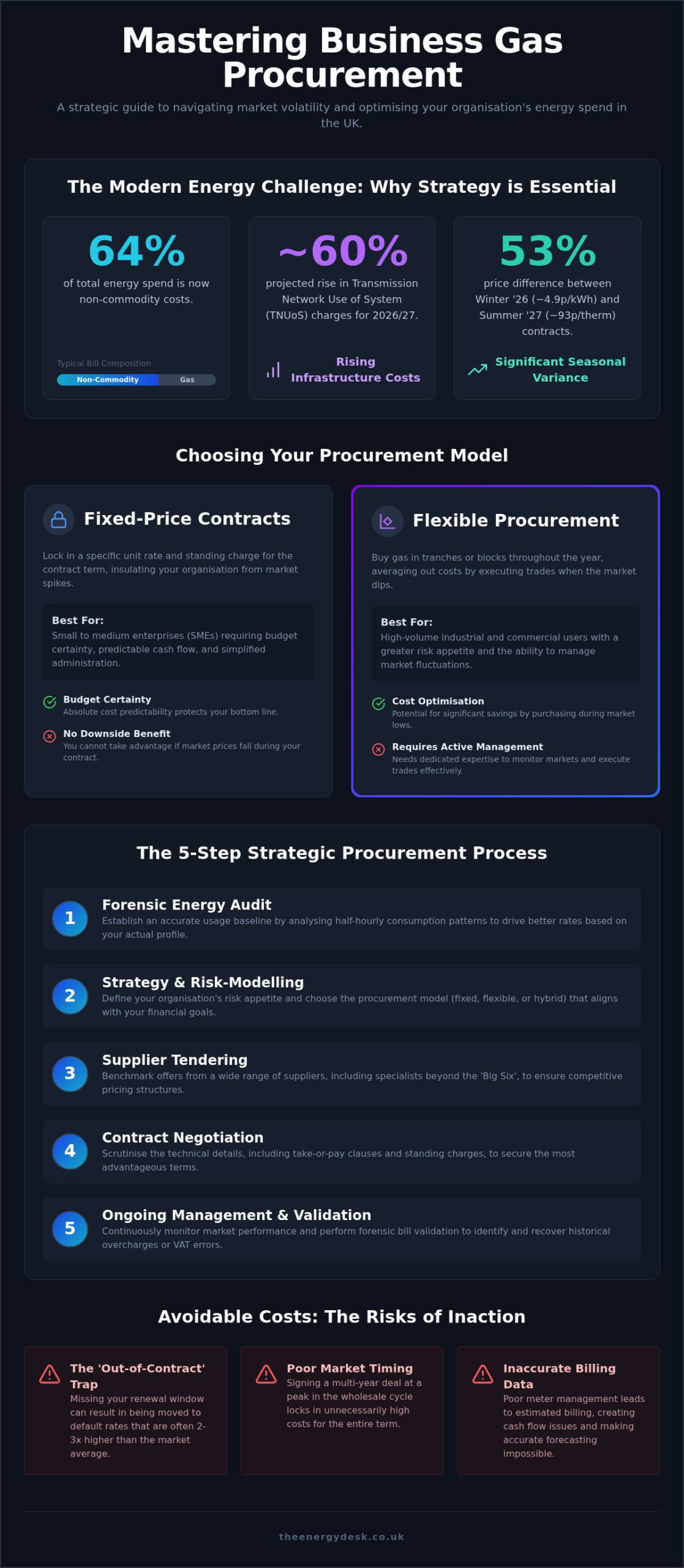
With Transmission Network Use of System (TNUoS) charges rising by approximately 60% for the 2026/27 period, the era of simply picking the cheapest unit rate is officially over. Many UK organisations are discovering that non-commodity costs now represent roughly 64% of their total energy spend, making traditional business gas procurement methods obsolete. You likely feel the pressure of unpredictable wholesale spikes and the lack of internal resource to unpick complex supplier contracts that hide escalating standing charges.
We understand that managing large-scale tenders whilst balancing corporate margins is a significant operational challenge. This guide provides the technical insight you need to master the UK wholesale market and build a robust procurement roadmap. We will examine how to secure lower rates, mitigate the impact of the £0.00801 per kWh Climate Change Levy, and integrate your gas strategy with broader sustainability goals for long-term fiscal stability. By moving from a transactional mindset to a strategic one, you can ensure your utility management remains a source of efficiency rather than a financial drain.
Key Takeaways
- Understand why a structured, data-driven approach to business gas procurement is essential for protecting corporate margins in a market without price caps.
- Evaluate the benefits of fixed-price security versus flexible procurement models to determine the best fit for your organisation’s risk appetite and consumption volume.
- Follow a proven five-step roadmap for securing optimal contracts, beginning with a forensic energy audit to establish an accurate usage baseline.
- Learn how to maximise ROI by pairing strategic acquisition with forensic bill validation to identify and recover historical overcharges or VAT errors.
- Discover how integrating infrastructure upgrades, such as CHP systems, can further reduce long-term costs whilst aligning your procurement with sustainability goals.
Business Gas Procurement: Why Strategy is Essential
Effective business gas procurement is far more than a simple transactional purchase. It’s a structured, data-driven methodology designed to secure energy at the most advantageous terms whilst protecting your bottom line. Unlike the domestic market, where price caps offer a level of protection, the commercial sector operates without such safety nets. This means your organisation is exposed to the full force of market volatility, making a bespoke contract essential for managing risk. Commercial agreements are typically volume-based and involve complex pricing structures that differ significantly from household supply.
The UK wholesale market in 2026 remains highly sensitive to geopolitical shifts and infrastructure changes. Relying on a reactive renewal-only approach is no longer viable for corporate budgeting. Instead, businesses must adopt a proactive hedging strategy that treats energy as a managed commodity rather than a fixed overhead. Engaging an energy procurement consultant allows you to move away from guesswork and towards a continuous market-monitoring behaviour that identifies buying opportunities before prices spike.
The Core Components of a Procurement Strategy
A robust strategy begins with forensic volume analysis. By examining your half-hourly consumption patterns, you can drive better rates based on your actual usage profile rather than generic estimates. This data also informs supplier benchmarking. Whilst many businesses default to the “Big Six”, looking towards independent and specialist providers often reveals more competitive structures. Finally, you must navigate the technical small print of your contract. Take-or-pay clauses and standing charges can significantly impact your total spend. It’s also vital to account for the Climate Change Levy (CCL), which as of April 2026 stands at £0.00801 per kWh, as these non-commodity costs now form a major part of your bill.
The Financial Risks of Poor Procurement
Failing to manage your business gas procurement proactively leads to several avoidable costs. The most common is the “out-of-contract” trap. If you miss your renewal window, suppliers will move you onto default rates, which are often double or triple the market average. Market timing is equally critical. Signing a multi-year deal at a peak in the wholesale cycle can lock in high costs for years. Additionally, poor meter management leads to inaccurate data and estimated billing. This creates cash flow issues and makes it impossible to forecast your energy expenditure with any degree of precision. Strategic oversight ensures these gaps are closed before they impact your margins.
Fixed vs Flexible Gas Procurement: Which Model Suits Your Business?
Selecting the right contract structure is the most influential decision in your business gas procurement journey. In the current 2026 landscape, wholesale prices show significant seasonal variance, with Winter 2026 delivery reaching approximately 143 pence per therm (4.9p/kWh) whilst Summer 2027 rates sit lower at around 93 pence per therm. This disparity creates a complex environment where your choice of model directly impacts your ability to protect corporate margins against sudden market shifts.
Deep Dive into Fixed-Price Contracts
Fixed-price contracts provide absolute budget certainty by locking in a specific unit rate and standing charge for the duration of the term. This model is highly effective for small to medium enterprises that require predictable cash flow and simplified administration. By securing a rate early, you insulate your organisation from price spikes caused by geopolitical instability or supply chain disruptions. The trade-off is that you won’t benefit if market prices crash during your contract. Suppliers also typically include a risk premium in these rates to cover their own exposure to wholesale volatility. This model remains best for firms with a low tolerance for cost fluctuations.
The Mechanics of Flexible Procurement
Flexible procurement allows high-volume industrial users to buy gas in tranches or blocks throughout the year. Instead of locking in a price on a single day, you average out your costs by executing trades when the market dips. This approach requires a dedicated energy desk to monitor daily fluctuations and execute trades on your behalf. It’s a proactive methodology that mirrors large-scale governmental frameworks, such as the Energy-Wide Strategic Sourcing (EWSS) Program, which focuses on leveraging market intelligence to reduce long-term expenditure. This model is best suited for industrial sites and large multi-site portfolios with significant gas spend.
For many UK businesses, a hybrid approach offers the best of both worlds. You can hedge a significant portion of your anticipated load to ensure budget stability whilst leaving a percentage open to capture wholesale improvements. Choosing the correct model depends on your annual consumption, cash flow requirements, and tolerance for market exposure. If you’re struggling to identify which path suits your operational needs, The Energy Desk can perform a forensic audit of your usage patterns to guide your decision.
The 5-Step Strategic Gas Procurement Process
Executing a successful business gas procurement strategy requires a disciplined, multi-stage approach. It’s not a task that ends with a signature; it’s a continuous cycle of data analysis and market engagement. By following a methodical process, you can move away from reactive decision-making and towards a model that prioritises fiscal responsibility and long-term stability. This structured roadmap ensures every aspect of your energy acquisition is optimised for cost and efficiency.
- Step 1: The Energy Audit. Establishing a precise usage baseline begins with a forensic energy audit. This involves examining historical bills and consumption data to identify immediate inefficiencies and establish a clear starting point for future tenders.
- Step 2: Strategy Development. Once the data is clear, your contract length and type must align with your business growth plans. This ensures your energy commitments support operational flexibility whilst maintaining budget control.
- Step 3: Market Tendering. Managing a competitive bid process across a national panel of suppliers is essential. This creates a high-pressure environment that forces suppliers to offer their most aggressive pricing to win your business.
- Step 4: Negotiation and Analysis. Expert analysis is required to decode complex offers and find the true bottom line cost. You must strip away the marketing jargon to reveal the actual impact on your corporate margins.
- Step 5: Implementation and Monitoring. After securing the deal, ensure a smooth transfer between providers. Continuous monitoring and forensic bill validation protect you from supplier billing errors throughout the contract term.
Mastering the Tender Phase
Structuring a tender correctly is vital to attract competitive bids from a broad panel of providers. You must provide accurate, granular consumption data to reduce the risk premiums that suppliers often add to uncertain usage profiles. Supplier credit scores are another critical factor in your decision. Choosing a financially unstable provider can lead to significant operational disruption if they fail. Always remember that the cheapest unit rate rarely translates to the lowest total cost of ownership. High standing charges or punitive take-or-pay clauses can quickly erode any perceived savings found in the unit price.
Post-Contract Management and Governance
Governance doesn’t end when the contract is signed. Setting up automated renewal alerts is the only reliable way to avoid expensive rollover rates that can devastate a budget. You should also monitor supplier performance against agreed service level agreements (SLAs). If a provider fails to meet these standards, proactive intervention is required to protect your interests. Half-hourly data plays a major role here. By refining your usage profile in real-time, you’re better prepared for future business gas procurement cycles and can identify opportunities for infrastructure improvements like CHP systems.
Optimising Gas Usage: Infrastructure and Bill Validation
Strategic business gas procurement delivers the best results when paired with rigorous consumption management. Securing a low unit rate is a hollow victory if your site is plagued by inefficient infrastructure or billing inaccuracies. To achieve a true return on investment, you must treat procurement as one component of a wider energy efficiency framework. This includes deploying smart metering and Automated Meter Reading (AMR) to provide the granular data required for accurate forecasting and tender preparation. Without this foundation, you’re merely guessing your future requirements.
Forensic Bill Validation: Recovering Lost Revenue
Billing errors are remarkably common in the UK commercial sector. In 2026, we frequently see incorrect standing charges and miscalculations of the Climate Change Levy (CCL), which currently stands at £0.00801 per kWh. Forensic bill validation involves a deep audit of historical invoices to identify these discrepancies and VAT overcharges. Recovering these lost funds provides an immediate cash injection that can be reinvested into more efficient plant machinery or building fabric. Our approach ensures no stone is left unturned, providing a level of oversight that internal finance teams often lack the technical expertise to perform.
Infrastructure Upgrades: CHP and Beyond
Integrating Combined Heat and Power (CHP) systems represents one of the most effective ways to leverage your business gas procurement strategy. These systems convert gas into both heat and electricity simultaneously, drastically lowering your reliance on the grid. By generating power on-site, you bypass a significant portion of the non-commodity costs, such as the Transmission Network Use of System (TNUoS) charges, which have seen a 60% increase for the 2026/27 period. This dual-use approach maximises the value of every therm purchased.
For expanding organisations, managing new utility connections and meter installations is often a complex bottleneck. Modern infrastructure not only supports operational growth but also forms a critical link to your corporate decarbonisation goals. By optimising how you consume gas, you reduce your carbon footprint whilst protecting your margins from future volatility. If you want to identify hidden savings in your current invoices, you can book a free energy audit to begin the process.
Why Partner with The Energy Desk for Your Gas Procurement?
Choosing a partner for your business gas procurement is a decision that impacts your operational stability for years. Since 2003, we’ve acted as a trusted advisor to UK organisations, navigating the extreme market cycles that define the energy sector. We aren’t just an intermediary; we function as your internal energy department. Our national coverage and independent status mean we access a broad panel of suppliers without bias, ensuring that the recommendations we provide are based purely on your specific requirements and fiscal objectives.
Our end-to-end management approach sets us apart from traditional brokers. We begin with a free energy audit to establish a forensic baseline and continue through to contract negotiation, CHP infrastructure project management, and ongoing bill validation. This comprehensive oversight ensures that the strategic goals established during the tender phase are actually realised in your monthly expenditure. We maintain a professional distance whilst remaining deeply invested in your long-term cost-efficiency.
Tailored Solutions for Industrial and Commercial Sites
High-volume industrial users face unique challenges that require sophisticated risk management. We specialise in managing flexible procurement models that allow you to leverage wholesale market dips through strategic tranche buying. For organisations with multi-site portfolios, we consolidate contracts to improve administrative efficiency and increase your collective buying power. Our methodology identifies hidden savings where others fail. For instance, by pairing strategic business gas procurement with a bespoke CHP system installation, we help clients significantly reduce their reliance on the grid whilst shielding them from the 60% increase in TNUoS charges seen in the 2026/27 period. This dual-pronged approach maximises ROI by tackling both unit rates and consumption volume.
Start Your 2026 Procurement Journey
The most common mistake in utility management is leaving renewal until the final window. To secure the most competitive terms and allow for a thorough market tender, you should start the procurement process at least 6 to 12 months before your current contract expires. This lead time allows us to monitor the wholesale market for optimal entry points and resolve any metering or data issues before they cause delays. We’re ready to help you navigate the complexities of the 2026 energy landscape with precision and transparency.
Your first step towards a resilient energy strategy is a clear understanding of your current usage. We invite you to Contact The Energy Desk to secure your business gas future and request your free, no-obligation energy audit today. Our methodical approach ensures your organisation remains competitive, efficient, and fully protected against market volatility.
Take Control of Your 2026 Gas Strategy
Success in the 2026 energy market requires moving beyond simple price comparisons. To protect your corporate margins, you must adopt a structured approach that combines proactive market monitoring with a contract model tailored to your specific risk appetite. Whether you opt for the budget certainty of a fixed-price deal or the agility of flexible procurement, your strategy should always be supported by granular consumption data and forensic oversight. Pairing your business gas procurement with infrastructure improvements like CHP systems ensures that you aren’t just buying better, but consuming more efficiently.
With over 20 years of industry expertise, we provide the technical depth required to navigate complex tenders and recover lost revenue through forensic bill validation. Our team specialises in high-efficiency CHP systems and end-to-end utility management, acting as a strategic ally in your operational success. Don’t leave your next renewal to chance or accept rising non-commodity costs as an inevitability. Book your free 2026 Business Energy Audit with The Energy Desk to begin building a more resilient energy future for your organisation today.
Frequently Asked Questions
How much can a business save through professional gas procurement?
Savings depend on your current tariff and consumption profile. By moving from a standard renewal to a strategic business gas procurement model, organisations often identify substantial reductions in both unit rates and standing charges. Forensic bill validation can also recover historical overcharges that standard brokers might overlook, providing an immediate boost to your bottom line.
What is the difference between an energy broker and a procurement consultant?
An energy broker usually focuses on the transactional element of finding a price. A procurement consultant acts as a long-term strategic partner. We provide additional services like CHP infrastructure management and forensic bill validation to ensure your energy strategy aligns with your wider operational goals and long-term sustainability targets.
How long does the business gas switching process typically take?
The physical switch usually takes 4 to 6 weeks once a contract is signed. However, the procurement process itself should begin 6 to 12 months before your current contract ends. This allows enough time to monitor market fluctuations and resolve any potential supplier objections or data discrepancies before the transfer date.
Can I cancel a business gas contract if I find a better rate elsewhere?
Commercial gas contracts are legally binding agreements with no cooling-off period. Once you’ve signed a business contract, you’re committed to that supplier for the duration of the term. This is why forensic analysis of the small print, including take-or-pay clauses, is essential before you commit to any new agreement.
What information do I need to provide for a gas procurement tender?
You must provide your Meter Point Reference Number (MPRN), a recent copy of an invoice, and your Letter of Authority (LOA). For larger industrial sites, providing half-hourly data is vital. This level of detail allows suppliers to offer more competitive, bespoke rates based on your actual usage patterns rather than generic estimates.
How does the wholesale gas market affect my commercial contract?
Wholesale market movements directly influence the unit rates offered by suppliers. In 2026, geopolitical factors and storage levels continue to cause volatility. Strategic business gas procurement involves monitoring these wholesale trends to time your contract execution when prices are at a cyclical low, protecting your margins from sudden spikes.
What are out-of-contract rates and how do I avoid them?
Out-of-contract rates are expensive default tariffs applied when your current agreement ends without a replacement. These rates can be significantly higher than negotiated prices. You avoid them by maintaining a proactive renewal calendar and engaging with the market at least six months before your contract’s end date.
Does The Energy Desk handle new gas meter installations?
We handle all aspects of utility connections, including new gas meter installations. Our team manages the technical complexity of infrastructure projects for expanding sites or new developments. This ensures your physical connections are ready in tandem with your procurement strategy, avoiding unnecessary operational delays.