


Could a charge on your electricity bill relate to the meter rather than the electricity you use? If you’re asking “what is a MOP agreement?”, the distinction matters: it covers services for operating the meter, separately from the contract that supplies your electricity.
MOP charges can be difficult to identify, and it may not be obvious who arranges meter maintenance or related support. Responsibilities depend on the metering arrangements and the terms in place. A supplier’s involvement does not, by itself, explain the full scope of the agreement.
This guide explains what a Meter Operator agreement covers, how MOP services differ from Data Collection (DC) and Data Aggregation (DA), and what to review in your business energy arrangements. You’ll find practical checks for identifying the relevant agreements, comparing responsibilities and matching charges to invoice descriptions. Understanding how these services fit together can help you review your metering arrangements alongside electricity procurement and energy management.
Key Takeaways
- To understand what is a MOP agreement, focus on the services connected to operating and maintaining the electricity meter, not the electricity tariff.
- Check how your metering arrangements describe installation, maintenance and meter-related support. Responsibilities depend on the agreement.
- Keep MOP, Data Collection (DC), Data Aggregation (DA) and electricity supply details distinct when reviewing bills and contracts.
- Identify the meter, gather the relevant agreements, compare stated responsibilities, then check contract dates and charges against invoices.
- Review MOP contracts and bill details as part of wider oversight of your business energy arrangements.
What Is a MOP Agreement in Business Energy?
If you’re asking what is a MOP agreement, it’s an arrangement covering services for operating and maintaining an electricity meter at a business site. It relates to the metering equipment and associated services, not the electricity your business buys. The parties and precise responsibilities depend on the meter, site setup and contract wording.
A MOP agreement covers services for the meter; an electricity supply contract covers the purchase of electricity. Keeping these roles distinct makes business energy paperwork easier to interpret. Metering arrangements may be documented in a separate contract or included within arrangements made through an electricity supplier, so check supplier paperwork as well as any standalone agreement.
What does MOP stand for in energy?
MOP stands for Meter Operator. In plain English, this is the role concerned with operating the electricity meter and, depending on the agreement, services such as installation, maintenance or meter-related support. The meter records electricity consumption, and the data is used in processes that support settlement and billing. Equipment and arrangements can vary between sites. For a general overview of the role, see Meter Operator (MOP).
The Meter Operator should not be confused with the electricity supplier or the parties involved in handling consumption data. The agreement identifies who is responsible for the services it covers. Read its scope rather than assuming every business meter has the same setup or that the role carries identical duties at every site.
Why might a business have a separate MOP agreement?
Metering services can be documented separately from the electricity supply contract, or they may sit within supplier arrangements. This affects where charges appear and which paperwork describes the service. You might see a metering reference on an invoice without having a standalone MOP document to hand. The relevant contracts and site setup determine how the arrangement is organised and billed.
A MOP agreement does not set the electricity unit price. That price belongs to the supply arrangement. The MOP agreement concerns the meter and the services specified for it. If a charge or responsibility is unclear, compare the wording in your metering paperwork with supplier documents and invoices. Check the service description, named party and site details together. This helps distinguish a metering service from the cost of electricity and gives you a clearer starting point for reviewing your arrangements.
What Does a MOP Agreement Cover, and How Does Metering Work?
A Meter Operator agreement can cover services such as installing, maintaining and supporting the meter. The exact scope depends on the agreement and site setup, so don’t assume every contract includes the same work. The UK national metering regulations guidance provides background on meter regulation. Your contract sets out the services and responsibilities that apply to your site.
To understand what is a MOP agreement in practice, separate physical meter services from the handling of consumption data. These functions are connected, but they are distinct roles.
MOP, DC and DA: what is the difference?
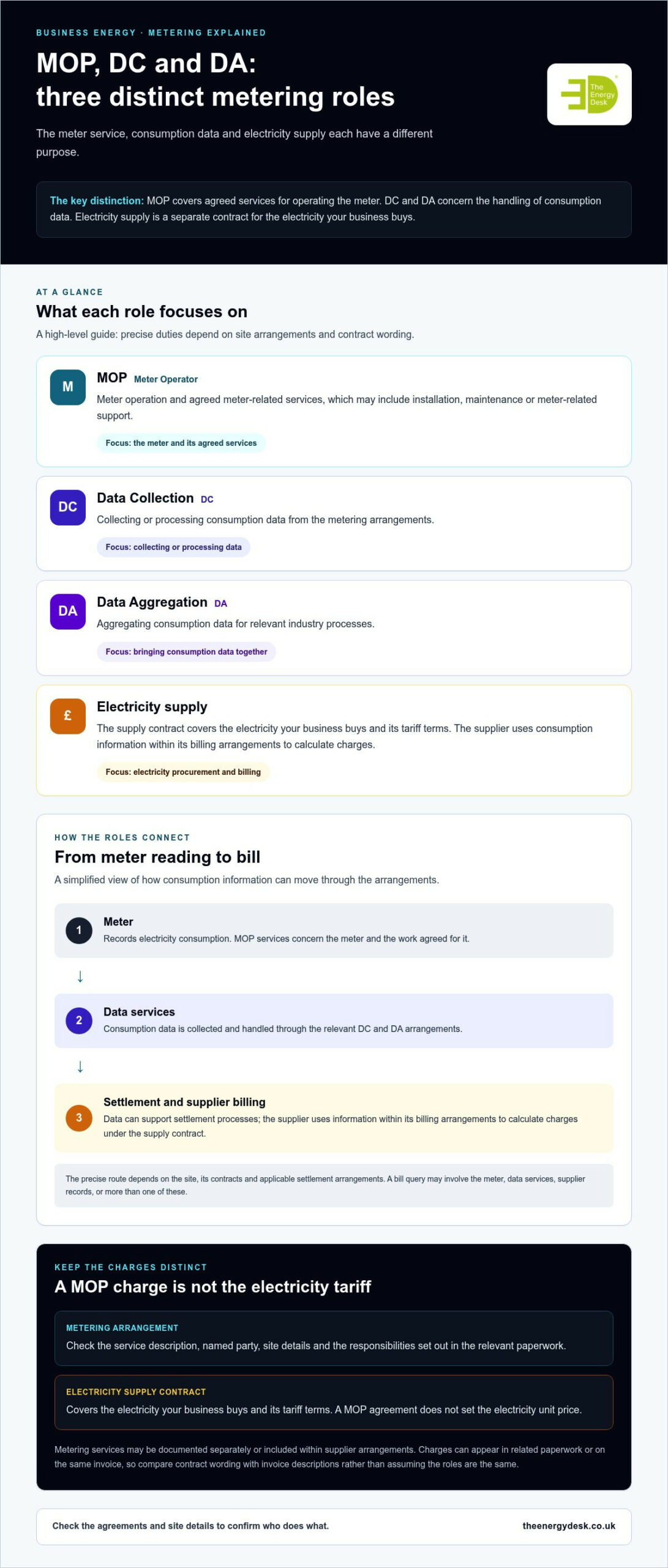
The MOP role concerns the meter service under the relevant agreement. Data Collection (DC) and Data Aggregation (DA) relate to processes for handling consumption data. The table is a high-level guide, not a complete account of every market arrangement.
| Role | Main focus |
|---|---|
| MOP | Meter operation and agreed meter-related services, such as maintenance. |
| DC | Collecting or processing consumption data from the metering arrangements. |
| DA | Aggregating consumption data for relevant industry processes. |
These roles may be arranged separately or together. The meter type, site configuration, contract terms and applicable settlement arrangements affect how they fit together. When reviewing documents, look for the named parties and their defined responsibilities rather than assuming each role has identical duties at every site.
How does the meter data reach an electricity bill?
In broad terms, the meter records electricity consumption. Data is then collected and handled through the relevant industry arrangements, which can support settlement processes and the supplier’s billing. The supplier uses the information within its billing arrangements to calculate charges under the electricity supply contract.
This is a simplified overview, not a complete map of every UK market process. Metering and settlement arrangements can change, and the precise route depends on the site and its contracts. Accurate data helps underpin billing, but a bill query may involve the meter, data services, supplier records or more than one of these.
For a practical review, compare the MOP, DC and DA details across your contracts and invoices. The Energy Desk’s MOP contract and bill validation support can help businesses make sense of these arrangements as part of wider energy management.
Is a MOP Agreement the Same as an Electricity Supply Contract?
No. A MOP agreement and an electricity supply contract have different purposes, even if charges appear in related paperwork or on the same invoice. The supply contract concerns the electricity your business buys and its tariff terms. The MOP agreement concerns meter services, with responsibilities set out in the relevant metering arrangements.
Supply covers electricity procurement, whilst MOP terms concern meter services.
The parties can differ too. A supplier provides the electricity under the supply contract, whilst a Meter Operator performs the services assigned to it under the MOP agreement. Depending on the site arrangement, a supplier may also organise metering services. The Association of Meter Operators provides further industry links for understanding the organisations and agreements involved in meter operation.
| What to compare | Supply contract | MOP agreement |
|---|---|---|
| Purpose | Sets out the business’s electricity supply arrangement and tariff terms. | Sets out agreed services for the electricity meter. |
| Parties | Business and electricity supplier. | Parties named in the metering agreement; this can vary by arrangement. |
| Paperwork | Supply contract, renewal quote or supplier invoice. | Metering agreement or supplier paperwork referring to meter services. |
Which charges or terms should a business look for?
Review your supply contract, MOP documents, invoices and renewal paperwork together. Search for references to the meter, Meter Operator or metering services, then compare the service description, responsible party, site and contract period. Labels and charging structures vary, and metering charges may appear separately or within supplier arrangements. A separate line item alone does not establish that a service is duplicated or billed incorrectly.
Can MOP and data services overlap?
MOP, Data Collection (DC) and Data Aggregation (DA) services are related, but concern different functions. They may be contracted separately or arranged through a supplier. If multiple charges appear, compare their descriptions and responsibilities before treating them as duplicates. For a wider approach to reviewing invoices, see our commercial utility bill validation guide.
How Can a Business Review Its MOP Agreement?
The question “what is a MOP agreement?” becomes practical when you need to check who is responsible for the meter, what services are included and when the arrangement may renew. Review the paperwork alongside supplier documents and invoices, rather than relying on a single bill description.
- Identify the meter and site. Record the meter identifiers and site details shown in your business records. Check that each document relates to the same meter and location.
- Locate the relevant agreements. Bring together your electricity supply documents, any MOP agreement paperwork, supplier correspondence and recent relevant invoices. Metering details may be documented separately or within supplier arrangements.
- Compare responsibilities. Match the services and responsible parties stated in the MOP paperwork against supplier documents and invoice descriptions. Note any differences or unclear references for follow-up.
- Review dates and charges. Record the contract start and end dates, renewal terms, stated notice requirements and charges shown in relevant paperwork. Compare how each charge is described across documents.
What documents and details should you gather?
Keep the supply contract, MOP agreement and relevant invoices together for each site. Note the meter identifiers exactly as recorded, then check the agreement’s stated services, contract dates, renewal wording and notice provisions. Record the service contact named in the paperwork as well. This creates a useful reference for future queries and helps prevent details for different sites or meters from being confused.
When should a business review its metering arrangements?
Review the arrangements during an electricity supply renewal, after a site change, or when an invoice raises an unexplained metering query. Revisit them if the supplier or contract arrangement changes, so it remains clear which agreement describes each responsibility. For broader planning around supply contracts, see our strategic electricity procurement guide.
For more detail on agreement terms and half-hourly metering, read our Meter Operator contracts guide for UK businesses. The Energy Desk also supports businesses with MOP contracts, energy procurement and bill validation, bringing the relevant documents into one review.
How The Energy Desk Can Help With MOP Contracts
Understanding what is a MOP agreement is one part of managing a business’s wider electricity arrangements. The Energy Desk supports UK businesses with MOP contracts alongside energy procurement and bill validation, helping bring contract terms and invoice details into view. This gives you a way to consider metering charges and responsibilities in the context of your wider energy arrangements.
The right review depends on the site and its contracts. One business may need to clarify a meter-related charge, whilst another may want to understand how metering responsibilities fit alongside a supply renewal. A useful review starts with the documents for the specific meter and checks whether the service descriptions, named parties and charges are consistent across them.
How MOP contract support fits with energy management
Reviewing the MOP agreement alongside procurement paperwork and invoices can clarify how the metering service is described, which responsibilities are stated and how charges appear. Bill validation helps businesses examine invoice details, while procurement support relates to reviewing electricity supply arrangements. Considering these together gives a more complete view without treating metering and energy supply as the same service.
This joined-up view is useful when a business has several sites or when contract and invoice references are unclear. It does not assume every site needs the same intervention. The focus is on understanding the documents and identifying practical next steps that fit the business’s arrangements.
What to prepare before discussing your agreement
Gather the relevant MOP agreement, a recent electricity invoice and the site or meter details shown in your records. Note any unclear charges, upcoming renewal dates and questions about the responsibilities listed in the paperwork. These details give the discussion a clear starting point.
Keep supply and metering documents together where possible. Comparing them can help distinguish a question about electricity procurement from one about the meter service or invoice. The Energy Desk can review MOP contracts as part of broader business energy procurement and management, including bill validation, so you can consider the relevant information in context.
To discuss your business energy arrangements, request a free energy audit.
Make Your Metering Arrangements Easier to Review
Knowing what is a MOP agreement helps you separate meter services from electricity procurement. The agreement sets out metering responsibilities, whilst the supply contract covers the electricity arrangement. Reviewing both alongside invoices can help clarify who handles each service and what the charges relate to.
The Energy Desk supports UK organisations with business energy procurement and management, MOP contracts and bill validation. The team can help bring contract terms and invoice details into context as part of your wider energy arrangements.
If you’re unsure how your metering arrangements fit with your supply paperwork, gather your agreement, a recent invoice and any renewal details. Request a free energy audit to discuss your business energy arrangements and review the relevant documents in context.
Frequently Asked Questions
What is a MOP agreement in simple terms?
A MOP agreement sets out services for operating and maintaining a business electricity meter. MOP stands for Meter Operator. Depending on the contract, services may include installation, maintenance or meter-related support. The agreement concerns the meter, not the electricity tariff. Check the named parties and service descriptions in your paperwork, as responsibilities can differ between sites and metering arrangements.
Is a MOP agreement the same as an electricity contract?
No. A MOP agreement covers agreed services for the electricity meter, whilst an electricity supply contract covers the business’s electricity procurement and tariff terms. The agreements may be documented separately or included in supplier arrangements, and charges may appear in different ways on paperwork or invoices. Compare the contract scope and named responsibilities rather than assuming a bill line alone tells you which service it covers.
Does every business need a MOP agreement?
No, not every business has the same metering setup. Businesses with half-hourly electricity meters need a valid MOP agreement under the applicable UK requirements. Other sites may have different meter types and arrangements. Check the meter details and relevant contracts for your site to understand what applies, including who has arranged the meter services and where those responsibilities are recorded.
Can a business change its MOP agreement?
A business may be able to change its MOP arrangement, but the process depends on the current contract, notice provisions, meter setup and supplier arrangements. Review the agreement’s end date, renewal terms and any stated notice requirements before acting. Compare the existing service scope with the proposed arrangement, and consider how a change would affect the responsibilities recorded for the meter at that site.
How much does a MOP agreement cost?
There isn’t one universal MOP agreement cost. Charges can depend on the meter, the services covered and how the arrangement is contracted. Review the agreement and relevant invoices to see how charges are described, then compare those details with supplier paperwork and renewal documents. The written scope matters as much as the amount: it can help establish which metering services a charge relates to.
Does a MOP agreement cover DC and DA services?
Not necessarily. MOP services relate to the electricity meter, whilst Data Collection (DC) and Data Aggregation (DA) relate to handling consumption data. These services may be contracted separately or arranged together through supplier arrangements. Read the agreement and invoice descriptions to identify which service each party is responsible for. Don’t assume two separate line items are duplicates without comparing their stated scope.
Does a MOP agreement apply to business gas meters?
No. A MOP agreement concerns the operation of an electricity meter, not a business gas meter. Gas metering has its own arrangements, so an electricity MOP contract shouldn’t be treated as covering gas meter services. If you’re reviewing bills or agreements for a site that uses both fuels, keep the electricity and gas metering paperwork distinct and check which meter and service each document refers to.