

What does your site need to measure, and who needs the data? For commercial electric meter installation, answering these questions helps establish whether you need a new meter, a replacement, a new connection or sub-metering within an existing supply. It also shapes how energy use is recorded, managed and allocated.
A commercial installation can involve several parties and dependencies. Meter type, MPAN status, half-hourly data arrangements, site access and connection requirements can all affect the work and its schedule. In a shared building, sub-meters can help track consumption, but the metering and billing arrangements need careful planning.
This guide explains the main commercial meter types, how to identify an arrangement for your premises and the stages involved in installation. It also covers the information and coordination that may be needed, plus key considerations for tenant sub-metering and electricity charges. The Energy Desk supports businesses with utility connection assistance, MOP contracts and DC/DA services, bringing metering into the wider energy and data-management picture.
Key Takeaways
- Distinguish meter installation from a new electricity connection so you can define the project correctly.
- Compare single-rate, multi-rate, smart and half-hourly arrangements against your site’s energy use and data needs.
- Understand how private sub-meters can help monitor tenant consumption without replacing the supplier-facing meter.
- Gather site records, access details and supply information to identify dependencies in the commercial electric meter installation process.
- Consider how utility connections, MOP contracts and DC/DA services can support joined-up management of metering, supply and consumption data.
Commercial electric meter installation: what it covers and when a business needs it
A commercial electricity meter records the electricity a business premises consumes, providing readings used for energy settlement and billing. Commercial electric meter installation means fitting or changing that measuring equipment at a supply point. It is different from creating a new electricity supply connection, which involves establishing the infrastructure needed to bring electricity to a site.
Meters measure consumption, but the equipment and arrangements used to capture readings vary. For a foundational overview of how meters record electricity use, see Electricity meter. Start by identifying what is already in place and what the business needs to measure.
Does your business need a new meter, replacement or connection?
If a site already has an electricity supply, meter work may involve fitting equipment to that existing supply. A first-time connection is different: it establishes the route and infrastructure needed to supply the premises. Metering may form part of this wider project, rather than replacing connection work.
Businesses may need a new or replacement meter when opening a site, replacing faulty equipment, changing the metering arrangement or relocating a meter during building works. The scope depends on the premises’ infrastructure and supply status. An existing meter and active supply present a different starting point from a new building without an established connection. Identify the project type before planning works or arranging site access.
What information identifies a commercial electricity supply?
Start with the site address, details shown on the current meter and the supply’s status. These records help identify the existing arrangement, particularly if your business operates across multiple sites or has recently taken on a building. Note whether a meter is present and accessible, and gather a recent electricity bill if available.
The bill usually shows the supply’s MPAN, or Meter Point Administration Number. This identifies the electricity supply point associated with the premises. It does not specify the meter type, capacity or installation requirements. Consider those details separately, alongside the physical setup and planned work.
Keeping the MPAN, address and meter information together gives the project a clear starting point. It also helps establish whether you need meter installation, replacement or relocation at an existing supply, or a broader connection project. That distinction informs decisions about meter arrangements, site preparation and coordination.
Commercial meter types compared: choose the arrangement that fits your site
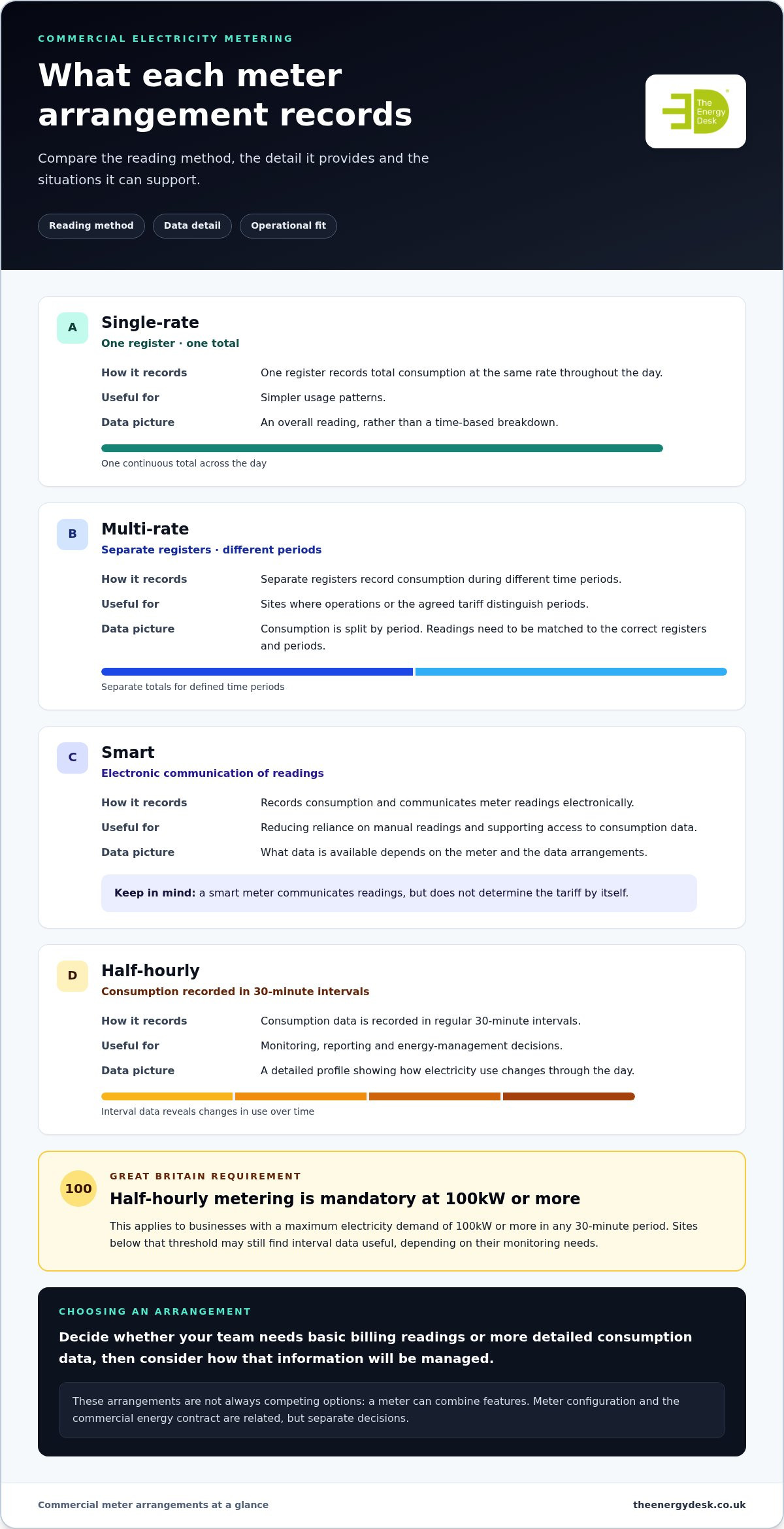
Meter arrangements differ in how they record consumption and how much detail they provide. A single-rate meter may suit a site with consistent operating hours, while a multi-rate arrangement can separate use across different time periods. Smart and half-hourly arrangements affect communication and data frequency. These are not always competing options: a meter can combine features, and the right setup depends on the site, supply and operational requirements.
| Arrangement | How readings are recorded | Typical use and data implications |
|---|---|---|
| Single-rate | One register records total consumption at the same rate throughout the day. | Suited to simpler usage patterns. Provides an overall reading rather than a time-based breakdown. |
| Multi-rate | Separate registers record consumption during different time periods. | Useful where operations or the agreed tariff distinguish periods. Readings need to be matched to the correct registers and periods. |
| Smart | Records consumption and communicates meter readings electronically. | Can reduce reliance on manual readings and support access to consumption data, subject to the meter and data arrangements. |
| Half-hourly | Consumption data is recorded in regular 30-minute intervals. | Provides a detailed usage profile for monitoring, reporting and energy-management decisions. |
Single-rate, multi-rate and smart meters: how do they differ?
A single-rate meter totals consumption on one register. A multi-rate meter keeps separate totals for defined periods, such as day and night. The applicable periods and charges depend on the supply and tariff arrangement. A smart meter adds electronic communication of readings, but does not determine the tariff by itself. Meter configuration and the commercial energy contract are related, but separate decisions.
When should a business consider half-hourly metering?
Half-hourly data shows how electricity use changes through the day. This can help businesses identify demand patterns and inform reporting or operational decisions. In Great Britain, half-hourly metering is mandatory for businesses with a maximum electricity demand of 100kW or more in any 30-minute period. Sites below that threshold may still find interval data useful, depending on their monitoring needs.
Before planning commercial electric meter installation, decide whether your team needs basic billing readings or more detailed consumption data, and how that information will be managed. The Energy Desk can help align metering requirements with wider commercial energy support.
Tenant sub-metering and UK rules: separate landlord readings from supply meters
A supplier-facing meter records the premises’ total electricity use for the supply account, while private sub-meters measure consumption within parts of that site, such as individual tenant units. A sub-meter can help a property manager monitor or allocate usage, but it does not replace the main supply meter or create a separate supplier billing relationship for each tenant.
This distinction matters in a multi-occupier building. The main meter records electricity entering the site; sub-meters can show how much is used in separately metered areas. Shared lighting, lifts and other common services may sit outside individual tenant readings, so the allocation method needs to account for them clearly.
Can a landlord use sub-meters to allocate tenant electricity use?
Sub-metering can give landlords and property managers a more detailed view of consumption by unit or occupier. Readings may, for example, help identify usage trends or inform how electricity costs are apportioned under the relevant occupancy and billing arrangement.
That allocation is separate from the supplier’s relationship with the main supply meter. The supplier-facing meter remains the record of the site’s total consumption, while the sub-meter measures use within the property. The readings alone do not determine what a landlord may charge or how costs must be presented. For domestic tenants in Great Britain, the maximum resale price rules limit electricity charges to no more than the landlord paid the supplier, including a proportional share of the standing charge. Other arrangements require consideration of their own applicable terms and rules.
What should property managers check before introducing sub-metering?
Before proceeding with commercial electric meter installation or adding sub-meters, define who is responsible for each part of the arrangement. Record who owns and maintains the equipment, who takes and stores readings, and who administers any allocation or billing process. If readings will be used to calculate charges, check the current metering and billing requirements, including whether meters used for billing must meet applicable measurement standards.
- Billing and transparency: Check the rules that apply to the occupancy and explain to tenants how readings are used, how charges are calculated and what information they receive.
- Shared consumption: Decide how common-area loads and any unmetered use will be treated, then document the allocation method.
- Faults and disputes: Set out how readings will be checked, how equipment faults will be reported and how disagreements about consumption will be handled.
Requirements can depend on the tenant relationship and the purpose of the readings. Review current UK guidance and the relevant agreement before using sub-meter data to allocate or recover electricity costs.
Commercial electric meter installation process: prepare the site and manage dependencies
Start with accurate supply records and a clear scope. Commercial electric meter installation may involve different steps depending on whether the site needs a replacement, upgrade, relocation or new connection. Site readiness, supply status, access arrangements and additional electrical or connection work all affect scheduling. Treat a typical timeline as a planning guide, not a promise for every premises.
What information should be ready before installation?
Bring together the records and practical details needed to define the work. A recent bill and existing meter information can help identify the supply arrangement, while site contacts can explain access and operational constraints. Be clear about whether the project is for an existing supply or includes a new connection.
- Supply records: MPAN, recent electricity bills and current supply-status information.
- Meter details: Existing meter type, location and any known faults or access issues.
- Site arrangements: Access instructions, operating hours and relevant site constraints.
- Project scope: Whether the requirement is a new connection, replacement, upgrade or relocation.
These details help identify dependencies early. An inaccessible meter location or inactive supply, for example, can change what needs to happen before installation work proceeds.
What happens during installation and commissioning?
Use this sequence to plan the project. The work at each stage depends on the site and supply:
- Assess: Review records, confirm the project scope and consider the existing supply and metering setup.
- Prepare: Arrange site access and identify any electrical, infrastructure or connection work required.
- Install: Fit or replace the meter as planned, coordinating necessary work around the site’s operating requirements.
- Test: Check the meter and associated setup to establish that the equipment is operating as intended.
- Commission and confirm: Complete the relevant commissioning steps and record the meter details and operational information.
This is a planning framework, not a fixed timetable. Additional work, supply status and site access can affect the order and scheduling. Keep project records together and ensure the people responsible for the premises, supply and meter data understand their roles.
The Energy Desk provides business utility connection and metering support.
Plan commercial electric meter installation with joined-up energy and data support
Metering decisions affect more than the equipment at the premises. The arrangement needs to work alongside the site’s electricity supply, procurement strategy and requirements for collecting and using consumption data. Planning these dependencies together helps businesses treat commercial electric meter installation as part of wider energy management, rather than an isolated task.
How do MOP, DC and DA services relate to commercial metering?
A Meter Operator (MOP) is responsible for the meter and its operation under the relevant agreement. A Data Collector (DC) collects and processes meter readings, while a Data Aggregator (DA) brings consumption data together for use in market and settlement processes. The exact responsibilities depend on the metering arrangement and contracts in place.
These roles connect the physical meter with the data used to understand and account for consumption. The Energy Desk supports businesses with MOP contracts and DC/DA services, alongside utility connection assistance and commercial energy procurement. Read the Meter Operator contract guide for UK businesses for more about the operator role.
What should a business do next after identifying its metering needs?
Bring together the decisions that link site infrastructure, supply and data. Use this checklist to identify what is settled and what still needs planning:
- Site: Which premises or units need to be measured, and are there access or infrastructure constraints?
- Supply: Is there an existing supply, or does the project also involve a new connection?
- Meter: Do you need a replacement, upgrade, relocation or different arrangement?
- Tenants: Will private sub-meters be used, and how will shared consumption and readings be handled?
- Data: Who needs the consumption information, how often, and who will manage it?
Once these points are clear, align metering plans with the wider commercial energy strategy. The guide to strategic electricity procurement for UK organisations explores how procurement decisions fit into that picture. Reviewing bills can also help clarify consumption and charges; see commercial utility bill validation.
A free energy audit can help you review energy requirements and project priorities. Find out about a free business energy audit.
Put your metering plan into action
The right commercial electric meter installation starts with a clear understanding of what the site needs to measure, how readings will be used and whether the work involves an existing supply or a new connection. Match the meter arrangement to your operations and data requirements, then plan for site access, supply status and any additional work. If tenants share the premises, define how sub-meter readings and consumption costs will be managed.
Metering also connects with wider energy procurement and data management. The Energy Desk, founded in 2003, supports UK businesses with utility connection assistance, MOP contracts and DC/DA services to help coordinate these requirements.
Request a free business energy audit to discuss your site’s energy needs, or call The Energy Desk on 03330 151 221.
Frequently Asked Questions
What is a commercial electricity meter, and how is it different from a sub-meter?
A commercial electricity meter records the electricity consumed at a business supply point for settlement and billing. A sub-meter measures usage in a particular area of a premises, such as a tenant’s unit or a department. The main meter continues to record the site’s total consumption; sub-meter readings can help monitor or allocate part of that use but do not replace the supply meter.
When does a business need a new electricity meter installed?
A business may need a new meter when opening a site with an existing supply but no suitable meter, replacing faulty equipment, upgrading its metering arrangement or moving a meter during building works. Commercial electric meter installation can also form part of a new connection project, although installing a meter at an existing supply is not the same as establishing a grid connection. The site’s infrastructure and supply status help determine the work involved.
How long does commercial electric meter installation take?
There is no single reliable timescale for every commercial installation. Scheduling depends on the project scope, whether the supply is active, site readiness, access arrangements and whether additional electrical or connection work is needed. A straightforward replacement at an accessible location differs from a project involving a new connection or changes to site infrastructure. Having supply records and site details ready helps clarify dependencies, but the schedule is specific to the project.
What information is needed to arrange a commercial meter installation?
Prepare the site address, MPAN, a recent electricity bill, existing meter details and information about the supply’s status. The MPAN identifies the electricity supply point, not the meter type or specification. Also record the meter’s location, access arrangements, operating hours and any site constraints. Explain whether the project involves a new connection, replacement, upgrade or relocation so the scope and potential dependencies are clear.
Can a landlord use sub-meters to measure tenant electricity consumption?
Landlords can use sub-meters to monitor electricity consumption in individual units or occupier areas, while the supplier-facing meter records the premises’ total use. Sub-meter readings may inform allocation, but they do not automatically establish how costs can be charged or presented. Those responsibilities depend on the tenancy and billing arrangement. Check current rules on billing, transparency and tenant information before using readings to calculate or recover electricity costs.
Do UK businesses have to use half-hourly electricity meters?
In Great Britain, half-hourly metering is mandatory for businesses with a maximum electricity demand of 100kW or more in any 30-minute period. Half-hourly data records consumption in regular 30-minute intervals, providing a more detailed usage profile than a single cumulative reading. Businesses below that demand threshold may still consider interval data for monitoring, reporting or energy management, depending on their operational and data requirements.
Does a new commercial electricity meter require a new grid connection?
No, fitting a new meter does not automatically require a new grid connection. If an existing supply is in place, the project may involve installing or replacing metering equipment at that supply. A new connection is a separate project to establish the infrastructure needed to bring electricity to a premises. The site’s supply status and existing infrastructure determine whether meter work alone is needed or connection work is also involved.