


A portfolio can contain plenty of utility data and still leave decision-makers without a clear view of what’s happening. Managing a multi-site utility portfolio means bringing supplier contracts, meter information and bills together, even when sites have different arrangements and renewal dates. Business energy contracts aren’t protected by the Ofgem price cap, so consistent oversight matters for budgeting and taking action at the right time.
If information is spread across suppliers, meters and internal teams, inconsistent bills and reporting can make it difficult to compare sites, spot exceptions or know who needs to act next. A workable process doesn’t require every location to operate identically. It needs reliable shared information and clear responsibilities, with room for appropriate site-level oversight.
This guide sets out a repeatable approach to building a portfolio-wide view, coordinating contract dates and checking utility data and costs. You’ll learn how to assign ownership, identify exceptions early and organise reporting so portfolio decisions are based on consistent records rather than scattered updates.
Key Takeaways
- Managing a multi-site utility portfolio starts with one dependable register linking each site to its meters, accounts and contracts.
- Use a consistent site identifier across procurement, finance, facilities and supplier records to make information easier to reconcile.
- Choose a centralised, site-led or supported management model, or combine central standards with local responsibility.
- Prioritise uncertain records and upcoming contract actions when establishing a repeatable oversight process.
- Connect procurement reviews, bill validation, metering and regular reporting to identify gaps and unresolved issues.
Why managing a multi-site utility portfolio needs a shared operating model
A multi-site utility portfolio is the organisation’s connected record of sites, meters, utility accounts and supply contracts, structured so each can be understood in relation to the others. Managing it well depends on consistent information and clear ownership, not on making every location work in exactly the same way. A shared view supports energy management principles by connecting utility oversight with functions such as procurement and facilities management.
Local teams often know their buildings best, but separate files, supplier contacts and naming conventions can make portfolio-wide oversight difficult. A central team may miss an approaching contract end date, while finance may receive an invoice under an account name that doesn’t match the site register. These gaps can delay reviews and make comparisons between locations less reliable.
Which utility records belong in one portfolio view?
Build the view around a stable site identifier used across procurement, finance, facilities and supplier records. For each site, record its name and supply address, meter references, utility type, supplier, account details and contract end date. Link electricity MPANs and gas MPRNs to the correct site and account instead of relying on names alone.
Record who owns or maintains each data item, who receives invoices and which details still need confirmation. Mark gaps as unknown rather than treating an empty field as proof that a meter, contract or responsibility doesn’t exist. This makes the register useful for follow-up as well as reference.
What makes multi-site oversight difficult?
Inconsistent site names, disconnected spreadsheets and unclear responsibility can turn routine checks into manual investigations. A missing meter reference may make it difficult to confirm which supply an invoice relates to. An absent contract end date can prevent a timely procurement review. When information is incomplete, teams may also compare sites using different assumptions.
A shared operating model gives central teams responsibility for common standards, portfolio reporting and tracking key actions. Individual sites can retain appropriate responsibility for local access, operational changes and checking details on the ground. The portfolio view should bring these perspectives together without obscuring site-level differences. That balance helps teams see both the overall position and the records or decisions needing attention at a particular location.
For organisations managing a multi-site utility portfolio, a practical first step is to make records comparable and ownership visible. Specialist support, such as data collection, bill validation or ongoing monitoring and reporting, can help address process gaps where internal teams need greater consistency.
How to build reliable site, meter and utility data
A useful central register does more than gather supplier details. It links each supply to the right site, account and responsible contact, so teams can check bills, prepare contract reviews and compare consumption consistently. Use one stable site identifier across procurement, finance, facilities and supplier records. Site names may vary between systems, but the identifier should not.
The table below is an illustrative template, not a client result. Adapt the fields to suit your organisation, while retaining enough detail to trace each utility record back to its source.
| Field | Why it matters | Example format |
|---|---|---|
| Site ID and site name | Matches records across internal systems | Unique code and agreed name |
| Supply address | Helps verify the location linked to an account | Full service address |
| Utility and meter reference | Identifies the relevant electricity or gas supply | Electricity MPAN or gas MPRN |
| Supplier, account and contract end date | Supports invoice checks and contract planning | Supplier name, account number, date |
| Record owner, invoice contact and status | Shows who can confirm details and flags gaps | Named role, contact and verified/uncertain |
How should businesses map MPANs and MPRNs to sites?
An MPAN identifies an electricity supply point, while an MPRN identifies a gas supply point. Record each reference against the correct site, utility account and supply address. Reconcile internal site names with supplier invoices and available meter information instead of assuming similar names refer to the same location. Flag duplicate, inactive or uncertain references for investigation before using them in reports or procurement reviews.
How can teams improve utility data quality over time?
Assign an owner to each record type, such as site details, meter references or contract information, and document how changes are checked and approved. Set consistent naming conventions and date formats, and retain evidence for updates, such as a supplier invoice or confirmed site record. Review completeness when a site opens, closes, changes use or renews a contract. This keeps the register current rather than treating it as a one-off exercise.
Build validation into routine administration. Check invoice supply periods and account details against the register, confirm meter references and site ownership, then log discrepancies with an owner and status. For additional guidance on business energy arrangements, consult Ofgem business energy advice. Organisations seeking specialist help with data collection and bill validation can explore utility data and bill validation support.
Centralised, site-led or supported: which management model fits?
The right operating model depends on the portfolio’s complexity and the time and expertise internal teams can commit. Central control can improve consistency, while local ownership keeps decisions close to day-to-day operations. Specialist support can add capacity where needed, and these approaches can be combined.
| Model | Control and consistency | Workload and visibility |
|---|---|---|
| Centralised | Common standards and coordinated decisions | Central team workload rises; portfolio view is easier to maintain |
| Site-led | Local flexibility, but processes may vary | Responsibility sits closer to operations; portfolio-wide visibility can be harder |
| Specialist-supported | Can reinforce shared processes, depending on agreed scope | Adds external capacity; internal owners still need clear oversight |
Central oversight needn’t reduce site visibility or accountability. It should clarify local responsibilities: central teams can set standards and track actions, while site contacts confirm operational changes and raise local issues. In practice, managing a multi-site utility portfolio often means applying shared rules for records and reporting while allowing sites to manage decisions shaped by their operations.
When does centralised utility management make sense?
A central team can coordinate records, contract reviews, reporting and supplier communication, particularly when fragmented processes make the whole portfolio difficult to see. Give each site a named contact to confirm changes such as a new use or a change in occupancy. Define decision rights as well: specify which actions central teams can take and which need approval, so routine work doesn’t get held up.
When should a business consider specialist support?
Consider external support if internal teams lack capacity for data validation, procurement activity or ongoing monitoring. Before appointing a provider, clarify the service scope, reporting approach, responsibilities and remuneration, including what remains with your team. Specialist support should complement internal accountability, not obscure it. For a more detailed provider-evaluation framework, see energy procurement consultant comparisons.
Choose an arrangement that fits your operational reality rather than assuming one model suits every organisation. A business with capable site teams may keep more work local under shared standards; another may centralise coordination or seek specialist input for specific tasks. Review the model when the portfolio or internal capacity changes, and check that every action still has a clear owner.
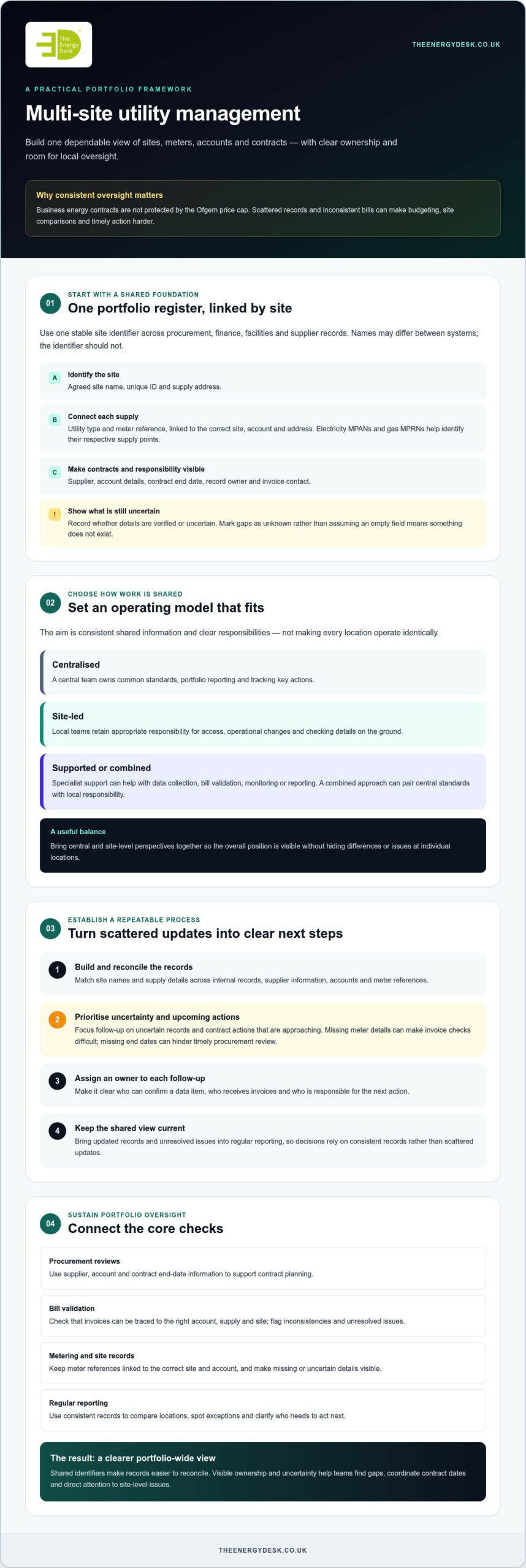
How to implement a multi-site utility management process
A process is useful when it turns portfolio information into assigned actions. Start with a clear baseline, then build in checks to keep records and decisions current. Prioritise uncertain records and upcoming contract actions instead of waiting for every data gap to be resolved before acting.
- 1. Scope the sites. Confirm which operational locations, supplies and accounts belong in the portfolio. Record exclusions and sites awaiting confirmation.
- 2. Reconcile the records. Compare the central register with supplier invoices, contract documents and available meter information. Flag missing or conflicting details instead of silently choosing one version.
- 3. Assign owners. Name accountable people for portfolio records, procurement decisions, invoice checks and site updates. Make clear who verifies changes and who approves action.
- 4. Review contracts. Check the supplier, account, terms and end date for each supply. Prioritise near-term renewals and uncertain contract details.
- 5. Establish reporting. Set a review routine that fits contract dates, reporting needs and available data. Track actions through to resolution, not just their initial identification.
In short, establish the portfolio baseline, reconcile and assign the records, review contracts, then report and repeat.
How should a business establish ownership and review routines?
Define ownership at both portfolio and site level. A portfolio owner can oversee record standards and reporting; procurement, finance and facilities contacts can manage decisions and checks within their remit; site contacts can confirm local changes. Set a review cadence that fits your contract calendar and reporting requirements. If an invoice query or meter issue remains unresolved, specify who follows it up and when it should be escalated, while recognising that cases may need different timescales.
How can bill validation support portfolio control?
Invoice checks can compare the billed period, meter details, contract terms and recorded consumption with the information held for that site. Log the result clearly, distinguishing a verified discrepancy from a question still awaiting confirmation from a supplier or site contact. This prevents an unconfirmed query from being reported as a proven error and gives the next owner a clear action. For detailed checking methods, read the commercial utility bill validation guide.
Use an exception log to make follow-up visible. Include missing bills, unusual consumption, disputed charges and unresolved meter details, alongside the affected site, owner, status, evidence and next action. Review the log as part of your regular reporting cycle. If your organisation needs support with commercial utility bill validation, specialist assistance is an option to consider.
How to sustain portfolio oversight with procurement, metering and reporting
Maintain oversight through a regular cycle: review portfolio data, validate bills, check meter arrangements, assess contract actions and report exceptions. Each activity informs the next. Reliable consumption and account information gives procurement reviews a stronger basis, while bill checks can flag records to correct before they affect portfolio reporting.
For organisations managing a multi-site utility portfolio, reporting should show both the overall position and site-level differences. Track indicators that prompt action rather than presenting figures without context:
- Contract status: upcoming end dates, supplies needing review and missing contract information.
- Data completeness: sites or accounts with unconfirmed meter references, supply details or consumption data.
- Invoice exceptions: unresolved queries, disputed charges and bills awaiting validation.
- Consumption: site-level and portfolio-level use over a clearly stated reporting period.
State the period covered and note data limitations, such as missing bills or estimated readings, so decision-makers can interpret comparisons responsibly. Don’t present incomplete records as a complete picture or claim savings and performance improvements without evidence.
What should a multi-site utility report show?
A useful report brings together site-level detail and portfolio summaries, including consumption, contract status and open data or billing exceptions. Include the reporting period, the source of the information and any known gaps. This helps readers distinguish a genuine change in consumption from a difference in data coverage or quality, and directs attention to records needing follow-up.
How do metering and procurement fit into ongoing oversight?
Review whether meter data and service arrangements provide information that meets your reporting needs. Use validated site, meter and consumption records to inform contract reviews, and check relevant meter operator arrangements as part of that process. For more detail on those arrangements, see the MOP contracts guide.
Set out the next review actions, assign an owner to each exception and bring unresolved items into the next reporting cycle. Commercial procurement, bill validation, MOP contracts, data collection and ongoing monitoring and reporting can each support portfolio oversight, depending on your requirements. To discuss where an audit may help identify data or process gaps, request a free energy audit.
Make portfolio oversight a consistent part of your operations
Managing a multi-site utility portfolio is more workable when information, responsibilities and review actions are connected. A reliable register gives teams a shared reference point, while clear ownership keeps site-level knowledge in view. Regular contract reviews, bill validation and reporting help surface gaps and actions needing attention.
The approach doesn’t have to be complex. Start with the records and contract actions that need clarification, establish a review routine that suits your organisation, and refine it as your portfolio changes.
The Energy Desk is an independent UK energy consultancy founded in 2003, offering commercial procurement, bill validation and ongoing monitoring services. A free energy audit is available to discuss utility data and process needs. Request a free energy audit to take a practical next step towards clearer portfolio oversight.
Frequently Asked Questions
How do you manage utilities across multiple business sites?
Manage utilities across multiple business sites by maintaining a central site-and-meter register, naming owners and tracking contracts, bills and exceptions. Set shared standards for records and reviews, while asking local contacts to confirm site changes and operational issues. Check records before comparing locations, so differences in billing periods, meter references or data quality aren’t mistaken for differences in performance. A regular exception review keeps unresolved actions visible.
What information should a multi-site utility portfolio include?
Include a stable site identifier, supply address, electricity MPAN or gas MPRN, supplier, account details, contract dates, invoice records and named data owners. These fields help teams connect bills and contract information to the correct supply and identify who can confirm a detail. Record uncertainty clearly rather than assuming a meter or account belongs to a particular site. This helps prevent incomplete records being treated as verified during reporting or procurement reviews.
Should utility procurement be centralised for multiple sites?
Central coordination can support consistent records, contract oversight and portfolio-wide visibility, particularly where sites have different suppliers or renewal dates. Local input remains useful for confirming changes, access requirements and operational needs that may affect a supply. The right balance depends on your organisation’s structure and decision-making requirements. Define which procurement decisions sit centrally and which need local approval, so shared oversight doesn’t create unnecessary delays or weaken site-level accountability.
How can a business compare utility costs across different sites?
Compare sites only after checking that bills cover comparable periods and relate to the correct meter references. Confirm consumption units and note site context, such as differences in use or operating patterns that may affect demand. Use consistent reporting periods and identify missing or estimated data. Raw bill totals alone don’t provide a fair comparison because they may reflect different consumption, contract terms, billing periods or levels of data completeness.
How often should a business review its multi-site utility portfolio?
Set a review routine that reflects contract dates, reporting needs, data availability and your internal team’s capacity. There’s no single interval that suits every organisation. Review regularly enough to track contract actions and open exceptions, and check records whenever sites or supply arrangements change. A change in site use, supplier or account details can affect reporting accuracy, so update the relevant records and responsibilities as part of that change.
Can an energy consultant help manage utilities across multiple sites?
Yes. An energy consultant may support commercial procurement, bill validation, data collection and ongoing monitoring or reporting. Agree the service scope, responsibilities and reporting approach in advance, and check how the provider is remunerated. The Energy Desk is an independent UK energy consultancy, not a direct energy supplier. It earns commission from suppliers for successful contract placements or renewals and charges professional fees for services such as bill validation and energy auditing.
What are MPANs and MPRNs, and why do they matter for multi-site management?
An MPAN is the reference used to identify an electricity supply point, while an MPRN identifies a gas supply point. Matching each reference to the right site and account helps teams reconcile invoices, meter information and contract records. Check references against reliable account documents or supplier records rather than relying on an internal site name alone. If a reference appears duplicated, inactive or uncertain, flag it for confirmation before using it in portfolio comparisons.