


A fall in wholesale energy prices doesn’t automatically mean a lower business bill. The impact of wholesale energy prices on business depends on when and how energy is purchased, as well as the charges that sit outside the wholesale market.
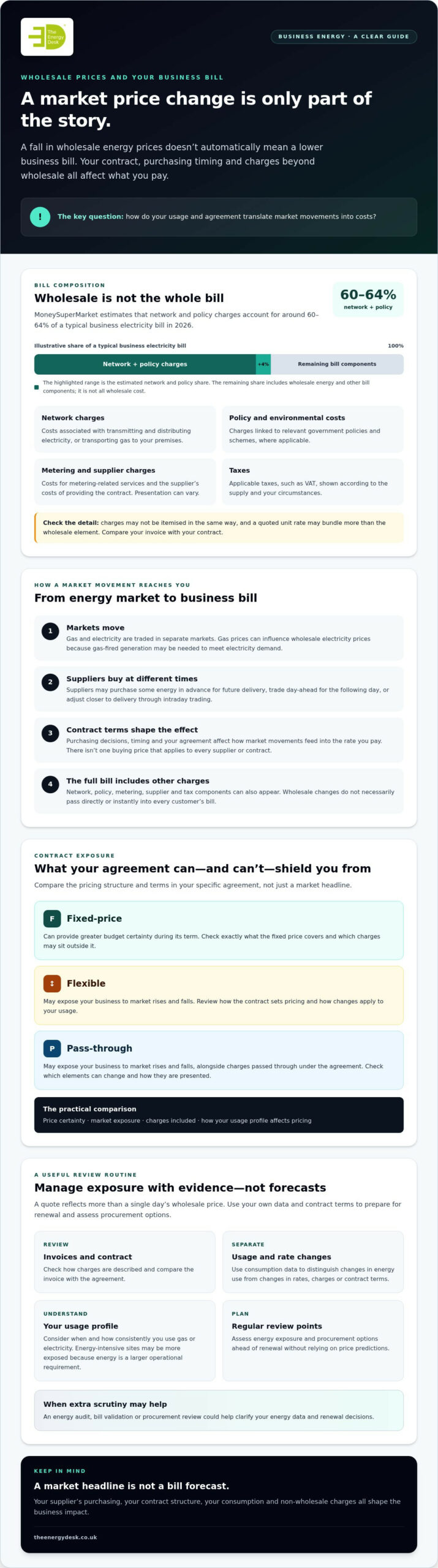
It’s understandable to focus on market movements when prices are volatile. Wholesale gas prices can influence UK electricity prices, but your contract determines how those movements feed through to the rate you pay. A fixed-price deal can provide greater budget certainty during its term, whilst flexible or pass-through arrangements may expose your business to market rises and falls. Wholesale costs are only part of the picture: MoneySuperMarket estimates that network and policy charges will account for around 60-64% of a typical business electricity bill in 2026.
This guide explains how wholesale markets affect business gas and electricity rates, what your contract can and can’t shield you from, and which bill components you can review or manage. It also sets out practical ways to assess energy use, prepare for renewal and manage exposure without relying on market forecasts.
Key Takeaways
- Understand the impact of wholesale energy prices on business by tracing how market movements can flow through supplier purchasing and contract terms.
- Compare fixed, flexible and pass-through contracts by checking the price certainty and market exposure set out in your specific agreement.
- Use invoices and consumption data to distinguish changes in usage from changes in rates, charges or contract terms.
- Set regular review points to assess your energy exposure and procurement options without relying on price predictions.
- Consider whether an audit, bill validation or procurement review could help clarify your energy data and renewal decisions.
What wholesale energy prices mean for your business
Wholesale energy prices are the market prices paid for gas and electricity before energy is supplied to end users. They reflect the cost of buying energy, not the full amount a business pays. Your bill also includes other charges, so wholesale movements are only one part of the impact of wholesale energy prices on business.
In the UK, gas and electricity are traded in separate markets. Gas prices can also influence wholesale electricity prices, since gas-fired generation may be needed to meet electricity demand. A useful introduction to how electricity prices are determined explains that generation is only one factor in the overall cost of electricity. Network, policy, metering, supplier and tax components can also appear on a business bill.
How wholesale gas and electricity markets work
Suppliers buy energy through different market arrangements and purchasing strategies. They may buy some energy in advance for future delivery, known as forward purchasing, then trade closer to the time of use. Day-ahead trading covers energy for the following day; intraday trading allows adjustments nearer to delivery as forecasts or demand change. There isn’t one universal buying price that applies to every supplier or contract.
These markets help balance expected supply and demand over different timeframes. Their movements can influence the prices suppliers use when preparing business contract offers, although the effect depends on purchasing decisions, timing and the agreement being quoted.
Why market movements matter to business decisions
Changing market conditions can affect the rates available when you renew and the assumptions behind your energy budgets. A quote reflects more than a single day’s wholesale price. When comparing offers or deciding when to review a contract, look at its terms and pricing structure, not just a market headline.
The effect also varies by organisation. An energy-intensive site may be more exposed because energy is a larger operational requirement, whilst a smaller user may consume less overall but still need to manage price uncertainty. Your usage profile matters too: when and how consistently you use gas or electricity can shape how a contract’s pricing applies. The practical question is not simply whether wholesale prices have risen or fallen, but how your consumption and agreement translate that movement into costs, budget assumptions and operating decisions.
How wholesale price movements reach business energy bills
Wholesale prices influence the cost suppliers face when buying energy, but they don’t pass directly or instantly into every customer’s bill. Suppliers purchase energy at different times and under different arrangements. They then price business contracts according to their purchasing costs, the contract structure and the charges included in the offer. This is why the impact of wholesale energy prices on business depends partly on how and when your energy is bought.
The distinction between wholesale and retail costs is also outlined in the grid operator NYISO’s guide to Wholesale vs. Retail Electricity. It offers a useful general explanation, though the specific components and terminology on UK business bills can differ.
Which parts of a business energy bill reflect wholesale costs?
A business bill may combine energy usage with charges for delivering and administering supply. The exact presentation and treatment depend on your supplier and contract. A simple breakdown is:
- Wholesale energy: the energy cost, reflected in the unit rate or another pricing mechanism set out in your contract.
- Network charges: costs associated with transmitting and distributing electricity or transporting gas to your premises.
- Policy and environmental costs: charges linked to relevant government policies and schemes, where applicable.
- Metering and supplier charges: costs for metering-related services and the supplier’s costs of providing the contract. How these appear can vary.
- Taxes: applicable taxes, such as VAT, shown according to the supply and your circumstances.
These categories aren’t always itemised in the same way, and a quoted unit rate may bundle together more than the wholesale element. Check your invoice against your contract to understand what each charge covers. The commercial utility bill validation guide can help you review how charges are presented and identify items that need clarification.
Why the timing of price changes varies
If you’re already on a contract with agreed pricing, a market movement may not immediately change the price you pay for each unit. The contract sets how prices are calculated and whether, or when, particular charges can change. A fixed arrangement can provide greater certainty for the agreed elements during its term, but it doesn’t necessarily fix every bill component or prevent bills changing as consumption changes.
Market movements may be more visible in quotes for a new contract or at renewal, when suppliers price offers using their purchasing position and current market conditions. Flexible or pass-through arrangements can expose some costs to market movements at different times, depending on their terms. Changes in consumption can also affect the bill independently of wholesale prices.
Review your contract alongside invoices to separate changes in usage, rates and other charges. If you need support understanding bills or procurement options, The Energy Desk provides business energy procurement support and bill validation. It acts as a consultancy and broker, not an energy supplier.
Fixed, flexible and pass-through contracts: compare wholesale exposure
Your contract determines how wholesale market movements can affect the price you pay, but labels alone don’t tell the whole story. Terms, included charges and purchasing arrangements vary between suppliers. Use the comparison below as a starting point, then check the contract documents to understand your actual exposure. The right approach depends on your risk appetite, consumption data and procurement requirements.
| Pricing approach | Exposure | Potential fit | Questions to ask |
|---|---|---|---|
| Fixed | An agreed unit rate can provide defined pricing for specified contract terms. Other charges or conditions may still change. | Businesses prioritising clearer unit-rate budgeting during the agreed term. | Which charges are fixed or excluded? What volume tolerance applies? When does the contract end? |
| Flexible | Pricing may reflect purchasing decisions made over time, so costs can respond to market movements. | Businesses with the capacity and data to review purchasing and manage budget variability. | Who makes purchasing decisions, when are they made, and how are costs reported? |
| Pass-through | Some charges, or specified elements of the energy cost, may be passed through separately and can vary. | Businesses prepared to track variable charges and understand how they affect budgets. | Which items can vary, how are they calculated, and when can they be updated? |
What wholesale exposure can a fixed contract leave?
A fixed contract can set an agreed unit rate for the specified term, limiting exposure to wholesale movements for the elements covered by that rate. It doesn’t necessarily fix standing charges, taxes or charges identified as pass-through items. Before agreeing, check the written terms for inclusions, exclusions, volume tolerance and renewal dates. A change in consumption may also affect total bills, even if the unit rate stays the same.
How flexible and pass-through contracts may respond to markets
Flexible arrangements may let purchasing decisions be made in stages, whilst pass-through terms can link specified costs to market movements or other charges. These structures can offer a different degree of purchasing control, but they may also make costs and budgets less predictable. Ask how decisions are made, what oversight your business has and how market changes will be communicated. For a broader framework, read about strategic energy risk management.
The impact of wholesale energy prices on business therefore depends not just on the market, but on the detail of your agreement and how well it fits your operating profile. Compare contract terms against consumption data and budget priorities, rather than choosing by contract label alone.
How to manage the business impact of wholesale energy prices
You can’t control wholesale market movements, but you can improve how clearly your organisation understands and manages its exposure. A consistent review process helps separate changes in energy use from changes in rates or contract terms, supporting better-informed budget and procurement decisions. Use these steps to build a practical approach without trying to predict where prices will go.
- Gather the information. Bring together recent invoices, contract documents, meter data, renewal dates and consumption records. For a multi-site organisation, organise records by site and fuel so you can compare like with like.
- Map where energy is used. Identify the sites, operating periods and processes with material gas or electricity demand. Note seasonal patterns, operational changes and planned changes that could affect future consumption.
- Set review points. Agree when the relevant teams will review consumption, bills, contract dates and budget assumptions. Set practical internal triggers, such as an approaching renewal or a material change in operations, rather than reacting to every market headline.
- Assess the available options. Compare procurement arrangements against your operating needs, consumption data, risk tolerance and capacity to manage variable costs. Use scenarios to consider how different rates or levels of usage could affect budgets, without treating any scenario as a price forecast.
Build a usable picture of energy exposure
Start with the evidence. Compare invoice periods with meter readings or other consumption records, then check whether changes in total charges reflect higher usage, a changed unit rate, contract terms or other bill components. For example, increased consumption during longer operating hours is a different budget issue from a rate change, even if both raise the invoice total.
Check invoices against the contract and clarify unfamiliar or inconsistent charges. Bill validation can help identify discrepancies for investigation. This gives you a more reliable view of how your sites use energy and where the main areas of exposure sit.
Turn uncertainty into review actions
Use your data to set budget assumptions and decide when to revisit them. Scenario planning can test the effect of different consumption levels or contract arrangements, helping teams prepare for uncertainty without relying on predictions. For a broader approach to oversight, see the business energy portfolio management guide.
If you need help reviewing your organisation’s consumption, bills and contract position, request a free business energy audit from The Energy Desk. Its audit and bill validation services can help clarify your energy data and inform procurement decisions.
When expert energy procurement support can help your business
An external review can be useful when energy bills are difficult to interpret, a renewal is approaching, internal teams lack time to assess options or business demand has changed. A new site, altered operating hours or changes to production can all affect how well an existing contract matches your requirements. Independent support can help clarify your position before a procurement decision, without promising savings or a particular market outcome.
What to expect from an independent energy review
A review can bring together consumption information, contract details, invoices and your organisation’s requirements. This helps distinguish changes in energy use from price or billing changes, and provides context for considering procurement options. The Energy Desk is an independent UK energy consultancy and broker, founded in 2003. Its services include commercial gas and electricity procurement, energy audits, bill validation, and monitoring and reporting.
The Energy Desk can arrange supply contracts through procurement, but it doesn’t directly supply energy. Before engaging any broker or consultant, ask what the review includes, how the business is remunerated and which contract terms or charges may apply. Make sure recommendations are based on your requirements and that you understand the options before making a decision. A clear review can help you assess the impact of wholesale energy prices on business operations, but it can’t guarantee future prices or market results.
Prepare for a business energy procurement conversation
Having relevant information ready makes it easier to discuss your current position and priorities. Gather:
- Current gas and electricity contracts, recent bills and meter details.
- Renewal dates and available consumption records.
- Operational plans that could change energy demand, such as changes to sites, hours or processes.
- Your budget priorities, tolerance for price changes and details of who is involved in procurement decisions.
This preparation helps focus the discussion on contract fit, consumption and the level of price certainty your organisation needs. It also gives you a practical basis for comparing options rather than trying to time the market.
If an independent review would help clarify your energy position, request a free energy audit from The Energy Desk to discuss your business requirements.
Take control of your business energy position
The impact of wholesale energy prices on business depends on more than market movements. Your contract determines how some costs respond, whilst consumption, network and other charges also shape the bill. Reviewing invoices alongside contract terms helps distinguish changes in usage from changes in rates, supporting clearer renewal and budget decisions.
A practical approach is to understand your energy data, set review points and compare contract options against your organisation’s operating needs and appetite for price variability. Scenario planning can help you prepare for uncertainty without relying on predictions about future market prices.
The Energy Desk is an independent UK energy consultancy founded in 2003. Its business procurement, bill validation, audit and ongoing monitoring support can help you review your energy position. The Energy Desk arranges supply contracts but doesn’t directly supply energy.
To discuss your requirements, request a free business energy audit. A clearer view of your consumption, bills and contract is a practical starting point for more confident energy decisions.
Frequently Asked Questions
What are wholesale energy prices?
Wholesale energy prices are the market prices for gas and electricity traded before energy is supplied to end users. Suppliers purchase energy through market arrangements, which may include buying in advance or trading closer to delivery. These prices are different from the full amount a business pays: its bill may also include network, policy, metering, supplier and tax components. Contract terms determine how wholesale costs feed into the rates charged to a business.
How do wholesale energy prices affect businesses?
The impact of wholesale energy prices on business depends on the contract, purchasing arrangements and how much energy the organisation uses. Market changes may influence supplier offers, particularly when a business takes out a new contract or renews. Businesses on market-linked arrangements may have more direct exposure, whilst agreed fixed rates can provide defined pricing for specified terms. Energy-intensive organisations may feel changes differently because energy is a larger part of their operating requirements.
Why do business energy bills rise when wholesale prices change?
A bill may rise after wholesale prices increase if the business’s contract allows the relevant energy costs to change or if it is renewing and receives a higher-priced offer. But wholesale movement isn’t necessarily the only cause. Bills can also change because consumption has increased, other charges have altered or contract terms apply differently. Compare invoices with meter or consumption records and contract details to identify what has changed.
Does a fixed business energy contract protect against wholesale price rises?
A fixed contract can protect the agreed unit rate from wholesale movements during the specified contract term, if that rate is fixed under the agreement. It doesn’t automatically fix every part of the bill. Standing charges, taxes or other items may be treated separately, and changes in consumption can still affect the total. Check the contract’s inclusions, exclusions, volume conditions and renewal date in writing before relying on a fixed rate for budgeting.
Can wholesale energy prices go down as well as up?
Yes. Wholesale gas and electricity prices can rise or fall as market conditions change. However, a fall in wholesale prices doesn’t guarantee an immediate reduction in a business’s bill. The effect depends on when and how the supplier bought energy, the contract’s pricing structure and which charges are included. A business on an agreed fixed rate may not see a change during the term, while market-linked arrangements may respond differently under their specific terms.
How can a business manage wholesale energy price risk?
Start by gathering contracts, invoices, meter information, consumption records and renewal dates. Compare usage over time with rates and other charges to understand what is driving bill changes. Then set review points, establish budget assumptions and assess contract options against your operating needs and tolerance for price variation. Scenario planning can help test the effect of different prices or consumption levels without relying on forecasts or attempting to time the market.
What is the difference between wholesale energy prices and business energy rates?
Wholesale prices are market prices for energy traded before it reaches end users. A business energy rate is the price set out in a supplier’s offer or contract, often expressed as a unit rate and potentially including more than the wholesale cost. The precise inclusions vary. A business bill may also contain other charges, so the rate alone may not show the full cost. Check contract documents and invoices to understand the pricing basis.