


The obvious choice isn’t always the most effective one. Your team may spot waste on site but miss a billing discrepancy or a problem in the underlying data. The DIY energy audit vs professional service decision is about identifying which checks your staff can carry out and when further analysis could change your next steps.
Your staff understand how the business operates and can often identify visible issues, such as equipment left running or heating and lighting used unnecessarily. That makes an internal review a practical starting point. But if bills are difficult to interpret, data is incomplete or sites have different operating patterns, it can be harder to establish what is driving consumption and which actions to prioritise.
This article compares what your team can assess internally with what professional support can add. It explains how energy auditing and bill validation address different, complementary questions, and how to weigh site complexity, data quality, staff time and business goals. Use those factors to choose a proportionate next step and plan how to check whether actions make a difference.
Key Takeaways
- Use internal checks to identify visible energy waste, then assess whether the evidence is strong enough to guide wider decisions.
- The DIY energy audit vs professional service choice depends on your site’s complexity, the quality of your data and the decisions you need to make.
- Build a useful review around a defined period, consistent records and notes about operational changes that could affect comparisons.
- Before commissioning professional support, clarify the scope, evidence required, deliverables, fees and follow-up arrangements.
- Keep energy auditing and bill validation distinct. They can complement one another when you need to investigate both energy use and billing questions.
DIY energy audit vs professional service: what does each approach cover?
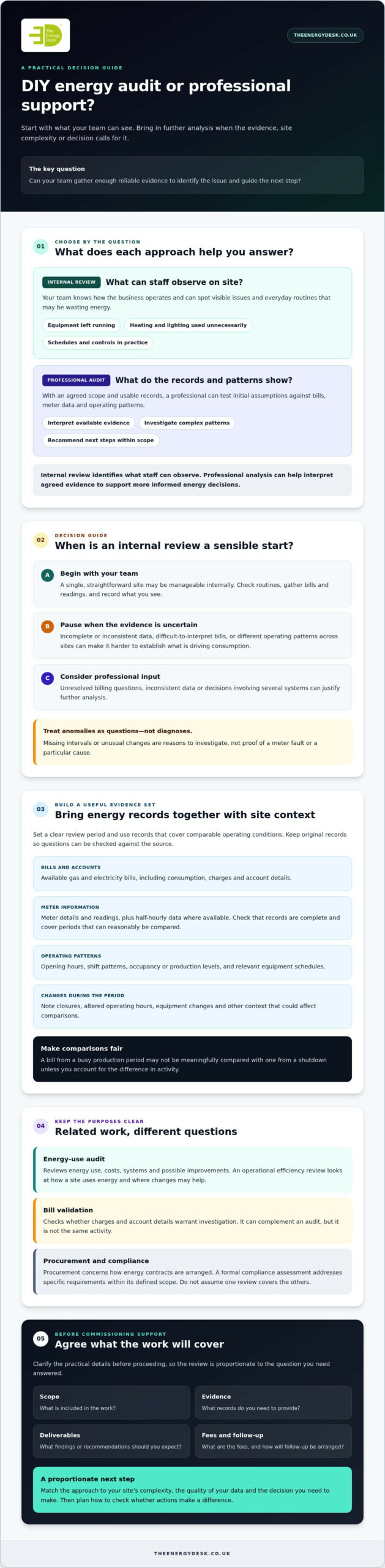
Internal checks are well suited to visible operational issues. Professional input is more useful when evidence is complex or a decision depends on understanding how bills, meter data and operating patterns fit together. An energy audit is a structured review of energy use, costs, systems and possible improvements. For a general overview of the term and process, see Energy audit.
Be clear about the purpose of the review. An operational efficiency review looks at how a site uses energy and where changes may help. Bill validation checks whether charges and account details warrant investigation. It can complement an audit, but it is not the same activity. Procurement concerns how energy contracts are arranged, while a formal compliance assessment addresses specific requirements within its defined scope. Do not assume one type of review covers the others.
What can a business assess through a DIY energy audit?
Your team can compare opening hours with heating and cooling schedules, check whether lighting controls are being used as intended, and observe whether equipment is shut down when it is not needed. Gather recent bills, consumption data and meter readings, then note relevant context such as shift patterns, production levels or unusual closures. Record what you observe, when it happened and under what conditions. Treat anomalies as questions to investigate, not technical diagnoses.
What does a professional energy audit add?
With an agreed scope and usable records, a professional can test initial assumptions against bills, meter data and operating patterns. Depending on the evidence and work commissioned, recommendations may cover operational changes or identify where further investigation is needed. Before proceeding, ask what is included, what evidence you need to provide and what deliverables to expect.
An internal review identifies what staff can observe. A professional audit analyses agreed evidence to support more informed energy decisions.
| Area | Internal review | Professional audit |
|---|---|---|
| Scope | Visible routines and site observations | Analysis defined by the agreed audit scope |
| Skills | Operational knowledge from staff | Specialist interpretation of available evidence |
| Evidence | Readings, bills and site notes gathered in-house | Evidence tested against operating patterns |
| Outputs | Observations and questions to follow up | Findings and recommendations, subject to scope |
| Time and follow-up | Staff time to collect, review and act on findings | Time and follow-up agreed before work begins |
The DIY energy audit vs professional service choice depends on the question you need answered. A single, straightforward site may be manageable internally. Unresolved billing questions, inconsistent data or decisions involving several systems can justify professional input. Use the comparison to pinpoint the gap your next step needs to address.
How a business energy audit uses bills, meters and operational evidence
Audit findings are only as dependable as the evidence behind them. Set a clear review period and use records that cover comparable operating conditions. For example, a bill from a busy production period may not be meaningfully compared with one from a shutdown unless you account for the difference in activity.
Which records should a business gather before an audit?
Bring together records that help explain both energy use and site activity:
- Available gas and electricity bills, including consumption, charges and account details.
- Meter information and readings, plus half-hourly data where available.
- Opening hours, shift patterns, occupancy or production levels, and relevant equipment schedules.
- Notes on changes during the review period, such as closures, altered operating hours or equipment changes.
For half-hourly supplies, check that the data is complete and covers periods that can reasonably be compared. Missing intervals or unusual changes are reasons to investigate, not proof of a meter fault or a particular cause. Keep the original records so questions can be checked against the source.
How do audit findings differ from bill validation?
Energy-use analysis considers consumption alongside operating patterns to identify possible efficiency opportunities. Bills provide context through recorded usage, charges and account details that may merit review. Bill validation focuses on whether those charges or details warrant further investigation. It can complement an audit, but it answers a different question.
For a closer look at that distinction, see this commercial utility bill validation guide. If you’re considering specialist analysis, the U.S. Department of Energy guide outlines professional audit levels and preparation. Use it as general background, not as a statement of UK requirements.
The DIY energy audit vs professional service decision becomes clearer when you know what your records can support. If data is incomplete, patterns are difficult to explain or billing questions remain unresolved, discuss the required scope and evidence with The Energy Desk’s energy audit and bill validation team. Confirm what any audit includes and whether fees apply before proceeding.
DIY energy audit vs professional service: compare effort, evidence and risk
The right choice depends on what you need to decide, not simply on whether a professional audit sounds more thorough. The DIY energy audit vs professional service comparison comes down to your team’s capabilities, the complexity of your operations and the reliability of your evidence. A DIY review may be proportionate for one straightforward site. Professional analysis becomes more useful as uncertainty increases or a decision has wider consequences.
- Staff capability: Internal teams know site routines and can record visible issues. Specialist analysis may be needed to interpret technical or conflicting evidence.
- Site complexity: A single site with clear operating hours is easier to review consistently than several sites or processes with different patterns.
- Data quality: Accessible, consistent records support an in-house review. Gaps or discrepancies limit what your team can confidently conclude.
- Decision requirements: A simple operational adjustment may need only an observation and follow-up. Larger technical or investment decisions call for stronger evidence and careful assessment.
When is a DIY energy audit a reasonable starting point?
Start internally if the site is straightforward, bills are accessible, operating hours are clear and equipment is easy to identify. Assign a responsible staff member to record observations consistently, including what was seen and when. This helps distinguish repeatable patterns from one-off events. Keep the review within the team’s competence. Do not make specialist safety or engineering judgements without suitable expertise.
When should a business consider professional support?
Consider professional input if bills, meter data and observed operations do not align, or if several sites need to be compared consistently. Energy-intensive processes can also make consumption harder to interpret from a walkthrough alone. Escalate technical, safety or regulatory questions that fall outside your team’s capability to an appropriately qualified professional, and agree the scope of that work in advance.
Professional analysis does not guarantee a particular reduction in consumption or cost. It can help assess possible opportunities against the available evidence, but recommendations still need to be judged for feasibility, implemented and monitored. An internal review is useful only if someone owns the findings and checks whether actions make a measurable difference.
Use the boundary between observation and judgement to choose what to do next. If staff can explain the evidence and act within their expertise, continue with a documented internal review. If uncertainty remains or a decision has wider operational or financial implications, seek further analysis instead of treating an unverified observation as a confirmed fault or saving.
How to run a DIY energy audit and decide when to escalate
A useful internal review should end with clear questions and owned actions, not a list of suspected faults or assumed savings. Keep the scope manageable, record what the evidence shows and flag anything that needs specialist assessment. This makes it easier to choose between an operational change, further data gathering and professional analysis.
A practical sequence for an internal energy review
- Define the review. Specify the site, energy sources, review period and business questions. Choose a baseline period that reflects normal operations, and note changes such as altered opening hours, production levels or temporary closures.
- Bring the evidence together. Keep bills, meter readings, available consumption data, operating schedules and relevant equipment information in one record. Note missing periods rather than filling gaps with estimates.
- Observe normal routines. Review how the site operates during typical hours. Record exceptions, such as equipment running outside scheduled hours, with the date and context. An observation is a prompt for investigation, not proof of a technical fault.
- Rank findings for follow-up. Prioritise by strength of evidence, relevance to operations and ease of investigation. Do not rank items by presumed savings unless those savings have been assessed.
- Assign ownership and review progress. Give each action a responsible person and a practical next step. Record what changes, then compare later evidence with the baseline while allowing for operational differences.
What should trigger a professional review?
Escalate if consumption changes remain unexplained, records are incomplete, or bills, meter data and site observations tell different stories. A review across several sites may also need a consistent method before results can be compared fairly. Seek specialist assessment when a proposed change requires technical validation or investment appraisal, or when the question is beyond your team’s expertise.
Escalate an internal review when the evidence is incomplete or conflicting, or when a decision depends on technical analysis your team cannot confidently provide. This is a practical boundary in the DIY energy audit vs professional service decision: staff can identify and document concerns, while professional analysis can assess unresolved questions within an agreed scope.
If you need help clarifying the evidence or audit scope required, discuss your business energy audit with The Energy Desk. Confirm what the audit covers, any eligibility or terms for a free audit, and whether fees apply to additional audit, bill validation or data collection work.
Choosing professional energy audit support and turning findings into action
Professional support is most useful when you know what you need answered. Before commissioning work, define the decision you are trying to make and ask for a scope that matches it. A clear brief helps you understand what the findings can support, what remains uncertain and whether further work may be needed.
Questions to ask before commissioning a professional audit
Discuss the proposed work before agreeing to proceed. Ask the provider:
- Which sites, fuels, bills, meters and operating processes are included, and what is excluded?
- What evidence must your team supply, and how will incomplete or uncertain data be handled?
- What will the deliverables contain, and will recommendations state assumptions and evidence limitations?
- What fees apply to the agreed work, and are implementation support or follow-up reviews included or separate?
- How will progress be assessed after recommendations are put into practice?
Useful findings should translate into action. Each recommendation should identify its supporting evidence, any assumptions, a responsible owner and a practical next step. Agree how progress will be monitored against a suitable baseline, noting operational changes that affect comparisons. Treat projected opportunities as estimates to assess, not guaranteed reductions in energy use or cost.
How The Energy Desk can support your next step
The Energy Desk supports UK organisations with energy audits, bill validation, data collection and ongoing energy management. These services can inform longer-term planning, but their scope and outcomes depend on the agreed work and evidence available. An energy audit reviews energy use and possible opportunities; bill validation is a separate activity focused on charges or account details that may warrant investigation.
The Energy Desk offers a free energy audit, but confirm its current scope, eligibility and terms before relying on that offer. Ask whether requested work beyond that scope, bill validation or data collection carries a professional fee, and clarify the details before commissioning it. Not every service is free.
The DIY energy audit vs professional service choice need not be all or nothing. Your team can gather records and observations, then seek professional input for unresolved questions or decisions that need deeper analysis. To discuss a suitable next step, request an energy audit discussion.
Choose your next step with confidence
The DIY energy audit vs professional service decision depends on the evidence you have and the decisions you need to make. Internal checks can identify visible operational issues, while specialist analysis can help investigate unclear data, conflicting records or complex sites. In either case, set a baseline, document assumptions and assign owners to follow-up actions. Treat potential savings as opportunities to assess, not guaranteed outcomes.
If you’re considering professional support, clarify the audit’s scope, deliverables and any fees before proceeding. The Energy Desk has supported UK organisations since 2003, with business energy procurement and management support available nationally across the UK. Its free energy audit has a defined scope and terms, so confirm what is currently included and whether additional audit, bill validation or data collection work is chargeable.
To discuss a practical next step for your organisation, discuss a business energy audit with The Energy Desk, or call 03330 151 221. Start with the questions your team needs answered, then build a measured plan to act on the findings.
Frequently Asked Questions
Can a business carry out its own energy audit?
Yes, a business can carry out an internal energy review. Staff can inspect operating routines, collect bills and meter information, and record visible issues such as lighting left on outside opening hours. Its usefulness depends on staff time, data quality and site complexity. Define the scope and review period, and treat observations as prompts, not technical diagnoses, billing investigations or formal assessments. Escalate questions that exceed internal expertise.
What is the difference between a DIY energy audit and a professional energy audit?
A DIY review is carried out by your own staff, who use their site knowledge to gather records and note visible operational patterns. A professional audit involves specialist analysis of evidence within an agreed scope, with outputs depending on the work commissioned and information available. The DIY energy audit vs professional service choice often starts with an internal review, then escalates if findings are uncertain or require deeper analysis.
How much does a professional business energy audit cost?
There is no single fee that applies to every professional business energy audit. The cost depends on the agreed scope, number of sites, data requirements and services included. The Energy Desk offers a free energy audit, but confirm its current eligibility, scope and terms before proceeding. Additional auditing, bill validation or data collection may carry professional fees, so ask for the specific work and charges to be explained in advance.
What should I check during a DIY energy audit?
Review recent bills and meter information alongside opening hours, heating and cooling schedules, lighting controls and equipment shutdown routines. Record the date and context of each observation, and note operational changes such as altered shifts or temporary closures that could affect comparisons. A basic review can highlight questions, but it cannot establish every technical cause of unusual consumption. Seek qualified advice where specialist assessment is needed.
When should a business hire a professional energy auditor?
Consider professional support if consumption data, bills and observed operations do not align, or if records are incomplete. Several sites or energy-intensive processes can make consistent comparison more difficult. Specialist analysis may also be appropriate when a proposed change needs technical validation or investment appraisal. Before commissioning work, agree which sites and evidence are covered, what deliverables to expect, what fees apply and how follow-up will be handled.
Does an energy audit include checking business energy bills?
Not necessarily. The agreed scope determines whether bills are checked. Energy-use analysis examines consumption and operational patterns to identify possible efficiency opportunities. Bill validation is a distinct but complementary activity that investigates account details and charges that may warrant review. Ask explicitly whether bill checks are included, what records the provider needs and whether separate fees apply. This helps prevent assumptions about the audit’s coverage.
What happens after a professional energy audit?
Review the findings, check the assumptions and assign an owner and next step to each agreed action. Decide how progress will be monitored against a suitable baseline, allowing for changes in operating hours or activity. Recommendations are not guarantees of savings and may need further technical or financial assessment. Before commissioning the audit, ask whether follow-up support is available and how the provider will handle unresolved data gaps.
Is a free energy audit the same as a full professional audit?
Not automatically. “Free” describes the price of an offer, not necessarily its scope or depth. Ask which sites, data, analysis and outputs are included, and whether eligibility conditions apply. The Energy Desk offers a free energy audit, but confirm its current terms before proceeding. Check separately whether further auditing, bill validation or data collection is included or carries a professional fee.