


What if your energy bills show the cost of consumption, but not what’s driving it? For many organisations, readings are spread across meters, invoices and building systems, making it difficult to see where and when energy is used. Energy monitoring for businesses brings these sources into a clearer picture, but only if the underlying data is dependable.
Monitoring can help reveal opportunities to manage costs and improve efficiency. The challenge is separating a genuine change in consumption from a missing reading, an inaccurate record or a change in how a site operates. A dashboard alone won’t make that distinction or tell your team what to do next.
This 2026 guide explains how business energy monitoring works and how to assess data quality. It covers establishing a reliable consumption baseline, spotting patterns, investigating unusual use and turning evidence into practical operational decisions. You’ll also see how monitoring can work alongside data collection, bill validation and wider energy management.
Key Takeaways
- Learn what consumption data can reveal beyond the totals on periodic energy bills.
- Compare monitoring approaches by checking data frequency, site coverage, reporting clarity and validation support.
- Build a practical review process: set objectives, establish a consistent baseline and record operational changes.
- Use energy monitoring for businesses to guide bill checks and efficiency investigations, alongside site knowledge and technical assessment.
- Connect monitoring with wider energy management so teams can turn findings into considered operational action.
What is energy monitoring for businesses, and what can it show?
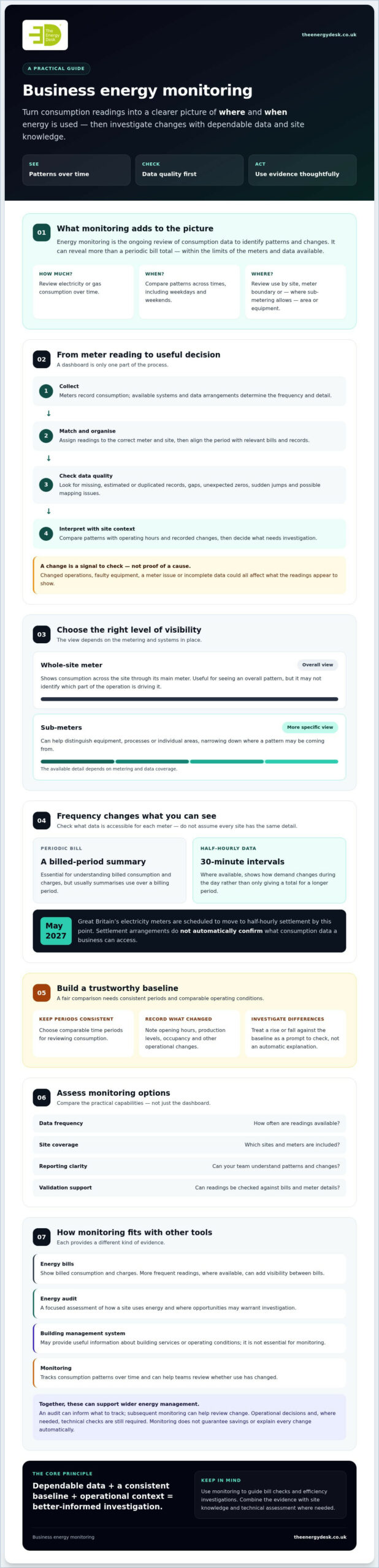
Energy monitoring collects and reviews consumption data over time. It helps a business see not only how much electricity or gas it uses, but also when and where that use occurs, within the limits of its meters and available data. Energy monitoring is the ongoing review of consumption data to identify patterns and changes; an energy audit is a focused assessment of energy use and potential opportunities.
Monitoring can cover a whole site through its main meter or use sub-meters to distinguish equipment, processes or individual areas. Whole-site data gives an overall view. Sub-metering can help narrow down which part of an operation contributes to a pattern. The detail available depends on the metering and systems in place.
What information can energy monitoring reveal?
With suitable data, energy monitoring for businesses can show how consumption varies by time, site or meter boundary. A business might compare weekday and weekend use, or check whether an area continues to consume energy outside its normal operating hours. These patterns help teams decide where to investigate rather than relying on a single total.
A baseline gives those comparisons context. Set it using consistent periods and comparable operating conditions, then record changes such as opening hours, production levels or occupancy. If usage rises against the baseline, treat the difference as a signal to check, not proof of a cause. It could reflect changed operations, faulty equipment, a meter issue or incomplete data.
Energy monitoring versus bills, audits and building controls
Energy bills are essential for understanding billed consumption and charges, but they usually summarise use over a billing period. More frequent readings, where available, can show when consumption occurs between bills. The frequency and quality of that information vary, so check its source and coverage before drawing conclusions.
An audit assesses how a site uses energy and may identify areas for further investigation. Monitoring follows consumption patterns over time. Used together, an audit can inform what to track, while subsequent data can help teams review whether usage has changed. Neither guarantees savings. Operational decisions and, where needed, technical checks are still required.
Building management systems may provide useful information about building services or operating conditions, but they aren’t essential for monitoring. They can form one part of a wider Energy Management System, alongside metering, data review and action. Treat monitoring as decision support, not a dashboard that explains every change automatically.
How business energy monitoring collects and checks consumption data
Useful monitoring involves more than collecting meter readings. Data must be matched to the right site and meter, checked for gaps or anomalies, then reviewed by someone who understands the operational context. That gives the business a sounder basis for deciding whether a change needs investigation or action.
Meters, half-hourly data and collection arrangements
The process starts with a meter recording consumption. Data is collected through the arrangements and systems available to the business, organised by meter and site, then reviewed over time. Teams can compare patterns with operating hours or other relevant changes and decide what to investigate. The frequency and detail available depend on the meter, data services and systems in place, so don’t assume every site provides the same level of detail.
Half-hourly data records consumption in 30-minute intervals. Where available, it can show how demand changes during the day, rather than presenting only a total for a longer period. Great Britain’s electricity meters are scheduled to move to half-hourly settlement by May 2027, but settlement arrangements don’t automatically confirm what consumption data a business can access. Check the arrangements for each meter. For more on meter responsibilities, see this guide to Meter Operator and MOP contracts.
How to spot gaps or inconsistencies in energy data
Before interpreting a trend, check that the data covers the period you intend to analyse and corresponds with the relevant bill dates. Compare readings with bills and meter details, and flag estimated, missing or duplicated records for review. An unexpected zero or sudden jump may be a genuine change, but it could also point to a data or mapping issue.
Meter identifiers matter, particularly when a business has multiple sites or meters. Confirm that each reading is assigned to the correct site and meter, and that the identifier matches the information on bills and in other records. A mapping error can make one location appear to use more energy while another appears to use less, undermining comparisons across a portfolio.
Keep a record of exceptions and how they were resolved. This gives the team a clearer basis for deciding whether a change is credible before taking operational action. The BSI overview of Energy Management Standards can provide further context for organisations reviewing their broader energy management approach.
If you need help bringing consumption records and bills into a clearer view, The Energy Desk offers a free energy audit.
How to assess energy monitoring options for your business
Start with the decisions you need monitoring to support. A site manager investigating overnight use may need different data from a central team comparing consumption across a portfolio. Choose a scope that answers a defined operational question rather than collecting more data than your team can review. No single approach suits every site, so confirm that the meters, data arrangements and reporting meet your requirements before committing.
Which monitoring approach fits a single site or portfolio?
Existing meter readings and invoices can provide a practical starting point when you need to understand whole-site consumption. If you need to distinguish a specific process or area, check whether existing sub-meters provide enough detail or whether additional metering is technically suitable. For a portfolio, consistent site and meter identifiers make comparisons more meaningful.
| Approach | Suitable use | Data detail | Questions to ask |
|---|---|---|---|
| Existing meter and invoice data | Establishing a whole-site view | Depends on available readings and billing periods | Which periods and meters are covered? |
| Sub-metering | Investigating a process, equipment group or area | More specific to the metered boundary | Does the meter capture the area you need to assess? |
| Broader monitoring service | Co-ordinating ongoing review across sites or data sources | Depends on included meters, collection arrangements and reporting | How is data checked, presented and followed up? |
Questions to ask before choosing a monitoring service
Before comparing options, ask what the service covers and how it supports follow-up. Check:
- Coverage: Which meters, fuels, sites and consumption data are included?
- Frequency: How often is data collected or updated, and what level of detail is available?
- Data quality: How are missing or estimated readings, unexpected values and meter changes identified?
- Access and reporting: Who can view the reports, and can teams compare sites consistently?
- Follow-up: Who can help interpret findings, validate data or identify what needs further investigation?
Check that reports are understandable to the people expected to act on them. A detailed data feed has limited value if responsibilities for review and follow-up aren’t clear. If you’re still establishing your priorities, a free energy audit may help clarify what to investigate and what monitoring information you need.
How to set up a practical business energy monitoring process
Monitoring becomes useful when it’s part of a repeatable process, with clear ownership and a defined response to findings. Use these steps to move from raw readings to informed operational decisions.
- Define the objective. Choose a question the data can help answer, such as when a site’s consumption changes or whether use follows operating hours. Keep it specific enough to guide which meters and reports you need.
- Set the boundaries. Record the sites, buildings, meters and processes included. This helps ensure comparisons use the same scope over time and prevents changes in meter coverage being mistaken for changes in consumption.
- Establish a baseline. Select a consistent period that reflects normal operations, using the data available. Note relevant context such as opening hours, occupancy, production levels, closures or equipment changes. This helps explain differences without assuming their cause.
- Assign responsibility and a review cadence. Name an owner to check the data and route exceptions to the appropriate operational contact. Set a review frequency the team can sustain, taking account of how often readings are available and how quickly the business needs to respond.
- Investigate, act and record the outcome. Check unusual readings and data quality first. Depending on the evidence, follow-up might involve reviewing operating schedules, arranging a maintenance check or assessing an efficiency opportunity. Record the finding, investigation, action owner and outcome.
- Review the result. Compare consumption over consistent periods after an action, while noting operational changes that could affect the comparison. A change in the data can inform the next decision, but alone it doesn’t prove that a specific action caused it.
Link monitoring reviews to bills and follow-up
Include bill checks in the process instead of treating consumption data and invoices as separate records. Compare the relevant periods, meter details and billed readings, then flag discrepancies for validation before drawing conclusions about a trend. This commercial utility bill validation guide explains what to review when checking business utility bills.
Use a simple action log to keep the process accountable. Note the date, meter or site, issue, checks completed, decision and follow-up date. Over time, this creates a useful record of how findings were handled and whether further investigation is needed. For support putting energy monitoring for businesses into a wider energy management process, request a free energy audit.
Turn monitoring data into better business energy management
Monitoring is most valuable when teams use it to decide what to check next. A recurring rise during a particular operating period might prompt a review of schedules, equipment use or maintenance records. A change across several sites could lead to a closer look at site operations or the data behind the comparison. Treat a pattern as a lead for investigation, not proof of a fault or waste.
Connect energy data with operational and reporting decisions
Bring consumption trends into routine operational reviews alongside information from people who know the site. They can explain changes in opening hours, production, occupancy or equipment that readings alone can’t show. Document what was reviewed, what action followed and what happened afterwards. This supports internal efficiency reviews, but a change in consumption by itself doesn’t prove that an action caused it or that savings have been achieved.
Monitoring may also contribute to energy reporting, but it doesn’t demonstrate compliance on its own. For example, SECR applies to quoted companies and to large unquoted companies and LLPs that meet at least two of the relevant size thresholds. Applicability depends on an organisation’s circumstances, and required reporting involves more than monitoring data. Check current official guidance or obtain appropriate advice before relying on energy records for a reporting obligation.
When external energy management support may help
Additional support can be useful if readings are spread across sites, bills don’t reconcile with consumption records, or teams aren’t sure who should investigate flagged changes. The Energy Desk supports organisations with energy management, including data collection, bill validation, energy audits, and ongoing monitoring and reporting. These services can help bring information together and inform further investigation, alongside site knowledge and any technical assessment needed.
A free energy audit can help your organisation review energy use and identify areas for further consideration. It doesn’t guarantee a particular saving, and monitoring remains one input to wider energy management. To discuss this as a next step, request a free energy audit.
Make energy data part of everyday decisions
Effective energy monitoring for businesses is more than collecting meter readings. It means checking that data is dependable, comparing consumption across consistent periods and using changes to guide investigation. When teams combine those insights with site knowledge, bill checks and clear ownership, monitoring can support practical operational decisions without treating a data trend as proof of its cause.
Start with a defined question, suitable meter coverage and a review process your team can maintain. Keep records of operational changes and follow-up actions, then assess what the evidence shows. This creates a stronger basis for managing consumption and identifying where further assessment may be useful.
The Energy Desk supports business energy management through monitoring, reporting and data collection, alongside bill validation and energy audits. A free energy audit is available as an optional way to review your organisation’s energy use and discuss possible next steps, without assuming a particular outcome.
Request a free energy audit to discuss how monitoring and energy management could support your business. With a clear process and reliable evidence, your team can decide what to investigate next.
Frequently Asked Questions
What is energy monitoring for businesses?
Energy monitoring for businesses is the ongoing collection and review of consumption data from meters and other available sources. It helps organisations understand how much energy they use and identify patterns by time, site or meter. Unlike a one-off review, monitoring tracks changes over time. Its value depends on data quality and coverage, plus whether teams investigate findings and decide what action, if any, is appropriate.
Can energy monitoring reduce business energy bills?
Energy monitoring can help a business identify consumption patterns and investigate where operational changes or efficiency reviews may be worthwhile, but it doesn’t automatically reduce bills or guarantee savings. For example, data showing use outside normal operating hours could prompt a review of equipment schedules. Check the readings and site conditions first, then assess any action against comparable periods. Bill validation can also help investigate whether billed consumption aligns with meter records.
How often should a business monitor its energy use?
Choose a review frequency that fits the available data, the way the site operates and how quickly the business needs to respond. More frequent readings may help investigate short-term changes, while periodic reviews can support broader comparisons. Assign a responsible person and set a routine the team can maintain. Whatever the cadence, check for missing or estimated readings and record relevant changes in operating hours, occupancy or production before interpreting trends.
What is the difference between energy monitoring and an energy audit?
Energy monitoring tracks consumption patterns over time, whereas an energy audit assesses how a business uses energy and may identify areas for further investigation. An audit can help establish what questions to monitor; subsequent data can show how usage changes. They serve different but complementary purposes. Neither monitoring data nor an audit alone proves that a particular action caused savings. Site knowledge and technical assessment may be needed to interpret findings or confirm an issue.
Does my business need half-hourly energy data for monitoring?
No, half-hourly data isn’t essential for every monitoring objective. It records consumption in 30-minute intervals and, where available, can help reveal how demand varies during the day. A business can begin with the meter data it can access, provided it suits the questions being asked. Check the meter and data arrangements for each site, as availability and detail vary. Don’t assume settlement arrangements automatically mean your organisation can view the underlying data.
How can a business monitor energy use across multiple sites?
Use a consistent approach to identify each site, meter and reporting period, then compare like with like. Confirm that readings are assigned to the correct locations and that changes in meter coverage are recorded. A central review can help spot differences between sites, while local teams provide context about operating hours, occupancy or processes. Avoid ranking locations on consumption alone if their size, function or operating patterns differ substantially.
What should I do if my business energy data is incomplete?
Flag affected periods before using them to assess trends. Check for missing, estimated, duplicated or unexpected zero readings, then compare data dates and meter identifiers with bills and meter records. Ask the relevant data or metering contact to investigate discrepancies. Keep a record of what’s confirmed and what remains uncertain. Don’t treat gaps as zero consumption or make firm comparisons until the data’s coverage and limitations are clear.