
The most flexible energy deal isn’t automatically the best choice for your business. A fixed contract can feel like a gamble if wholesale prices fall after you sign, whilst waiting for a market dip can leave your budget exposed to further increases. Understanding the fixed vs flexible energy contract pros and cons means weighing cost predictability against the opportunity to respond to market movements.
If unpredictable overheads are putting pressure on margins, you’re right to question whether locking in a rate now is prudent or whether a flexible arrangement could suit your business. In 2026, geopolitical events and rising network charges add complexity, making the decision about more than the headline unit rate.
This guide explains how each procurement approach works, where the risks and potential benefits lie, and what to check before choosing a contract. Business size, energy use, appetite for risk and capacity for active management can all shape the right approach. If you’re still weighing your options, The Energy Desk’s free energy audit can help you review your energy requirements and plan your procurement.
Key Takeaways
- Compare the fixed vs flexible energy contract pros and cons against your organisation’s budget priorities and tolerance for market risk.
- Understand what a fixed unit rate can help you plan for, and which parts of your energy costs may still vary.
- Assess whether your consumption and internal capacity make tranche-based purchasing a practical option.
- Use a clear procurement framework to weigh potential wholesale market opportunities against the need for predictable costs in 2026.
- A free energy audit from The Energy Desk can help clarify your requirements before you choose a contract approach.
The 2026 UK Business Energy Landscape: Why Contract Choice Matters
Energy procurement in 2026 calls for more than choosing the lowest available unit rate. Wholesale prices remain sensitive to geopolitical events that can affect global oil and liquefied natural gas supplies. Meanwhile, the UK’s growing share of renewable generation is changing the generation mix, and investment in the electricity network is pushing non-commodity costs higher. These factors can make the total cost of energy less predictable, even when a business has secured a competitive supply rate.
For finance teams, the effect is practical: a sudden market movement can undermine forecasts, squeeze margins and make annual budgets harder to manage. The right response depends on how much risk the organisation can absorb and how actively it can manage purchasing. The fixed vs flexible energy contract pros and cons are best assessed against your consumption, budget requirements and internal capacity, rather than in isolation.
Market Volatility and Your Bottom Line
A wholesale price spike can affect renewal offers and procurement decisions, putting planned expenditure under pressure. Letting a contract expire without arranging a replacement creates a separate risk: your business may move onto costly out-of-contract rates. Check contract end dates early and allow time to understand your replacement options before renewal becomes urgent.
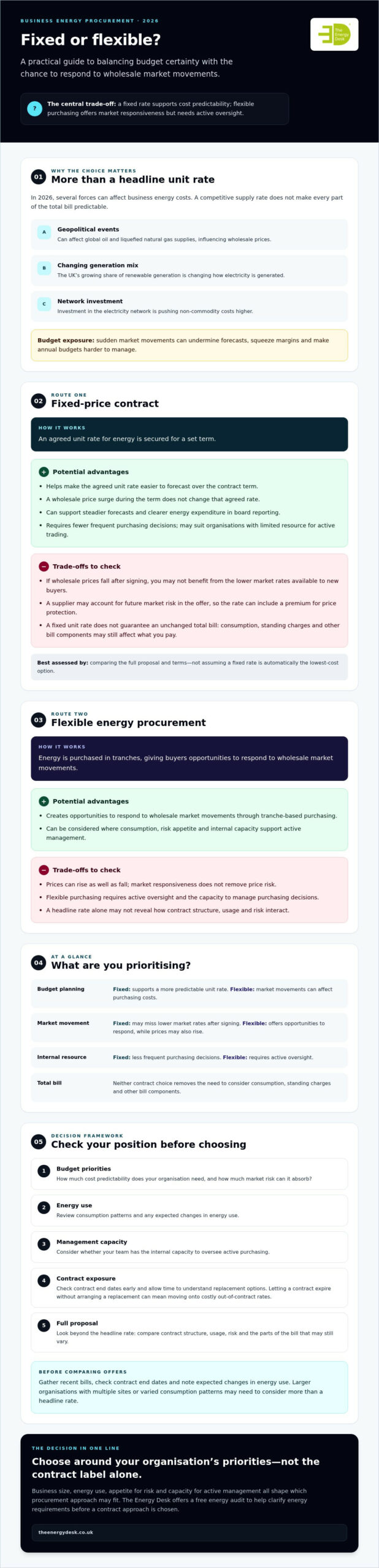
Procurement generally follows two routes. A fixed-rate contract secures an agreed unit rate for a set term, supporting more predictable budgeting. Flexible trading allows energy to be purchased in tranches, giving buyers opportunities to respond to wholesale market movements. However, prices can rise as well as fall, and flexible purchasing requires active oversight. Some long-term electricity arrangements take the form of a Power Purchase Agreement (PPA), a contract between a generator and a customer.
The Shift Towards Strategic Procurement
In a more complex market, procurement involves more than buying energy. It means understanding consumption, reviewing contract exposure, planning renewal timing and choosing an approach that matches business priorities. This is particularly relevant in 2026, when network charges and wholesale market movements can affect different parts of the bill in different ways.
Comparison sites may help with straightforward requirements, but can be less useful for larger organisations with multiple sites, varied consumption patterns or a need to consider flexible purchasing. A headline rate alone may not show how contract structure, usage and risk interact. Before comparing offers, gather recent bills, check contract end dates and note any expected changes in energy use. The Energy Desk’s free energy audit can help organisations clarify their requirements before deciding which procurement route to consider.
Fixed-Price Energy Contracts: Security and Budget Certainty
A fixed-price contract agrees a unit rate for energy over a set term. It can make one part of your budget easier to forecast, but it doesn’t guarantee an unchanging total bill: consumption, standing charges and other bill components may still affect what you pay. For SMEs with limited time or resource to monitor wholesale markets, a fixed deal can be a more manageable approach to procurement.
That certainty has a trade-off. Suppliers may account for the risk of future market movements when setting a fixed offer, so the rate can include a premium for price protection. The size and structure of an offer depend on market conditions and contract terms. Compare the full proposal rather than assuming a fixed rate is automatically the lowest-cost option.
The Pros of Going Fixed
Once the agreed unit rate is in place, a wholesale price surge during the contract term won’t change that rate. This can support steadier forecasts and make energy expenditure easier to explain in board reporting. It also reduces the need to make frequent purchasing decisions, which can suit organisations without dedicated resource for active trading. There’s less to monitor, although renewal dates and contract conditions still need attention.
Practical measures can complement procurement. Ofgem’s energy efficiency guidance offers a starting point for considering how business energy use may be managed alongside contract choices.
The Cons of Fixed-Price Agreements
A fixed rate limits your ability to benefit if wholesale prices fall after you sign. If the market drops, your contracted unit rate may be above the rates available to new buyers, depending on timing and terms. This is the central trade-off in the fixed vs flexible energy contract pros and cons: protection from rises means less opportunity to benefit from market lows.
Before agreeing, check how the contract handles changes in consumption, such as a site opening, closure or change in operating hours. Contract terms can differ, and a mismatch between assumed and actual use can complicate budgeting. Review volume tolerances and any relevant change provisions carefully.
In 2026, a fixed contract may suit an SME that values budget stability over the possibility of buying at a lower market rate. But no contract removes every cost risk. Compare the offered rate, term, volume conditions and other bill components, and consider whether efficiency improvements could help manage consumption. Businesses reviewing their options can explore The Energy Desk’s commercial energy procurement expertise.
Flexible Energy Procurement: Agility and Market Opportunity
Flexible procurement lets a business buy its forecast energy requirement in portions, or “tranches”, rather than fixing the whole volume at one point. Purchases are made over time against wholesale market prices, usually through a supplier and an agreed contract structure. If some energy is secured when market prices are lower, this can reduce the average commodity cost. It’s an opportunity, not a guaranteed saving: prices may rise before later tranches are bought.
This approach can suit organisations with substantial, predictable consumption and the resource to oversee purchasing decisions. For high-volume users, even small changes in the average price can have a material effect on overall energy spend. But scale alone isn’t enough. A business needs a clear risk framework, suitable decision-making authority and an understanding of how much price movement its budget can tolerate. Flexible trading is not automatically right for every large organisation.
The Advantages of Flexible Trading
Buying in layers spreads procurement across different market conditions. For example, a business might secure part of its forecast requirement in one purchasing window, then review its remaining exposure before placing further tranches. This can reduce reliance on a single buying date and provide opportunities to act when prices fall. The outcome depends on timing, purchasing rules and market movements, so establish those rules before trading begins.
Flexible contracts can also provide more visibility into the commodity element of the bill, separately from delivery and other charges. That distinction can help energy teams understand which costs market movements affect and which sit outside the purchasing strategy. Better consumption management can complement procurement. The UK government’s SME energy guide provides practical efficiency advice for smaller businesses.
The Risks of a Flexible Approach
Flexibility cuts both ways. If a business delays purchases and wholesale prices rise, it may have to secure later tranches at a higher level. Without defined limits and regular oversight, decisions can become reactive, inconsistent or difficult to explain. Set out who can approve purchases, how exposure will be reviewed and what actions are permitted in different market conditions.
Flexible purchasing also requires time and market understanding. A dedicated energy consultant can help translate market information into a structured purchasing approach, particularly where the organisation lacks in-house expertise. The Energy Desk provides business energy management services, including energy audits and bill validation. For organisations assessing procurement support, The Energy Desk’s commercial energy procurement services are a relevant place to start.
The fixed vs flexible energy contract pros and cons ultimately depend on whether your organisation can actively manage exposure in return for potential market opportunity. Define your risk appetite and oversight process first, then assess whether a flexible contract fits.
Fixed vs Flexible Energy Contract Pros and Cons: A Direct Comparison
There’s no single contract model that suits every organisation. Start with three questions: how much budget certainty do you need, how much energy do you use, and who has the time and expertise to oversee procurement? Higher consumption can make flexible purchasing more worthwhile because market movements affect a larger volume of energy. It also makes careful exposure management more important. A lower-volume organisation with limited capacity to monitor markets may place greater value on fixed-rate predictability.
Onsite generation changes the calculation. Solar or a CHP system can affect how much electricity a site needs to buy and when it draws energy from the grid. Procurement should reflect expected consumption after generation, as well as periods when the site may still need supply. Review operating patterns and generation alongside contract volume assumptions before deciding between fixed and flexible purchasing.
Which Model Suits Your Sector?
Manufacturing and heavy industry may have high, steady demand and the internal capacity to consider purchasing in tranches. That can make flexible procurement worth assessing, provided the business has clear controls and can tolerate price movements. Professional services and retail may favour fixed-rate stability when energy is a smaller operational focus or predictable costs are a priority. These are starting points, not rules: site usage and risk appetite matter more than sector labels.
For organisations with several sites, a single contract decision may not reflect every location’s consumption or renewal timing. Business energy portfolio management can help decision makers consider sites together, identify differing requirements and coordinate procurement planning. Compare each site’s usage and contract position before treating the portfolio as one uniform load.
The Hybrid Option: Can You Have Both?
Some procurement arrangements combine elements of fixed and flexible purchasing. A basket or group-buying approach may pool demand or use a defined purchasing strategy, but the structure, allocation of costs and decision-making terms need careful review. Another possible framework is to fix an agreed portion of expected base load and manage other volumes flexibly. Whether this is available or suitable depends on contract terms and the organisation’s ability to manage variable exposure.
Whichever model you choose, bill validation can help check that invoices reflect agreed contract terms and recorded usage. It doesn’t remove market risk, but it supports oversight and can help identify discrepancies for review. For a procurement assessment that considers consumption, onsite generation and contract structure together, discuss your business energy procurement options with The Energy Desk.
Optimising Your Energy Strategy with The Energy Desk
Market information only creates value when it informs a sound purchasing decision. In 2026, that means considering contract structure alongside consumption, budget priorities and the organisation’s capacity to manage risk. The Energy Desk helps businesses assess these factors and compare procurement options, rather than treating a headline rate as the whole decision.
A free energy audit can provide a practical starting point if you’re unsure whether fixed or flexible purchasing fits. Reviewing utility bills and energy requirements can help clarify current arrangements and identify questions to consider before renewal. The findings can give you a more informed basis for weighing the fixed vs flexible energy contract pros and cons against your organisation’s needs.
Professional Procurement and Risk Management
Flexible trading involves decisions about timing, purchase volumes and acceptable market exposure. These need clear oversight. Before choosing procurement support, establish what the arrangement includes: who tracks market information, how purchasing decisions are authorised, and how risks and costs will be explained to decision makers.
The Energy Desk supports commercial gas procurement and commercial electricity procurement. Its business energy procurement services can help organisations review their requirements and approach to purchasing. Compare contract terms and purchasing structures carefully, including how they align with budget plans and expected energy use.
Taking the Next Step: Your Free Energy Audit
An audit can help bring contract decisions into focus by reviewing relevant utility bills and the business’s energy requirements. This may help identify billing items to check, opportunities to improve energy use and details to clarify before a tender or renewal. The findings can inform the next procurement discussion, but shouldn’t be treated as a promise of a specific saving or contract outcome.
In 2026, a proactive approach gives your organisation time to understand its position before a renewal deadline creates pressure. The Energy Desk works with UK businesses on energy procurement and management. Use an audit to establish what matters most: cost predictability, potential market flexibility, or a considered balance between the two.
Contact The Energy Desk to arrange your free energy audit and take a structured first step towards a procurement strategy that reflects your business’s requirements.
Make Your 2026 Energy Strategy Work for Your Business
The right contract choice depends on your organisation’s priorities, energy use and ability to manage market exposure. Fixed purchasing can support more predictable budgets, whilst flexible procurement may offer opportunities to respond to wholesale movements, provided it’s managed with clear oversight. Match the approach to your operational needs rather than choosing on headline rates alone.
Understanding the fixed vs flexible energy contract pros and cons is a useful starting point, but your current contract position and consumption patterns matter too. A review can help identify what to clarify before renewal and inform a more proactive procurement plan for 2026.
The Energy Desk supports UK businesses with energy procurement and management, including commercial gas and electricity procurement. Start with a free energy audit to assess your requirements and consider which contract model may suit your organisation.
Request your free energy audit from The Energy Desk and take an informed step towards managing your energy procurement.
Frequently Asked Questions
What is the main difference between a fixed and flexible energy contract?
A fixed contract sets an agreed unit rate for a defined term, whilst a flexible contract allows energy to be purchased in portions at different times. Fixed purchasing can make the unit rate more predictable, although other bill components and actual consumption can still vary. Flexible purchasing creates opportunities to respond to wholesale market movements, but prices can rise as well as fall. These are the core fixed vs flexible energy contract pros and cons to weigh.
Is a flexible energy contract always cheaper than a fixed one?
No. Flexible procurement may benefit a business if purchases are made at favourable market levels, but wholesale prices can also rise before remaining energy is bought. The eventual cost depends on market movements, purchasing decisions, contract terms and the organisation’s energy use. A fixed offer may provide greater unit-rate predictability, but could appear less favourable if market prices subsequently fall. Compare the complete contract structure and risk, not just one rate or forecast.
Can a small business access flexible energy procurement in 2026?
Possibly, but availability and suitability depend on the supplier’s terms and the business’s consumption profile. Flexible contracts generally require active oversight, purchasing decisions and the capacity to manage price exposure. For an SME with limited resource, a fixed contract may be simpler to budget for, while flexibility could require external expertise. Before deciding, review your energy use, risk tolerance and contract options. An energy audit can help clarify what to ask about.
How often can I buy energy on a flexible contract?
There isn’t one universal purchasing frequency. The contract and agreed strategy determine when and how often tranches can be bought, and the approach may reflect market conditions, forecast consumption and the organisation’s risk limits. Before signing, ask how purchasing windows work, who authorises each transaction, what happens if expected usage changes, and how unpurchased volumes are treated. Make sure the process and reporting expectations are clear to everyone responsible for managing energy risk.
What happens if I don’t choose a contract and fall onto out-of-contract rates?
If an agreed contract ends without a replacement, your business may be placed on the supplier’s out-of-contract or deemed terms. These rates can be more expensive than a negotiated contract, so leaving renewal until the last moment can expose your budget to avoidable uncertainty. Check your contract end date and renewal conditions early, then contact your supplier or procurement adviser to understand your options. Review any new offer carefully before agreeing to its terms.
How does a CHP system affect my choice of energy contract?
A combined heat and power (CHP) system generates electricity and useful heat onsite, so it can change how much energy a business needs to buy from the grid and when. Your procurement decision should account for the system’s operating pattern, expected grid imports and any periods when demand exceeds onsite generation. Compare those requirements with contract volume terms before choosing fixed or flexible purchasing. A review of CHP operation and energy use can support more informed procurement planning.
What are the typical durations for business energy contracts in the UK?
Business contract terms vary by supplier, product and the organisation’s requirements. Offers may include shorter fixed terms, such as 12 months, as well as longer terms, including 24 to 36 months. A longer agreement may provide an extended period of unit-rate certainty, but it also commits the business for longer. Check renewal dates, termination provisions, volume conditions and how the quoted rate applies throughout the term before making a decision.
Do I need a half-hourly meter for a flexible energy contract?
Not necessarily in every case. Meter requirements depend on the supplier, contract structure and the business’s consumption and settlement arrangements. Half-hourly data can provide more detailed information about when energy is used, which may support consumption analysis and purchasing decisions. Ask prospective suppliers whether your meter setup qualifies for the flexible option being considered, what data is required, and whether any metering changes would be needed. Don’t assume eligibility based on business size alone.