


Upgrading plant machinery achieves very little if tariff discrepancies and misaligned operational schedules are quietly draining your corporate budget. If your organisation is grappling with erratic non-commodity network charges, preparing for ESOS Phase 4, or struggling to present a credible business case for energy retrofits to the board, you aren’t alone. Minimising operational disruption whilst attempting to decipher complex consumption profiles often stalls progress entirely. A thorough commercial energy efficiency audit resolves this dilemma by bridging utility bill validation with targeted, on-site technical inspection.
In this guide, you’ll discover how an audit uncovers hidden operational waste, protects your organisation against regulatory penalties, and decisively cuts enterprise utility expenditure. We examine immediate, zero-cost behavioural adjustments you can implement right away, alongside a practical methodology to formulate a prioritised capital investment schedule ranked by transparent payback periods.
Key Takeaways
- Understand the critical difference between high-level desktop utility analysis and a comprehensive on-site commercial energy efficiency audit that assesses physical plant performance.
- Pinpoint structural energy losses across critical operational centres, including mechanical HVAC systems, process machinery, thermal envelopes, and automated building controls.
- Establish full compliance with statutory UK mandates, such as ESOS Phase 4, using recognised technical standards like BS EN 16247 and ISO 50002.
- Follow an actionable site preparation checklist to organise billing data, half-hourly profiles, and plant registers before technical assessors arrive.
- Translate complex technical recommendations into a board-ready capital expenditure schedule, categorised into zero-cost operational wins and long-term infrastructure schemes.
What Is a Commercial Energy Efficiency Audit?
A commercial energy efficiency audit is a methodical operational evaluation designed to quantify how an enterprise consumes energy, identify structural waste, and align physical asset performance with commercial tariffs. Many corporate strategies falter by treating energy procurement and site-level engineering as isolated disciplines. A rigorous audit bridges this divide, verifying that the energy purchased at wholesale or retail rates actually serves productive on-site needs. Standard industry frameworks, such as a formal energy audit, trace the complete energy journey through a facility to drive down baseline demand and protect operating margins.
Desktop Consumption Review vs On-Site Inspection
Data interrogation provides the foundation for effective auditing. Analysts evaluate half-hourly (HH) data streams, network capacity charges, and utility contracts to flag out-of-hours baseload spikes, weekend consumption anomalies, and erratic peak demand profiles. These desk reviews expose where money is lost on paper, but they cannot pinpoint why.
Physical on-site assessments close that loop. Experienced engineers inspect physical building fabric, HVAC distribution, compressed air systems, and Building Management System (BMS) controls. They uncover faulty sensors, overridden thermostats, degraded heat exchangers, and uninsulated pipework. Pairing utility data analytics with hands-on site investigation delivers a verified operational diagnosis rather than speculative projections.
Regulatory Compliance and Corporate Mandates
For large UK businesses, regular assessments are mandatory. Mandatory schemes such as the Energy Savings Opportunity Scheme (ESOS) Phase 4 require qualifying enterprises to audit overall energy profiles every four years, with an increasing focus on demonstrable action plans. Similarly, Streamlined Energy and Carbon Reporting (SECR) dictates transparent annual emissions disclosures in Directors’ reports.
Conducting a comprehensive commercial energy efficiency audit ensures complete compliance with these evolving UK statutory frameworks. For organisations aligning energy performance with wider estate safety and legal duties, working with specialist providers such as Oxford Environmental Consultants (OEC) ensures multi-disciplinary property compliance is maintained across commercial portfolios. The process generates clean, defensible data that eliminates compliance risk and gives executive boards clear governance evidence to reassure institutional investors and audit committees.
Key Operational Focus Areas During an Energy Audit
Enterprise facilities waste substantial capital through miscalibrated plant and unmanaged baseload consumption. A thorough commercial energy efficiency audit moves past high-level consumption summaries to inspect the physical infrastructure driving your utility spend. Standardised methodologies, such as the DOE Building Energy Asset Score framework, illustrate that physical building fabric, active mechanical plant, and operational run hours must be evaluated together to establish an accurate performance baseline.
HVAC and Environmental Control Systems
Heating and cooling networks typically account for the largest proportion of building energy demand. Auditors inspect commercial boiler combustion efficiency, chilled water flow temperatures, and variable air volume systems. A frequent cause of waste is Building Management System (BMS) degradation, where drifting temperature sensors, stuck dampers, or manual operational overrides cause simultaneous heating and cooling. Implementing run-around coils or thermal wheels recovers valuable heat from building exhaust air to pre-condition incoming ventilation, substantially lowering boiler load.
Power Distribution, Lighting, and Industrial Motors
While upgrading luminaires to LED with daylight harvesting and passive infrared sensors provides straightforward savings, electrical distribution networks hold deeper efficiency potential. Technical assessors evaluate motor load factors, identifying oversized equipment running continuously below peak efficiency. Adding variable speed drives to pumps and fans eliminates throttling losses. Assessors also analyse power factor and incoming voltage levels; correcting poor power factor prevents supplier penalties, while voltage optimisation protects sensitive machinery and trims unnecessary electrical draw.
Compressed Air and Process Thermal Efficiency
Compressed air networks remain one of the most expensive and inefficient utilities across manufacturing plants. During operational audits, engineers use ultrasonic acoustic detection to trace line leaks without disrupting active shifts. In thermal loops, faulty steam traps and uninsulated pipework lead to rapid thermal dissipation. Capturing high-temperature exhaust heat from continuous processes or integrating on-site CHP systems allows high-demand facilities to generate low-carbon power while repurposing rejected thermal energy directly into site heating.
Comparing Commercial Energy Audit Services and Methodologies
Selecting the right commercial energy efficiency audit depends on matching the investigation’s depth to your organisation’s financial objectives. Audits range from rapid operational screenings to capital-intensive feasibility studies. Two primary international standards govern these procedures: BS EN 16247 across the UK and Europe, and ISO 50002 globally. Both standards establish clear protocols for data collection, site measurements, and reporting transparency, preventing generic estimates from being presented as verified engineering conclusions.
Walk-Through Preliminary Surveys vs Investment-Grade Audits
Technical assessments generally follow a three-tiered progression that dictates analytical rigor:
- Level 1 (Walk-Through Survey): A qualitative review of operational practices, controls, and visible plant condition. It prioritises immediate, no-cost behavioural adjustments and basic maintenance fixes.
- Level 2 (Detailed Energy Assessment): A quantitative analysis incorporating sub-meter profiles, thermal imaging, and operating schedules. It establishes baseline energy balances and calculates financial returns for mid-scale plant retrofits.
- Level 3 (Investment-Grade Audit): A rigorous technical appraisal featuring calibrated energy models, dynamic thermal simulations, and continuous data logging. This level produces bankable financial business cases suitable for significant capital expenditure and board sign-off.
Selecting Accredited Technical Assessor Standards
Internal maintenance teams often carry out initial walkthroughs, but an internal assessment lacks the independent objectivity required for major capital allocation or statutory compliance. Engaging certified Lead Assessors and Chartered Energy Engineers guarantees adherence to BS EN 16247 methodologies. Independent experts bring deep sector-specific benchmarks, identifying inefficiencies that in-house teams overlook through operational habit.
Auditing physical infrastructure without interrogating supply contracts introduces substantial financial distortion. Baseline consumption calculations can be skewed if utility billing contains unrecognised supplier estimation errors, incorrectly applied climate change levies, or reactive power penalties. Integrating forensic commercial utility bill validation prior to physical site surveys ensures engineers work exclusively with verified data. This integrated approach ensures every projected payback period reflects genuine fiscal savings rather than billing discrepancies.
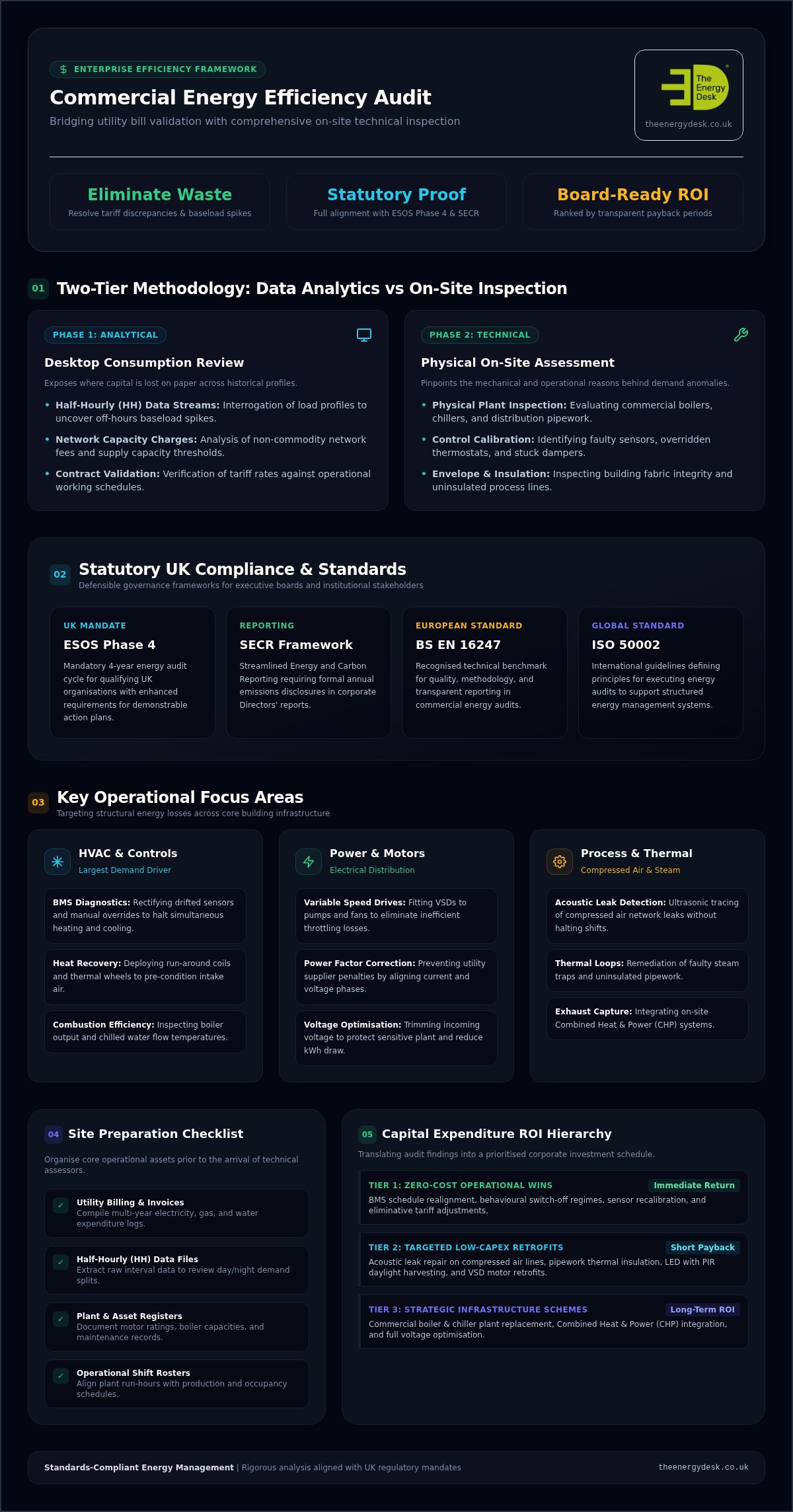
The Enterprise Energy Audit Preparation Checklist
Thorough preparation ensures your commercial energy efficiency audit runs efficiently and yields precise recommendations. Auditors rely on historical records, architectural documentation, and transparent operational context to determine where plant adjustments will deliver genuine savings. Collating these materials beforehand prevents delays during on-site inspections.
Phase 1: Compiling Historical Consumption Records
Engineers must first understand your baseline consumption trends. Gather at least 24 months of half-hourly (HH) electricity data profiles alongside daily gas records. If your estate operates secondary energy sources, retrieve delivery logs for fuel oil, biomass, or liquefied petroleum gas. You should also pull complete tariff schedules and supplier agreements secured via business electricity procurement. Having contract terms readily available allows assessors to model the financial impact of off-peak load shifting with high accuracy.
Phase 2: Technical Asset and Facility Documentation
Physical plant schematics are essential for verifying equipment boundaries and load allocations. Ensure your engineering team organises the following records:
- Up-to-date mechanical asset registers listing machinery age, rated electrical capacities, and service histories.
- Electrical single-line distribution diagrams (SLDs) and mechanical ventilation layouts.
- Building Management System (BMS) administrative login credentials, including remote interface privileges.
- Floor plans highlighting recent structural modifications, mezzanine additions, or thermal fabric changes.
Phase 3: Operational Logistics and Staff Briefings
An audit shouldn’t disrupt active production shifts. Notify plant managers, shift supervisors, and resident facilities contractors well ahead of the scheduled inspection. Clarify access requirements for secure plant rooms, high-voltage substations, and rooftop chiller enclosures. Ensure site security has visitor badges and Personal Protective Equipment (PPE) ready, and confirm mandatory health and safety induction times. Briefing departmental heads also helps auditors log recurring temperature, ventilation, or lighting complaints across specific production zones.
To streamline your compliance strategy and identify immediate efficiency gains across your property portfolio, contact our technical utility consultants to schedule a site review.
Transforming Audit Recommendations into Measurable Financial ROI
An engineering report delivers zero fiscal value if it sits unread on a shelf. Securing board approval requires transforming technical findings into a commercially structured investment schedule. A thorough commercial energy efficiency audit separates recommendations into clear financial payback bands, allowing financial directors to fund capital-intensive plant retrofits using cash freed up by low-cost operational fixes.
Categorising Interventions by Financial Payback
Executive stakeholders respond to clear hurdle rates and straightforward payback timelines. Organise audit actions into three distinct capital expenditure tiers:
- Tier 1 (Immediate / Zero-Cost): Interventions with paybacks under 12 months. These include resetting BMS operational schedules, adjusting temperature deadbands, eliminating compressed air leaks, and enforcing staff shutdown policies.
- Tier 2 (Medium-Cost Retrofits): Measures yielding returns within two to four years. Typical schemes involve retrofitting variable speed drives to water pumps, upgrading legacy distribution transformers, and fitting localized heat recovery systems.
- Tier 3 (Strategic Capital Infrastructure): Long-term investments with paybacks exceeding four years. These involve major plant modernisations that align with the business case for commercial renewable energy.
Long-Term Generation: Solar, CHP, and Storage
Heavy energy users can combine demand reduction with behind-the-meter generation. For manufacturing and processing plants requiring consistent heat alongside baseline electricity, evaluating a CHP system installation for businesses delivers significant primary energy savings. Rooftop solar PV installations should be sized precisely against audited daytime baseloads to avoid exporting low-value power back to the grid. Incorporating commercial battery storage and preparing charging capacity for fleet electrification locks in long-term resilience against volatile transmission charges.
Establishing Long-Term Measurement and Verification (M&V)
Achieving projected savings requires continuous validation. Research demonstrates that without active monitoring, efficiency gains can degrade by 10% to 15% within two years due to system overrides and uncalibrated instrumentation. Establishing a formal Measurement and Verification (M&V) protocol, aligned with the International Performance Measurement and Verification Protocol (IPMVP), ensures savings remain robust.
Track normalised, weather-adjusted utility data against post-audit baseline targets via automated sub-metering. Coupling continuous technical verification with competitive wholesale pricing secured through structured business gas procurement protects operating margins across subsequent financial years.
Securing Long-Term Utility Reductions for Your Estate
Bridging utility bill validation with rigorous on-site mechanical inspection removes the guesswork from enterprise utility management. Aligning your operational schedules, eliminating baseline drift, and addressing statutory mandates like ESOS Phase 4 creates immediate fiscal stability. When you rank interventions into clear payback tiers, technical recommendations become board-approved investment opportunities. A structured engineering assessment provides the clarity required to eliminate unneeded overheads whilst driving decarbonisation targets forward.
Backing your operational strategy with over two decades of national UK utility auditing and commercial procurement expertise, The Energy Desk offers comprehensive project support from preliminary desk reviews through to major capital installations. We’ve delivered proven multi-million-pound savings across complex industrial, logistics, and commercial property portfolios, ensuring every technical intervention delivers verified returns. Request an independent commercial energy efficiency audit to take command of your utility spend and build lasting resilience.
Frequently Asked Questions
What is the main difference between an ESOS assessment and a voluntary energy audit?
An ESOS assessment is a legally mandated compliance exercise for qualifying large UK enterprises, requiring formal sign-off from a registered Lead Assessor and board-level reporting. In contrast, a voluntary commercial energy efficiency audit is driven purely by commercial strategy, cost-reduction targets, or internal sustainability goals. While ESOS audits follow prescriptive statutory guidelines, voluntary audits can focus entirely on specific high-consumption assets, tailored payback thresholds, or bespoke infrastructure upgrades without regulatory constraints.
How long does a thorough commercial energy efficiency audit take to complete?
A standard audit cycle typically spans two to four weeks from initial data onboarding to final report presentation. The preliminary desk review and billing analysis require three to five days, followed by an on-site physical walk-through lasting one to two days depending on estate size. The remaining time is dedicated to sub-meter profile analysis, thermal calculations, and financial modelling to ensure the final report provides accurate, bankable capital estimates.
Will an on-site energy inspection disrupt our day-to-day manufacturing or office operations?
On-site inspections cause no operational downtime or disruption to normal business workflows. Assessors use non-intrusive diagnostic tools, such as thermal imaging cameras, ultrasonic leak detectors, and portable data loggers, which don’t require machinery shutdown or electrical isolation. Engineering inspections of plant rooms, distribution boards, and rooftop chillers are coordinated around shift rotas and scheduled maintenance windows to maintain standard production output without interference.
What data do we need to supply before the auditor visits our commercial premises?
You should provide at least 12 to 24 months of half-hourly electricity profiles, daily gas billing records, and active utility supply contracts. Supplementing this data with single-line electrical distribution schematics, mechanical plant asset registers, and floor plans accelerates the discovery phase. Giving the audit team administrative BMS login credentials beforehand ensures engineers can evaluate time clock settings, temperature deadbands, and baseline control programming prior to arriving on site.
How quickly do organisations typically recover the financial cost of an audit?
Most enterprises recover audit costs within 8 to 16 months through the implementation of zero-cost and low-cost operational adjustments. Eliminating out-of-hours baseload run time, recalibrating BMS setpoints, and repairing compressed air leaks frequently generates immediate savings of 10% to 30%. Because these operational wins require minimal capital outlay, the resulting utility reductions offset professional fees long before major equipment retrofits are commissioned.
Can an energy audit help resolve issues with our commercial utility standing charges?
Yes, an audit frequently identifies misaligned non-commodity costs by examining half-hourly peak demand data against contracted network capacity. Assessors evaluate your agreed Available Capacity (kVA) to determine whether your business pays for redundant grid headroom or incurs avoidable excess capacity penalties. When paired with comprehensive bill validation and updated DC/DA or MOP contracts, an audit helps right-size network agreements to lower ongoing non-commodity expenditure.
What happens after the audit report is delivered to our management team?
Once the report is delivered, the consultancy presents the findings to your executive team, breaking down capital expenditure proposals by payback priority. You receive an actionable implementation roadmap covering quick operational wins alongside long-term project viability studies, such as solar PV or CHP systems. Continuous Measurement and Verification (M&V) protocols are then established, tracking subsequent utility consumption against baseline targets to prevent savings degradation over future operating cycles.