


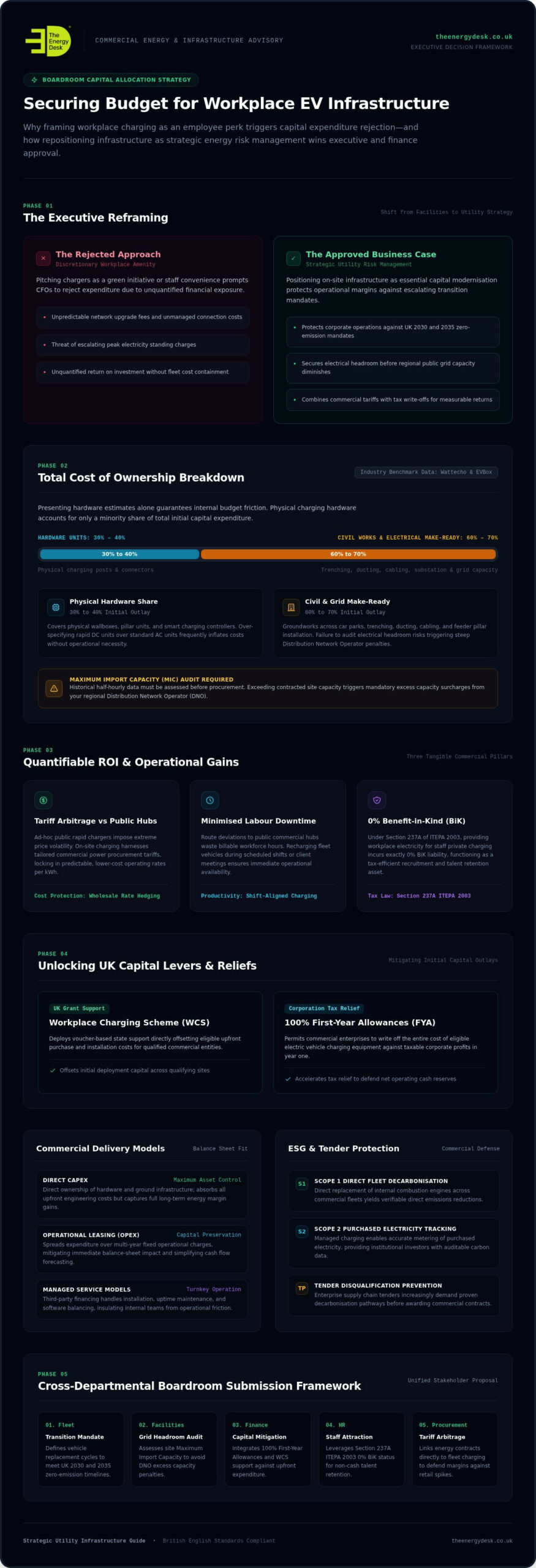
Pitching workplace charging as a corporate perk or a green initiative is the fastest way to have your capital expenditure request rejected. To understand how to get budget for workplace EV chargers past a cautious finance director, you must frame the project as strategic energy risk management rather than a discretionary facilities cost. CFOs are right to scrutinise proposals when faced with unpredictable network upgrade fees, unquantified returns, and the threat of rising peak electricity standing charges.
You don’t have to battle finance teams when the numbers stand on their own merit. By pairing your deployment strategy with available UK support, such as the Workplace Charging Scheme and 100% First-Year Allowances, you can mitigate capital outlays whilst establishing significant fleet and operational efficiencies.
This guide provides a structured framework to map commercial savings, leverage available government incentives, and align utility procurement to protect your corporate margins from unexpected grid penalties.
Key Takeaways
- Position charging infrastructure as a strategic utility asset that directly supports corporate fleet transition targets rather than a discretionary workplace amenity.
- Assess on-site electrical capacity and utility connection feasibility prior to hardware procurement to prevent unmanaged network charges and expensive grid upgrades.
- Discover how to get budget for workplace EV chargers by combining active UK grant schemes, such as the Workplace Charging Scheme, with 100% First-Year Allowances.
- Compare direct capital expenditure with operational leasing and managed service models to identify the optimal delivery structure for corporate balance sheets.
- Structure a cross-departmental proposal that links long-term electricity procurement and tariff management directly to tangible return on investment.
Building the Financial Foundation: Why Workplace EV Charging Demands a Strategic Business Case
Treating charging points as non-core facilities costs inevitably triggers executive pushback. To master how to get budget for workplace EV chargers, you must reframe the installation as an essential capital upgrade tied directly to core operational resilience. The UK’s zero-emission mandates for 2030 and 2035 mean commercial transport transition is no longer optional. Deferring action exposes organisations to escalating operational disruption, compliance penalties, and expensive reactive installations once public grid capacity in your area diminishes.
A successful internal submission aligns procurement, facilities management, HR, and finance into a single stakeholder coalition. Presenting a fragmented view invites budget delays. Instead, demonstrate how modern electric vehicle charging stations serve mutual priorities, protecting operating margins while modernising on-site infrastructure.
Aligning Commercial EV Infrastructure with Corporate ESG Objectives
Workplace charging delivers measurable reporting gains across Scope 1 direct fleet reductions and Scope 2 purchased electricity tracking. Corporate tenders increasingly require proven decarbonisation roadmaps before awarding enterprise supply contracts. Establishing managed infrastructure verifies regulatory compliance, shielding your firm from procurement disqualification and demonstrating concrete sustainability governance to institutional investors.
Quantifying Fleet Operational Efficiencies and Employee Retention
The operational logic behind on-site power infrastructure centres on cost control and staff productivity:
- Tariff Arbitrage: Relying on ad-hoc public rapid chargers introduces severe wholesale price volatility. Charging fleet vehicles on-site allows organisations to leverage tailored commercial electricity procurement tariffs, securing predictable running costs per kilowatt-hour.
- Minimised Downtime: Route deviations to off-site commercial hubs waste billable labour hours. Charging vehicles whilst drivers attend standard shifts or meetings ensures fleet readiness without dedicated refuelling windows.
- Recruitment Advantage: Offering workplace charging serves as a competitive, tax-efficient benefit-in-kind. Under Section 237A of ITEPA 2003, providing workplace electricity to staff for private vehicle charging incurs 0% Benefit-in-Kind liability, strengthening talent retention at negligible relative cost.
Addressing these commercial realities transforms the proposal. Demonstrating clear cost containment and workforce advantages ensures you show leadership exactly how to get budget for workplace EV chargers through tangible returns on investment.
Calculating the Total Cost of Ownership: Capital, Capacity, and Grid Connection
Hardware procurement represents only a fraction of the actual capital expenditure required for electrification. According to industry data from Wattecho and EVBox, physical charging units account for just 30% to 40% of initial project costs, with civil engineering, groundworks, and electrical make-ready infrastructure absorbing the remaining 60% to 70%. When preparing your proposal for how to get budget for workplace EV chargers, presenting hardware estimates alone guarantees financial friction later. CFOs expect a comprehensive total cost of ownership model that reflects network realities, ongoing software management, and tariff exposure.
Assessing Site Maximum Import Capacity and Infrastructure Readiness
Before purchasing hardware, audit your historical half-hourly data to establish available electrical headroom. Exceeding your site’s Maximum Import Capacity triggers steep excess capacity penalties from your regional Distribution Network Operator. Incorporating expert workplace charging planning guidance helps you evaluate whether physical substation upgrades are necessary or whether smart management can avoid them entirely.
Balancing Hardware Procurement with Civil Engineering and Groundworks
Trenching, ducting, and cabling across car parks quickly outstrip hardware expenses. Boards often overestimate the need for rapid DC systems when standard 7.4 kW to 22 kW AC destination chargers match typical employee dwell times of six to eight hours. Deploying smart Dynamic Load Management balances power draw across charging points in real time, preventing local substation overloads without requiring expensive network reinforcement.
Mitigating On-Peak Commercial Electricity Tariffs and Standing Charges
Unmanaged charging can drive peak electricity demand charges up to 30% to 70% of a commercial facility’s monthly utility spend. Review your half-hourly Meter Operator arrangements and data collection services to ensure billing transparency across all assets. Aligning your infrastructure rollout with strategic electricity procurement for UK organisations ensures you secure flexible commercial electricity tariffs and scheduled off-peak charging regimes. To safeguard your return on investment, engage The Energy Desk to assess connection feasibility and review billing accuracy before finalising hardware commitments.
A transparent lifecycle budget showing software fees, maintenance provisions, and managed power demand proves to the board that your business case is built on rigorous operational forecasting, showing exactly how to get budget for workplace EV chargers without budget overruns.
Unlocking External Capital: Government Grants, Subsidies, and Tax Allowances
Internal capital expenditure hurdles often stall sustainability proposals before they reach executive sign-off. Securing CFO buy-in requires demonstrating that external mechanisms can shoulder a significant portion of the upfront cost. When finance directors review how to get budget for workplace EV chargers, they look beyond simple cash flow deductions to see how fiscal policy compresses the project’s net outlay and payback horizon.
By layering public grant support alongside corporate tax reliefs, organisations can bridge the gap between initial investment requirements and executive capital thresholds.
Navigating the UK Workplace Charging Scheme (WCS) Rules
The primary direct subsidy route remains the Office for Zero Emission Vehicles (OZEV) Workplace Charging Scheme, which has been extended to 31 March 2027. Under official Workplace Charging Scheme guidance, qualifying organisations can claim up to 75% of purchase and installation costs, capped at £500 per socket across a maximum of 40 sockets per applicant business (£20,000 total). While the separate EV Infrastructure Grant for Staff and Fleets closed to new applicants on 31 March 2026, the WCS continues to provide crucial co-funding. To protect grant redemption, works must be carried out by an OZEV-approved installer following voucher issuance.
Leveraging Capital Allowances and Corporate Tax Relief
Strategic fiscal relief dramatically alters investment economics on company balance sheets:
- 100% First-Year Allowance (FYA): Commercial organisations investing in qualifying electric vehicle chargepoint plant and machinery can deduct the full 100% of the cost against taxable corporate profits in year one. This targeted allowance is active until 31 March 2027.
- Writing-Down Allowance Adjustments: For assets that fall outside first-year expensing rules, the UK main-rate writing-down allowance reduced from 18% to 14% on 1 April 2026. This adjustment makes the immediate cash-flow benefit of the dedicated 100% FYA even more advantageous for corporate balance sheets.
- Self-Funding via Utility Audits: Combining tax write-downs with retrospective bill validation audits across your existing commercial energy estate can recover historical utility overcharges, unlocking internal operating cash to fund civil groundworks.
Demonstrating how these fiscal allowances stack against gross installation costs shows financial controllers how to get budget for workplace EV chargers whilst delivering lower hurdle rates and rapid capital recovery.
Comparing Financial Delivery Frameworks: Capex, Opex, and Alternative Models
Securing executive sign-off often hinges on matching the commercial delivery structure to internal balance sheet preferences. When establishing how to get budget for workplace EV chargers, you must decide whether to deploy upfront capital or absorb recurring operating expenditure. Each funding route shifts risk, tax liability, and asset control differently across your corporate structure.
Direct Capital Expenditure vs Infrastructure-as-a-Service Contracts
Direct ownership requires immediate cash commitment but offers maximum lifetime control and avoids third-party margin stacking. It allows businesses to capture full depreciation benefits and retain direct revenue from power tariffs. Conversely, an operational expenditure model, such as Charging-as-a-Service, shifts hardware procurement, groundworks, software management, and maintenance into a fixed monthly operating charge. This approach transfers technical obsolescence risk and service-level agreements to external suppliers, bypassing rigid annual capital expenditure committees.
Integrating generation assets offers another pathway to soften capital hurdles. Reviewing our commercial renewable energy business case guide explains how co-locating solar solutions can offset new grid demand whilst providing lower-cost on-site generation for fleet charging.
Implementing Revenue Generation and Cost Recovery Tariffs
Workplace infrastructure does not need to operate as a financial sinkhole. Establishing automated back-office controls enables tailored billing structures across diverse user groups:
- Tiered Tariff Structures: Grant preferential electricity rates to commercial fleets and staff whilst setting commercial markups for public or visitor charging sessions.
- Idle Overstay Penalties: Introduce automated hourly fees once a battery reaches capacity. This discourages bay blocking and maintains high asset utilisation across business hours.
- RFID and App Authorisation: Ring-fence departmental fleet power usage from general employee consumption to guarantee accurate inter-departmental cross-charging.
- Salary Sacrifice Integration: Link workplace socket access to broader corporate electric car schemes, letting employees contribute toward infrastructure costs through gross salary deductions.
Organisations can also unlock internal capital by identifying historical billing errors. Uncover hidden estate savings by discovering commercial utility bill validation methods today to repurpose reclaimed cash into EV deployment. To explore the ideal commercial structure for your property portfolio, contact The Energy Desk to review available delivery frameworks before finalising vendor contracts.
Aligning delivery structures with balance sheet objectives ensures you demonstrate how to get budget for workplace EV chargers that meet executive governance criteria.
Crafting the Final Proposal: Presenting Your EV Business Case to the Board
A successful executive proposal speaks the language of the boardroom. When determining how to get budget for workplace EV chargers approved, your pitch must shift away from technical specifications and centre on financial risk, capital efficiency, and long-term asset value. CFOs don’t reject projects because they dislike sustainability; they reject proposals that present open-ended liabilities, vague operational timelines, or disconnected utility costs. A structured, one-page executive summary highlighting clear net figures, sensitivity models, and payback horizons immediately separates your proposal from generic departmental requests.
Aligning Facilities, HR, Fleet, and Finance Stakeholders
Securing capital requires a cohesive coalition. When internal departments present competing priorities, finance boards hesitate. You can eliminate organisational friction by giving each department leader a defined stake in the project outcome:
- Finance: Deliver transparent cash-flow modelling that combines capital tax allowances, grant subsidies, and lower kilowatt-hour fuel costs.
- Facilities Management: Ensure electrical headroom security through dynamic load management, protecting main intake switchgear from capacity breach penalties.
- Fleet Operations: Establish predictable pence-per-mile operating margins that decouple company logistics from expensive public rapid charging networks.
- Human Resources: Provide zero-BiK charging access that enhances employee value propositions and supports salary sacrifice adoption.
Presenting Risk Mitigation and Whole-Estate Utility Integration
Your final board submission must contain robust sensitivity analyses. Model scenarios that account for fluctuating wholesale power rates and progressive fleet expansion over a five-to-ten-year horizon. Demonstrate that your infrastructure won’t expose the organisation to crippling peak demand penalties by pairing smart charge point scheduling with site-wide commercial electricity contracts. Independent energy management expertise de-risks connection engineering and prevents budget surprises during civil groundworks. Schedule a consultative site and infrastructure audit with The Energy Desk to validate grid headroom, align commercial contracts, and build an airtight proposal showing how to get budget for workplace EV chargers on your balance sheet.
Securing Executive Approval for Your EV Infrastructure
A CFO-ready proposal bridges the gap between commercial fleet mandates and disciplined energy management. When you treat charging facilities as a strategic operational asset rather than an isolated facilities expense, the commercial logic becomes compelling. By stacking available subsidies and capital allowances against rigorous load assessments, you eliminate the threat of grid penalties and unbudgeted capital calls.
Understanding how to get budget for workplace EV chargers is ultimately about presenting verified numbers. Independent business energy consultancy The Energy Desk has delivered strategic procurement and project-based utility connections since 2003. Our specialists help organisations de-risk infrastructure investments, evaluate network headroom, and conduct forensic utility audits to uncover budget-releasing historical billing overcharges.
Take control of your organisation’s energy transition today. Request a Comprehensive Workplace Energy and EV Feasibility Audit to build an irrefutable business case that delivers lasting operational resilience.
Frequently Asked Questions
How do I justify the cost of workplace EV chargers to my CFO?
Justify the investment by framing chargers as operational risk management and fleet fuel reduction rather than facilities expenditure. On-site commercial power rates drastically undercut volatile public charging networks for commercial fleets. When evaluating how to get budget for workplace EV chargers, present a lifecycle model incorporating 100% First-Year Allowances, Workplace Charging Scheme grants, and documented workforce retention benefits to prove rapid capital recovery.
What government grants are currently available for commercial EV charger installations in the UK?
The primary subsidy route is the Workplace Charging Scheme (WCS), open until 31 March 2027. It covers up to 75% of purchase and installation costs, capped at £500 per socket across a maximum of 40 sockets (£20,000 total per business). Note that the separate EV Infrastructure Grant for Staff and Fleets closed to new applicants on 31 March 2026.
Can our business charge employees and visitors for electricity consumed at work?
Yes, modern back-office management systems allow organisations to configure automated billing schedules. You can provide cost-price or subsidised power to employees via RFID cards or mobile applications whilst setting commercial market rates for visitors. Implementing idle overstay fees after a battery reaches capacity encourages driver rotation, preventing bay blocking and protecting asset availability throughout normal operational hours.
What happens if our commercial site does not have enough electrical capacity for chargers?
Insufficient electrical headroom doesn’t automatically mean you must pay for costly substation upgrades. Deploying smart Dynamic Load Management balances power delivery across chargers in real time based on your building’s live electricity demand. Where capacity increases are unavoidable, completing a professional utility connection feasibility study ensures network reinforcements are scoped accurately without incurring unmanaged regional network penalty fees.
Is direct capital purchase better than an operational lease or subscription model?
The right delivery model depends entirely on internal capital allocation priorities. Direct capital purchase offers the greatest lifetime return on investment, full revenue retention, and immediate tax write-down benefits. Conversely, operational leases or managed service contracts absorb maintenance liabilities, cellular networking fees, and hardware obsolescence into predictable monthly operating expenses, effectively bypassing rigid board-level capital expenditure committees.
How quickly can an organisation expect a return on investment from EV infrastructure?
Most commercial organisations achieve full financial breakeven within two to four years. Fleet electrification delivers the fastest payback by replacing expensive rapid public refuelling with controlled on-site commercial electricity contracts. Highlighting how historical overcharge recoveries from utility bill validation can self-fund installation works demonstrates to executive teams how to get budget for workplace EV chargers with minimal risk.
Does installing workplace charging affect our overall commercial electricity contract rates?
Adding charging infrastructure increases overall site power consumption and peak electricity demand, which directly impacts supply contract structures. If unmanaged, simultaneous charging can exceed your agreed Maximum Import Capacity, triggering steep excess capacity charges. Reviewing half-hourly metering data and timing charging windows away from peak operational hours ensures your business negotiates optimal commercial electricity procurement rates.