


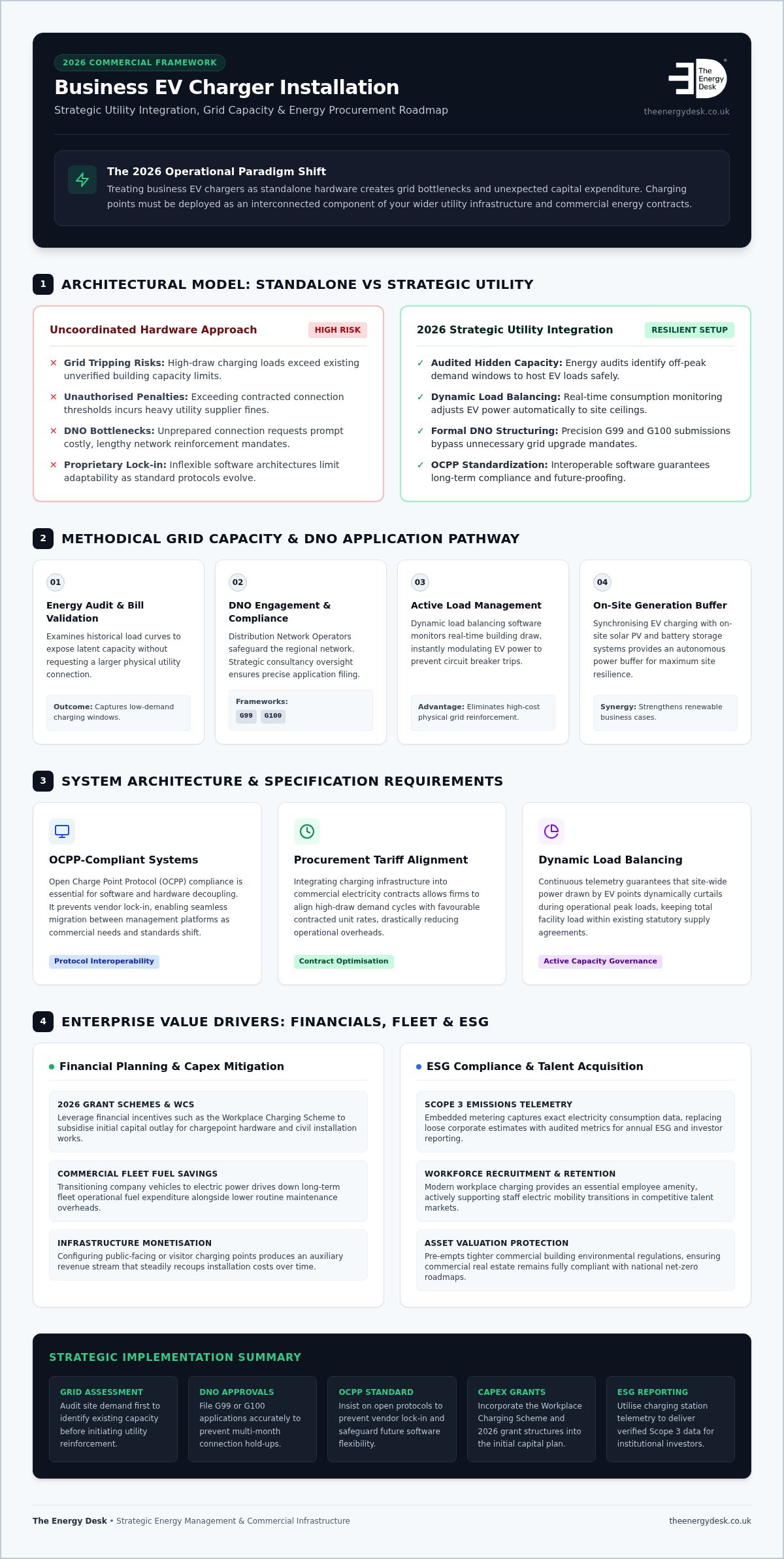
By 2026, a business EV charger installation is no longer a mere facility upgrade; it is a critical component of your firm’s wider energy procurement strategy. Treating charging points as standalone hardware often leads to unforeseen costs and grid capacity issues that can stall a project before it begins. To achieve a truly resilient setup, you must view your charging network as a dynamic part of your utility infrastructure rather than a simple plug-and-play addition.
We understand that the prospect of managing complex utility connections whilst balancing high upfront capital expenditure is a significant hurdle for many UK enterprises. It’s a challenging landscape where technical requirements often outpace internal expertise, leaving decision-makers concerned about future-proofing. This guide provides a methodical roadmap to help you bypass these bottlenecks, ensuring your infrastructure is both scalable and fiscally responsible from the outset.
You’ll discover how to navigate the technicalities of DNO applications, integrate charging with your existing commercial electricity contracts for maximum ROI, and protect your site against evolving technological standards. We will also outline how a strategic approach to energy audits can transform your EV transition from a logistical burden into a powerful driver for enhanced ESG credentials and reduced operational overheads.
Key Takeaways
- Determine how to navigate grid capacity constraints and the DNO approval process to avoid project delays and unnecessary infrastructure costs.
- Learn how to integrate a business EV charger installation into your wider energy procurement strategy to maximise operational ROI.
- Evaluate hardware and software specifications, prioritising OCPP-compliant systems to ensure your infrastructure remains flexible as technology evolves.
- Identify current financial incentives and 2026 grant schemes, including the Workplace Charging Scheme, to mitigate initial capital expenditure.
- Discover how to synchronise EV charging with broader energy management solutions to enhance site efficiency and meet corporate ESG targets.
The Strategic Business Case for EV Infrastructure in 2026
By 2026, the transition to electric mobility has reached a tipping point where commercial facilities without charging infrastructure face a tangible competitive disadvantage. A business EV charger installation is no longer a luxury; it’s a foundational requirement for any enterprise looking to maintain its market position. It serves as a visible marker of your firm’s operational modernisation and its readiness for a decarbonised economy.
Integrating these systems into your site does more than just power vehicles. It significantly bolsters the business case for commercial renewable energy UK by acting as a flexible load that can be synchronised with on-site generation. This synergy protects property values by ensuring assets remain compliant with tightening environmental standards whilst providing the necessary infrastructure for both staff and visitors.
ESG and Corporate Responsibility
Environmental, Social, and Governance (ESG) frameworks have evolved to require more than just intent. In 2026, stakeholders demand granular data on carbon reduction. Implementing electric vehicle charging stations allows firms to capture precise telemetry on energy usage, which is essential for accurate Scope 3 emissions reporting. This transparency builds trust with investors who prioritise organisations with clear, data-backed sustainability roadmaps. By using these metrics in annual reports, you demonstrate a methodical commitment to national net-zero targets rather than relying on vague corporate promises.
Commercial Benefits and Workplace Attraction
The battle for top-tier talent is increasingly fought on the grounds of workplace benefits. Providing reliable charging facilities is a powerful tool for recruitment and retention, as employees expect their employers to support their personal shift to electric mobility. Beyond talent, a business EV charger installation offers direct fiscal advantages. It allows for the electrification of company fleets, which reduces long-term fuel expenditure and maintenance costs. Some organisations also choose to monetise their infrastructure by offering public-facing chargers, creating a new revenue stream that offsets the initial capital outlay. This proactive approach ensures your operations remain efficient and attractive in a rapidly changing commercial environment.
Navigating Grid Capacity and Power Supply Requirements
Grid capacity represents the maximum electrical load your facility’s connection to the local network can sustain. In the context of a business EV charger installation, capacity is the primary technical hurdle. Most commercial buildings were designed for specific operational loads that did not account for the high-draw requirements of multiple electric vehicles. Attempting to install chargers without verifying this limit risks tripping main breakers or incurring significant unauthorised usage penalties from your provider.
Identifying hidden capacity is often a more cost-effective first step than requesting a new connection. Through a methodical energy audit and rigorous bill validation, it’s possible to identify periods of low demand where EV charging can be safely integrated. If physical limits are reached, strategic alternatives like on-site solar PV or battery storage systems can provide the necessary buffer. These solutions allow you to bypass expensive grid reinforcements whilst improving your site’s overall resilience.
The DNO Application Process
The Distribution Network Operator (DNO) owns the infrastructure that delivers power to your site. They must approve any significant increase in demand to ensure local network stability. This involves submitting G99 applications for larger installations or G100 applications for systems using export limitation. Managing this technical dialogue is complex; a consultancy acts as a strategic ally to navigate these utility connections. Expert oversight ensures applications are accurate, reducing the likelihood of the DNO mandating costly and time-consuming network upgrades that could stall your project for months.
Active Load Management vs. Grid Upgrades
Active load management, or dynamic load balancing, is a sophisticated alternative to physical infrastructure expansion. This technology monitors the building’s total energy consumption in real time and adjusts the power delivered to each charger accordingly. If your primary operations require a sudden surge in power, the charging network automatically throttles down to protect the system. This approach aligns with current Workplace Charging Scheme guidance by promoting efficient resource use.
Integrating these loads with strategic electricity procurement is essential for fiscal responsibility. By aligning your charging behaviour with off-peak tariffs, you can significantly reduce operational costs. Before finalising your hardware choices, we recommend you arrange a professional energy audit to establish your site’s true electrical baseline.
Selecting Hardware and Software for Commercial Use Cases
Choosing the right hardware is a critical decision that impacts both user experience and long-term maintenance costs. For a high-traffic workplace, socketed chargers are typically the most robust choice. They remove the risk of cable damage from frequent use and allow drivers with different vehicle types to use their own leads. Conversely, tethered units are often more suitable for dedicated fleet bays where speed of connection is a priority. Access control is equally important; RFID cards offer a reliable, signal-independent solution for staff, whereas app-based access provides enhanced telemetry for guest users.
Every business EV charger installation must prioritise hardware that supports the Open Charge Point Protocol (OCPP). This ensures your infrastructure isn’t tied to a single software provider, allowing you to switch back-office systems as your requirements evolve. Compliance with the latest smart charge point regulations is non-negotiable. These standards ensure that your chargers can communicate effectively with the grid, protecting your site from overloads whilst enabling automated off-peak scheduling to reduce operational costs.
AC vs. DC Charging for Business
AC chargers, typically ranging from 7kW to 22kW, are the logical choice for employees who remain on-site for the full working day. They are more cost-effective to install and place less strain on your utility connection. DC rapid chargers are reserved for fleet hubs or visitor centres where a fast turnaround is essential. Whilst the capital expenditure for DC units is significantly higher, the business case is justified for operational vehicles that cannot afford long dwell times. A thorough cost-benefit analysis should weigh these charging speeds against the potential costs of grid reinforcement.
Software Integration and Data Reporting
Sophisticated back-office software simplifies the administrative burden of managing a charging network. It automates the tracking of energy consumption, which is vital for P11D benefits and accurate tax reporting for HMRC compliance. By linking this data to your business energy portfolio management system, you gain a holistic view of your firm’s power usage. This integration allows for real-time monitoring and proactive fault detection, ensuring maximum uptime for your infrastructure whilst providing the granular telemetry required for corporate carbon footprinting.
Financial Planning: Costs, Incentives, and ROI Strategies
Financial planning for a business EV charger installation requires a shift from viewing it as a one-off expense to a long-term infrastructure investment. Total cost of ownership includes the hardware, professional installation, and recurring maintenance contracts; it’s essential to look for “lost” capital within your existing energy spend. For instance, commercial utility bill validation can identify historical overcharges, providing a source of funding that doesn’t impact your primary budget.
Leveraging capital allowances is another critical component of a robust ROI strategy. UK tax incentives often allow for the immediate write-off of qualifying plant and machinery investments, which can significantly offset the initial capital outlay. By categorising your charging assets correctly, you can accelerate tax relief and improve your firm’s cash flow during the early stages of the project.
Incentives and Funding Models
Navigating the OZEV grant landscape remains vital, with the Workplace Charging Scheme (WCS) continuing to provide vouchers for eligible organisations. Large corporations should evaluate the choice between an outright capital purchase and a “Charging-as-a-Service” model. Whilst the former offers higher long-term ROI, the latter preserves cash flow by spreading costs over a fixed term. Additionally, tax benefits such as the Benefit-in-Kind (BiK) rates scheduled for the 2026/27 tax year continue to make electric company cars a tax-efficient option for both the employer and the workforce.
Optimising Operational Expenditure
Ongoing costs are heavily influenced by your procurement strategy and how you manage demand. Using time-of-use tariffs allows you to charge vehicles during off-peak windows when wholesale electricity prices are lowest. Strategic procurement also helps mitigate the standing charge increases often associated with higher capacity connections. Delaying your business EV charger installation carries a “cost of inaction”, as demand for installation services and grid capacity grows, the price for entry is likely to rise. This proactive approach ensures your operations remain efficient and attractive in a rapidly changing commercial environment.
To ensure your project is financially viable from day one, we recommend you contact our consultancy team for a comprehensive cost-benefit analysis.
Integrating EV Charging into Your Total Energy Management
A successful business EV charger installation requires a holistic view of your site’s power profile. Treating charging points as isolated hardware ignores the complex interactions between your various utility assets. By adopting a total energy management approach, you ensure that new charging loads don’t destabilise your existing operations or lead to punitive peak-demand charges. This is where commercial energy risk management becomes indispensable, as it allows firms to hedge against market volatility whilst integrating high-draw infrastructure.
One of the most effective ways to support a large-scale charging network is through CHP system installation for businesses. A Combined Heat and Power unit provides a consistent, on-site source of electricity and heat, which can act as a reliable base load for your EV fleet. This reduces your reliance on the external grid and ensures that your charging capabilities remain operational even during periods of national grid stress.
The Onsite Generation Advantage
Integrating Solar PV into your charging strategy offers a clear path to reducing operational expenditure. By utilising solar energy to provide “free” daytime charging for workplace fleets, you maximise the ROI of your renewable assets. Battery storage systems further enhance this setup by capturing excess generation and discharging it during peak EV demand periods. This creates a circular energy economy within your commercial premises, allowing you to bypass grid constraints and maintain a stable power supply without the need for expensive utility upgrades.
Consultancy-Led Installation
The complexity of a modern energy estate demands a “one-stop” approach to project management. A dedicated energy consultant handles every aspect of the transition, from the initial site audit to the negotiation of MOP contracts and the selection of hardware. This oversight ensures that your business EV charger installation complies with the latest UK wiring regulations and safety standards. By managing multiple stakeholders and technical requirements, a consultant simplifies the process, allowing your team to focus on core operations whilst the infrastructure is delivered. The first step toward this integrated future is requesting a professional energy audit to establish a baseline for your site’s potential.
Securing Your Enterprise Mobility Strategy
A successful business EV charger installation in 2026 requires more than selecting hardware. It demands a methodical approach to grid capacity, DNO negotiations, and integrated energy procurement. By viewing your charging network as a core utility asset rather than a standalone facility, you ensure long-term operational resilience and fiscal efficiency. We have explored how onsite generation and smart load management protect your site from peak demand charges whilst enhancing your corporate ESG credentials.
Since 2003, The Energy Desk has operated as an independent UK consultancy specialising in complex utility connections and full project management. We manage the entire lifecycle of your infrastructure, from the initial technical audit to final installation and ongoing monitoring. Our expertise ensures your transition to electric mobility is seamless, scalable, and fully optimised for future growth. Request your free business energy audit and EV feasibility study today to begin your transition with confidence. Taking a proactive stance now will safeguard your property value and operational efficiency for years to come.
Frequently Asked Questions
How much does it cost to install a commercial EV charger in the UK?
Costs vary based on hardware specifications, site geography, and the required utility connections. A basic AC installation is significantly less expensive than a DC rapid charging setup. Factors such as the distance from the main distribution board and the need for groundworks will influence the final figure. We recommend a full site audit to establish a precise technical scope and a realistic budget for your specific infrastructure project.
Do I need planning permission for business EV charger installation?
Most installations fall under permitted development rights, meaning formal planning permission is often unnecessary for typical commercial sites. However, specific conditions apply, such as the height of the charging pedestal and proximity to a highway. If your premises is a listed building or located in a conservation area, you must consult your local planning authority. Our consultancy team can review your site’s status during the feasibility study to ensure full compliance.
What is the Workplace Charging Scheme (WCS) and can my business apply?
The Workplace Charging Scheme is a voucher-based grant that supports the upfront costs of a business EV charger installation. It’s available to registered businesses, charities, and public sector organisations across the UK. Eligibility depends on having off-street parking and a clear need for charging infrastructure. The scheme aims to accelerate the transition to electric fleets by reducing the capital burden on employers. We can assist in verifying your eligibility and managing the application.
How many EV chargers does my business actually need for its fleet?
The ideal number of chargers depends on your fleet’s daily mileage, vehicle dwell times, and operational duty cycles. If your vehicles are parked overnight, fewer slow-speed AC chargers might suffice. For high-turnover delivery fleets, a mix of rapid DC units is often required. We use data from energy audits to calculate your peak demand and ensure your infrastructure is scalable without overstretching your current commercial power supply.
Can I install EV chargers if my site has limited grid capacity?
Limited capacity doesn’t necessarily prevent installation, but it requires strategic management. Active load balancing technology allows you to distribute available power across multiple chargers without overloading the system. Alternatively, integrating on-site solar PV or battery storage can provide the necessary power buffer. Our experts specialise in utility connections and can negotiate with the DNO to find the most efficient solution for sites with power constraints or technical bottlenecks.
How do I manage billing for employees who use workplace chargers?
Modern back-office software automates the billing process through RFID cards or mobile applications. You can set different tariffs for employees, visitors, and fleet vehicles to ensure fair usage and cost recovery. This data is essential for accurate P11D reporting and HMRC compliance. Integrating this telemetry with your wider business energy management system allows for seamless reimbursement and detailed oversight of your organisation’s total electricity expenditure and carbon footprint.
What maintenance is required for commercial EV charging stations?
Commercial chargers require periodic safety inspections and software updates to maintain optimal performance. Physical maintenance involves checking cables, connectors, and mounting hardware for wear or damage. Smart chargers also benefit from remote monitoring, which allows our team to detect and resolve technical faults before they affect your operations. Regular servicing ensures your infrastructure remains compliant with UK safety standards and protects your long-term capital investment from premature hardware failure.
How does EV charging affect my business electricity standing charges?
A business EV charger installation might require an increase in your agreed supply capacity, which can lead to higher standing charges. If your existing connection cannot handle the new load, the DNO may charge for network reinforcement. We mitigate these costs by optimising your procurement strategy and using load management to keep demand within existing limits. Our bill validation service ensures you aren’t overcharged for these capacity adjustments during your transition.