
Whilst domestic households benefit from the Ofgem price cap, UK enterprises remain fully exposed to a volatile wholesale market that lacks such regulatory protections. This exposure makes sophisticated business energy portfolio management a necessity rather than a luxury for any organisation overseeing multiple sites. You’re likely dealing with the daily friction of fragmented data and the frustration of unexpected out-of-contract rates that erode your commercial margins. It’s difficult to maintain a clear view of your total carbon footprint when utility information is scattered across various platforms and providers.
We understand that managing a complex energy estate requires more than just a reactive approach to renewals. This guide provides a structured framework to help you master these complexities, reducing risk through diversified procurement and forensic oversight. You’ll learn how to transform chaotic utility data into a strategic asset that helps you optimise commercial utility costs whilst supporting long-term operational efficiency.
We’ll examine the methods for centralising your energy spend, the importance of forensic bill validation in recovering overcharges, and how to establish a credible path toward your net-zero targets. By the end of this article, you’ll have a clear roadmap to secure your energy future in an increasingly unpredictable market.
Key Takeaways
- Shift from reactive energy purchasing to a proactive risk-management model to safeguard commercial margins against 2026 market volatility.
- Master the complexities of business energy portfolio management by centralising multi-site data into a single, transparent framework.
- Utilise forensic bill validation to recover historical overcharges and ensure every utility invoice across your estate remains accurate.
- Determine whether fixed-price certainty or flexible market-tracking procurement best suits your organisation’s specific risk profile and consumption volume.
- Identify immediate cost-saving opportunities and carbon reduction paths by conducting thorough consumption audits and data-led analysis.
The Evolution of Business Energy Portfolio Management in 2026
The 2026 energy market demands a departure from the traditional, reactive approach to procurement. With electricity demand surging due to AI-driven data centres and the rapid electrification of transport, relying on simple annual renewals isn’t enough to protect your bottom line against wholesale volatility. Effective business energy portfolio management has evolved into a continuous process of risk assessment and strategic oversight, moving away from short-term fixes toward a long-term, data-driven framework. This approach aligns with the principles of Strategic energy management, which focuses on continuous improvement in energy performance and cost reduction.
Business energy portfolio management is the comprehensive oversight of an organisation’s utility assets and contracts, prioritising rigorous cost control and environmental sustainability through proactive risk mitigation.
A fragmented approach often leads to the “out of contract” rate trap. When individual sites or departments manage their own utilities, it’s easy for renewal windows to be missed. Suppliers then move these accounts onto “deemed” or “out of contract” rates, which are frequently double the price of a negotiated agreement. Without a centralised view, these cost spikes can go unnoticed for months, draining capital that should be invested in business growth. Understanding how to identify and exit out of contract energy rates is therefore a critical first step for any organisation seeking to regain control of its utility spend.
Why Centralised Oversight is Non-Negotiable
Procurement silos represent a significant operational risk. If your manufacturing division buys electricity independently from your retail arm, you lose the collective bargaining power of your total volume. Centralising this data allows you to present a unified, high-volume profile to suppliers, which improves your negotiating position. Beyond costs, centralised data is essential for accurate corporate ESG reporting. It’s impossible to track progress toward net-zero targets if your carbon footprint data is scattered across multiple spreadsheets and providers. A single source of truth ensures that your sustainability claims are backed by verifiable, estate-wide data.
Identifying Your Organisation’s Portfolio Profile
Not all sites are equal. A high-intensity manufacturing plant has different risk tolerances than a low-intensity retail unit. Effective business energy portfolio management begins by categorising your estate based on consumption patterns and critical needs. You must map out every contract expiry date across the portfolio to identify immediate risks. This visibility allows you to decide where you need the budget certainty of a fixed-price contract and where you can afford to leverage flexible procurement to capitalise on market dips. Mapping these profiles ensures that your procurement strategy reflects the actual operational requirements of each site rather than a one-size-fits-all assumption.
The Four Pillars of a Resilient Energy Portfolio
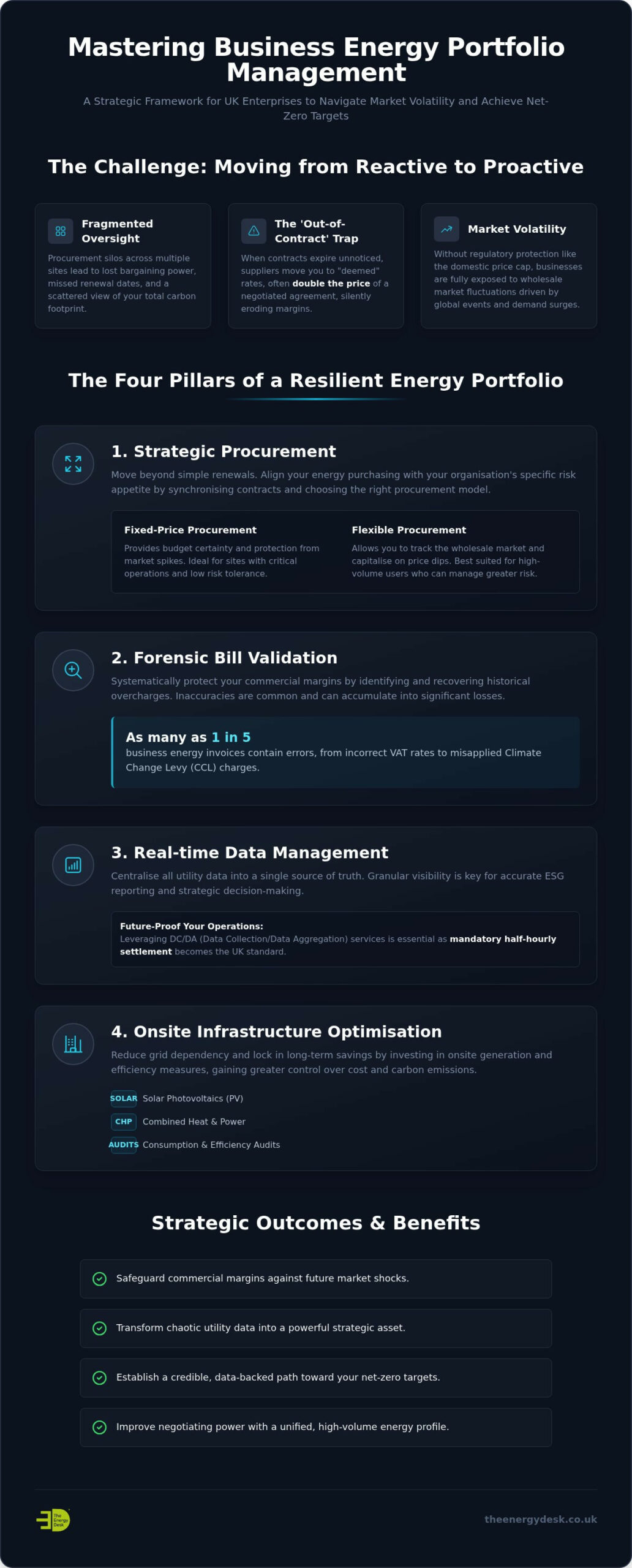
A robust approach to business energy portfolio management rests on more than just securing a low unit rate. It requires a balanced architecture that addresses procurement, financial oversight, data transparency, and physical infrastructure. By treating these four areas as interconnected pillars, organisations can build a strategy that withstands market shocks whilst driving down operational costs. To implement these effectively, businesses should adopt a step-by-step framework that moves from initial assessment to active asset management.
- Strategic Procurement: Synchronising gas and electricity contracts to align with the organisation’s risk appetite.
- Forensic Bill Validation: Protecting margins by identifying and recovering historical overcharges.
- Real-time Data Management: Leveraging DC/DA services for granular visibility, essential as half-hourly settlement becomes the UK standard in December 2026.
- Onsite Infrastructure: Deploying CHP and Solar PV to reduce grid dependency and lock in long-term savings.
Forensic Bill Validation: Recovering Lost Margins
Inaccuracies in commercial utility billing are surprisingly common. Industry estimates suggest as many as one in five business energy invoices contain errors, ranging from incorrect VAT rates to misapplied Climate Change Levy (CCL) charges. These discrepancies often go unnoticed because business billing is inherently complex, involving various pass-through costs and network charges. Implementing commercial utility bill validation allows you to audit every line item across your entire multi-site estate. This forensic oversight isn’t just about spotting future errors; it’s a mechanism for cost recovery that can secure significant rebates for your organisation.
Integrating Onsite Generation into the Mix
A truly resilient portfolio doesn’t rely solely on the grid. Integrating onsite generation assets like Solar PV and CHP system installation for businesses provides a physical hedge against market price spikes. CHP systems are particularly effective for high-demand sites, as they generate electricity and heat simultaneously, drastically improving overall efficiency. These technologies don’t just lower your carbon footprint; they provide price certainty that procurement alone cannot match. By generating a portion of your own power, you’re less exposed to the geopolitical volatility that often dictates wholesale costs. If you’re looking to start this transition, an independent energy audit can identify which technologies offer the best return for your specific sites.
Fixed vs Flexible: Selecting Your Procurement Strategy
Selecting the right procurement vehicle is a critical component of business energy portfolio management. For most organisations, the choice between a fixed or flexible contract isn’t just about the unit price; it’s about how much market exposure their balance sheet can realistically handle. Fixed contracts provide absolute budget certainty by locking in a rate for a set duration, usually between one and three years. This protects you against the sudden price spikes seen throughout 2025 and 2026, though it prevents the business from benefiting if wholesale costs drop during the term.
In contrast, flexible procurement allows high-volume users to purchase energy in “tranches” throughout the contract period. This strategy enables you to “ride” the market dips, buying when prices are low and holding back when they rise. For those seeking a middle ground, hybrid models offer a balanced solution. You can lock in your base load at a fixed rate whilst leaving your variable consumption to float on the wholesale market. Whilst fixed contracts offer peace of mind through price stability, flexible procurement rewards organisations with a higher risk tolerance and the capacity to actively track market movements. Effective energy portfolio management requires matching these strategies to your specific operational needs and financial objectives. Understanding the latest business energy procurement UK strategic trends for 2026 is essential for making informed decisions about which approach best suits your organisation’s risk profile.
Risk Management Frameworks for 2026
To succeed with a flexible strategy, you need a disciplined framework. This includes setting “stop-loss” limits, which are pre-determined price ceilings that trigger an automatic purchase if the market rises too high. This prevents a floating strategy from becoming a financial liability during periods of geopolitical instability. Timing is everything. Accessing high-level market intelligence ensures you aren’t renewing during a seasonal peak. Implementing a robust commercial energy risk management plan allows you to make these purchasing decisions based on data rather than guesswork.
The Role of Energy Procurement Consultants
There’s a fundamental difference between a simple energy broker and a strategic consultant. A broker typically offers a transactional price comparison, whereas energy procurement consultants provide ongoing portfolio oversight. Consultants have access to wholesale markets and “basket” deals that aren’t available to direct buyers or smaller brokers. They act as a strategic ally, helping you navigate complex contract terms and identifying the optimal moments to execute trades. In a market as volatile as 2026, having an expert who understands the nuances of business energy portfolio management can be the difference between an operational surplus and a budget deficit.
A Step-by-Step Framework for Portfolio Management
Implementing a successful strategy for business energy portfolio management requires a disciplined, five-step process. This framework ensures that your utility estate moves from a state of reactive administration to one of proactive optimisation. By following a methodical sequence, you can eliminate waste and secure more competitive rates through aggregated volume.
- Step 1: Data Aggregation. Centralise every MPAN and MPRN across your estate into a single register. This provides the visibility needed to manage MOP contracts and DC/DA services effectively.
- Step 2: Consumption Analysis. Use historical data to identify high-waste areas. This is the baseline from which all future savings are measured.
- Step 3: Strategy Design. Align your procurement with business growth. If you’re planning to expand your site count, your contracts must offer the flexibility to add new meters without penalty.
- Step 4: Implementation. Execute tenders across the whole portfolio simultaneously to maximise your negotiating leverage with suppliers.
- Step 5: Continuous Monitoring. Review performance monthly. With half-hourly metering set to become the standard for settlement by December 2026, real-time oversight is becoming a regulatory necessity.
The Audit: Your Portfolio Baseline
The foundation of any improvement plan is a comprehensive energy audit. This shouldn’t just be a surface-level check; it must examine meter types, insulation standards, and operational behaviours. Identifying “quick wins”, such as upgrading to LED lighting or installing sensor-based controls, creates immediate savings that can fund larger infrastructure projects. We use half-hourly data to spot unusual consumption patterns, such as equipment being left on during out-of-hours periods. This granular insight often reveals that a significant portion of energy spend is being wasted on an empty building. To identify these hidden costs in your own estate, you can book a free energy audit with our specialist team.
Reporting and Stakeholder Management
Modern business energy portfolio management involves more than just the facilities team; it requires boardroom buy-in. Creating a monthly “Energy Dashboard” allows stakeholders to see a centralised view of spend and carbon reduction progress. This is particularly important for compliance with schemes like ESOS, where the next progress update deadline falls on 5 December 2026. Clear data makes it much easier to justify capital investments in Solar PV or EV charging infrastructure. When you can demonstrate a clear ROI through reduced grid dependency and lower CCL payments, energy becomes a strategic asset rather than a fixed overhead.
Optimising Your Strategy with The Energy Desk
The Energy Desk (TED) has operated as an independent consultancy since 2003, specialising in end-to-end utility solutions for the UK corporate sector. Unlike brokers tied to specific panels, our independent status ensures you gain unbiased access to the entire wholesale market. This transparency is vital for effective business energy portfolio management, as it allows us to negotiate bespoke terms that reflect your specific consumption profile rather than a generic supplier template. We don’t just facilitate a transaction; we act as a strategic ally throughout the duration of your contracts.
Managing a multi-site portfolio is an administrative burden that often leads to costly oversights. We solve this by providing a dedicated account manager who understands the nuances of your estate. Your manager oversees everything from initial procurement to infrastructure integration, ensuring that no renewal window is missed and no “out of contract” rates are applied. This level of oversight is essential for maintaining a centralised view of your spend and carbon footprint, particularly as reporting requirements become more stringent.
Future-Proofing Your Energy Infrastructure
A resilient strategy must account for the shift toward onsite generation and electric transport. We provide expert project management for CHP systems and Solar PV installations, helping you reduce grid dependency and lock in long-term savings. As the UK moves toward the December 2026 deadline for standard half-hourly settlement, we ensure your MOP and DC/DA contracts are fully optimised. This ensures your data is accurate and your billing remains transparent. By integrating these physical assets into your broader business energy portfolio management plan, you create a hedge against the market volatility that frequently dictates wholesale prices.
Your Next Steps to Energy Resilience
Starting your journey toward a more efficient estate begins with a clear baseline. Our free energy audit serves as the entry point for portfolio optimisation, identifying immediate “quick wins” and long-term infrastructure opportunities. To begin, you can contact the TED team on 03330 151 221 for a professional consultation. We recommend preparing your most recent utility bills for a preliminary review, which allows us to identify potential overcharges or contract discrepancies immediately. Our team manages the entire switch and renewal process, ensuring zero downtime and a seamless transition to a more cost-effective strategy. We handle the technical complexities so you can focus on your core business operations.
Securing Your Organisation’s Energy Future
Effective business energy portfolio management is no longer a peripheral administrative task; it’s a core strategic function that directly impacts your commercial resilience. By centralising your multi-site data and integrating onsite generation like Solar or CHP, you move beyond simple price comparison to a model of total cost control. Proactive risk management and forensic bill validation ensure that your organisation remains protected against market volatility whilst recovering capital lost to historical invoicing errors.
The Energy Desk has operated as an independent UK consultancy since 2003, providing the technical expertise required to navigate these complexities. Whether you’re looking to optimise your procurement strategy or implement end-to-end infrastructure solutions, our specialists are here to guide your transition. Taking the first step today ensures your estate is prepared for the regulatory shifts of 2026 and beyond.
Book your free energy audit with The Energy Desk today to identify immediate saving opportunities and establish a clear path toward long-term energy security. We’re ready to help you transform your utility spend into a strategic advantage.
Frequently Asked Questions
What is the difference between an energy broker and a portfolio manager?
An energy broker is typically transactional, focusing on a single point-in-time price comparison. A portfolio manager provides ongoing, strategic oversight of your entire utility estate. They manage contract renewals, monitor consumption, and integrate infrastructure projects like CHP or Solar. This holistic approach ensures long-term cost optimisation rather than just a one-off switch. At The Energy Desk, we act as a strategic ally, offering end-to-end management from procurement to billing validation.
How many sites do I need to have to benefit from portfolio management?
You don’t need a specific number of sites to benefit, but the value increases significantly for organisations with two or more locations. Multi-site businesses often struggle with fragmented data and staggered contract expiry dates. Centralising these through business energy portfolio management allows for aggregated volume negotiation and simplified administration. Even a single large industrial site with complex usage patterns benefits from the risk mitigation and forensic auditing a managed approach provides.
Can business energy portfolio management help with net-zero targets?
Yes, it’s a fundamental tool for achieving carbon reduction goals. Effective management provides the granular data needed for ESOS compliance and SECR reporting. By identifying high-waste areas through audits, you can implement efficiency measures that lower your total carbon footprint. Additionally, a managed portfolio makes it easier to integrate renewable technologies like Solar PV and EV solutions, providing a clear, data-backed roadmap toward your organisation’s net-zero ambitions.
What are the risks of out-of-contract energy rates for large businesses?
The primary risk is a massive spike in operational costs, as out of contract energy rates are often significantly higher than negotiated tariffs. These rates are extremely volatile and can double your unit costs overnight. For large businesses, this leads to substantial budget deficits and eroded margins. Without proactive oversight, these expensive rates can go unnoticed for several billing cycles, making a centralised management framework essential for financial stability.
How often should a business energy portfolio be reviewed?
We recommend a formal monthly review of your energy portfolio to ensure performance stays aligned with your strategy. Whilst procurement might happen annually or every few years, monthly validation is necessary to catch billing errors and monitor consumption spikes. Regular reviews allow you can adjust your risk management tactics in response to wholesale market changes. This frequency is especially important as the UK moves toward standard half-hourly settlement by December 2026.
What data is required to start a forensic bill validation process?
You’ll need at least twelve months of historical utility bills for every site in your estate. This includes detailed information on unit rates, standing charges, VAT, and Climate Change Levy (CCL) payments. We also require access to your half-hourly data via your DC/DA provider to verify that your actual consumption matches the invoiced amounts. This data allows our team to identify discrepancies and initiate recovery claims for any historical overcharges identified during the audit.
Is flexible energy procurement safer than fixed-price contracts in 2026?
Safety depends entirely on your organisation’s risk appetite and consumption volume. Fixed-price contracts offer absolute budget certainty, which is safer for businesses requiring predictable overheads. However, flexible procurement can be more cost-effective for high-volume users who can capitalise on market dips. In the volatile 2026 market, flexible contracts require sophisticated business energy portfolio management and stop-loss limits to ensure they don’t become a financial liability during sudden wholesale price surges.
How does onsite generation impact my commercial energy contract?
Onsite generation like CHP or Solar PV reduces your reliance on the grid, which changes your consumption profile. This often leads to lower standing charges and reduced exposure to wholesale price spikes. However, it requires careful contract negotiation to ensure you aren’t penalised for lower volume or “take-or-pay” clauses. We help you synchronise your procurement strategy with your infrastructure assets to maximise the ROI on your renewable investments whilst maintaining contract compliance.