


For many UK enterprises in 2026, energy overheads now represent up to 20% of total operating costs, yet few organisations have a formalised strategy to defend those margins. You likely feel the pressure of unpredictable wholesale prices and the technical complexity of the transition to Market-wide Half-Hourly Settlement. It’s difficult to maintain budget certainty when market movements seem detached from your operational reality. We recognise that a lack of internal expertise often leads to reactive decision-making rather than proactive, strategic planning.
This article provides a robust framework for commercial energy risk management, specifically designed to protect your bottom line and ensure long-term price stability. You’ll learn how to master the complexities of flexible procurement contracts whilst leveraging expert oversight to mitigate market volatility. We will examine the essential components of a modern strategy, including forensic bill validation and the integration of onsite generation solutions. By the end, you will have the clarity needed to move away from utility confusion and towards a stable, predictable energy budget that supports your long-term business growth.
Key Takeaways
- Transition from reactive energy “switching” to a robust commercial energy risk management framework that prioritises long-term margin protection over short-term fixes.
- Identify the four critical pillars of energy risk, Market, Volume, Credit, and Regulatory, to ensure your strategy addresses every potential threat to your utility budget.
- Compare the budget certainty of fixed-price contracts against the strategic advantages of flexible procurement to find the optimal balance for your business operations.
- Establish a methodical implementation process beginning with a comprehensive audit and a clearly defined risk tolerance to avoid unexpected cost variances.
- Explore physical risk mitigation strategies, including onsite generation and CHP systems, to reduce your reliance on the volatile wholesale grid and secure price stability.
What is Commercial Energy Risk Management in 2026?
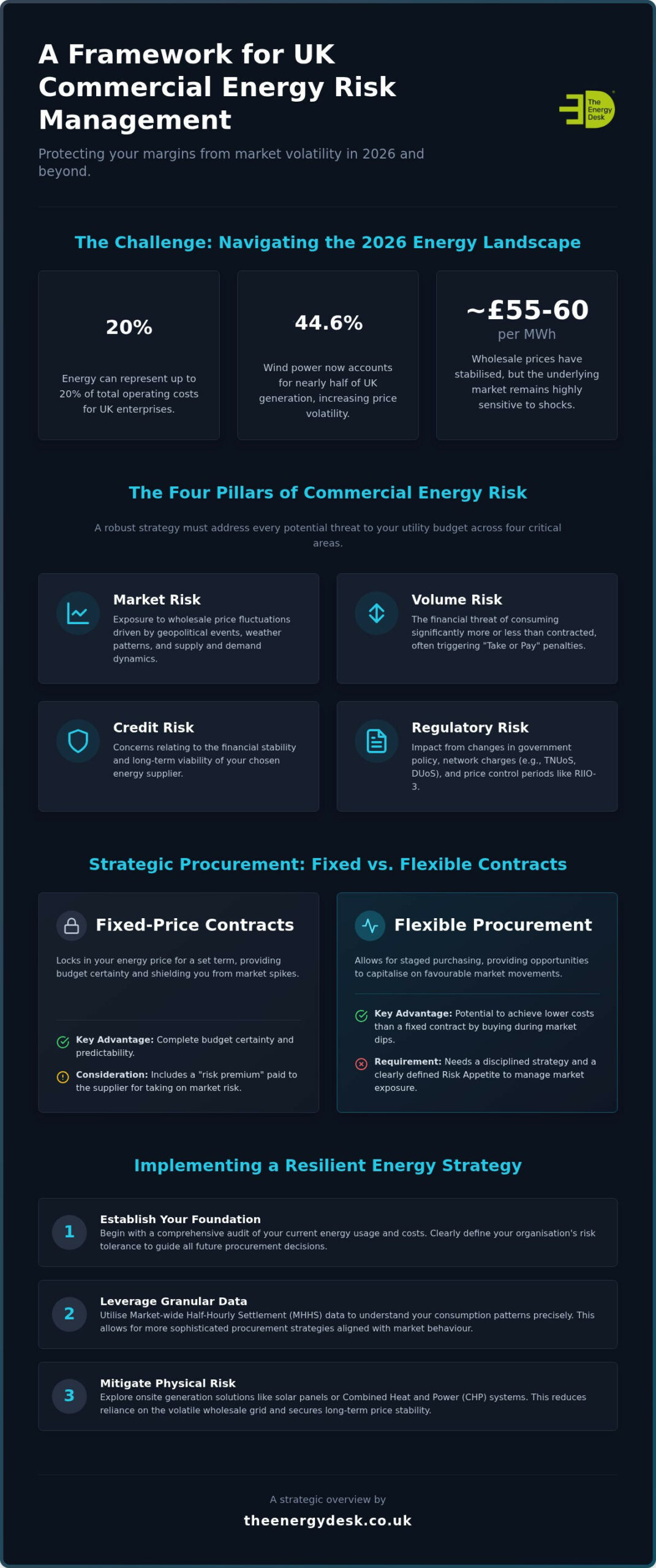
Commercial energy risk management is the systematic process of identifying, measuring, and mitigating a business’s exposure to wholesale price volatility. It’s far more than simple energy “switching,” which often amounts to a reactive response to high bills. Instead, it’s a disciplined approach to procurement that prioritises long-term financial stability. In 2026, energy overheads account for between 5% and 20% of total operating costs for many UK firms, making price stability a critical boardroom objective rather than just a facilities management task.
The primary goal is to achieve budget certainty whilst retaining the agility to capitalise on favourable market movements. Whilst wholesale electricity prices have stabilised around £55 to £60 per MWh as of August 2026, the underlying market remains sensitive to external shocks. A robust strategy ensures that your margins are protected from sudden spikes, preventing utility costs from eroding your profitability.
The Evolution of Energy Markets
The UK energy landscape has shifted significantly. We’ve moved from a market dominated by predictable fossil fuel baseloads to one where wind power accounts for 44.6% of generation. This transition to renewables, whilst essential for sustainability, introduces inherent intermittency and price swings. Geopolitical uncertainty and supply constraints continue to drive this volatility. Consequently, businesses have moved away from simple fixed-price deals toward structured risk portfolios that allow for staged purchasing. In the current environment, “doing nothing” is the highest risk strategy an organisation can adopt, as it leaves the business entirely exposed to the whims of the spot market.
Risk Management vs. Energy Management
It’s vital to distinguish between energy management and risk management. Energy management focuses on operational efficiency and reducing physical consumption. Conversely, Fuel price risk management focuses on the financial side of the equation: the price paid for that consumption. Whilst they are distinct disciplines, they overlap to create a resilient strategy. For instance, reducing usage during peak periods, known as demand-side response, can lower both your volume risk and your unit cost.
Data is the bridge between these two areas. The migration to Market-wide Half-Hourly Settlement (MHHS), which is expected to be completed by May 2027, provides the granular consumption data required for sophisticated procurement. By aligning your usage patterns with wholesale market behaviours, you can transform energy from a volatile variable into a controlled, predictable asset.
Identifying the Core Risks to Your Energy Budget
Effective commercial energy risk management requires a comprehensive understanding of the four primary risk categories: Market, Volume, Credit, and Regulatory. Market risk refers to price fluctuations in the wholesale sector. Volume risk involves consuming more or less than your contracted amount. Credit risk concerns the financial stability of the supplier, whilst regulatory risk encompasses changes in government policy and network charges. Failing to account for any one of these pillars can leave a business exposed to significant financial shocks.
Regulatory risk is often overlooked but can significantly impact the bottom line. Non-commodity costs, such as Transmission Network Use of System (TNUoS) and Distribution Use of System (DUoS) charges, make up a substantial portion of a business energy bill. Changes in these rates, alongside the RIIO-3 price control period that began in April 2026, can lead to unexpected cost increases even if your wholesale rate is locked. Understanding these mechanics is vital for maintaining budget integrity.
Market Volatility and Price Risk
Wholesale prices are driven by complex global factors, from geopolitical instability to seasonal weather patterns. For fixed-rate contract holders, market risk is managed through a “risk premium” paid to the supplier for price certainty. Flexible contract holders face direct exposure to market movements, which requires a disciplined purchasing strategy. Attempting to “time the market” is often a gambler’s fallacy for large organisations. Instead, you should establish a defined Risk Appetite statement. This document outlines the maximum level of budget variance your company can tolerate before corrective action is taken.
Volume and Consumption Variability
Volume risk presents a hidden financial threat through “Take or Pay” clauses. If your business consumes significantly less than forecasted, you may still be billed for a portion of the unused energy. Conversely, over-consumption often triggers premium balancing costs. As the UK moves toward full Market-wide Half-Hourly Settlement (MHHS) by May 2027, the accuracy of your consumption data becomes paramount. Integrating commercial utility bill validation is essential to catch volume-based errors and ensure your supplier’s charges align with actual usage. It’s a critical step in maintaining oversight of your energy portfolio.
Managing these variables requires a methodical approach that goes beyond simple procurement. To ensure your strategy is robust enough for the current climate, you might consider requesting a free energy audit to identify hidden vulnerabilities in your current contracts.
Strategic Procurement: Fixed vs. Flexible Contracts
Selecting the appropriate contract structure is a fundamental decision within a robust commercial energy risk management framework. For many UK organisations, the choice between fixed-price and flexible procurement depends on their specific financial objectives and risk tolerance. Fixed-price contracts provide absolute budget certainty by locking in a unit rate for the duration of the term, typically one to three years. Whilst this protects against wholesale spikes, it requires the payment of a “risk premium” to the supplier, who assumes the market volatility on your behalf.
Flexible procurement offers a more dynamic alternative, allowing businesses to purchase energy in tranches or “clips” throughout the contract period. This approach enables you to take advantage of market downturns rather than being locked into a single price point. Smaller organisations that lack the individual volume to access the wholesale market directly can often join a “basket” or collective purchasing group. This allows them to benefit from the same staged purchasing strategies as larger industrial users. Engaging energy procurement consultants is often the most effective way to determine which structure aligns with your operational goals.
When to Choose a Fixed-Price Agreement
Fixed agreements remain the preferred choice for businesses with rigid overhead structures or low risk tolerance. If your profit margins are sensitive to even minor utility fluctuations, the certainty of a fixed rate outweighs the potential savings of a flexible deal. In 2026, some firms are opting for longer-term five-year deals to secure stability, though this requires careful timing to avoid locking in at a market peak. It’s vital to manage your renewal window proactively; failing to agree a new contract before the current one expires leads to out of contract energy rates, which are significantly more expensive than standard commercial tariffs.
The Mechanics of Flexible Procurement
Flexible buying relies on a sophisticated understanding of market signals. You can choose to buy “Forward” to secure future volume or utilise “Day Ahead” purchasing to capitalise on immediate price drops. This level of active management requires continuous business electricity procurement expertise to monitor wholesale movements. By spreading the timing of your purchases, you effectively average out the cost of your energy, reducing the impact of any single market spike on your total annual spend. This methodical approach transforms energy from an unpredictable expense into a manageable strategic variable.
How to Implement a Risk Management Framework
Implementing a formal commercial energy risk management framework is a methodical process that transforms utility procurement from a clerical task into a strategic advantage. It requires a disciplined five-step approach to ensure your organisation remains resilient against market volatility. By following a structured roadmap, you move away from reactive decision-making and towards a position of financial control. Organisations managing multiple sites will find that a structured approach to business energy portfolio management is essential for maintaining oversight across a complex energy estate.
- Step 1: Audit and Baseline. Conduct a forensic review of your current energy contracts and historical consumption data. This identifies your starting point and uncovers any immediate billing discrepancies or volume-based risks.
- Step 2: Define Risk Tolerance. You must determine exactly how much budget variance your business can sustain. A rigid budget may require high certainty, whilst a more liquid balance sheet might tolerate higher variance in exchange for potential market-tracking savings.
- Step 3: Strategy Selection. Align your procurement structure with your defined tolerance. This involves choosing between the absolute certainty of a fixed-rate deal or the staged purchasing opportunities of a flexible agreement.
- Step 4: Execution and Monitoring. This is the active phase where trades are placed or expert oversight is maintained. It ensures your position remains within the agreed risk parameters at all times.
- Step 5: Review and Optimise. Perform quarterly performance reviews against wholesale market benchmarks. This allow you to refine your approach and ensure the strategy remains fit for purpose in a changing economic climate.
Setting Your Risk Policy
A successful policy requires collaboration between Finance, Operations, and Sustainability departments. This ensures that procurement goals don’t conflict with operational needs or carbon reduction targets. You should document a clear “Stop-Loss” strategy. This is a pre-determined price point where you will automatically lock in remaining volumes to prevent catastrophic budget hits if the market spikes. Aligning this policy with your business gas procurement cycle is essential, as gas markets often exhibit different volatility patterns compared to electricity.
Continuous Monitoring and Reporting
Transparency is vital for board-level buy-in. Utilising Energy Trading and Risk Management (ETRM) software provides real-time visibility into your portfolio’s performance. Accurate data is the foundation of this oversight. You should ensure your infrastructure meets half hourly metering requirements UK, as this granular data allows for precise forecasting and risk assessment. Regular monthly reporting keeps stakeholders informed and ensures the strategy remains aligned with the company’s broader fiscal health.
To begin building your own framework, you can contact The Energy Desk for a professional assessment of your current risk exposure.
Physical Risk Mitigation: Onsite Generation and Resilience
Whilst financial hedging through procurement is essential, physical risk mitigation offers a more permanent solution to market volatility. Onsite generation acts as the ultimate hedge, allowing a business to bypass the wholesale grid for a significant portion of its demand. By producing energy behind the meter, you insulate your operations from the price spikes and non-commodity charges discussed in previous chapters. This dual approach, combining strategic procurement with infrastructure investment, forms the most resilient commercial energy risk management strategy available in 2026.
The Energy Desk acts as a strategic ally by integrating these two disciplines. We don’t just secure your contracts; we evaluate your site’s physical potential to reduce external reliance. This holistic oversight ensures that your infrastructure investments are perfectly aligned with your procurement portfolio, creating a total risk solution that protects your margins for the long term.
CHP as a Market Hedge
Generating your own power from gas through CHP system installation for businesses provides a unique financial advantage known as the “Spark Spread.” This is the difference between the price of the gas used to run the system and the value of the electricity produced. When electricity prices spike relative to gas, the financial benefit of CHP increases. Beyond the fiscal gains, CHP offers operational resilience. It ensures your facility maintains power during periods of grid instability, which is a growing concern as the UK integrates more intermittent renewable capacity.
Solar PV and Long-term Cost Certainty
Solar solutions offer a different but equally powerful risk mitigation tool. The business case for commercial renewable energy UK is increasingly driven by the desire for absolute cost certainty. Once a solar PV system is installed, the generation cost is effectively locked at 0p/kWh for the 25-plus-year lifespan of the asset. This drastically reduces your “Volume Risk” because you no longer need to forecast or purchase that portion of your energy from the grid. Even as wholesale electricity prices stabilised around £55 to £60 per MWh in August 2026, the long-term stability of onsite solar remains superior to any grid-supplied contract.
Renewable assets also improve your credit risk profile. Modern lenders and stakeholders increasingly view onsite renewable assets as a sign of financial stability and forward-thinking management. By reducing your exposure to the volatile wholesale market, you demonstrate a disciplined approach to fiscal responsibility that enhances your organisation’s overall value and sustainability standing.
Securing Your Competitive Advantage in a Volatile Market
Modern utility management requires a shift from passive procurement to a disciplined, multi-layered strategy. By integrating sophisticated data analysis with physical infrastructure, your organisation can transform energy from a volatile liability into a predictable asset. We’ve explored how a robust framework for commercial energy risk management combines the right contract structures with forensic oversight to protect your margins against unforeseen wholesale shifts.
The Energy Desk has operated as an independent UK consultancy since 2003, providing the technical proficiency needed to navigate these complex markets. Our team offers deep expertise across gas and electricity procurement, alongside renewable solutions such as CHP and solar. We also provide a comprehensive forensic bill validation service to ensure every penny of your utility spend is accounted for and accurate.
Taking control of your energy portfolio is a proactive step toward long-term fiscal health. Secure your business energy future with a free expert audit from The Energy Desk and ensure your strategy is fit for the challenges of 2026 and beyond.
Frequently Asked Questions
What is the difference between an energy broker and a risk management consultant?
A broker typically focuses on transactional switching and commission-based contract placement. In contrast, a risk management consultant acts as a strategic ally, providing ongoing oversight and data-led strategies to protect margins. The Energy Desk, founded in 2003, operates as an independent consultancy, offering forensic analysis and infrastructure advice alongside procurement. This ensures that your energy strategy aligns with long-term financial stability rather than just securing a one-off cheaper rate.
Does my business need a flexible energy contract to manage risk?
Not necessarily, as the choice depends on your specific budget requirements and risk tolerance. Whilst flexible procurement allows for staged purchasing to capitalise on market dips, fixed-price contracts offer absolute budget certainty. A robust approach to commercial energy risk management involves evaluating which structure best protects your bottom line. If your business cannot sustain price variance, a fixed-rate deal with a known risk premium is often the more secure option.
How often should we review our energy risk management strategy?
You should review your strategy at least quarterly to ensure it remains aligned with current wholesale market conditions. These reviews allow you to adjust your “Stop-Loss” triggers and purchasing tranches based on the latest volatility data. In a fast-moving market, waiting until the renewal window to assess your position is a high-risk approach. Regular reporting to the board ensures transparency and allows for proactive adjustments before energy costs impact your operational profitability.
Can small businesses benefit from commercial energy risk management?
Yes, small businesses can access the benefits of sophisticated risk management by joining collective purchasing “baskets.” This allows smaller organisations to leverage the same flexible procurement strategies and wholesale market access typically reserved for industrial users. Even without high volume, small firms benefit from forensic bill validation and audits to identify overcharges. Implementing these methodical controls ensures that utility overheads don’t become an unmanageable variable as the business grows.
What are the main types of energy market risks for UK companies?
UK companies face four primary risk pillars: Market, Volume, Credit, and Regulatory. Market risk involves wholesale price swings, whilst volume risk concerns the financial impact of consuming more or less than your contracted amount. Credit risk relates to the stability of energy suppliers, and regulatory risk includes changes to network charges and government levies. Addressing each of these through a formalised commercial energy risk management programme is essential for maintaining total budget integrity.
How does bill validation fit into a risk management programme?
Bill validation is the forensic foundation of any risk management strategy. It involves checking every invoice against actual meter data and contract terms to catch supplier errors, which are frequent in complex commercial billing. By ensuring you only pay for the energy you actually use at the agreed rate, you eliminate unnecessary cost leakage. This oversight provides the accurate consumption baseline required for effective forecasting and future procurement decisions.
Will onsite generation like CHP actually reduce my financial risk?
Onsite generation acts as a physical hedge that significantly reduces your reliance on the volatile wholesale grid. Systems like CHP allow you to generate your own electricity and heat, bypassing many of the non-commodity costs and price spikes associated with grid supply. This investment provides long-term cost certainty and operational resilience. By producing energy behind the meter, you gain a level of price stability that traditional procurement contracts alone cannot provide.
What is a “Risk Appetite Statement” in energy procurement?
A Risk Appetite Statement is a formal document that defines the maximum level of budget variance your business is willing to accept. It sets the boundaries for your procurement strategy, such as when to trigger a “Stop-Loss” lock-in or how much volume to leave exposed to the spot market. Establishing this policy ensures that all stakeholders, from finance to operations, are aligned on the balance between potential cost savings and financial security. If you are currently paying out of contract energy rates due to a lapsed agreement, addressing this should be the first priority before any formal risk appetite can be meaningfully set.