
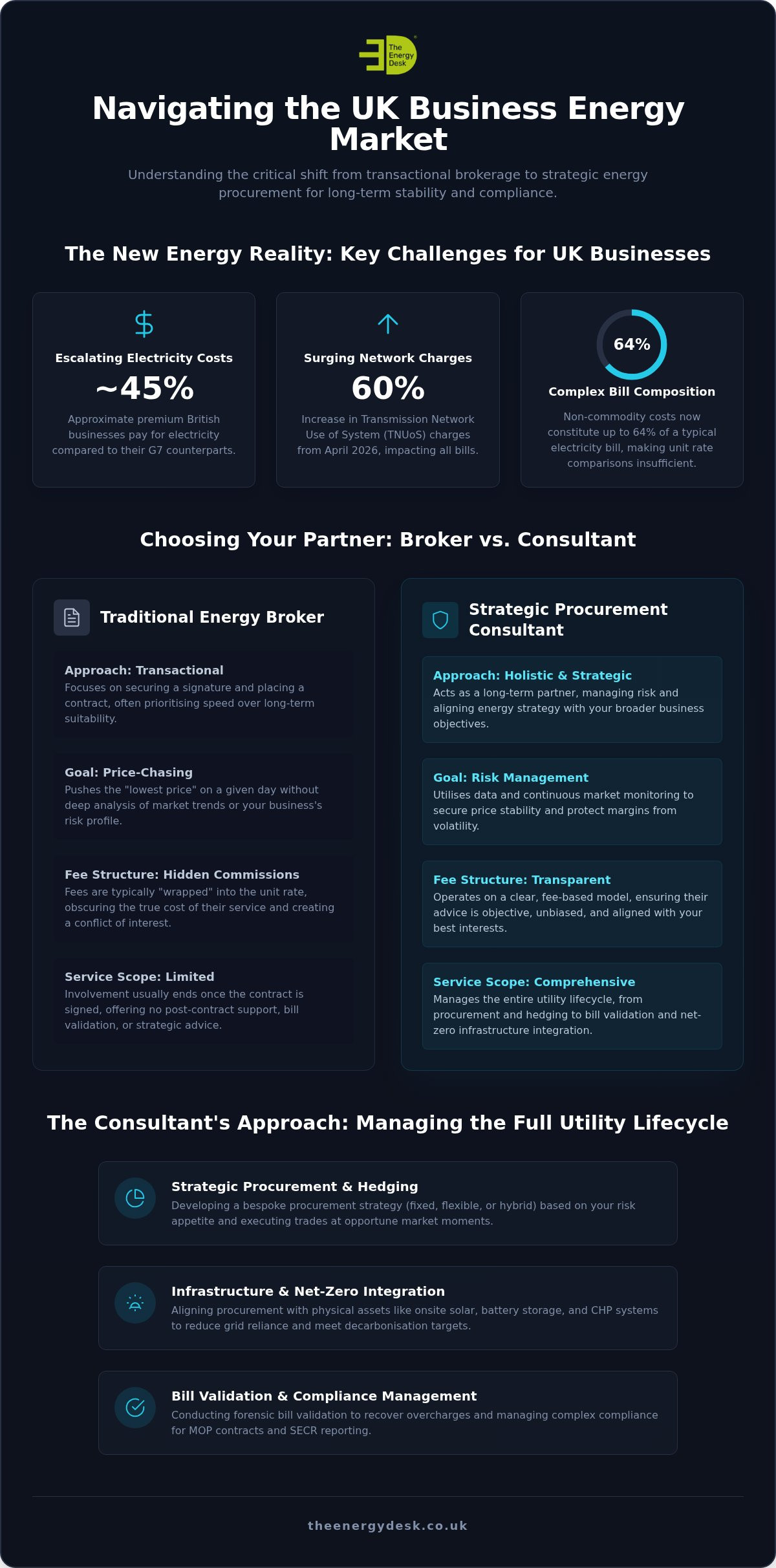
British businesses now pay approximately 45% more for electricity than their G7 counterparts, a figure driven by the 60% surge in Transmission Network Use of System (TNUoS) charges that hit in April 2026. For most organisations, energy is no longer a simple utility bill to be paid; it’s a volatile risk that threatens core margins. It’s frustrating to manage unpredictable price spikes whilst trying to align your corporate decarbonisation goals with the new Market-wide Half-Hourly Settlement (MHHS) requirements.
You likely recognise that the traditional model of ‘free’ brokerage often hides commissions that erode your bottom line. This guide demonstrates how to distinguish between transactional brokers and strategic energy procurement consultants to secure long-term price stability and net-zero compliance. We will examine the shift from passive bill-paying to active load management, highlighting how The Energy Desk (TED) manages the entire utility lifecycle. You will discover how a methodical approach to utility management, encompassing everything from CHP systems to forensic bill validation, ensures your business remains competitive through 2030 and beyond.
Key Takeaways
- Recognise the transition from transactional price-chasing to a holistic risk management strategy essential for navigating the 2026 UK market.
- Distinguish between the hidden costs of commission-based brokers and the transparent value offered by professional energy procurement consultants.
- Evaluate potential partners based on their access to both major and green niche suppliers, alongside their proficiency in flexible hedging strategies.
- Understand how to align your procurement portfolio with physical infrastructure like solar solutions and CHP systems to meet corporate decarbonisation targets.
- Identify the operational advantages of an independent approach that oversees the entire utility lifecycle, including bill validation and MOP contracts.
The Evolution of Energy Procurement in 2026: Why Strategy Beats Price
By August 2026, the UK business energy market has transitioned from a period of simple price comparison to one of complex structural risk management. Modern energy procurement is no longer a transactional task; it’s a comprehensive service designed to protect margins against systemic volatility. Effective energy management now requires a sophisticated blend of market timing and technical oversight. Businesses that once focused solely on ‘price-chasing’ now find themselves exposed to structural costs that unit rates alone cannot fix.
Strategic positioning is the new standard for 2026. This shift is driven by three essential pillars: cost, compliance, and carbon. Whilst unit prices remain a priority, compliance with new regulations, such as the Electricity Supplier Payments (Amendment) Regulations 2026, is equally vital. Additionally, with non-commodity charges now making up 60-64% of a typical electricity bill, the focus has shifted toward managing fixed elements. For instance, standing charges for large businesses have reached 148p per day. Professional energy procurement consultants help mitigate these costs by reviewing agreed capacity and optimising load profiles rather than just accepting standard supplier terms.
The Limitations of Traditional Energy Brokers
Traditional brokers often operate on a high-volume, transactional basis. Their primary goal is to secure a signature on a specific day, frequently pushing the ‘lowest price’ without considering the long-term trajectory of the market. This approach often ignores hidden commissions and fails to provide support after the contract is live. If a business signs a fixed deal during a temporary price spike, the broker has already moved on, leaving the client to deal with the financial fallout for years. This lack of ongoing oversight is why many UK companies are moving away from simple brokerage models that offer no post-contract support.
The Strategic Advantage of Procurement Consultants
In contrast, energy procurement consultants like The Energy Desk (TED) operate as trusted advisors. This model relies on continuous market monitoring rather than annual renewals. It’s about using data-driven insights to determine whether a fixed or flexible contract best suits a company’s specific risk appetite. A consultant doesn’t just place a contract; they manage the entire utility lifecycle. This includes forensic bill validation to catch overcharges and managing complex MOP contracts. By acting as a strategic ally, TED ensures that procurement decisions are integrated with broader infrastructure goals, such as onsite solar solutions or CHP systems, providing stability in a market that rewards precision over speed.
Energy Procurement Consultants vs. Brokers: A Comparison
Understanding the distinction between these two roles is critical for any UK business leader. Whilst the terms are often used interchangeably, their operational behaviours differ significantly. A broker typically acts as a sales intermediary whose primary objective is contract placement. Professional energy procurement consultants, however, function as long-term strategic partners, focusing on the total cost of ownership and risk mitigation over the entire utility lifecycle. This difference in approach determines whether your business is simply buying energy or actively managing a complex financial asset.
Transparency and Fee Structures
Revenue models define the relationship between the advisor and the client. Brokers often operate on a commission-based system where fees are ‘wrapped’ into the unit rate, making it difficult for businesses to see the true cost of the service. This lack of clarity can complicate Streamlined Energy and Carbon Reporting (SECR) and other corporate transparency requirements. In contrast, fee-based consultancy models provide a clear breakdown of professional costs, separating the energy price from the service fee. This alignment is increasingly important as the UK government’s energy policy continues to emphasise transparency and market efficiency. An independent consultancy is a firm with no preferred supplier bias to ensure objective market coverage.
Service Scope and Long-term Management
The depth of service further separates these entities. A broker’s involvement usually ends once the contract is signed, leaving the business to manage its own utility issues. Strategic energy procurement consultants provide continuous oversight, managing everything from Meter Operator (MOP) contracts to Data Collection and Data Aggregation (DC/DA) services. This lifecycle management is vital during transition periods where ‘out of contract’ rates can devastate a budget if not proactively managed. A consultant monitors market trends daily, ensuring your portfolio is positioned to avoid the geopolitical price spikes seen in August 2026. For organisations managing multiple sites, a structured approach to business energy portfolio management is essential to maintain visibility and control across your entire estate. If you’re concerned about hidden margins in your current contracts, you can review your strategy with The Energy Desk to explore a more transparent approach.
Evaluating Energy Procurement Companies: A Decision Framework
Selecting the right partner requires a robust framework that extends beyond basic supplier comparisons. You must assess whether energy procurement consultants have deep relationships with both the ‘Big Six’ and smaller, niche green suppliers. This wide market access ensures you aren’t limited to standard tariffs that may not reflect your specific consumption profile or sustainability targets. Additionally, evaluate their risk management capabilities; a competent firm should offer flexible baskets and sophisticated hedging strategies to shield your budget from geopolitical volatility. A formalised approach to commercial energy risk management is now essential for any organisation seeking long-term price stability in the 2026 market.
Technical proficiency is another essential differentiator. Many organisations overlook the importance of utility connections and meter installations during the procurement phase. A partner that handles these physical infrastructure requirements alongside the contract provides a more cohesive service. This technical depth allows for a smoother transition between suppliers and ensures that your metering setup is optimised for the latest settlement regulations. It’s a proactive approach that prevents delays in contract starts and avoids costly ‘out of contract’ rates.
The Role of Forensic Bill Auditing
Auditing historical bills is often the most effective first step in a procurement strategy. It’s common for businesses to discover significant overcharges resulting from VAT errors, Climate Change Levy (CCL) miscalculations, or standing charge discrepancies that have gone unnoticed for years. By conducting commercial utility bill validation, you can identify these historical mistakes and secure rebates. Many consultants, including TED, operate on a ‘no-win, no-fee’ basis for these forensic recoveries. This ensures that any recovered capital can be immediately reinvested into energy efficiency projects or used to offset future procurement costs.
Data Management and DC/DA Services
Accurate data is the foundation of any successful business electricity procurement strategy. The move to Market-wide Half-Hourly Settlement (MHHS) in 2026 makes granular data essential for all large-scale users. Professional energy procurement consultants utilise Data Collection (DC) and Data Aggregation (DA) services to improve procurement accuracy. This precision allows for better ‘shape’ analysis, which is vital for flexible purchasing and load shifting. For further guidance on standard market practices, you can consult Ofgem’s energy advice for businesses. This level of technical oversight ensures that your procurement decisions are based on actual consumption patterns rather than supplier estimates, leading to more predictable long-term costs.
Integrating Infrastructure: Procurement in the Age of Net Zero
In 2026, a procurement strategy that ignores physical infrastructure is incomplete. As UK businesses strive for decarbonisation, the interaction between grid-supplied energy and onsite assets has become a primary cost driver. Modern energy procurement consultants must look beyond the meter to understand how hardware like solar arrays or EV charging stations affects your load profile. This holistic view ensures that your supply contract isn’t penalising you for peak demand spikes caused by fleet electrification or failing to capitalise on surplus generation.
Power Purchase Agreements (PPAs) now play a central role in corporate portfolios. They provide long-term price certainty by locking in rates from renewable sources, often for ten to fifteen years. This provides a vital buffer against the geopolitical volatility that has characterised the market throughout 2026. By integrating PPAs with standard supply contracts, businesses can create a diversified energy mix that supports both fiscal stability and net-zero targets.
Solar PV and Onsite Generation
Installing solar panels fundamentally changes your relationship with the grid. It creates a ‘Z-curve’ effect, where daytime grid requirements plummet whilst evening demand remains high. This shift requires a contract that offers flexibility rather than rigid volume constraints. Professional energy procurement consultants help businesses navigate ‘Export Tenders,’ allowing you to sell excess energy back to the grid at competitive rates. This turns a cost centre into a revenue stream, provided the metering and PPA structures are correctly aligned from the outset.
Combined Heat and Power (CHP) Strategy
For industrial sites with high thermal requirements, CHP system installation for businesses provides a powerful hedge against electricity price volatility. By generating power onsite using gas, you gain greater control over your energy mix. However, this strategy relies heavily on precise business gas procurement to maintain the unit’s economic viability. Managing the maintenance, MOP requirements, and high-voltage connections for such units is technically demanding. TED provides the oversight needed to ensure these assets work in harmony with your wider procurement goals.
Fleet electrification also introduces new risks to your electricity contract. Adding a rapid EV charging network can significantly increase a site’s maximum demand, potentially leading to expensive capacity charges if your kVA allowance isn’t adjusted. A consultant reviews your agreed capacity and amends your contract to accommodate these new loads without overpaying for unused headroom. If you’re planning to install onsite assets, partner with The Energy Desk to ensure your procurement strategy supports your infrastructure investments.
Partnering with The Energy Desk for Strategic Oversight
Choosing a partner to manage your utility portfolio requires a methodical approach that aligns with your long-term fiscal goals. The Energy Desk (TED) operates a comprehensive 360-degree model: Audit, Procure, Manage, and Optimise. Unlike high-volume brokers, TED acts as an independent ally, ensuring that supplier comparisons are unbiased and based purely on value. This independence is vital in a 2026 market where complex levy structures and non-commodity costs can easily obscure the true cost of a contract. By serving as a single point of contact for both energy contracts and physical infrastructure, TED simplifies the management of complex utility environments.
For UK businesses, the most effective entry point is often a ‘Free Energy Audit’. This low-friction assessment provides immediate clarity on potential savings and compliance gaps without requiring an upfront financial commitment. It allows our energy procurement consultants to demonstrate tangible value before any long-term agreements are signed. This disciplined mindset ensures that every recommendation is backed by data and tailored to the operational realities of your specific site.
The TED Audit and Onboarding Process
The onboarding journey is designed to be thorough and transparent, moving from data gathering to strategic execution through three defined stages:
- Step 1: Data collection and historical bill validation. We gather half-hourly data and perform a forensic audit of previous invoices to identify overcharges and establish an accurate consumption baseline.
- Step 2: Market analysis and risk profile development. Our team assesses market trends against your risk appetite to determine whether fixed, flexible, or hybrid procurement models offer the best stability.
- Step 3: Supplier tendering and contract negotiation. We leverage our relationships across the entire UK supplier landscape to secure terms that reflect your specific load shape and sustainability requirements.
Ongoing Portfolio Management
Successful utility management doesn’t end when the contract starts. Energy procurement consultants must provide continuous oversight to remain effective. TED delivers detailed monthly reporting and performance tracking, allowing you to monitor spend and carbon footprint in real-time. We manage contract renewals well in advance, typically 12 to 18 months before expiry, to protect your business from the volatility of out-of-contract rates. This proactive stance is supported by our national team, available on 03330 151 221, ensuring that technical expertise is always accessible when your infrastructure or procurement needs change.
Securing Your Energy Future Through 2030
The UK energy landscape in 2026 requires a transition from reactive contract switching to proactive portfolio management. By distinguishing between high-volume brokers and strategic energy procurement consultants, your organisation can secure the price stability necessary to protect long-term margins. Integrating physical assets like solar solutions or CHP systems into your supply strategy isn’t just a sustainability goal; it’s the foundation of a resilient business model. Organisations overseeing multiple sites will find that effective business energy portfolio management is the critical discipline that ties procurement, infrastructure, and carbon reporting into a single coherent strategy.
As an independent consultancy founded in 2003, The Energy Desk (TED) provides the technical depth and market independence required to navigate these complexities. We specialise in full-service utility management, from strategic procurement and CHP installation to forensic bill validation and overcharge recovery. Our role is to act as a disciplined ally, ensuring your infrastructure and contracts work in perfect harmony.
Request your free business energy audit from The Energy Desk today to identify immediate savings and establish a methodical roadmap for the years ahead. We look forward to helping you stabilise your costs and accelerate your journey toward net zero.
Frequently Asked Questions
What is the difference between an energy broker and an energy procurement consultant?
An energy broker typically focuses on a single transaction to secure the lowest price on a specific day. In contrast, energy procurement consultants act as strategic advisors who manage your entire utility lifecycle. This includes risk management, data analysis, and infrastructure integration. Whilst a broker’s involvement ends at contract signature, a consultant provides continuous oversight to ensure your energy strategy remains aligned with your operational and financial objectives.
How do energy procurement consultants get paid?
Revenue models usually fall into two categories: commission-based or fee-based. In a commission model, the consultant receives a small payment from the energy supplier for every unit of energy you consume. Fee-based models involve a transparent professional charge for specific services such as bill validation or onsite audits. TED offers both options, providing the flexibility to choose a structure that best suits your company’s transparency and reporting requirements.
Can a consultant help my business achieve Net Zero?
Professional consultants are essential for navigating the transition to net zero. They assist by sourcing green energy contracts and Power Purchase Agreements (PPAs) that guarantee renewable origins. Beyond procurement, they integrate onsite generation assets like solar solutions and CHP systems into your portfolio. This combined approach reduces your reliance on the grid whilst providing the transparent carbon reporting required for modern corporate compliance and environmental targets.
What are the benefits of flexible energy procurement over fixed-price contracts?
Flexible procurement allows larger organisations to buy energy in tranches throughout the year rather than locking in a single price on one day. This strategy helps you avoid market peaks by spreading the risk. Whilst fixed-price contracts offer budget certainty, flexible models can lead to lower average costs in volatile markets. A consultant uses data-driven insights to determine which model best fits your specific risk appetite and consumption profile.
How long does a typical energy procurement audit take?
The duration of an energy audit varies based on the size of your portfolio and the availability of consumption data. Typically, the initial data collection and historical bill validation phase takes approximately one to two weeks. Once this information is processed, your consultant will present a comprehensive report outlining potential overcharge recoveries and strategic procurement recommendations. This methodical process ensures that every decision is based on accurate historical performance rather than estimates.
Will a consultant manage my MOP and DC/DA contracts as well?
Yes, managing Meter Operator (MOP) and Data Collection (DC/DA) contracts is a core part of a consultant’s role. These services are vital for businesses with half-hourly metering, as they ensure your consumption data is accurate and accessible. By consolidating these contracts, energy procurement consultants can often reduce administrative costs and improve the precision of your energy billing. This oversight prevents data gaps that could lead to estimated supplier invoices.
What happens if my business goes into out-of-contract rates?
If your current contract expires without a renewal in place, your supplier will move you to ‘out-of-contract’ or ‘deemed’ rates. These prices are often significantly higher than negotiated market rates and can erode your margins almost overnight. Consultants prevent this by monitoring your contract end dates and initiating the renewal process up to 18 months in advance. This proactive approach ensures you never pay more than the negotiated market value.
Can energy procurement consultants help with new utility connections?
Consultants like TED manage the entire utility connection process from initial design to final meter installation. This includes coordinating with Distribution Network Operators (DNOs) and suppliers to ensure your new site has the required capacity. Whether you’re upgrading an existing supply for EV charging or connecting a new industrial facility, professional oversight ensures the project is completed efficiently without the delays typical of unmanaged utility applications.