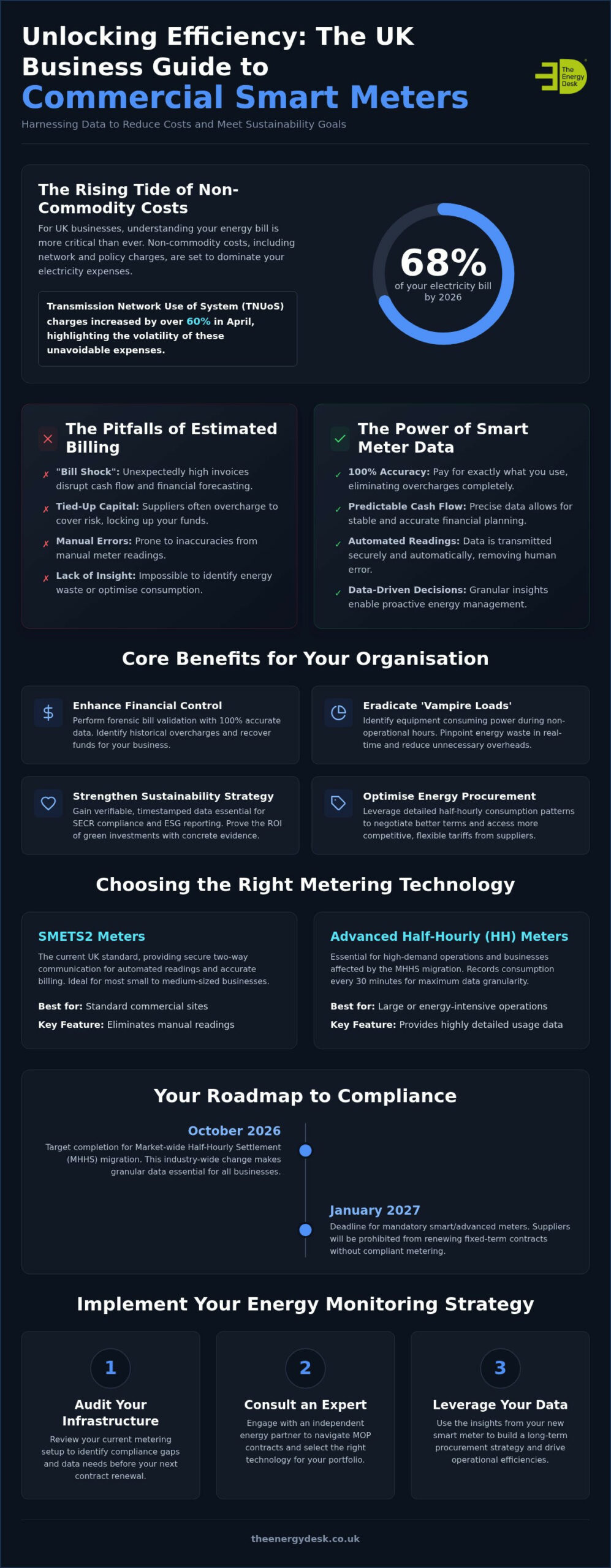
Did you know that non-commodity costs are projected to account for 68% of a UK business’s electricity bill throughout 2026? With Transmission Network Use of System charges having increased by over 60% in April, understanding the specific commercial smart meter benefits for your organisation is no longer optional; it’s a financial necessity. You’re likely familiar with the frustration of estimated billing that disrupts cash flow, alongside the mounting pressure to meet UK decarbonisation targets without granular data to guide your decisions.
We recognise that visibility is the fundamental starting point for operational efficiency. By leveraging the data these devices provide, you can eliminate billing inaccuracies, identify energy waste in real-time, and secure access to more competitive commercial tariffs. This guide provides a structured roadmap for using meter data to reduce overheads and strengthen your corporate sustainability strategy. We’ll examine the mandatory transition to half-hourly settlement and explain how professional MOP contracts and DC/DA services ensure your business remains compliant well before the January 2027 deadline.
Key Takeaways
- Learn why distinguishing between SMETS2 and advanced half-hourly meters is essential for meeting SECR compliance and achieving granular data visibility.
- Understand how commercial smart meter benefits include the total elimination of “bill shock” by replacing estimated invoicing with 100% accurate data.
- Discover how to identify and eradicate “vampire loads” by monitoring equipment performance during non-operational hours to reduce unnecessary overheads.
- Implement a methodical energy strategy by auditing your current metering infrastructure and consulting with an independent partner before your next contract renewal.
- Leverage smart data to perform forensic bill validation, allowing your organisation to recover overcharges and optimise your long-term procurement strategy.
Why Energy Monitoring is Critical for UK Businesses in 2026
Energy monitoring for businesses involves the systematic tracking of gas and electricity consumption to identify waste and optimise procurement. In 2026, this level of oversight is mandatory for any organisation looking to protect its bottom line. Non-commodity costs, such as network and policy charges, now account for roughly 68% of a UK business’s electricity bill. Managing these expenses requires granular, half-hourly data that traditional metering simply cannot provide. To understand the hardware involved, one might ask: What is a smart meter? It is a device that enables two-way communication, providing the precise data required for modern energy management.
Understanding the full scope of commercial smart meter benefits helps directors justify the transition before regulatory deadlines. Moving away from estimated billing is the first essential step in protecting commercial margins against market volatility. If you understand exactly how much energy you use and when you use it, you can shift from reactive bill payments to proactive management. This data-driven approach is no longer optional. From January 2027, UK energy suppliers will be prohibited from entering into or renewing fixed-term contracts with non-domestic customers unless a smart or advanced meter is installed.
The Shift from Estimated to Actual Consumption
Estimated bills represent a significant risk to corporate cash flow and financial forecasting. When a supplier guesses your usage, they often overcharge to cover their own risk, which ties up capital that could be used elsewhere in the business. Smart meters eliminate manual reading errors whilst ensuring total billing precision. By providing a direct link between your site and the supplier, these devices remove the ambiguity that leads to “bill shock” at the end of a quarter. Energy monitoring serves as the foundation of modern commercial utility bill validation.
Meeting Net-Zero and ESG Requirements
Accurate data collection is the engine behind any successful corporate decarbonisation strategy. For organisations required to comply with Streamlined Energy and Carbon Reporting (SECR), manual data entry is no longer sufficient. You need verifiable, timestamped energy data to satisfy stakeholders and secure green certifications. Real-time monitoring also allows you to track the performance of on-site infrastructure and prove the return on investment for commercial renewable energy solutions. Without this granular visibility, your sustainability claims lack the empirical evidence required in a transparent 2026 market.
The Role of Commercial Smart Meters in Data-Driven Management
Commercial smart meters are far more than digital versions of traditional hardware; they act as the primary data hub for your facility. These devices, specifically the SMETS2 standard, provide a secure two-way communication channel between your site and the energy supplier. This connection facilitates automated data transmission without human intervention, removing the risk of manual reading errors. According to the official government cost-benefit analysis, the transition to smart technology is a foundational pillar for a more flexible and efficient national grid. For the individual business, this translates into immediate visibility of consumption patterns that were previously hidden in monthly estimates.
Understanding the difference between standard smart meters and advanced Half-Hourly (HH) meters is critical for larger organisations. Whilst smaller sites may function well with a standard SMETS2 unit, high-demand operations require HH meters to record usage every thirty minutes. This granular reporting is essential for businesses affected by the Market-wide Half-Hourly Settlement (MHHS) migration, which is scheduled for completion by October 2026. Managing this sophisticated data flow requires a formal Meter Operator (MOP) contract. This agreement ensures that your metering hardware is maintained and that your data is securely and accurately relayed to your energy partners.
SMETS2: The Current Standard for Business
The SMETS2 meter is the current regulatory standard for UK businesses. Its primary advantage is interoperability, which allows you to maintain smart functionality even when switching business electricity procurement partners. Earlier SMETS1 models often lost their “smart” features during a supplier transfer, but SMETS2 units remain connected via the secure Data Communications Company (DCC) network. This centralised network protects sensitive corporate usage data whilst allowing multi-site organisations to centralise their energy oversight. If you manage a portfolio of properties, these meters allow you to compare performance across different locations from a single dashboard.
Integrating DC/DA Services for Forensic Insight
To extract the full commercial smart meter benefits, you must look beyond the hardware and focus on data management. Professional DC DA energy services are vital for this process. Data Collection (DC) involves the retrieval of your usage information, whilst Data Aggregation (DA) involves processing that data for settlement. These third-party services ensure your supplier charges you the correct rates based on actual consumption rather than estimated profiles. If you are unsure whether your current metering setup is delivering accurate data, you can speak with our consultants to review your existing infrastructure and contract obligations.
Key Commercial Smart Meter Benefits for UK Organisations
The transition to digital metering provides a suite of advantages that extend far beyond simple convenience. For the modern finance director, the most immediate of these commercial smart meter benefits is the total elimination of “bill shock.” By providing 100% accurate, non-estimated monthly invoicing, smart technology ensures that you only pay for what you consume. This precision is vital for maintaining a healthy cash flow, especially as non-commodity costs continue to rise. As highlighted by the UK Parliament’s Office of Science and Technology, smart meters are a critical component of a flexible national energy system, allowing businesses to align their operational habits with the needs of the grid.
Beyond simple billing accuracy, granular data allows organisations to identify “vampire loads.” These are systems or pieces of machinery that consume significant power during non-operational hours or whilst the building is unoccupied. Without half-hourly visibility, these hidden costs are often absorbed into a generic monthly total. Smart meters expose these inefficiencies, allowing facility managers to implement automated shutdown protocols or adjust maintenance schedules to prevent fiscal leakage.
Operational Efficiency and Waste Reduction
Harnessing real-time data allows you to centre your energy-saving efforts where they will have the greatest impact. Traditional meters provide a retrospective look at consumption, but smart technology highlights specific inefficiencies in HVAC and lighting systems that often go unnoticed. For instance, you might discover that a specific production line is drawing excessive power compared to its output, indicating a mechanical fault. There’s also a significant psychological benefit to this transparency. Making energy data visible to the workforce often encourages better energy-saving behaviour amongst staff, as the direct impact of their actions becomes quantifiable.
Financial Control and Procurement Leverage
Accurate load profiles are essential when negotiating business gas procurement and electricity contracts. When a supplier understands your exact usage patterns, they can offer more competitive “flexible” contracts that reward you for shifting consumption to off-peak periods. You can also use this data to optimise your agreed capacity, potentially reducing standing charges if your actual peak demand is lower than your current contract allows. Accurate data is the most powerful tool a business possesses during contract renewal negotiations. It transforms you from a passive consumer into a strategic buyer with the empirical evidence needed to demand better rates.
How to Implement a Comprehensive Energy Monitoring Strategy
A successful transition to digital monitoring requires more than just hardware installation. It demands a methodical approach that aligns your physical infrastructure with your long-term fiscal objectives. By following a structured implementation plan, you ensure that the commercial smart meter benefits discussed earlier are fully realised within your operational budget. This process should ideally begin at least twelve months before your current energy contract expires. This lead time allows for any necessary infrastructure upgrades or connection changes without the pressure of an imminent renewal deadline.
Step 1: Audit and Infrastructure Assessment
Your first task is a comprehensive audit of all existing “dumb” meters across your portfolio. You must assess the ease of a new commercial electricity connection if your current setup cannot support smart technology. This is particularly urgent for sites falling under P272 regulations, which mandate half-hourly settlement for larger energy users. During this phase, check for physical barriers such as poor signal strength in basement plant rooms or restricted site access that might delay a technician’s visit. Identifying these constraints early prevents last-minute complications that could force you onto expensive out-of-contract rates.
Step 2: Choosing the Right Monitoring Partners
Relying solely on your energy supplier for data can be a strategic error. Suppliers often provide limited dashboards that don’t allow for the forensic interrogation needed to spot billing mistakes or “vampire loads.” Working with an independent consultancy like The Energy Desk ensures you receive unbiased oversight and data that you truly own. This independent data is vital when planning future capital projects, such as a CHP system installation for businesses or a large-scale solar array. Accurate baseline data ensures these investments are sized correctly and deliver the projected return on investment based on your actual consumption profile.
Once your hardware is in place, you must establish a formal MOP agreement and a DC/DA service. These components ensure your data is collected and validated independently of the supplier, providing a reliable source of truth for your organisation. Integrating this monitoring data into your monthly financial and sustainability reporting cycles is the final step. This turns raw numbers into actionable intelligence that your board can use to drive efficiency and meet SECR obligations. If you’re ready to upgrade your infrastructure, you can request a metering audit from our specialist team today to begin the process.
Optimising Your Energy Portfolio with Professional Monitoring Solutions
The true value of a digital metering strategy lies in the transition from simple data collection to actionable procurement intelligence. Whilst many organisations view the installation as the final step, it is actually the commencement of a more sophisticated management cycle. By integrating granular usage patterns with forensic bill validation, businesses can recover historic overcharges and ensure future invoices are 100% accurate. This synergy is one of the most significant commercial smart meter benefits, as it provides the empirical evidence required to challenge supplier errors that generic software often overlooks.
For organisations managing multi-site portfolios, scaling these solutions is essential for centralised oversight. Centralising your energy data allows for a direct comparison between facilities, highlighting outliers where efficiency measures are failing. This high-level visibility is critical when justifying the capital expenditure required for renewable infrastructure or EV charging networks. Without the baseline data provided by a smart meter, calculating the true displacement of grid energy by on-site generation remains a matter of guesswork. Precise data ensures your infrastructure is sized to meet actual demand rather than theoretical peaks.
The Energy Desk Approach: Beyond the Meter
We take a methodical approach to utility management that extends far beyond the physical hardware. Our team manages the complexities of MOP contracts and DC/DA services on behalf of our clients, ensuring that data flows are secure and uninterrupted. Our analytical mindset allows us to identify cost-saving opportunities that standard supplier dashboards miss, such as subtle shifts in base-load consumption that indicate equipment degradation. If you’re looking to professionalise your energy oversight, you can contact our specialists on 03330 151 221 for a free initial energy monitoring consultation.
Future-Proofing Your Business for 2026 and Beyond
As we approach the 2027 deadline for non-domestic smart meter mandates, preparing your infrastructure now is a matter of fiscal responsibility. The regulatory standards in the UK are evolving, with a clear move toward mandatory half-hourly settlement for all business classes. This data is the primary requirement for the design and implementation of bespoke CHP systems, which rely on accurate thermal and electrical load profiles to deliver maximum efficiency. Recognising the commercial smart meter benefits today ensures your business is positioned to lead in a decarbonised economy. In 2026, energy data is as valuable as the energy itself.
Securing Operational Stability Through Energy Intelligence
Transitioning to a data-driven energy strategy is the most effective way to protect your organisation from market volatility and rising non-commodity charges. By eliminating estimated bills and identifying hidden waste, you gain the transparency needed for accurate financial forecasting and robust sustainability reporting. Fully realising commercial smart meter benefits requires a methodical approach that combines high-specification hardware with professional data management and independent oversight.
As an independent energy consultancy since 2003, our expert UK-based support team specialises in complex commercial utility management and forensic auditing. We help you transform raw consumption data into a strategic asset that drives down overheads and improves procurement leverage. Request a free energy audit from The Energy Desk to optimise your monitoring strategy and ensure your infrastructure is ready for the 2027 regulatory shift. Taking control of your data today provides the stability your organisation needs to thrive in a more transparent energy market.
Frequently Asked Questions
What are the main commercial smart meter benefits for small businesses?
The primary commercial smart meter benefits for small businesses include the elimination of estimated billing and the protection of cash flow. Accurate invoicing ensures you only pay for actual consumption, which is critical for micro-businesses facing electricity rates that can be 35% higher on out-of-contract tariffs. These devices also provide the visibility needed to identify “vampire loads,” allowing smaller operations to reduce waste without the need for expensive dedicated energy management software.
Is a smart meter mandatory for UK businesses by 2026?
Whilst the rollout is ongoing throughout 2026, a specific mandate takes effect on 1 January 2027. From this date, UK energy suppliers are prohibited from entering into or renewing fixed-term contracts with non-domestic customers unless a smart or advanced meter is installed. Businesses that fail to comply risk being moved to significantly higher out-of-contract rates, making 2026 the critical window for arranging an installation before contract renewals occur.
How much does it cost to have a commercial smart meter installed?
Most UK energy suppliers offer smart meter installations at no upfront cost to the business, as the programme is funded through existing energy bills. However, new Ofgem rules introduced in February 2026 mandate a £40 automatic payment to the customer if an installation appointment is delayed by more than six weeks. You should contact your supplier or an independent consultant to verify your eligibility and avoid potential “deemed” contract rates.
What happens if my business has poor mobile signal for the smart meter?
If your site has poor mobile signal, technicians can often install an external antenna or a high-gain aerial to boost connectivity to the secure Data Communications Company (DCC) network. In some cases, a different communication hub may be used to find a stronger signal. It’s important to resolve these issues early, as a functioning connection is required to transmit the half-hourly data needed for accurate billing and forensic auditing.
Can a smart meter help me switch business energy suppliers more easily?
Yes, a SMETS2 smart meter significantly simplifies the switching process between energy suppliers. Unlike earlier models, SMETS2 units are fully interoperable, meaning they retain their smart functionality even when you move to a new provider. This allows your broker to access historical usage data immediately, making it easier to negotiate competitive new tariffs based on your actual load profile rather than generic industry estimates.
What is the difference between a smart meter and an AMR (Automated Meter Reading) device?
The main difference lies in communication capability. A smart meter (SMETS2) offers two-way communication and is connected to the national DCC network, allowing for remote updates and interoperability. An Automated Meter Reading (AMR) device is typically a one-way system that transmits data to the supplier but lacks the advanced features of a SMETS2 unit. Both provide the half-hourly data required for modern business energy management and P272 compliance.
How does smart meter data improve the accuracy of business energy audits?
Smart meter data transforms a standard energy audit from a snapshot into a comprehensive analysis of operational behaviour. By reviewing 30-minute usage intervals, auditors can pinpoint exactly when peak demand occurs and identify machinery that is consuming power inefficiently. This granular visibility allows for the design of bespoke solutions, such as CHP systems or solar arrays, that are perfectly sized to meet your site’s specific electrical and thermal requirements.
Will my business operations be disrupted during the smart meter installation?
You should expect a brief period of disruption, usually lasting between 30 and 60 minutes, as the power or gas supply must be isolated during the meter exchange. Most providers allow you to schedule this installation during off-peak hours or weekends to minimise the impact on your business operations. Planning this transition in 2026 ensures you have the flexibility to choose a time that suits your production or service schedule.