


Did you know that by December 2026, every business energy meter in the UK must transition to mandatory half-hourly settlement? This regulatory shift highlights a growing challenge for many organisations: maintaining business energy data accuracy in an increasingly complex market. You’ve likely experienced the frustration of unpredictable costs and bills that seem impossible to validate, often leaving you to manage budgets whilst dealing with the uncertainty of estimated readings.
We understand that a lack of visibility into site-specific usage limits your growth and complicates carbon reporting. This guide explains how professional Data Collection (DC) and Data Aggregation (DA) services provide the oversight you need to regain control. By appointing an independent expert, you can eliminate the guesswork of estimated billing and ensure your financial records are 100% accurate. We’ll explore how these services work, the benefits of forensic auditing to recover overcharges, and why securing your data infrastructure is the first step toward strategic utility management.
Key Takeaways
- Understand the critical points of failure in the “data journey” and how these gaps directly impact business energy data accuracy.
- Learn how professional Data Collection (DC) and Data Aggregation (DA) services work together to validate half-hourly usage for precise billing.
- Identify the specific technical records and physical verification steps needed to spot site mismatches and supplier errors.
- Discover how sub-metering and AMR technology provide the granular visibility required to manage energy behaviour across complex sites.
- Explore the benefits of forensic utility auditing in recovering historic overcharges and securing long-term cost control.
What is Business Energy Data Accuracy and Why Does it Fail?
At its core, business energy data accuracy represents the perfect alignment between the physical energy consumed on-site and the financial records held by your supplier. It isn’t just about reading a dial; it’s about ensuring every kilowatt-hour (kWh) is correctly identified, validated, and billed. For large-scale operations, even a minor discrepancy in this alignment can result in thousands of pounds in wasted expenditure.
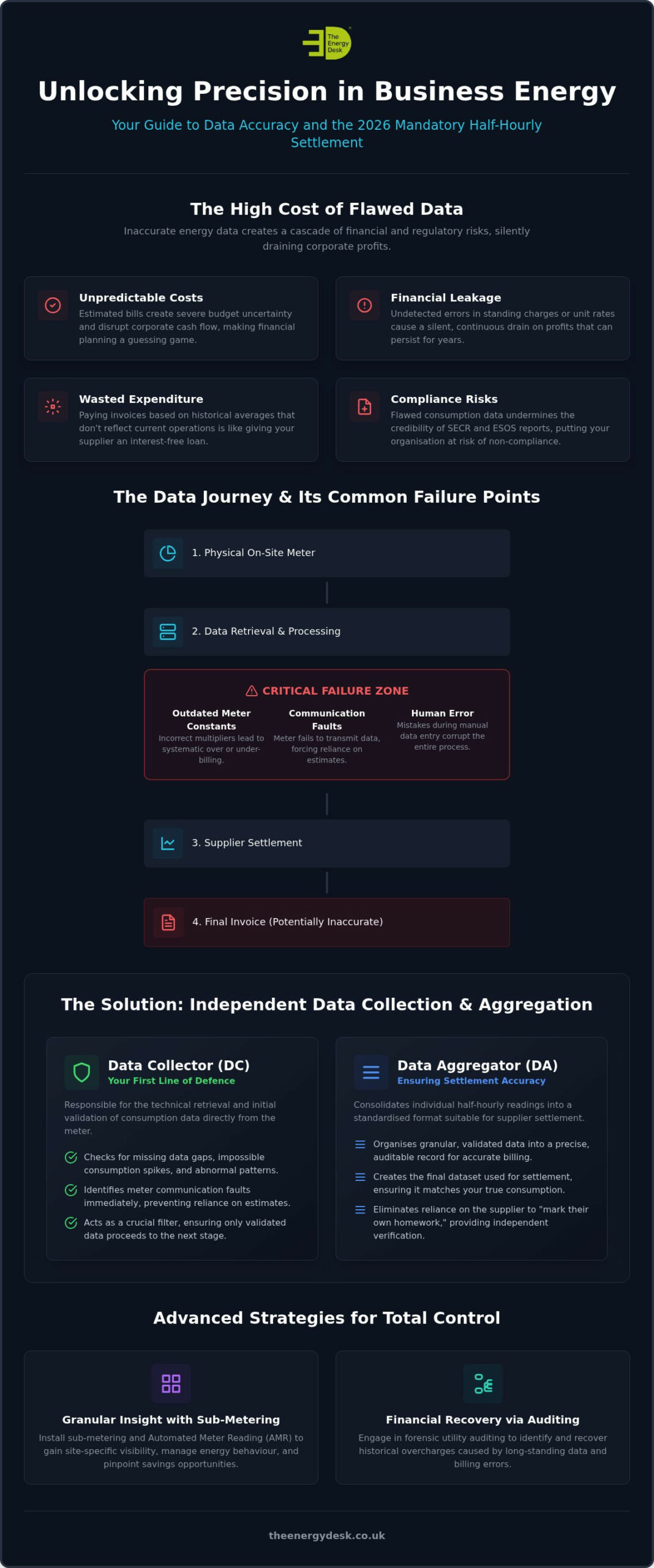
The “Data Journey” is the complex path energy information takes from your meter display to the final invoice. This process involves multiple stakeholders and technical handovers. Data is first retrieved from the meter, then processed through Meter data management (MDM) systems, and finally passed to the supplier for settlement. Failures often occur during these transitions. Common culprits include outdated meter constants, where the multiplier used to calculate consumption is incorrect, or communication faults that prevent remote meters from “talking” to the network. Human error during manual data entry also remains a persistent issue for sites without automated systems.
The Hidden Risks of Estimated Meter Readings
When a supplier fails to receive a valid reading, they don’t stop billing. Instead, they use historical averages to generate an “estimated” invoice. These figures rarely reflect current operational reality. If your production levels have dropped but the estimate remains high, you’re essentially providing the supplier with an interest-free loan. Conversely, if estimates are too low, you face the threat of “catch-up” bills. These unexpected, high-value invoices can appear months later, causing significant disruption to corporate cash flow. Manual readings are no longer a viable solution for modern energy management as they lack the granularity required for the upcoming Market-wide Half-Hourly Settlement (MHHS) deadlines in 2026.
The Financial Impact of Data Inaccuracy
Inaccurate data often manifests as incorrect standing charges or unit rates. This frequently happens when the technical records for your MPAN (Meter Point Administration Number) or MPRN (Meter Point Reference Number) don’t match the physical hardware on-site. Beyond the immediate invoice, poor data quality sabotages your compliance efforts. Maintaining high levels of business energy data accuracy is therefore a financial and regulatory necessity. Organisations reporting under SECR or ESOS mandates cannot provide reliable carbon footprints if their base consumption data is flawed. Billing leakage is the silent drain on corporate profits caused by undetected errors within the utility billing cycle.
The Role of DC DA Energy Services in Data Validation
For large UK enterprises, half-hourly (HH) metering is often a regulatory obligation. This is where Data Collection (DC) and Data Aggregation (DA) services become indispensable. A Data Collector is responsible for the technical retrieval and initial validation of your consumption data directly from the meter. Once this data is verified, the Data Aggregator steps in to consolidate these individual readings into a format suitable for supplier settlement. Together, they act as an essential filter, ensuring the information reaching your supplier is a precise reflection of your operational reality.
These services are no longer just “back-office” functions. They are the primary mechanism for maintaining business energy data accuracy in a market moving toward total half-hourly settlement by 2027. Without an independent DC/DA, you’re entirely reliant on your supplier’s internal agents to mark their own homework. This often leads to undetected errors that remain on your account for years.
How Data Collectors (DC) Ensure Integrity
The Data Collector serves as the first line of defence for your utility budget. During the validation process, the DC checks for missing data gaps, impossible consumption spikes, or patterns that don’t align with your historical usage. Maintaining robust communication links with your Meter Operator (MOP) contracts is vital here. If a meter stops transmitting, the DC identifies the fault immediately. Prompt detection prevents the supplier from relying on months of estimated data, which results in the “billing leakage” that can devastate margins. High-quality Data Quality in the Energy Industry ensures that every kilowatt-hour is accounted for before it ever touches an invoice.
Data Aggregation (DA) and Supplier Settlement
Data Aggregation is the second phase of the data journey. The DA organises granular half-hourly data into the specific formats required for industry settlement and final billing. This role is also critical for the wider energy infrastructure. The DA ensures the national grid remains balanced by providing accurate consumption reports to central systems. Whilst many businesses let their supplier appoint these agents, choosing your own independent DC/DA provider offers far greater transparency. It allows you to access your own data in real-time, rather than waiting for a monthly bill. If you’re concerned about your current data flow, starting with a free energy audit can reveal where supplier-appointed agents might be failing to protect your interests.
How to Verify and Audit Your Business Energy Data
Auditing your energy consumption is a methodical process that begins with high-quality documentation. To maintain business energy data accuracy, you must first gather your recent utility invoices, clear time-stamped photos of your meter displays, and your site’s technical MPAN or MPRN records. These documents serve as the baseline for your investigation and allow you to trace discrepancies back to their source.
A common point of failure is a site mismatch, where the meter serial number on your physical hardware does not align with the records on your supplier’s bill. Cross-referencing these numbers is a simple yet effective way to identify if you are being charged for a different site’s consumption or an obsolete meter. Once the hardware is verified, you should request half-hourly data reports from your appointed Data Collector. Analyse these reports for “flat lines,” which often indicate a communication fault where the meter has stopped transmitting and the system is repeating the last known value. Conversely, unexplained peaks in consumption often point to operational inefficiencies or equipment faults that require immediate intervention.
Identifying Discrepancies in Your Utility Bills
Modern digital invoices contain specific indicators that reveal the quality of your data. Look for an “E” next to your meter readings, which denotes an estimate, versus an “A” for an actual reading. If your bills consistently show estimates despite having a smart meter, your data chain is broken. For organisations with a Building Management System (BMS), comparing internal sensor data against supplier figures is a powerful validation step. Discrepancies here often highlight where commercial utility bill validation is required to unearth historical overcharges and systemic errors that automated systems might miss.
Escalating Data Mismatches with Suppliers
When you identify a mismatch, following the correct industry protocol is essential for a swift resolution. You should first raise a formal dispute with your Meter Operator (MOP) or Data Collector to verify the technical integrity of the meter and the communication link. Your strongest asset during this process is a library of time-stamped meter photos, which provide irrefutable evidence of physical readings at a specific point in time. Dealing with supplier bureaucracies can be time-consuming and technically demanding. Many organisations choose to involve an independent energy consultant to manage these disputes, ensuring that technical jargon doesn’t obscure the financial recovery your business is owed.
Enhancing Accuracy Through Sub-Metering and AMR
Whilst previous sections detailed the external “data journey,” internal infrastructure is equally vital for maintaining business energy data accuracy. Most organisations rely solely on their primary billing meter, which measures the total energy intake for the entire site. However, internal sub-metering systems provide an essential second layer of verification. By monitoring specific departments or high-drain equipment, you can cross-reference internal totals against your supplier’s primary meter data. If the sum of your sub-meters doesn’t align with the main intake, it’s a clear indicator of either a technical fault or a billing error that needs immediate investigation.
For smaller commercial sites where full half-hourly metering isn’t yet mandatory, Automated Meter Reading (AMR) technology offers a significant step up from manual processes. AMR devices retrofitted to existing meters automatically transmit consumption data to your provider, removing the risk of human error during site visits. Automated Meter Reading (AMR) is the minimum standard for modern business efficiency. Integrating this real-time monitoring into your corporate energy strategy ensures that you aren’t just reacting to bills but actively managing your usage patterns.
The Strategic Benefits of Granular Data
Granular data allows facility managers to pinpoint energy waste that is often hidden in a single, site-wide total. You can identify machinery or HVAC systems that remain active during off-peak hours, allowing for immediate operational adjustments. Sub-metering also simplifies cost allocation amongst different tenants or cost centres, ensuring each department is only responsible for its actual consumption. This level of detail is crucial when building the business case for onsite generation, such as CHP systems, as it provides the precise thermal and electrical load profiles needed for accurate system sizing. If you want to identify where your site is losing efficiency, you can book a free energy audit to evaluate your current metering setup.
Future-Proofing with Smart Metering Infrastructure
The UK energy market is currently undergoing its most significant modernisation in decades. The transition towards Market-wide Half-Hourly Settlement (MHHS) means that by December 2026, the majority of businesses will be settled based on granular, 30-minute data. Ensuring your metering hardware is compatible with these 2026 data standards is a prerequisite for business energy data accuracy. Organisations that fail to upgrade their infrastructure now risk being left with “estimated” profiles that don’t reflect their true behaviour, leading to higher costs under new flexible tariffs. Proactive infrastructure management ensures your business remains compliant whilst gaining a competitive edge through superior data visibility.
Strategic Energy Management: The Energy Desk Approach
Many businesses rely on their energy supplier to manage data validation. This creates an inherent conflict of interest. As an independent consultancy, The Energy Desk provides an unbiased audit of your consumption records. We ensure that business energy data accuracy is maintained by acting as a third-party watchdog. We manage the intricate relationships between Meter Operators (MOPs), Data Collectors (DCs), and Data Aggregators (DAs) on your behalf. This coordination removes the technical burden from your internal teams whilst ensuring every agent in the chain is performing correctly. Without this independent oversight, errors in the data journey often go unchallenged, leading to years of overpayment.
Forensic Auditing and Cost Recovery
Our methodical process goes beyond simple bill checking. We employ a forensic approach to identify historical billing errors dating back up to six years. These discrepancies often stem from the technical failures discussed earlier, such as incorrect meter constants or site mismatches. The Energy Desk has successfully recovered thousands of pounds in overcharges for UK clients by identifying these systemic flaws. Once we verify your data, we integrate these insights into your strategic electricity procurement. Having accurate historical data allows us to forecast your future needs with precision. This data-led approach ensures you aren’t purchasing more capacity than required, securing more competitive rates during contract negotiations. A free energy audit is the most effective starting point for any organisation looking to uncover these hidden savings. It provides the clarity needed to transition from reactive payment to strategic management.
Proactive Data Management for 2026
With the Market-wide Half-Hourly Settlement (MHHS) deadline approaching in December 2026, reactive management is no longer sufficient. We provide ongoing monitoring to ensure business energy data accuracy remains high throughout your entire contract lifecycle. Our customised reporting provides a clear centre of truth for your energy usage, moving away from the fragmented data typically provided by suppliers. We track your performance in real-time, identifying consumption spikes or communication faults before they escalate into financial losses. This proactive oversight ensures your business is fully prepared for the 2026 data standards and the migration window starting in May 2026. By establishing a robust data foundation now, you can take advantage of the more flexible tariffs that half-hourly settlement will enable. Contact The Energy Desk today for a free energy audit and data accuracy review to secure your utility infrastructure.
Securing Your Operational Future Through Data Integrity
The transition toward the 2026 half-hourly settlement deadline makes business energy data accuracy a critical pillar of corporate financial health. Relying on supplier-appointed agents often leads to unvalidated estimates that drain your margins. By taking control of your DC/DA and MOP contracts, you gain the granular visibility needed to identify waste and ensure every invoice is precise. This isn’t just about compliance; it’s about reclaiming lost revenue through forensic auditing and protecting your cash flow from unexpected “catch-up” bills.
The Energy Desk is an independent UK energy consultancy specialising in forensic bill validation and the expert management of technical utility contracts. We act as your strategic ally, simplifying the market whilst delivering results that support your long-term growth. Don’t let inaccurate data undermine your procurement strategy. Request a free energy audit from The Energy Desk to secure your data accuracy and gain total oversight of your consumption. We’re ready to help you build a more transparent and efficient energy future.
Frequently Asked Questions
What is the difference between a DC and a DA in business energy?
The Data Collector (DC) is responsible for the technical retrieval and validation of consumption data directly from your meter. The Data Aggregator (DA) then consolidates this validated data into a format suitable for supplier settlement and billing. The DC ensures the numbers are physically correct, whilst the DA prepares them for the industry systems. This ensures the data journey remains secure from the physical meter to the final invoice.
Why is my business energy bill based on estimated readings?
Estimated readings occur when your supplier doesn’t receive a valid data stream from your meter. This often happens due to communication faults in the hardware or a lapse in your Data Collection contract. If the DC cannot retrieve actual usage, the supplier defaults to historical averages. These estimates are a primary cause of billing leakage and can lead to significant financial discrepancies over time.
Can I choose my own Data Collector (DC) and Data Aggregator (DA)?
Yes, businesses with half-hourly meters have the right to appoint their own independent DC/DA providers. Whilst many organisations allow their supplier to appoint these agents by default, choosing an independent provider offers greater transparency. It allows you to access your own consumption data in real-time and ensures that the agents responsible for your data are working directly for your interests rather than the supplier’s.
How much can a business save by improving energy data accuracy?
Savings vary depending on the scale of historical errors, but identifying inaccuracies often leads to the recovery of thousands of pounds. Improving business energy data accuracy eliminates overpayments caused by incorrect meter constants or site mismatches. Beyond direct recovery, accurate data allows for more precise procurement, ensuring you don’t pay for excess capacity or “ghost” consumption that doesn’t actually exist on-site.
What is a Meter Operator (MOP) agreement and do I need one?
A Meter Operator (MOP) agreement is a legal contract that covers the installation, maintenance, and technical communication of your electricity meter. If you have a half-hourly meter, a MOP contract is mandatory. The MOP ensures the hardware is functioning correctly so that the Data Collector can retrieve accurate readings. Without a valid MOP agreement, your data stream will likely fail, resulting in expensive estimated bills.
How often should a business audit its energy data for inaccuracies?
Organisations should ideally conduct a high-level review of their energy data monthly against their physical meter readings. However, a comprehensive forensic audit is recommended at least once a year or whenever you switch suppliers. Regular auditing ensures that technical faults are identified early, preventing the accumulation of historical errors that become increasingly difficult to dispute after several years of billing cycles have passed.
What happens if my energy meter data does not match my supplier bill?
If a mismatch occurs, you should immediately raise a technical dispute with your Data Collector to verify the retrieval process. You must provide evidence, such as time-stamped photos of the meter display, to prove the physical reading differs from the invoiced amount. An independent consultant can manage this escalation between the DC, MOP, and supplier to ensure the error is corrected and any overcharges are refunded.
Is half-hourly data collection mandatory for all UK businesses?
Half-hourly data collection is currently mandatory for businesses with a peak demand of 100kW or more. However, the UK market is transitioning through the Market-wide Half-Hourly Settlement (MHHS) programme. By December 2026, almost all business meters will be moved to half-hourly settlement. This shift aims to modernise the grid and provide more accurate billing for organisations of all sizes throughout the country.