
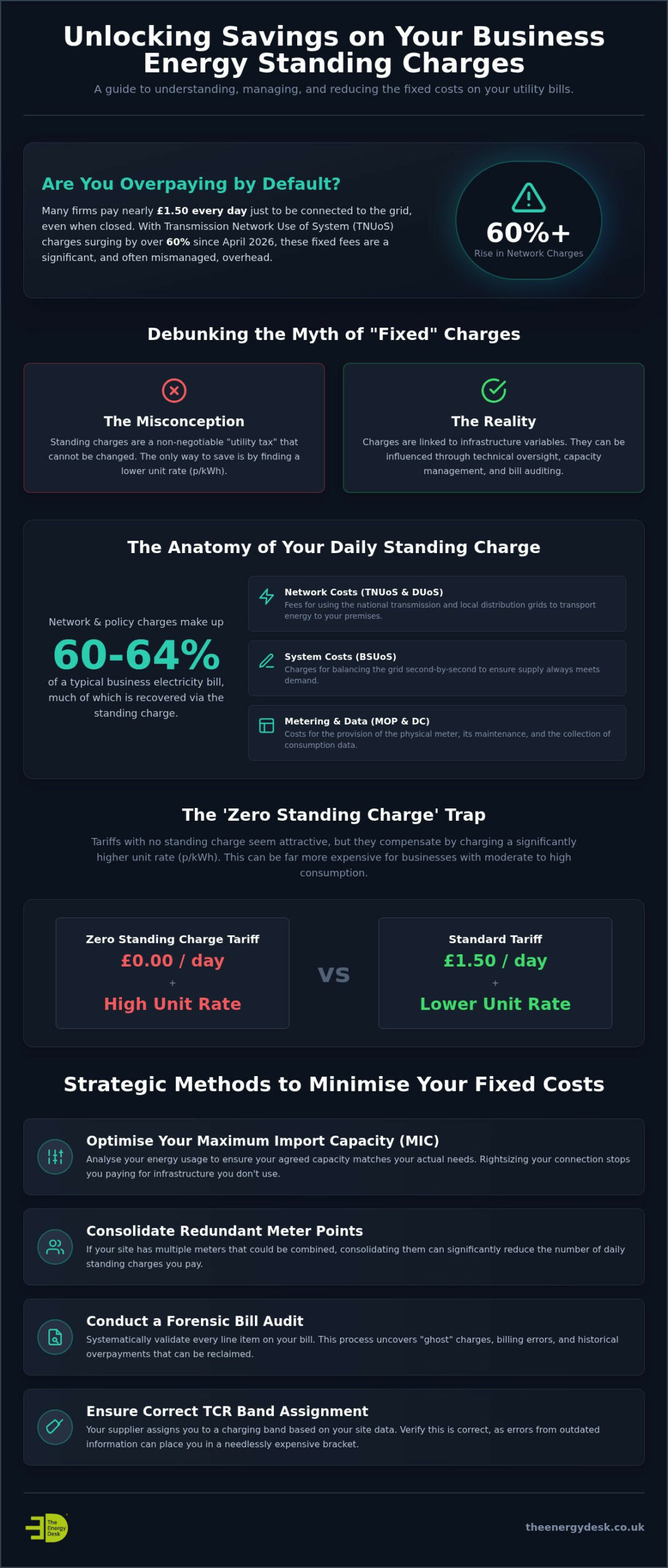
Why is your firm paying nearly £1.50 every single day just for the privilege of being connected to the grid, even when your premises are locked and the lights are out? You’ve likely felt the sting of rising daily fees, especially since Transmission Network Use of System (TNUoS) charges surged by over 60% in April 2026. It’s frustrating to see fixed costs climb whilst your actual consumption remains steady. Many directors feel trapped by jargon like DUoS or TCR bands, believing these fees are non-negotiable taxes. This guide will show you how to reduce business energy standing charges by moving beyond simple rate comparisons and into the realm of technical capacity management and forensic bill auditing.
We’ll dismantle the complexity of network charges, evaluate the true value of zero-standing charge tariffs, and explain how rightsizing your connection can stop you from overpaying for infrastructure you don’t use. By the end, you’ll have a clear strategy to reclaim control over your utility overheads. Our methodical approach ensures you understand the data behind the debt, allowing for more precise fiscal oversight in an increasingly volatile market.
Key Takeaways
- Learn why standing charges are not non-negotiable taxes but infrastructure-linked variables that can be influenced through technical oversight.
- Understand the financial mechanics of zero-standing charge tariffs to determine if a higher unit rate truly benefits your specific consumption profile.
- Discover how to reduce business energy standing charges by optimising your Maximum Import Capacity (MIC) and consolidating redundant meter points.
- Identify and reclaim costs from “ghost” charges or billing errors through a forensic bill validation process.
- Master the breakdown of pass-through costs like TNUoS and DUoS to ensure your supplier has assigned your business to the correct TCR band.
Debunking the Myth: Are Business Energy Standing Charges Truly Fixed?
A business energy standing charge is a daily fee applied to your account to cover the ongoing costs of maintaining the national grid and local distribution networks. Unlike your unit rate, which is the price you pay for every kilowatt-hour (kWh) consumed, the standing charge remains constant regardless of whether your machinery is running or your site is closed for the weekend. Many organisations view these fees as a non-negotiable “utility tax” that must be accepted as part of the price of doing business. This mindset is incorrect. Whilst the fee is a standard component of your invoice, the specific amount you are billed is often based on variables that your business can influence.
To understand the anatomy of a utility bill, one must distinguish between the energy you use and the infrastructure required to deliver it. In 2026, network and policy charges make up approximately 60% to 64% of a typical business electricity bill. A significant portion of this is recovered through the standing charge. The exact daily rate is determined by “banding,” a system that categorises businesses based on their potential demand and historical usage. If your business is placed in the wrong band, your fixed costs will be artificially inflated from the outset.
The “Fixed Fee” Misconception Amongst UK Businesses
Financial Directors frequently overlook standing charges during the contract negotiation phase. The common strategy is to secure the lowest possible unit rate, assuming the standing charge is a fixed industry standard that cannot be altered. This oversight is costly. Since April 2026, Transmission Network Use of System (TNUoS) charges have risen by over 60%, making the fixed portion of your bill a much larger overhead than in previous years. The Targeted Charging Review (TCR) is an Ofgem initiative to ensure fair network cost distribution. This review shifted many costs from variable unit rates to fixed daily charges, meaning that finding ways to reduce business energy standing charges is now more critical than simply chasing a lower pence-per-kWh rate.
Why Your Business Might Be Overpaying by Default
Suppliers often rely on outdated or generic site data when assigning your business to a charging band. Errors in meter classifications or historical data from previous tenants can trap your organisation in a higher cost bracket than your current operations require. If your business has downsized its equipment or improved its energy efficiency, your connection capacity might be significantly higher than necessary. This leads to a situation where you’re paying for infrastructure availability that you never actually use. Recognising these discrepancies requires a methodical approach to your data. We recommend implementing commercial utility bill validation to audit every line item of your energy expenditure. This forensic oversight is the only reliable way to identify if your supplier is billing you at the correct band and to uncover opportunities to lower your daily operational costs.
The Anatomy of a Daily Fee: Understanding What You Actually Pay For
Your daily standing charge is not a solitary figure plucked from thin air by your supplier. It’s a composite of several regulated and unregulated costs. To effectively reduce business energy standing charges, you must first understand the specific levers that drive the total price. These components include Transmission Network Use of System (TNUoS), Distribution Use of System (DUoS), and Balancing Services Use of System (BSUoS) fees. According to Ofgem on standing charges, these elements are designed to recover the costs of building, maintaining, and operating the physical wires and pipes that deliver energy to your premises.
Beyond these network costs, your bill includes Meter Operator (MOP) and Data Collection (DC) fees. These cover the provision of the physical meter and the management of the data it produces. Many businesses accept the default MOP and DC/DA arrangements provided by their supplier, often at a premium. Managing these as separate, competitive contracts is a methodical way to ensure oversight and lower your fixed overheads. Regional variations also play a significant role. Businesses in areas with lower population density or more challenging terrain often face higher base costs before a supplier even adds their margin. If you want to ensure these components are being billed accurately, you might consider a professional review of your commercial energy procurement strategy.
TNUoS and DUoS: The Hidden Drivers of Your Bill
DUoS charges are particularly complex as they vary based on your voltage level and the time of day you use energy. These are often categorised into Red, Amber, and Green time bands. Red bands represent peak demand periods when the local network is under the most strain. Whilst the standing charge itself is a daily fee, the “band” you’re placed in for these charges is often determined by your peak capacity requirements. Larger industrial sites face significantly higher transmission costs because they require more robust infrastructure. Since TNUoS charges rose by over 60% in April 2026, the impact of being in a high-capacity band has never been more financially damaging for UK firms.
Supplier Operating Costs and Profit Margins
Suppliers add their own layer to the standing charge to cover billing, customer service, and credit risk. There are two primary ways these are handled in commercial contracts. “Bundled” fixed rates hide these margins within a single daily figure, making it difficult to see what you’re actually paying for. Conversely, “transparent” pass-through contracts separate the regulated network costs from the supplier’s specific fee. This transparency allows procurement consultants to negotiate the supplier-specific element more effectively. Choosing a pass-through structure provides the clarity needed to identify where costs can be trimmed, rather than accepting a opaque, all-in-one daily rate.
The ‘Zero Standing Charge’ Trap: Why No-Fee Tariffs Can Cost You More
Many businesses are attracted to “zero standing charge” products as a seemingly instant way to reduce business energy standing charges. It sounds like a logical financial move: if the daily fee is the problem, simply remove it. However, energy suppliers are not charities. They must still recover the network and policy costs we explored in previous sections. To do this, they shift the financial burden from the daily fee onto the unit rate. In 2026, whilst a standard small business tariff might have a unit rate around 22p per kWh, a zero-fee alternative often exceeds 30p per kWh. This shift can turn a perceived saving into a significant annual loss.
The appeal of these tariffs is often superficial. Suppliers recoup their margins by inflating the pence-per-kWh price, meaning you pay more for every single light bulb or computer you turn on. Before committing to such a structure, it is vital to conduct a thorough business energy consumption analysis. Without a clear understanding of your load profile, you’re essentially guessing whether the lack of a daily fee compensates for the premium you’ll pay on consumption.
Calculating the Real Cost of “Free” Standing Charges
Consider a medium-sized office with a standard daily standing charge of approximately 102.1p. Over a year, this fixed cost totals roughly £373. If that office consumes 40,000 kWh annually, a 7p increase in the unit rate to cover the “free” standing charge would add £2,800 to the annual bill. In this scenario, the business spends an extra £2,427 just to avoid a £373 fee. High-consumption businesses should almost always avoid zero-fee deals. There’s also a tax implication. Because the costs are bundled into the unit rate, they are subject to VAT and the Climate Change Levy (CCL). This often results in a higher total tax liability compared to a bill where the infrastructure costs are kept as a separate, lower-taxed fixed fee.
When Does a Zero-Standing Charge Tariff Make Sense?
These tariffs are niche products designed for specific, low-usage operational profiles. They are not intended for the average active business. They can be highly effective in the following scenarios:
- Holiday parks or seasonal attractions that close completely during the winter months.
- Redundant pumping stations or emergency backup facilities that draw negligible power.
- Empty commercial units or warehouses currently awaiting a new tenant.
The primary risk with these products is the “out-of-contract” trap. If a zero-fee deal expires and you haven’t arranged a renewal, you could be moved to deemed rates where standing charges can soar to over 330p per day for gas. A strategic business gas procurement strategy focuses on matching the tariff to the actual behaviour of the site. Chasing a “zero” on one line item whilst ignoring the inflated costs on another is a common procurement error that professional oversight can easily prevent.
Strategic Methods to Minimise Your Fixed Utility Costs
While selecting the right tariff is a fundamental step, achieving a permanent reduction in overheads requires a shift from procurement to technical infrastructure management. To reduce business energy standing charges effectively, you must address the underlying infrastructure that dictates your billing profile. This involves moving beyond surface-level rate comparisons and into the realm of capacity optimisation and meter management. By refining how your site connects to the grid, you can influence the regulated components of your bill that most businesses assume are set in stone.
One of the most effective ways to lower administrative overheads is through independent Meter Operator (MOP) agreements. Most suppliers bundle MOP and Data Collection (DC) services into the standing charge at a premium rate. By appointing an independent provider, you gain direct oversight of your metering costs and ensure you are only paying for the specific services your site requires. Additionally, transitioning from standard metering to Half-Hourly (HH) metering provides the data granularity needed to identify inefficiencies. This granular data is the foundation for any meaningful attempt to rightsize your utility connections and eliminate waste.
Rightsising Your Maximum Import Capacity (MIC)
Maximum Import Capacity (MIC) is the upper limit of electricity your site is permitted to draw from the local network, measured in kilovolt-amperes (kVA). Many UK businesses are currently over-provisioned, paying for a level of capacity they haven’t reached in years. This is often a legacy of previous manufacturing processes or older, less efficient equipment. You are billed a daily rate for every kVA of capacity reserved for your site, regardless of whether you use it. Reducing your MIC requires a formal negotiation with your Distribution Network Operator (DNO) to lower your kVA allowance. Crucially, reducing MIC can drop a business into a lower TCR standing charge band, leading to a significant and permanent reduction in daily fees.
Meter Consolidation and Redundant Connection Removal
For organisations operating across multi-building sites or large industrial complexes, the presence of multiple meters is a common source of financial leakage. Each meter point (MPAN) attracts its own daily standing charge, MOP fee, and administrative markup. Meter consolidation involves merging multiple supplies into a single point of connection. Whilst this requires an initial technical investment and coordination with network engineers, the long-term ROI is substantial. Removing redundant meters stops the accumulation of “ghost” charges for buildings or equipment that are no longer in active use. It is most effective to coordinate these infrastructure changes with business electricity procurement experts during contract renewal windows to ensure your new tariff reflects the simplified site structure. If you are unsure whether your current capacity matches your operational needs, you can work with our team to negotiate these technical changes with your network operator.
Forensic Auditing: Recovering Costs and Optimising Future Charges
Forensic auditing represents the final, essential stage in a comprehensive strategy to reduce business energy standing charges. This process moves beyond future-looking procurement and enters the territory of historical cost recovery. It involves a line-by-line examination of previous invoices to ensure every penny billed aligns with actual site infrastructure and current regulatory standards. Many organisations are unaware that their standing charges often include “ghost” fees. These usually stem from meters associated with previous tenants or equipment that has long since been disconnected but remains active on the supplier’s database. Without a forensic review, you’ll continue paying for these non-existent connection points indefinitely.
Accurate half-hourly data is the backbone of this oversight. Specialised Data Collection (DC) and Data Aggregation (DA) services ensure that the information passed to your supplier is precise and verified. Without this technical layer, suppliers frequently rely on estimates or outdated site records. This leads to systemic overcharging on the fixed elements of the bill, as the supplier assumes a level of infrastructure availability that doesn’t reflect your current operational reality. Forensic bill validation identifies these discrepancies, allowing for the correction of your account at the source.
Identifying Historical Overbilling in Standing Charges
Common reasons for standing charge overbilling include incorrect kVA settings that don’t match the agreed Maximum Import Capacity or the application of the wrong VAT rate. In the UK, businesses can typically claim for utility overbilling going back six years. This means a single error in your standing charge band could result in a significant rebate when extrapolated over half a decade. Whilst conducting these audits, it’s also vital to check for climate change levy exemption for business. Combining a standing charge review with a CCL audit ensures that every potential avenue for tax and fee reduction is explored simultaneously, maximising the total recovery for your firm.
The Energy Desk: Your Partner in Fixed Cost Optimisation
The Energy Desk acts as a strategic ally, handling the complex, behind-the-scenes negotiations required to correct these billing discrepancies. We don’t just identify errors; we manage the entire process of liaising with suppliers and Distribution Network Operators (DNOs) to secure your refunds and lower your future rates. Our methodical approach begins with a free energy audit, which provides a clear roadmap to reduce business energy standing charges across your entire portfolio. By requesting a forensic audit today, you can secure your 2026 utility budget and ensure your organisation is no longer paying for infrastructure it doesn’t use. Proactive portfolio management is the only way to maintain fiscal discipline in an era of rising network costs.
Securing Your Utility Budget Through Strategic Oversight
Managing fixed costs in 2026 requires more than just switching suppliers; it demands a technical understanding of your site’s infrastructure. By rightsizing your Maximum Import Capacity and avoiding the superficial allure of zero-fee tariffs, you can effectively reduce business energy standing charges and protect your bottom line from rising network fees. These strategic adjustments ensure you only pay for the capacity your operations actually require.
As an independent consultancy established in 2003, The Energy Desk provides the forensic expertise needed to navigate these technical complexities. Our team specialises in comprehensive DC/DA and MOP contract management, ensuring your data is accurate and your fees remain transparent. We act as your expert partner, handling the behind-the-scenes negotiations with network operators to correct banding errors and secure the most efficient terms for your portfolio.
Request your free forensic energy audit from The Energy Desk today to identify historical overcharges and reclaim costs through expert bill validation. Our methodical approach uncovers the hidden savings that standard procurement processes often overlook.
Taking control of your utility data today ensures long-term stability and fiscal discipline for your organisation’s financial future.
Frequently Asked Questions
Can I negotiate the standing charge on my business energy bill?
You can negotiate the supplier margin portion of the fee, but the regulated network costs are set by the Distribution Network Operator. To effectively reduce business energy standing charges, you should focus on technical adjustments such as rightsizing your connection capacity. Whilst the supplier’s markup is competitive, the infrastructure band you occupy is often the larger expense. Engaging a consultant to manage these behind-the-scenes negotiations with network operators is the most methodical way to secure lower rates.
What is the average business electricity standing charge in 2026?
According to data published in August 2026, average daily fees vary significantly by business size. A micro business typically pays 54.9p per day, whilst small businesses average 62.3p. Medium enterprises often face charges of 102.1p, and large organisations reach 148.0p. If you are out of contract, these figures can climb to 254.0p. These averages reflect the increased infrastructure investment costs currently being recovered through the UK’s national and local energy networks.
Why has my standing charge increased even though my usage has stayed the same?
Your standing charge has likely increased due to a significant rise in Transmission Network Use of System (TNUoS) charges, which rose by over 60% in April 2026. Ofgem’s Targeted Charging Review also shifted costs away from variable unit rates toward fixed daily fees. This ensures that the costs of maintaining the grid are distributed more evenly across all users. Consequently, even if you reduce your consumption, your fixed daily overheads may continue to rise.
What is Maximum Import Capacity (MIC) and how does it affect my fees?
Maximum Import Capacity (MIC) is the specific amount of electricity your site is permitted to draw from the grid, measured in kVA. You pay a daily fee for this reserved capacity regardless of your actual usage. If your MIC is set higher than your peak demand, you are paying for infrastructure you don’t use. Rightsizing this capacity is a primary technical lever used to reduce business energy standing charges and move into a lower billing band.
Is it possible to have a business energy contract with no standing charge?
Yes, zero-standing charge tariffs are available from major suppliers such as TotalEnergies as of early 2026. These products are specifically designed for seasonal businesses or sites with irregular consumption patterns. However, they typically carry a much higher unit rate (pence per kWh) to recoup the supplier’s fixed costs. For businesses with consistent daily usage, these tariffs often result in a higher total annual expenditure compared to standard contracts with a fixed daily fee.
How do I know if my business is in the correct TCR band?
Determining your correct TCR band requires a forensic analysis of your historical demand data against your current meter classification. Suppliers often rely on legacy data which may no longer reflect your operational reality. If your site has recently improved its energy efficiency or downsized its machinery, you could be eligible for a lower band. Bill validation is the only reliable method to verify that your supplier has assigned your business to the most cost-effective charging bracket.
Does a smart meter help reduce business energy standing charges?
A smart meter does not directly lower the daily fee, but it provides the half-hourly data granularity needed for strategic cost management. This data allows you to identify your true peak demand, which is essential when negotiating a reduction in your Maximum Import Capacity. Without accurate data collection, you cannot prove to your network operator that your site requires less capacity. Therefore, smart metering is a vital tool for any organisation looking to optimise its fixed costs.
What should I do if I think I am being overcharged for my daily standing fee?
If you suspect a billing error, you should immediately request a forensic audit of your utility invoices. Common issues include ghost charges from disconnected equipment or being placed in an incorrect TCR band based on outdated site information. In the UK, businesses can typically recover overcharges dating back six years. Partnering with a specialist consultancy to handle these audits ensures that all technical discrepancies are identified and that refunds are successfully negotiated with your supplier.