
What if your business is essentially donating thousands of pounds to HMRC every year simply because your energy billing hasn’t kept pace with your infrastructure? On 1 April 2026, the main CCL rates for electricity and gas will rise to £0.00801 per kWh, making these non-commodity costs a significant burden on your commercial overheads. It’s a common frustration that many organisations struggle with complex HMRC paperwork and the uncertainty of how onsite generation, such as solar or CHP, impacts their tax status. Securing a climate change levy exemption for business is not just about compliance; it’s a strategic financial tool to protect your bottom line.
We recognise that internal teams often lack the capacity to navigate the dense regulatory landscape of Climate Change Agreements. This guide provides a professional protocol to identify your eligibility, manage the application process, and potentially reclaim overpaid tax from previous years. You’ll discover how to transform your energy procurement strategy by eliminating unnecessary overheads and ensuring your site’s efficiency upgrades are correctly reflected in your tax burden. We’ll examine the 2026 rate changes and the specific steps required to achieve a measurable reduction in your monthly energy spend.
Key Takeaways
- Prepare for the April 2026 rate hike by understanding how the £0.00801 per kWh charge impacts your commercial energy overheads.
- Determine if your specific industrial processes or onsite generation qualify for a full climate change levy exemption for business.
- Assess the financial advantages of Climate Change Agreements (CCAs) to secure significant levy discounts of up to 92% for electricity.
- Follow a methodical compliance protocol to conduct forensic energy audits and reclaim historical overpayments from previous years.
- Integrate infrastructure solutions like CHP systems to naturally optimise your tax position and reduce long-term utility expenditure.
Understanding the Climate Change Levy (CCL) Burden for UK Businesses
The Climate Change Levy serves as a primary mechanism in the UK government’s drive toward Net Zero. By understanding the Climate Change Levy (CCL) as a policy tool, businesses can better anticipate how the UK’s shift toward decarbonisation affects their operational costs. This tax is applied to energy delivered to non-domestic users, designed specifically to incentivise efficiency and reduce carbon emissions. For energy-intensive industrial and commercial sectors, these charges aren’t merely a small administrative fee; they represent a substantial portion of the total utility spend that can erode profit margins if left unmanaged.
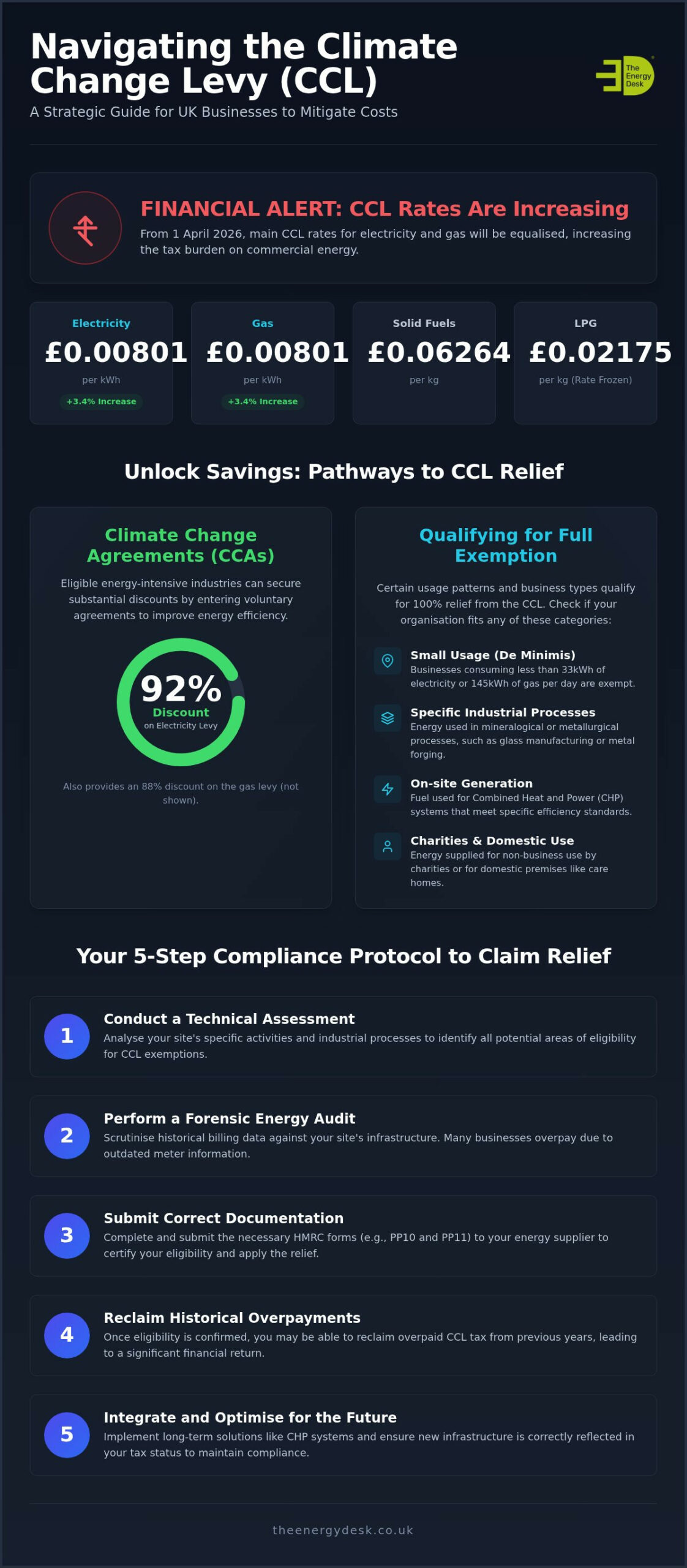
Effective from 1 April 2026, the government is resuming regular rate increases following a two-year freeze. Both electricity and gas will see rates rise to £0.00801 per kWh, representing a 3.4% increase. This equalisation of gas and electricity rates is a strategic move to encourage businesses to move away from fossil fuels. Solid fuels will rise to £0.06264 per kg, whilst LPG remains frozen at £0.02175 per kg. Because CCL is a pass-through charge, it impacts every business invoice regardless of whether you’ve secured a fixed-price energy contract. Many organisations currently overpay because their billing data hasn’t been updated to reflect recent site changes or efficiency improvements.
The 2026 Energy Tax Landscape
The 2026 fiscal year marks a turning point as the government aligns CCL increases with the Retail Price Index. This shift happens alongside broader changes in non-commodity costs. Recent Target Charging Review (TCR) updates have already restructured how Distribution Use of System (DUoS) and Transmission Network Use of System (TNUoS) charges are applied, often moving them to fixed daily rates. This makes the variable nature of CCL one of the few remaining areas where operational changes can directly reduce tax exposure. The Climate Change Levy is a manageable overhead rather than a fixed cost. Businesses seeking a complete picture of their non-commodity exposure should also explore how to reduce business energy standing charges, particularly given the significant TNUoS surges already affecting fixed daily rates in 2026.
Why Businesses Miss Exemption Opportunities
A significant number of firms fail to secure a climate change levy exemption for business because they assume the process is automatic. Whilst charities and domestic consumers are exempt, commercial entities must proactively prove their eligibility through technical documentation. Standard business gas procurement often overlooks these nuances, focusing only on the unit price rather than the underlying tax structure. Mismanagement frequently occurs during site mergers or acquisitions, where inherited meters are billed at standard rates despite the processes they power qualifying for relief. Without a forensic audit, these errors can persist for years, leading to thousands of pounds in unnecessary expenditure. Securing a climate change levy exemption for business requires a methodical review of how energy is utilised across every part of your infrastructure.
Qualifying for Full CCL Exemptions: Is Your Site Eligible?
Determining your eligibility for a climate change levy exemption for business begins with a technical assessment of your site’s specific activities. Whilst the levy applies broadly, certain sectors and usage patterns qualify for full relief. For instance, small businesses falling below the de minimis limit, consuming less than 33kWh of electricity or 145kWh of gas per day, are typically exempt. Similarly, energy supplied for non-business use by charities or for domestic premises, such as care homes or student accommodation, does not incur the tax. Identifying these categories is the first step in a forensic energy audit.
Industrial and Process-Specific Exemptions
Energy used in specific industrial processes often qualifies for significant relief. This includes mineralogical processes, like glass or ceramic manufacture, and metallurgical processes, such as metal casting or forging. To secure these benefits, you must submit the correct certification to your supplier via PP10 and PP11 forms. These documents verify the percentage of energy used for qualifying purposes. Referencing the official government guidance on CCL reliefs is essential to ensure your process meets the strict HMRC criteria.
Infrastructure also plays a pivotal role in tax mitigation. Implementing a CHP system installation for businesses can trigger a full exemption on the fuel used to generate electricity, provided the system meets “Good Quality” standards under the CHPQA programme. This dual benefit of high-efficiency heating and tax-free power generation makes CHP a cornerstone of industrial energy strategy. If you’re unsure if your plant qualifies, our team can conduct a technical review to identify missed relief opportunities.
Renewable Energy and Self-Generation
Onsite renewable generation offers a direct path to reducing your CCL burden. Electricity produced from solar panels and consumed onsite is naturally exempt from the levy because it isn’t “delivered” by a licensed supplier. This distinction is vital for businesses looking to mitigate the 2026 rate increases. By generating your own power, you reduce the volume of imported energy subject to taxation. It’s a proactive way to lower your carbon footprint whilst simultaneously insulating your bottom line from rising non-commodity costs.
It’s important to distinguish between direct exemptions for self-generation and the broader climate change levy exemption for business achieved through Climate Change Agreements. Whilst self-generation eliminates the tax on that specific volume of power, industrial exemptions through technical processes can apply to the entire site’s supply. Methodical planning ensures these different relief streams work in tandem to maximise your total savings and long-term utility stability.
Climate Change Agreements (CCAs) vs. Direct Exemptions
While direct exemptions offer 100% relief for specific processes, many organisations find that a Climate Change Agreement (CCA) provides a more accessible route to significant savings. A CCA is a voluntary arrangement between a business and the Environment Agency. By committing to specific energy efficiency or carbon reduction targets, your site gains access to substantial discounts on the main CCL rates. This is often the preferred strategy for sectors that consume vast amounts of energy but don’t meet the narrow criteria for process-specific exemptions discussed in the previous section.
According to the official government guidance on Climate Change Levy, businesses with an active CCA benefit from a 92% discount on electricity and an 89% discount on gas. For a high-consumption industrial site, this reduction transforms the 2026 rate of £0.00801 per kWh into a negligible operational cost. It’s a powerful tool for maintaining competitiveness in a market where non-commodity costs are steadily rising.
Evaluating the Business Case for a CCA
CCAs are available to over 50 industrial sectors, including food and drink manufacturing, chemical production, and data centres. The primary trade-off involves rigorous reporting and target-setting. If your site fails to meet its efficiency goals, you must utilise the “buy-out” mechanism, paying a fee to maintain your eligibility for the reduced rates. Calculating the ROI of membership requires an analytical approach. You must weigh the administrative costs of compliance against the potential six-figure tax savings. For many high-use sites, the financial gain far outweighs the reporting burden.
Comparing Relief Levels
Choosing between a direct climate change levy exemption for business and a CCA depends on your site’s technical profile. Direct exemptions are process-led and offer 100% relief but are strictly restricted to metallurgical or mineralogical activities. CCAs are sector-led and offer tiered relief across various fuel types:
- Electricity: 92% relief
- Natural Gas: 89% relief
- LPG: 77% relief
- Solid Fuels: 89% relief
Forensic auditing identifies the most lucrative relief path by mapping your energy consumption against both process-specific criteria and CCA sector eligibility. This ensures you don’t settle for a 92% discount if a 100% exemption is legally attainable. Securing a climate change levy exemption for business through the correct channel prevents overpayment and provides a predictable cost structure through 2027 and beyond.
How to Claim Your CCL Relief: A 5-Step Compliance Protocol
Securing a climate change levy exemption for business requires more than a simple tick-box exercise. It demands a structured approach to ensure compliance and maximise financial recovery. Without a methodical protocol, businesses often fail to provide the technical evidence HMRC requires, leading to rejected claims or missed savings. Following a professional five-step compliance protocol ensures your organisation navigates the transition to the 2026 rates with precision.
- Step 1: Forensic Energy Audit. Identify every process onsite and determine which energy streams qualify for relief based on current regulations.
- Step 2: Technical Analysis. Calculate the exact percentage of energy eligible for relief. This is vital for sites where only a portion of the energy is used for qualifying processes. A thorough business energy consumption analysis provides the data-backed evidence needed to support accurate relief calculations.
- Step 3: HMRC Documentation. Complete and submit forms PP10 and PP11. These certificates notify HMRC and your supplier of your exempt status.
- Step 4: Supplier Notification. Ensure your energy supplier applies the relief to the correct MPAN or MPRN and that your monthly invoices reflect the updated status.
- Step 5: Retrospective Recovery. Review historical bills to identify overpayments. You can typically reclaim overpaid CCL for up to four years.
Data Accuracy and HMRC Submission
For mixed-use sites, performing a “split-metering” analysis is essential to separate taxable commercial activities from exempt industrial processes. HMRC mandates a high level of accuracy; over-claiming can result in significant financial penalties. To support a mineralogical exemption claim, you must provide technical process descriptions and energy balance sheets that demonstrate the commodity is used directly for the qualifying chemical or physical transformation. This level of detail protects your organisation during future audits and ensures your climate change levy exemption for business remains valid.
Managing the Supplier Relationship
Once your certificates are submitted, you must verify that your supplier has implemented the changes across all relevant meters. Many businesses assume this happens automatically, but administrative delays are common. Under current HMRC limits for 2026, organisations can still look back over a four-year window to recover historical overcharges. Utilising commercial utility bill validation helps automate this verification process, flagging any instances where the levy is still being applied at the full rate despite your exempt status.
If you suspect your organisation has been overpaying, it’s vital to act quickly to secure your retrospective refund. You can contact our forensic audit team today to begin a review of your historical billing data and identify immediate savings opportunities.
Optimising Your Energy Tax Strategy with The Energy Desk
Securing a climate change levy exemption for business is a complex undertaking that requires forensic precision and deep regulatory knowledge. While the compliance protocol outlined earlier provides a roadmap, internal teams often lack the dedicated time to manage the technical analysis and supplier disputes required for a successful claim. We act as your strategic ally, providing a seasoned perspective on the UK’s evolving energy tax landscape. Our auditors specialise in uncovering misapplied taxes that standard billing systems often ignore, ensuring your organisation doesn’t pay a penny more than legally required.
Our approach is unique because it combines forensic bill validation with infrastructure expertise. We don’t just identify overcharges; we provide the technical solutions to prevent them. By integrating high-efficiency CHP systems or onsite solar solutions, your business can fundamentally change its tax profile whilst advancing its decarbonisation goals. This end-to-end service ensures that your energy procurement, onsite generation, and tax compliance are perfectly aligned for maximum fiscal efficiency.
A UK manufacturing organisation recently realised the value of this methodical approach. After a forensic audit of their historical billing, we discovered they had been charged the full CCL rate on processes that qualified for metallurgical relief. By managing the recovery process with both the supplier and HMRC, we secured a six-figure rebate covering the maximum four-year backbilling period. This intervention didn’t just provide a one-off windfall; it permanently reduced their monthly energy overheads ahead of the April 2026 rate increases.
Our Forensic Audit Methodology
We utilise data collection and MOP contracts to provide an irrefutable trail of energy end-use. Our team manages the entire dispute and recovery process, acting as a buffer between your business and the complexities of HMRC regulations. This includes the technical “split-metering” analysis required for mixed-use sites and the ongoing monitoring of your accounts. As regulations evolve through 2026 and 2027, we ensure your site remains compliant and continues to benefit from the highest possible relief levels.
Next Steps for Your Organisation
The first step toward reducing your non-commodity costs is a zero-risk energy audit. Our national team provides a confidential review of your current CCL status and historical billing data. We identify immediate tax savings and provide a clear strategy for infrastructure upgrades that support long-term relief. Don’t let outdated site data or administrative errors inflate your utility spend as the new fiscal year approaches.
Contact The Energy Desk to secure your CCL exemption today
Protecting Your Commercial Margins Against 2026 Tax Increases
The rising Climate Change Levy rates from April 2026 demand a proactive response from UK industry. By distinguishing between process-specific reliefs and sector-led Climate Change Agreements, your organisation can avoid the scheduled rate hike and secure long-term cost stability. Securing a climate change levy exemption for business isn’t just about reducing future energy bills; it’s also a vital opportunity to reclaim overpaid taxes from the previous four-year window. Methodical auditing and technical certification are the only ways to ensure your site’s efficiency is accurately reflected in your utility spend.
As an authorised UK energy consultancy since 2003, we possess national expertise in industrial tax recovery and forensic bill validation. Our team specialises in integrating CHP and renewable infrastructure to help businesses naturally optimise their tax position. Don’t let administrative errors or outdated site data drain your operational budget as non-commodity costs continue to rise. Book a free business energy consumption analysis to identify your CCL exemptions and safeguard your bottom line. We’re ready to help you navigate these regulatory complexities and deliver measurable results for your business.
Frequently Asked Questions
What are the current Climate Change Levy rates for 2026?
From 1 April 2026, the main CCL rates for both electricity and gas will increase to £0.00801 per kWh. This represents a 3.4% rise following a two-year freeze. Other fuels see varying treatments; LPG rates remain frozen at £0.02175 per kg, whilst other solid fuels rise to £0.06264 per kg. These rates are scheduled for a further increase in April 2027 to £0.00827 per kWh as the government equalises gas and electricity taxation.
Can my business claim a backdated refund for overpaid CCL?
Yes, organisations can typically reclaim overpaid levy charges for up to four years from the date of the overpayment. This process involves a forensic review of historical billing data to identify instances where exemptions were not applied or were calculated incorrectly. Once the discrepancy is verified, a claim is submitted to both HMRC and your energy supplier. Successful recovery can result in significant capital injections for energy-intensive industrial sites that have overlooked their eligibility status.
Is my business eligible for the small business “de minimis” CCL exemption?
Your organisation qualifies for the de minimis exemption if your daily energy consumption remains below specific thresholds. For electricity, this limit is 33kWh per day; for gas, it is 145kWh per day. If your usage falls below these levels, your supplier should automatically apply the 5% VAT rate and waive the CCL entirely. It is vital to monitor your consumption data regularly, as exceeding these limits even occasionally can trigger the full levy on your invoices.
Do charities have to pay the Climate Change Levy?
Charities are exempt from paying the levy on energy used for non-business activities. This includes premises such as places of worship, administrative offices for charitable purposes, or residential care homes. However, if a charity engages in commercial activities, such as running a high-street shop or renting out space, that portion of energy use remains taxable. Securing a climate change levy exemption for business in this context requires a precise declaration of the percentage of energy used for qualifying purposes.
How does a Climate Change Agreement (CCA) differ from a full CCL exemption?
A full exemption provides 100% relief but is strictly limited to specific metallurgical or mineralogical processes. In contrast, a Climate Change Agreement (CCA) is a sector-wide voluntary scheme that offers a significant discount rather than a total waiver. In 2026, CCA participants receive a 92% discount on electricity and an 89% discount on gas. Whilst a CCA requires meeting energy efficiency targets, it is often a more accessible route for data centres and food manufacturers.
What forms do I need to submit to HMRC to claim CCL relief?
To formalise your relief, you must complete and submit two primary documents. Form PP10 is submitted directly to HMRC to register your exempt status and provide technical evidence of your qualifying processes. Simultaneously, you must provide form PP11 to your energy supplier. This certificate instructs the supplier to apply the correct relief percentage to your MPAN or MPRN. Maintaining accurate copies of these submissions is essential for compliance audits and ensures your climate change levy exemption for business remains active.
Does installing solar panels reduce the amount of CCL my business pays?
Installing solar panels reduces your CCL burden by lowering the volume of taxable energy you import from the grid. Electricity generated onsite and consumed directly by your business is naturally exempt from the levy because it is not delivered by a licensed supplier. This infrastructure upgrade provides a dual benefit: it lowers your overall carbon footprint whilst insulating your organisation from the 3.4% rate increase scheduled for April 2026. It is a proactive step toward long-term utility cost management.
What happens if my energy supplier refuses to apply a CCL exemption?
If a supplier refuses to apply your exemption despite valid certification, you should initiate a formal dispute backed by forensic evidence. Suppliers are legally obligated to apply the relief once they receive a valid PP11 form, provided HMRC has accepted your PP10. In cases of persistent refusal, a professional energy consultant can mediate with the supplier or escalate the matter to HMRC for a direct ruling. Forensic bill validation serves as the primary tool to prove your eligibility and resolve these discrepancies.