
If your business premises are completely empty at 3 AM, why is your meter still recording 40% of its peak daytime load? This invisible waste is often the result of mismanaged building systems or redundant equipment, yet it remains hidden without a detailed business energy consumption analysis. Most commercial leaders accept rising energy costs as an unavoidable operational burden, often feeling overwhelmed by the technicalities of half-hourly data and the confusion surrounding MOP charges. We understand that deciphering these patterns is difficult, especially whilst trying to benchmark performance against the rigorous 2026 industry standards.
By adopting a forensic approach to your utility usage, you can identify specific areas of waste. This methodology allows you to optimise your standing charges and secure more competitive procurement rates. This article provides a comprehensive checklist for an internal energy audit, designed to help you reduce overheads and generate data-backed evidence for renewable energy ROI. We’ll examine how to validate your billing accuracy, manage your meter operator services, and prepare your infrastructure for a more efficient fiscal future.
Key Takeaways
- Understand why forensic data is more valuable than traditional fixed-rate contracts when managing 2026 market volatility.
- Identify the critical data sources, such as Meter Operator (MOP) contracts and Half-Hourly Data, required for an accurate audit.
- Execute a comprehensive business energy consumption analysis to uncover out-of-hours waste and compare performance against 2026 benchmarks.
- Align your energy usage profile with strategic procurement options and onsite generation solutions to lower long-term overheads.
- Map operational schedules against energy spikes to identify specific opportunities for load shifting and cost reduction.
The Strategic Importance of Business Energy Consumption Analysis in 2026
Business energy consumption analysis is the systematic review of how and when your organisation uses utilities. It’s a proactive discipline designed to optimise both fiscal performance and operational efficiency. By examining granular data, you can move beyond simply paying invoices to actively managing your energy as a strategic asset. In a market where utility costs can fluctuate wildly within a single day, understanding your usage profile is the difference between controlled overheads and unpredictable losses.
The 2026 energy market is defined by high volatility. Relying on fixed-rate contracts without understanding your usage data is no longer a viable strategy for long-term stability. A forensic business energy consumption analysis allows you to identify exactly where your money goes, distinguishing between essential operational load and avoidable waste. Whilst a basic bill review might spot a clerical error, a forensic audit investigates the “why” behind the numbers. It uncovers the inefficiencies that standard accounting processes often overlook, such as equipment running during non-operational hours or misconfigured building management systems.
For large and medium enterprises, this level of scrutiny is now a regulatory necessity. UK Net Zero reporting requirements demand transparent, data-backed evidence of carbon reduction efforts. You can’t manage what you don’t measure. Forensic analysis provides the empirical foundation for these reports, ensuring your compliance is based on fact rather than estimation.
Beyond the Bill: Why Data is Your Most Valuable Utility
Granular data is the cornerstone of modern Energy management. When you have access to half-hourly insights, you can implement “load shifting.” This involves moving energy-intensive processes to periods when demand on the grid is lower and tariffs are cheaper. This level of transparency also significantly improves your corporate ESG scores. Investors and stakeholders increasingly look for evidence of operational efficiency as a proxy for good management. In the context of UK manufacturing, energy intensity represents the specific quantity of energy consumed to produce one unit of economic output or physical product.
Regulatory Drivers for Analysis in 2026
The 2026 landscape includes stricter carbon taxation and updates to the Climate Change Levy (CCL). Detailed analysis is the only way to accurately assess your liability and identify opportunities for CCL exemptions for business. Without forensic data, your firm might be overpaying for levies it’s legally entitled to avoid. Furthermore, the transition to mandatory half-hourly settlement means that even SMEs are now being billed based on their actual usage patterns. This shift penalises businesses with “peak-heavy” profiles, making consumption analysis a vital tool for protecting your bottom line against rising regulatory costs.
Gathering the Data: Smart Meters, HHD, and MOP Contracts
The foundation of any forensic business energy consumption analysis is the quality of the raw data. To move beyond surface-level observations, you must aggregate information from three primary sources: your historic invoices, the physical smart meter, and your Data Collector (DC). For complex industrial sites, relying solely on monthly invoices is a mistake. These documents often rely on estimated billing, which can mask significant overcharges or technical faults in the metering hardware. Forensic auditing requires actual, timestamped usage figures to identify the root cause of high costs.
Your Meter Operator (MOP) contract is central to this process. The MOP is the entity responsible for the installation and maintenance of your meter, as well as the secure transmission of data to your supplier. High-consumption businesses often remain on default MOP agreements provided by their energy supplier, which can be expensive and offer limited data transparency. Reviewing these contracts ensures you have full control over your metering infrastructure and the accuracy of the data it generates. It’s often beneficial to optimise your MOP contracts to ensure you are receiving the granular HHD files necessary for professional analysis.
The Power of Half-Hourly Data (HHD)
Half-hourly data provides a 24-hour snapshot of your energy usage in 48 distinct blocks. You can request these HHD files directly from your supplier or your Data Aggregator (DA) in a spreadsheet format. This level of detail allows you to visualise your “Baseload”—the minimum amount of power your site requires to function—against your “Peak load” during operational hours. By analysing these patterns, you can identify “Phantom Loads.” These are spikes in consumption that occur when the business is closed, such as overnight or during weekends. Finding and eliminating these invisible drains is one of the fastest ways to reduce your standing charges.
Optimising Metering Infrastructure
For multi-unit sites or large manufacturing facilities, primary metering is often insufficient. Sub-metering allows you to track the consumption of specific machinery, departments, or tenants. This granularity is essential for identifying which assets are underperforming or nearing the end of their lifecycle. Independent MOP contracts can also offer more competitive rates than default supplier agreements. Finally, ensure your hardware is compliant with current UK grid standards to avoid penalties and ensure seamless integration with future smart grid technologies.
Identifying Patterns: Benchmarking and Forensic Waste Detection
Identifying patterns is the core of a professional business energy consumption analysis. It’s not enough to know how much you spend; you must understand the rhythm of your usage. Start with an “Out-of-Hours” audit. If your facility is idle at night but usage remains at 30% of peak levels, you have a significant efficiency leak. This often stems from poorly programmed HVAC systems or “always-on” equipment that doesn’t need to be active. Seasonality analysis is equally vital. Your consumption curve will naturally shift as heating and cooling demands fluctuate. Forensic auditing allows you to isolate weather-related spikes from genuine operational waste.
Internal vs External Benchmarking
If you operate multiple sites, internal benchmarking is your first line of defence. Comparing the kWh per square metre across your portfolio can highlight outliers that require immediate attention. External benchmarking involves using UK government statistics to see how your performance aligns with 2026 industry standards. Normalising this data for weather variations using “Degree Days” ensures that a particularly cold month doesn’t lead to false conclusions about your building’s efficiency. This methodical approach allows you to categorise sites by performance and prioritise infrastructure investment where it’s needed most.
Spotting Forensic Anomalies
Beyond usage patterns, you must scrutinise the components of your bill. Forensic bill validation involves searching for historical overcharges and tariff misalignments that standard accounts payable teams often miss. Errors frequently occur within non-commodity charges like DUoS (Distribution Use of System) and TNUoS (Transmission Network Use of System). These are complex, location-based charges that suppliers often miscalculate. You should consult the UK Forensic Guide to Bill Validation for a deeper dive into these recovery processes.
You should also look for reactive power charges on your invoices. These fees are essentially a penalty for inefficient equipment, such as ageing motors or transformers, that draw more current than they effectively use. Identifying these charges through your business energy consumption analysis provides clear evidence for infrastructure upgrades that offer a high ROI. By addressing these technical inefficiencies, you reduce your unit rates and protect your equipment from premature wear.
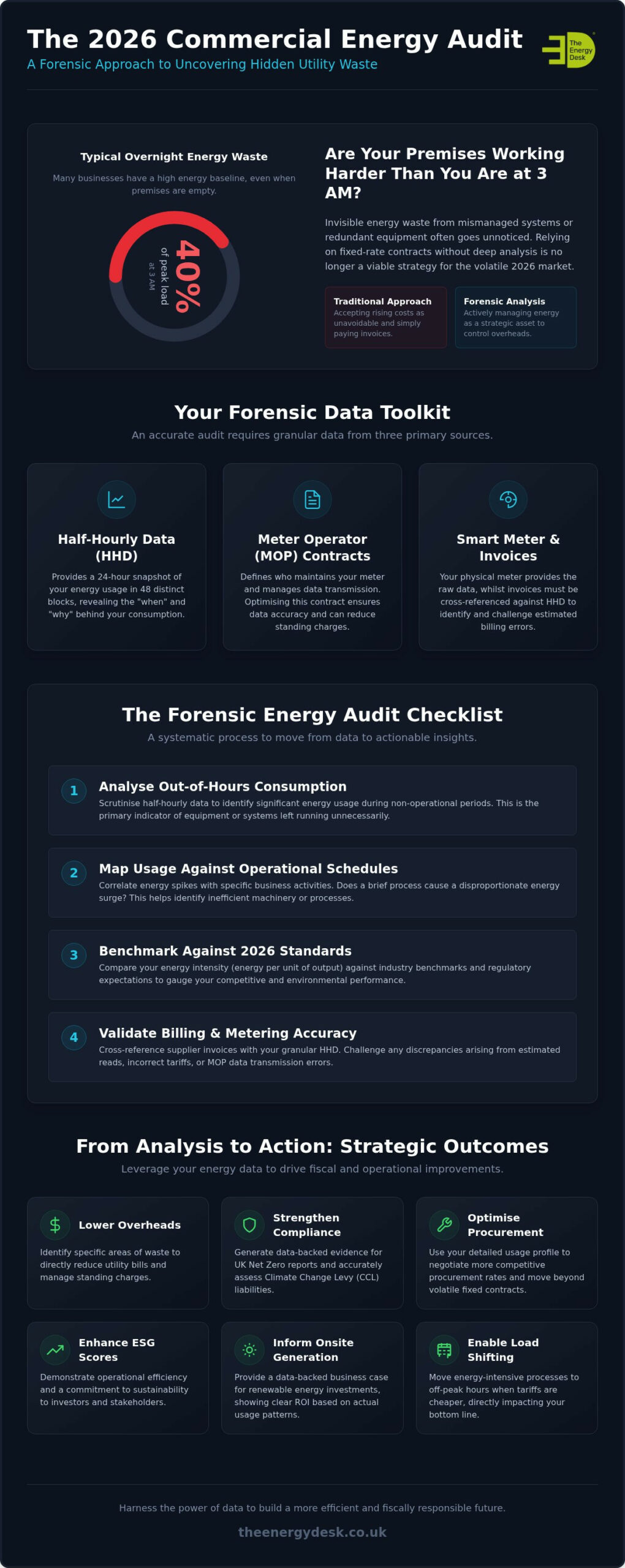
The 2026 Commercial Energy Efficiency Audit Checklist
A structured approach transforms raw data into actionable savings. This checklist provides a methodical framework for conducting a professional business energy consumption analysis, ensuring no technical or financial detail is overlooked. By following these steps, you can move from passive observation to active utility management.
- Step 1: Data Aggregation – Collate a minimum of 12 months of Half-Hourly Data (HHD) and invoices. This duration is essential to account for seasonal fluctuations and annual production cycles.
- Step 2: Operational Mapping – Align your energy spikes with your daily production or office schedules. If your consumption peaks before staff arrive or remains high after hours, your building management system requires recalibration.
- Step 3: Infrastructure Review – Assess the age and efficiency of your HVAC and lighting systems. Older units often represent the largest portion of controllable waste in commercial properties.
- Step 4: Tariff Verification – Compare your current unit rates against 2026 market averages. Procurement strategies should be reviewed at least six months before contract expiry.
- Step 5: Capacity Check – Review your “Available Capacity” or kVA settings. Many businesses pay for a level of grid access they never actually reach, resulting in unnecessary monthly charges.
The Operational Efficiency Checklist
Focusing on physical infrastructure often yields the most immediate results. Transitioning from standard LEDs to sensor-controlled, high-efficiency arrays can reduce lighting costs by up to 30% in warehouse environments. You should also inspect the building fabric of industrial units; poor insulation and draughts in loading bays significantly increase the load on heating systems. Finally, address staff behaviour. Implementing energy-aware cultures and “Switch Off” policies ensures that your technical optimisations aren’t undermined by human error.
The Financial and Contractual Checklist
Financial errors on utility bills are common and often go undetected for years. You must validate the VAT and Climate Change Levy (CCL) rates on every invoice to ensure you aren’t being overcharged. Standing charges should also be scrutinised; these can often be reduced through more aggressive procurement or by consolidating meters across a site. For a detailed breakdown of how to reduce business energy standing charges through technical capacity management and forensic bill auditing, our myth-busting guide covers the full range of strategies available in 2026. Once your business energy consumption analysis is complete, use the resulting profile to assess the ROI for onsite generation, such as Solar or CHP. To ensure your data is being interpreted with forensic precision, you can book a free energy audit with our specialist team to identify immediate recovery opportunities.
From Analysis to Action: Optimising Procurement and Infrastructure
The final stage of a business energy consumption analysis is translating data into a commercial advantage. Once you understand your usage patterns, you can move away from restrictive, one-size-fits-all utility agreements. Your consumption profile is the most powerful tool you have when negotiating with suppliers. It allows you to prove your load predictability or demonstrate your ability to shift demand, both of which can lead to lower unit rates. Data-backed evidence removes the guesswork for suppliers, often resulting in more favourable risk premiums.
For many large organisations, the choice between “Fixed” and “Flexible” energy contracts depends entirely on this data. A fixed-rate contract offers budget certainty, but a flexible arrangement allows you to purchase energy in “tranches” when market prices are lower. Without a forensic understanding of your usage, a flexible contract can be risky; with it, it becomes a strategic asset that protects your bottom line from 2026 market volatility. This shift from a passive payer to an active buyer is only possible when you have full visibility over your metering data.
Strategic Procurement Based on Data
Multi-site organisations can leverage their combined data through “Basket” or “Portfolio” purchasing. By aggregating the demand of several properties, you increase your bargaining power with suppliers. This approach is particularly effective for Strategic Business Gas Procurement, where timing the market is essential. Your analysis will indicate the optimal windows for locking in future rates, ensuring you don’t buy during seasonal price peaks. Professional procurement is no longer just about the lowest price; it’s about the best timing and contract structure.
Infrastructure Investments for Long-Term Savings
Onsite generation can fundamentally alter your consumption curve, reducing your reliance on the national grid. For industries with high heat and power demands, such as manufacturing or leisure centres, the Combined Heat and Power (CHP) business case is often compelling. CHP systems generate electricity onsite whilst capturing the resulting heat for use in industrial processes or space heating, significantly increasing overall efficiency and reducing carbon liabilities.
Solar PV remains a cornerstone of onsite generation, but its value depends on your “Self-Consumption” rate. This is the percentage of solar energy your business uses directly rather than exporting it back to the grid. A business energy consumption analysis helps you size a solar array that matches your daytime load perfectly, maximising your ROI. Integrating battery storage further enhances this by allowing you to store excess energy for use during “Red Zones” or Triad periods, when grid charges are at their highest. This same data-led approach is vital for EV charging infrastructure. By using smart load management based on your consumption profile, you can install multiple charging points without triggering expensive and time-consuming grid upgrades.
Securing Your Fiscal Future Through Forensic Utility Management
Mastering half-hourly data and optimising your metering infrastructure are no longer optional tasks for the modern enterprise. These technical disciplines allow you to eliminate expensive phantom loads. They also align your procurement strategy with your actual usage profile. A professional business energy consumption analysis provides the empirical foundation needed to navigate the 2026 market with confidence. It ensures your infrastructure investments deliver a verifiable return whilst protecting your bottom line from volatility.
The Energy Desk has been a trusted independent UK consultancy since 2003, serving industrial and commercial sites nationwide. As forensic bill validation experts, we specialise in identifying historical overcharges and technical inefficiencies that standard audits miss. Don’t leave your overheads to chance in an increasingly complex market. Request your free 2026 Business Energy Audit from The Energy Desk today to begin your transition toward a more efficient, data-led utility strategy. Taking control of your data is the first step toward long-term operational stability and sustainable growth.
Frequently Asked Questions
What is a business energy consumption analysis?
A business energy consumption analysis is a systematic review of utility usage patterns to identify operational waste and fiscal inefficiencies. It involves examining granular data to understand how energy is used across a facility. By mapping usage against production schedules, firms can uncover hidden costs. This proactive management approach allows companies to optimise their procurement strategies and improve their overall energy intensity. It’s a foundational step for any organisation aiming for 2026 sustainability goals.
How much can a business save through a professional energy audit?
Savings vary based on the sector and current efficiency levels, but many organisations identify significant recovery opportunities during their first audit. A professional review can uncover overcharges through forensic bill validation and highlight immediate operational savings by eliminating out-of-hours waste. Beyond direct usage reductions, audits often lead to lower unit rates through better procurement timing. These cumulative improvements can fundamentally reduce annual utility overheads, providing a clear ROI for the auditing process.
What is half-hourly data and why is it important for my business?
Half-hourly data (HHD) provides a detailed record of your electricity usage in 48 distinct blocks every day. This granularity is essential because it allows you to see exactly when your business hits peak demand. By understanding these spikes, you can implement load-shifting strategies to avoid high-tariff periods. HHD is also a requirement for mandatory half-hourly settlement, which is becoming the standard for UK businesses. Without this data, your billing is often based on inaccurate estimates.
Can I reduce my business energy standing charges through analysis?
Yes, you can often reduce standing charges by reviewing your metering infrastructure and “Available Capacity” (kVA). Many businesses pay for a level of grid access that far exceeds their actual peak requirements. By conducting a business energy consumption analysis, you can determine your true capacity needs and request a reduction from your Distribution Network Operator (DNO). This technical adjustment lowers your fixed monthly costs regardless of how much energy you consume. For a comprehensive breakdown of every available strategy, our guide on how to reduce business energy standing charges in 2026 explains the full range of technical and contractual options.
What happens if my consumption analysis reveals I have been overcharged?
If an analysis identifies overcharges, you can initiate a forensic bill validation process to recover the funds. This involves presenting documented evidence of tariff misalignments or clerical errors to your supplier. Professional consultancies handle these negotiations to ensure you receive the full rebate you’re entitled to. Historically, these overcharges often stem from miscalculated non-commodity fees like DUoS and TNUoS. Recovering these costs provides an immediate cash injection into your business operations.
Is a smart meter enough for a comprehensive energy analysis?
Whilst a smart meter is a valuable tool, it’s generally not sufficient for a truly forensic analysis on its own. Smart meters provide basic usage data, but they don’t offer the deep insights required to map operational inefficiencies or validate complex non-commodity charges. A comprehensive audit requires the integration of half-hourly data, MOP contract reviews, and sub-metering for specific high-load equipment. You need professional interpretation to turn raw meter readings into a strategic utility management plan.
How often should a business conduct an energy consumption audit?
Businesses should ideally conduct a formal energy audit at least once a year. This frequency ensures you stay aligned with shifting 2026 industry benchmarks and regulatory requirements. However, you should also trigger an audit whenever there are significant changes to your operations, such as installing new machinery or expanding your premises. Regular reviews allow you to spot efficiency drift early. They also ensure your procurement strategy remains optimal as your usage profile evolves over time.
What is the difference between a broker and an energy consultant?
An energy broker primarily focuses on switching suppliers to find a lower unit rate at the point of contract renewal. In contrast, an energy consultant acts as a long-term strategic ally. Consultants provide a broader suite of services, including forensic bill validation, infrastructure projects like CHP or solar, and ongoing consumption analysis. Whilst a broker is transactional, a consultant manages your entire utility portfolio to ensure long-term cost-efficiency and regulatory compliance.