


Treating a meter operator agreement as an unavoidable administrative burden is one of the costliest missteps in commercial energy management. If you’ve recently scrutinised an unbundled electricity invoice, you’ve probably wondered what a meter operator actually does, and why your organisation is required to maintain a separate contract alongside your standard energy supply. Unbundled charges often create confusion, leaving finance and operational teams facing inflated standing charges alongside the constant worry of non-compliance with half-hourly settlement rules.
It’s an understandable frustration, but you don’t have to accept supplier-default rates or settle for opaque billing. By taking an active approach to your metering infrastructure, you can ensure full regulatory compliance, eliminate unnecessary overheads, and build the foundation for forensic bill validation. In this guide, we break down the vital distinctions between MOP and DC/DA roles, clarify your legal obligations under half-hourly metering frameworks, and explain how an independent agreement gives your business direct control over its energy data.
Key Takeaways
- Clarify the distinct technical responsibilities of an accredited meter operator versus your energy supplier to eliminate confusion around unbundled invoices.
- Navigate mandatory half-hourly settlement regulations with confidence, ensuring continuous compliance across high-demand operational sites.
- Avoid inflated default standing charges by moving away from supplier-appointed arrangements in favour of competitive, independent agreements.
- Unlock granular half-hourly consumption data to strengthen forensic bill validation and inform smarter corporate energy procurement.
- Implement a structured procurement roadmap to audit existing meter assets, assess connection hardware, and secure transparent contract terms.
Understanding the Role of a Meter Operator (MOP) in the UK
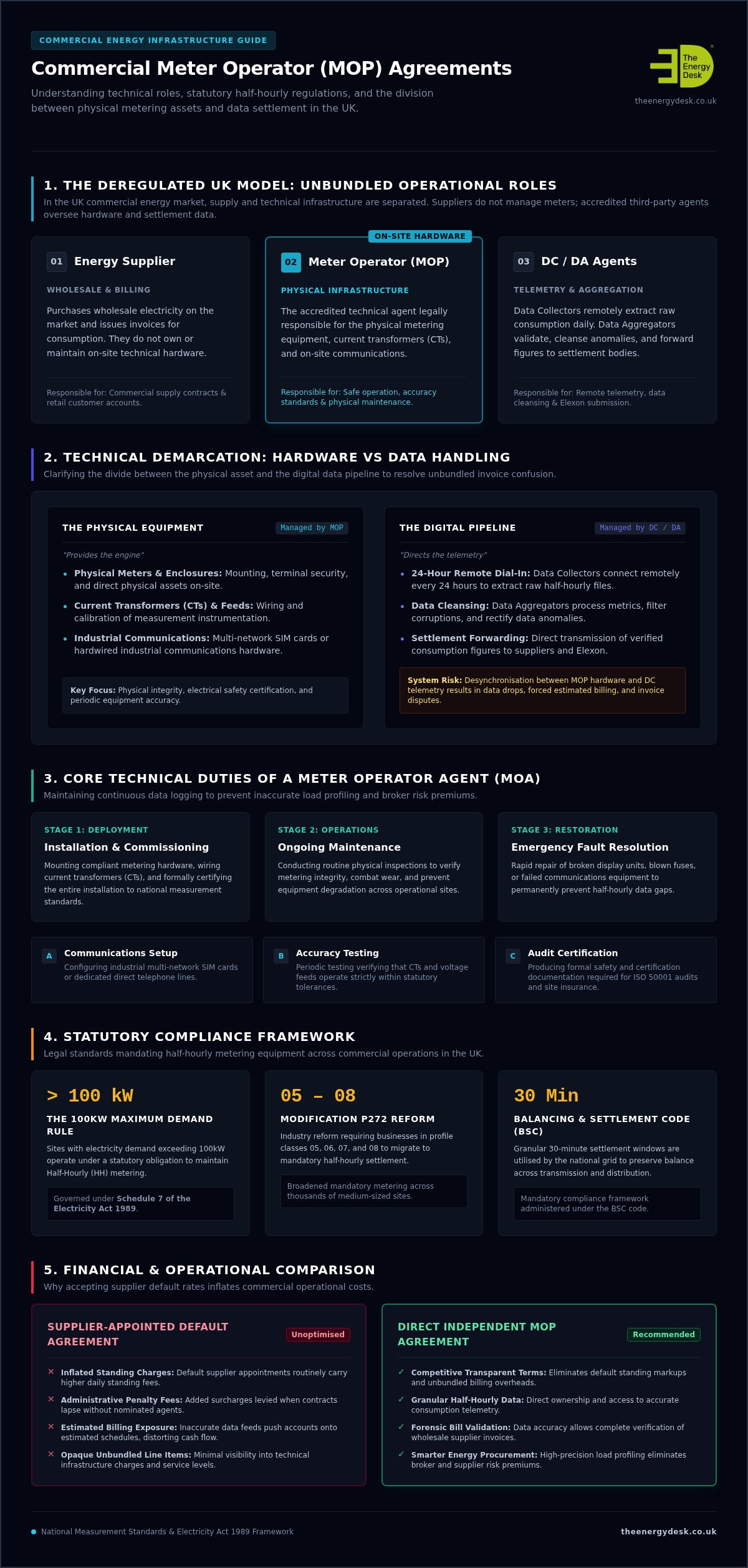
In the commercial energy framework, a Meter operator (MOP) is the accredited organisation legally responsible for the physical metering equipment at your facility. Many businesses assume their energy supplier owns and manages their meters. In reality, the UK market operates on a deregulated, unbundled model where suppliers simply buy and bill wholesale power, while independent technical agents handle the infrastructure.
A Meter Operator Agent (MOA) manages the physical lifecycle of your metering point. Their baseline duties include:
- Installation and commissioning: Mounting compliant hardware, wiring current transformers (CTs), and certifying the installation to national standards.
- Ongoing maintenance: Conducting routine inspections to verify meter integrity and prevent physical degradation.
- Emergency fault resolution: Repairing broken display units, blown fuses, or failed communications equipment to prevent data gaps.
Without properly maintained hardware, your half-hourly consumption data fails to log accurately. These data inaccuracies directly disrupt strategic electricity procurement, leaving brokers and suppliers unable to assess accurate load profiles, which often results in risk premiums being added to your supply contracts.
The Technical Duties of an MOA
Beyond physical maintenance, an MOA ensures your hardware communicates seamlessly with the wider settlement network. They configure and maintain industrial communications equipment, such as multi-network SIM cards or direct phone lines, allowing settlement bodies to retrieve consumption metrics automatically. MOAs also conduct mandatory periodic accuracy testing to ensure current transformers and voltage feeds operate within strict tolerances. Following every technical visit, they produce safety documentation and certification notices essential for ISO 50001 audits and site insurance compliance.
MOP vs. DC/DA: Clarifying the Confusion
Energy invoices often bundle technical line items together, leading finance directors to confuse the meter operator with Data Collectors (DC) and Data Aggregators (DA). Understanding the split between hardware and data handling clarifies these charges:
- The MOP manages the hardware: They own, install, and service the physical meters, transformers, and communication modems on your wall.
- The DC/DA manages the data: The Data Collector remotely dialles into the MOP’s hardware every 24 hours to retrieve raw half-hourly consumption files. The Data Aggregator then validates this data, cleans anomalies, and submits compliant billing figures to your supplier and Elexon.
Think of your MOP as providing the engine, whilst the DC and DA direct the telemetry. When these agents fail to synchronise, data drops out, suppliers revert to estimated billing, and invoice disputes follow quickly.
Regulatory Compliance: The 100kW Rule and Half-Hourly Metering
Operating a high-demand commercial facility in the UK comes with strict statutory metering rules. Historically, any site with a maximum electricity demand exceeding 100kW had a legal obligation to install Half-Hourly (HH) metering equipment. Governed under provisions such as Schedule 7 of the Electricity Act 1989, these high-capacity installations require an accredited meter operator agreement to ensure the physical apparatus remains safe, certified, and compliant with national measurement standards.
The regulatory scope broadened significantly with the implementation of modification P272. This industry reform mandated that businesses in profile classes 05 through 08, traditionally classified as maximum demand non-half-hourly customers, migrate onto half-hourly settlement. The shift brought thousands of medium-sized businesses into the mandatory metering net.
Allowing a contract to lapse carries immediate operational penalties. When a business fails to nominate an independent provider, suppliers step in with default arrangements. These default appointments routinely inflate daily standing charges, trigger administrative penalty fees, and force accounts onto estimated billing schedules that severely distort corporate cash flow.
Half-Hourly Metering Explained
The UK power grid relies on granular thirty-minute settlement windows to maintain stability across transmission and distribution networks. Administered under the Balancing and Settlement Code (BSC), HH meters record actual usage every half hour and transmit that consumption data daily via secure cellular telemetry. Access to continuous, verified telemetry underpins rigorous commercial utility bill validation. It allows operational teams to eliminate estimated readings, audit network pass-through fees, and dispute inaccurate supplier invoices before payment release.
Is Your Site Required to Have an MOP Contract?
Determining your site’s status requires a brief review of your electricity invoice. Locate your Supply Number (S-Number or MPAN); if the two-digit profile class located in the top-left box displays “00”, your connection is half-hourly settled and legally requires an appointed meter operator.
Even non-mandatory sites increasingly adopt half-hourly agreements on a voluntary basis. Access to granular consumption patterns exposes overnight base-load waste and streamlines estate management across multi-site portfolios. If you are auditing existing utility agreements, consulting with a market specialist like The Energy Desk ensures your metering infrastructure meets all regulatory codes without subjecting your business to punitive supplier markups.
Supplier-Appointed vs. Independent MOP Agreements
Signing a standard commercial electricity supply agreement usually triggers an automatic, default appointment. The energy supplier nominates their preferred meter operator, rolls the metering fee into your recurring standing charge, and manages the relationship behind closed doors. This bundled model offers convenience, but it routinely strips organisations of commercial control and financial transparency.
Unbundling your metering services alters this dynamic entirely. By procuring a dedicated agreement directly with an accredited provider, you decouple physical asset management from wholesale energy supply. This strategic separation transforms a passive line item into an active operational asset, delivering measurable advantages across service reliability and commercial expenditure.
The Risks of Supplier-Default MOP Rates
Supplier-appointed arrangements frequently conceal inflated administrative margins inside consolidated standing charges. Because the metering cost is aggregated into your daily tariff, tracking what you actually pay for hardware maintenance versus energy delivery becomes exceptionally difficult.
Communication delays present an even greater operational risk. If a meter modem fails or a current transformer drifts, raising a ticket through your supplier’s generic customer service desk creates substantial lag. Suppliers act as middlemen, routing queries through multiple internal departments before notifying field technicians. While all work must ultimately satisfy statutory Metering Codes of Practice, these administrative bottlenecks leave sites stranded with estimated billing and missing settlement data for weeks.
Benefits of an Independent MOP Contract
Contracting directly with an independent provider provides distinct financial and operational leverage:
- Long-term cost reduction: Committing to an independent 3-to-5-year agreement locks in competitive baseline rates, removing supplier retail markups entirely.
- Direct technical SLAs: You gain immediate access to specialised engineering support, securing contractual response times for site repairs and hardware reconfigurations without third-party delay.
- Portfolio consistency: If you manage multiple sites supplied by different energy providers, an independent contract centralises all physical metering under a single agreement.
This estate-wide uniformity is invaluable for multi-site operators. When your energy contracts come up for renewal, you can switch commodity suppliers freely without needing to transfer meter registrations or risk site survey disruptions.
Leveraging MOP Services for Energy Intelligence
Accurate metering is the foundation of modern utility intelligence, not merely a compliance checkbox. While many organisations treat their physical meter operator simply as an equipment provider, the integrity of that hardware directly determines the quality of your corporate consumption data. When field hardware records precisely, energy managers gain the empirical visibility needed to overhaul broader commercial purchasing, including aligning cross-commodity operations through informed business gas procurement strategies.
Feeding clean half-hourly telemetry into an on-site Energy Management System (EMS) opens immediate operational wins:
- Isolating baseload waste: Pinpointing unexpected overnight power draws across unoccupied facilities, identifying equipment left running unnecessarily.
- Peak demand clipping: Highlighting costly consumption spikes during regional network triad periods or red-band distribution windows.
- On-site generation verification: Providing reliable sub-metering data to measure electrical output and thermal efficiency across complex CHP system installations.
Metering and Decarbonisation
Corporate sustainability reporting requires audit-ready numbers. Robust metering infrastructure captures granular electricity consumption, enabling organisations to calculate verifiable Scope 2 carbon emissions rather than relying on crude sector averages. This precision proves essential when demonstrating regulatory compliance for corporate green declarations. When investing in solar PV or plant efficiency upgrades, your meter data provides the definitive baseline to quantify return on investment, measure actual carbon reductions, and accelerate corporate net-zero targets.
Data Accuracy and Financial Oversight
Direct communication links maintained by a competent meter operator safeguard cash flow. Faulty modems force suppliers to issue estimated bills, often using punitive historical load profiles that lock up operating capital. With verified half-hourly telemetry feeding your accounts, your finance department can conduct forensic utility auditing with total confidence, matching consumption line-by-line against contract tariffs. These detailed consumption profiles also put you in a position of strength when entering wholesale flexible purchasing contracts, as suppliers offer tighter margins to businesses with predictable usage patterns.
To take complete control of your estate’s data pipeline, explore how independent management from The Energy Desk can streamline your metering agreements and drive measurable cost recovery.
How to Procure and Manage an MOP Contract
Procuring an independent agreement requires a structured approach. Transitioning away from supplier-default billing doesn’t need to be disruptive, but managing the procurement process methodically protects operational continuity and prevents dual-billing errors. Follow this five-step roadmap to secure an agreement aligned with your commercial objectives:
- Step 1: Audit existing meter points: Gather every MPAN across your estate, review current supplier invoices, and identify which meters sit on default arrangements versus active contracts.
- Step 2: Define technical requirements: Confirm site telemetry specifications, including cellular signal requirements (such as 4G-compatible modems) or dedicated hardwired links for basement installations.
- Step 3: Tender the portfolio: Approach accredited independent meter operator providers with a unified schedule of meters and defined contract terms.
- Step 4: Evaluate competitive bids: Review responses beyond raw standing charges, weighing service level agreements (SLAs), emergency fix windows, and remote telemetry support.
- Step 5: Facilitate the Change of Agent: Issue formal appointment notices to coordinate standard industry data flows, ensuring your supplier updates their settlement records accurately.
What to Look for in an MOP Partner
Selecting the right provider protects your long-term data integrity. First, verify that any prospective partner holds full accreditation with Elexon and the Association of Meter Operators. Next, examine their regional engineering coverage to confirm they can deliver on contractual call-out times across your entire geographic footprint. Finally, check that their hardware configurations integrate smoothly with your appointed Data Collection (DC) services to avoid communication hand-off failures.
The Role of The Energy Desk in MOP Procurement
Managing technical appointments internally often creates administrative bottlenecks for busy finance and operational teams. With over 20 years of sector experience, The Energy Desk manages the entire Change of Agent process on your behalf. Our independent consultants audit your technical connections, challenge inflated supplier margins, and negotiate competitive agreements tailored to your estate. We provide ongoing contract governance, ensuring your physical infrastructure stays fully compliant with evolving UK regulations. Contact our advisory team directly on 03330 151 221 to arrange your specialist metering audit.
Transform Your Metering Strategy into a Commercial Advantage
Passive reliance on supplier-appointed arrangements frequently traps organisations in inflated tariffs and opaque data structures. By establishing an independent contract with an accredited meter operator, your business eliminates unnecessary default markups, secures rigorous technical SLAs, and guarantees full compliance across all half-hourly settlement requirements. This simple structural shift transforms what was once an administrative burden into an active commercial asset, feeding verified telemetry directly into your utility validation and procurement strategies.
Taking control of your infrastructure doesn’t have to strain internal resources. As an accredited UK energy consultancy with over two decades of market experience, The Energy Desk provides independent expert oversight as specialists in DC/DA and MOP management. We identify hidden standing charge premiums across multi-site portfolios, resolve complex utility connections, and streamline data governance. Request a free metering audit from The Energy Desk today to secure complete billing transparency and take command of your energy estate.
Frequently Asked Questions
What is an MOP contract and is it mandatory?
An MOP contract covers the installation, maintenance, and technical management of physical electricity meters, and it’s legally mandatory for any UK site with half-hourly settlement. If your facility has a maximum demand of 100kW or falls under Profile Class 00, statutory industry regulations require a valid contract. Without an independent agreement in place, your energy supplier automatically appoints a provider on default rates, often increasing daily standing charges unnecessarily.
How much does a typical business MOP contract cost?
The cost of a commercial MOP contract varies based on your connection capacity, meter profile, communication hardware, and the chosen contract length. While single-site rates depend on whether low-voltage or high-voltage transformers are present, multi-site estates typically secure lower unit rates through aggregated tenders. Procuring an independent contract directly rather than accepting supplier-default pricing consistently reduces annual operational expenditure by eliminating the supplier’s built-in retail markups.
Can I change my meter operator if I am mid-way through an energy supply contract?
Yes, you can appoint an independent meter operator at any point during an existing energy supply contract. Metering agreements are operationally separate from commodity supply agreements under the UK’s unbundled market structure. Once you select a new provider, they initiate a formal Change of Agent notification with your electricity supplier. Your supplier updates their settlement records, removing default metering charges from your monthly standing fee without disrupting power delivery.
What is the difference between an MOP and a Data Collector (DC)?
The fundamental difference lies in hardware versus data: the MOP manages the physical meter equipment, whilst the Data Collector manages electronic data retrieval. Your MOP installs, calibrates, and maintains the physical meters, modems, and transformers on site. In contrast, the DC remotely dials into the meter every 24 hours to download raw half-hourly consumption files, passing them along to Data Aggregators for validation and wholesale billing settlement.
What happens if my meter operator fails to maintain my equipment?
If your meter operator fails to service faulty hardware, your remote communication link drops, forcing your energy supplier to generate estimated bills. These estimated readings rely on conservative historical profiles that frequently overstate actual consumption, inflating utility costs and tying up working capital. Prolonged equipment failures also risk non-compliance with Balancing and Settlement Code standards, potentially incurring administrative penalties and delaying essential bill validation audits until field engineers carry out repairs.
Do I need an MOP agreement for a standard non-half-hourly meter?
Standard non-half-hourly meters don’t require an individual, standalone MOP agreement, as your chosen energy supplier manages the physical hardware as part of their standard supply contract. However, with the ongoing industry rollout of Market-Wide Half-Hourly Settlement (MHHS), many non-half-hourly sites are steadily migrating to half-hourly settlement. Once a meter transitions to half-hourly reporting, appointing an independent technical agent becomes an option to secure direct data visibility and lower costs.
How long do MOP contracts usually last?
Business MOP agreements typically run for fixed terms between three and five years. Longer commitments generally yield more favourable annual rates because providers amortise initial installation and modem equipment costs over an extended lifecycle. Aligning your MOP term across all meters in a multi-site estate ensures co-terminus end dates, simplifying portfolio management and giving you full flexibility to switch electricity suppliers whenever wholesale contracts expire without altering metering infrastructure.
Why do I see MOP charges on my bill if I haven’t signed a separate agreement?
You see these charges because your supplier has automatically placed your site on default rates to meet mandatory settlement regulations. If you manage a half-hourly meter and haven’t nominated an independent provider, your energy supplier appoints one on your behalf and rolls the charge directly into your standing fee. These default supplier rates are rarely competitive, which is why auditing your invoices and tendering independently delivers immediate financial savings.