

What if the most expensive mistake your business makes this year isn’t a failed product launch, but a poorly planned power connection? Securing a new commercial electricity connection often feels like navigating a technical maze where DNOs, ICPs, and G99 applications create more questions than they answer. It’s common to feel overwhelmed by the pressure of choosing the correct kVA capacity or the fear of being trapped in punitive “out-of-contract” rates once your meter finally goes live. We understand that infrastructure delays don’t just cause frustration; they stall your growth and impact your capital expenditure.
This 2026 guide provides the expert roadmap you need to manage the lifecycle of your connection with confidence. You’ll learn how to synchronise network providers with cost-efficient procurement strategies to ensure your site is powered on time and within budget. We’ll break down the essential steps from application to live supply, highlighting how to integrate renewable energy goals and bill validation from the very start. By the end of this article, you’ll have a clear strategy to avoid fiscal waste and turn your utility requirements into a streamlined operational asset.
Key Takeaways
- Understand the distinction between regional Distribution Network Operators (DNOs) and Independent Connection Providers (ICPs) to secure competitive pricing for contestable works.
- Learn how to accurately calculate your required kVA capacity to prevent site instability whilst avoiding the unnecessary expense of over-specified availability charges.
- Navigate the technical milestones of a new commercial electricity connection, including site surveys and G99 application timelines, to ensure your project remains on schedule.
- Identify opportunities to integrate renewable infrastructure, such as solar solutions and EV charging, during the initial design phase for long-term operational efficiency.
- Establish a post-connection strategy that includes bill validation and strategic procurement to protect your business from punitive out-of-contract energy rates.
New commercial electricity connections: why so complex?
A new commercial electricity connection is the physical process of installing a dedicated power cable from the local distribution network directly to your business premises. It is far more than a simple utility request; it is a complex engineering project that requires precise coordination. Unlike residential properties, commercial sites often demand high-voltage supplies and bespoke infrastructure to handle significant operational loads. This complexity is why these projects require a structured approach to design and implementation.
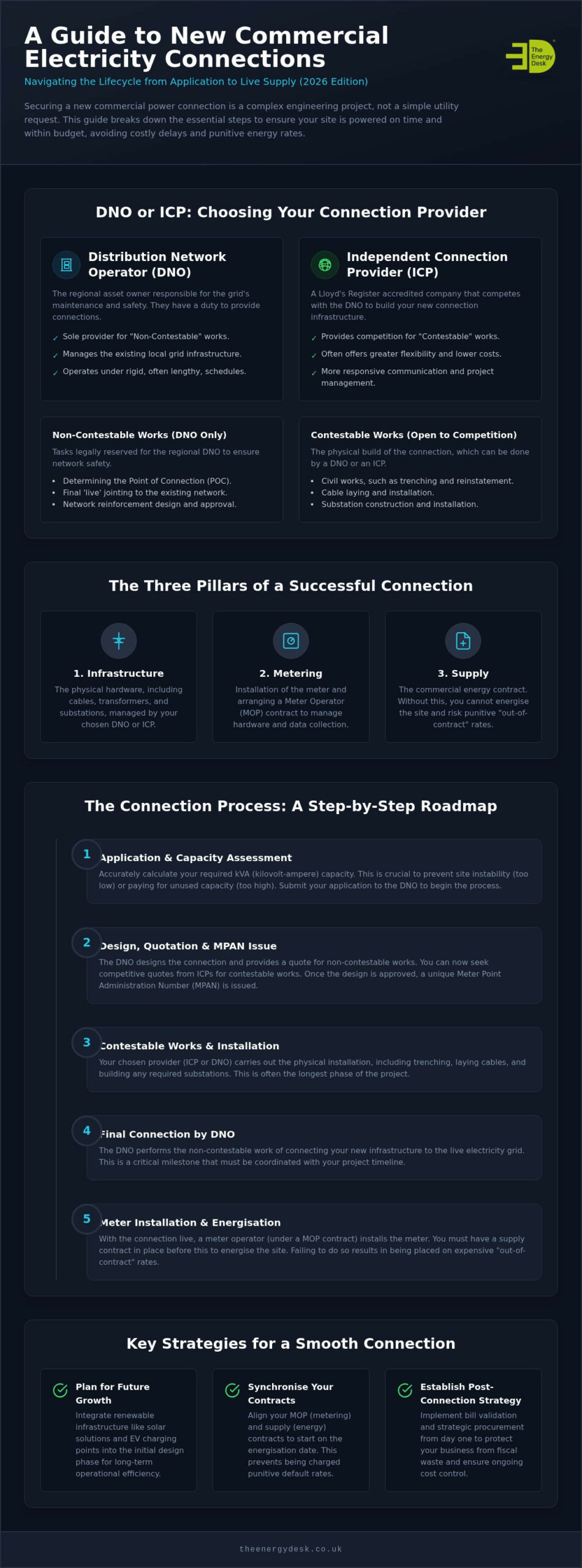
Ofgem classifies connection work into two distinct categories: contestable and non-contestable. Non-contestable tasks, such as determining the point of connection or performing the final “live” joint to the existing network, remain the sole responsibility of the regional Distribution Network Operator (DNO). However, contestable work, which includes trenching, cable laying, and substation installation, can be opened to competition. Engaging an Independent Connection Provider (ICP) for these tasks often results in more flexible timelines and competitive pricing for your business.
Commercial connections also differ from domestic ones because they are entirely non-subsidised. Whilst residential connections benefit from broader network investment, a business must fund the specific infrastructure required for its site. This includes the cost of any network reinforcements if the local grid cannot currently support your requested load. Central to this process is the Meter Point Administration Number (MPAN). This unique 13-digit code identifies your connection on the national grid. You can’t secure a supply contract or install a meter without a valid MPAN, which is typically issued by the DNO once the design is approved.
When does a business need a new connection?
There are several scenarios where a standard supply won’t suffice. New build industrial units and commercial developments require entirely new infrastructure from the ground up. You might also need a new connection when splitting a large warehouse into multiple smaller units, as each business requires its own metered supply. Modern upgrades, such as installing high-capacity EV charging hubs or heavy manufacturing machinery, often exceed existing capacity and necessitate a completely new high-voltage line.
The three pillars of a successful connection
- Infrastructure: This involves the physical hardware, including cables, transformers, and substations, managed by either a DNO or an ICP.
- Metering: Once the cable is live, you must arrange for a meter installation and a formal MOP contract to manage the hardware and data.
- Supply: The final pillar is the commercial energy contract. Without this, you cannot energise the site and you risk being placed on expensive emergency rates from the moment the meter is installed.
DNO or ICP: Which provider should manage your connection?
When planning a new commercial electricity connection, you aren’t restricted to your regional network owner. Under the “Competition in Connections” framework established by Ofgem, businesses can choose between a Distribution Network Operator (DNO) and an Independent Connection Provider (ICP). The DNO is the regional asset owner responsible for the grid’s maintenance and safety in a specific geographic area. Whilst they have a duty to provide connections, they often operate under rigid internal schedules that may not align with your construction timelines.
ICPs are Lloyd’s Register accredited companies that compete with DNOs to build the infrastructure required for your site. Choosing an ICP often provides greater project flexibility and more responsive communication. Because these providers operate in a competitive market, they are incentivised to offer more efficient delivery and potentially lower costs for the build phase. This competition ensures that you aren’t beholden to a single monopoly for the entirety of your project’s physical installation.
What is ‘Non-Contestable’ work?
Despite the competitive market, certain tasks remain “non-contestable,” meaning only the regional DNO can legally perform them. These tasks include identifying the Point of Connection (POC) to the existing network and carrying out the final “live” jointing to energise the new cables. You will always receive a bill from the DNO for these specific services, even if an independent provider handles every other aspect of the build. A specialist consultant often manages this technical liaison, ensuring the ICP’s design meets the DNO’s strict adoption standards to avoid costly rework or delays. Many businesses find that professional utility connection management simplifies this dual-provider relationship by acting as a single point of contact.
The advantages of an ICP for large developments
For complex industrial parks or large-scale solar farms, the advantages of using an ICP are significant. Independent providers typically offer more bespoke design solutions that can be tailored to specific site constraints. They also allow for the bundling of multiple utilities, such as gas and water, under a single project manager. This integrated approach reduces the number of contractors on-site and helps synchronise the entire infrastructure rollout. If your project involves tight deadlines, an ICP’s ability to prioritise your build over the DNO’s general network maintenance tasks can be the difference between meeting your “power-on” date and facing expensive operational delays.
How do you determine the correct kVA capacity for your business?
Determining the correct Kilovolt-Amps (kVA) is one of the most critical decisions during the application for a new commercial electricity connection. In technical terms, kVA represents your “Available Capacity,” which is essentially the maximum volume of power the network reserves specifically for your premises. Getting this figure right requires a precise balance between operational safety and fiscal responsibility. Every kVA you request must be supported by the local network, and getting the calculation wrong can lead to significant financial penalties.
If you under-specify your kVA, you risk blown fuses, equipment damage, and site-wide outages during peak operational hours. These interruptions are not just inconvenient; they can lead to costly production downtime. However, the more common error is over-specifying. For every kVA of capacity you reserve, the DNO applies a monthly “Availability Charge” on your energy bill. If you secure 200kVA but your site only ever peaks at 100kVA, you’re paying for infrastructure you don’t use. Calculating your load involves assessing the simultaneous demand of machinery, HVAC systems, and IT infrastructure to find a realistic peak requirement.
Future-proofing for EV charging and renewables
Modern commercial developments must account for the rapid shift toward electrification. A 2026 build that ignores fleet EV charging requirements will likely face expensive capacity upgrades within just a few years. It is often more cost-effective to secure a higher kVA capacity initially than to pay for network reinforcement later. If your strategy includes onsite generation, such as integrating CHP systems, your capacity planning becomes even more nuanced. For sites intending to export surplus power, G99 applications are mandatory to ensure the local grid can safely handle the bidirectional flow of energy.
CT vs Whole Current Metering
The size of your connection dictates the type of metering hardware required. Smaller commercial loads, typically those drawing up to 100A per phase, use “Whole Current” (WC) metering. In these setups, the entire current passes directly through the meter. For larger industrial demands, Current Transformer (CT) metering is necessary. CT meters use external sensors to monitor high-volume current safely and accurately. Because high-capacity sites incur significant costs, the necessity of accurate data collection cannot be overstated. Precise metering ensures you only pay for the energy consumed whilst providing the granular data needed to optimise your kVA requirements over time.
What are the essential steps in the commercial connection process?
The journey toward securing a new commercial electricity connection involves a series of technical and legal milestones that must be managed with precision. It begins with a comprehensive site survey and load assessment to establish your peak power requirements. This data forms the basis of your application to the Distribution Network Operator (DNO) for a Point of Connection (POC). The POC confirms exactly where and how your site will interface with the existing grid infrastructure.
Following the POC offer, the design and quotation phase provides the technical blueprints and costings for the project. At this stage, you must review the DNO or ICP proposal to ensure the design aligns with your operational layout. Once accepted, the project enters the legalities phase. This often involves negotiating wayleaves and easements to secure the necessary rights for cable routing. A Wayleave is a legal agreement for equipment to sit on private land. The process concludes with the physical construction phase, followed by meter installation and final site energisation.
Managing timelines and avoiding delays
Project lead times are frequently underestimated. You should ideally begin the application process 6 to 12 months before you require live power. Common bottlenecks include the time required to secure legal permissions from third-party landowners and the procurement of long-lead items like substations. Street work permits and local authority coordination can also add weeks to the schedule. Proactive management of these variables is essential to prevent your construction programme from stalling due to a lack of utility infrastructure. If you require expert oversight to keep your project on track, professional utility connection management can help mitigate these common risks.
Generating your MPAN
The Meter Point Administration Number (MPAN) is a critical output of the connection process. The DNO typically issues this unique 13-digit identifier once the infrastructure design is formally accepted and the connection agreement is in place. You cannot secure a business electricity contract without a valid MPAN. This creates a vital dependency; your energy supplier needs this number to register the site and arrange for the meter installation. Synchronising the completion of the physical cables with your supplier registration is the final step to ensuring your business isn’t left with a live cable but no legal authority to draw power.
How can businesses avoid delays and excessive connection costs?
To mitigate the risks of a new commercial electricity connection, businesses must treat the project as a strategic procurement exercise rather than a simple engineering task. Engaging a specialist utility consultant allows you to manage the ‘Competition in Connections’ tender process effectively. This ensures you receive competitive bids for all contestable works whilst subjecting initial DNO or ICP quotes to a forensic audit. By identifying unnecessary contingencies or over-engineered solutions in these quotes, you can significantly reduce the upfront capital expenditure required to get your site powered.
‘Right-sizing’ your requested capacity is equally vital for long-term fiscal health. Every excess kVA represents a recurring monthly cost that adds no value to your operations. Precision in your initial load assessment prevents you from paying for network capacity that remains idle. You should also synchronise the physical meter installation with the start date of your preferred supply contract. Failing to align these dates often results in the site being powered on before a supplier has registered the MPAN, leading to administrative chaos and immediate financial penalties.
Avoiding ‘Out-of-Contract’ rates at energisation
The moment your meter is installed and the connection is live, your business begins consuming energy. If a supplier isn’t registered in time, you will automatically fall onto ‘Deemed’ rates. These out-of-contract prices are often double or triple the market average and can quickly erode your project budget. Procurement specialists avoid this by securing competitive forward-contracts months before the energisation date. Integrating bill validation from day one ensures that the initial invoices correctly reflect your agreed kVA and contract rates, preventing overcharging during the critical early stages of site operation.
Leveraging renewable infrastructure
Strategic oversight of your infrastructure can uncover significant savings through onsite generation. Integrating commercial solar PV or other renewable solutions often reduces the total kVA demand you need to request from the grid. This “behind-the-meter” generation provides a dual benefit: it lowers your monthly availability charges and provides cheaper power for industrial processes. To achieve these results, you must manage the infrastructure build and the energy procurement as a single, unified project. This holistic approach ensures that your new commercial electricity connection is not just a pipe for power, but a foundation for a modern, cost-efficient utility strategy.
Securing Your Business Infrastructure for 2026
Successfully delivering a new commercial electricity connection requires a disciplined approach to both technical design and energy procurement. You must balance immediate infrastructure needs with long-term operational goals, such as right-sizing your kVA capacity and preparing for renewable integration. By navigating the competitive landscape of DNOs and ICPs with precision, you can eliminate delays and avoid the punitive costs of out-of-contract rates at the point of energisation.
The Energy Desk provides national, UK-wide expertise in managing complex industrial utility projects. With over 20 years of experience as an independent consultancy, we act as your strategic ally to ensure your infrastructure is efficient and future-proof. Our methodical oversight covers everything from technical liaison to bill validation. To secure expert guidance for your next project, request a free utility connection consultation with The Energy Desk today. We’re ready to help you power your business growth with confidence.
Frequently Asked Questions
How long does a new commercial electricity connection take?
A new commercial electricity connection typically takes between six and twelve months from the initial application to site energisation. Smaller projects might be completed faster, but larger industrial developments often face delays due to legal wayleaves or substation requirements. You should initiate the process as early as possible to ensure your construction timelines aren’t stalled by utility infrastructure delays or network reinforcement needs.
What is the difference between a DNO and an ICP?
A Distribution Network Operator (DNO) is the regional asset owner responsible for maintaining the local grid. In contrast, an Independent Connection Provider (ICP) is an accredited third party that can design and build the “contestable” parts of your infrastructure. Using an ICP often provides more flexibility and competitive pricing for your build, whilst the DNO retains responsibility for the final “non-contestable” connection to the existing network.
Do I need a new meter for a new electricity connection?
Yes, you must arrange for a new meter installation once the physical connection is in place. The connection itself only provides the cable to your boundary; the meter is the device that records your consumption. You cannot install a meter without a valid MPAN and a signed supply contract. For large commercial sites, you’ll also need a Meter Operator (MOP) contract to manage the hardware and data collection.
How much kVA does my business need for a new connection?
Your required kVA (Kilovolt-Amps) depends on your peak operational load, including machinery, HVAC systems, and office equipment. For 2026 builds, it’s vital to account for future demand from EV charging hubs and renewable exports. Under-specifying leads to outages, whilst over-specifying results in unnecessary monthly availability charges. A detailed load assessment is essential to determine the precise capacity needed for your specific business operations.
What is an MPAN and when do I get one for my new site?
An MPAN (Meter Point Administration Number) is a unique 13-digit code that identifies your specific connection on the national grid. The DNO usually issues this number once your connection design is accepted and the legal agreements are signed. You’ll need this number to secure a commercial energy contract and to arrange for the final meter installation. It’s a critical milestone that bridges the gap between infrastructure and supply.
Can I choose any electricity supplier for my new commercial connection?
Yes, you have the freedom to choose any commercial energy supplier once you have a valid MPAN for your new commercial electricity connection. It’s often beneficial to work with a specialist procurement consultant to secure a competitive forward contract. This prevents your site from falling onto expensive “deemed” rates the moment the meter is live. Aligning your supplier registration with the infrastructure completion is critical for a seamless power-on date.
What are wayleaves and easements in utility connections?
Wayleaves and easements are legal permissions required when utility cables or equipment must cross private land owned by a third party. A wayleave is typically a recurring agreement, whilst an easement is a permanent right registered on the property’s title. Securing these legal rights is a common cause of project delays, so identifying required permissions during the initial site survey is essential for maintaining your broader construction schedule.
How can I reduce the cost of my new business power supply?
You can reduce costs by leveraging “Competition in Connections” to tender contestable work to Independent Connection Providers. Additionally, “right-sizing” your kVA capacity ensures you don’t pay for unused availability. Implementing a strategic procurement plan and conducting bill validation from day one helps prevent overcharging and protects your business from the high costs of out-of-contract rates during the initial operational phase of your project.