
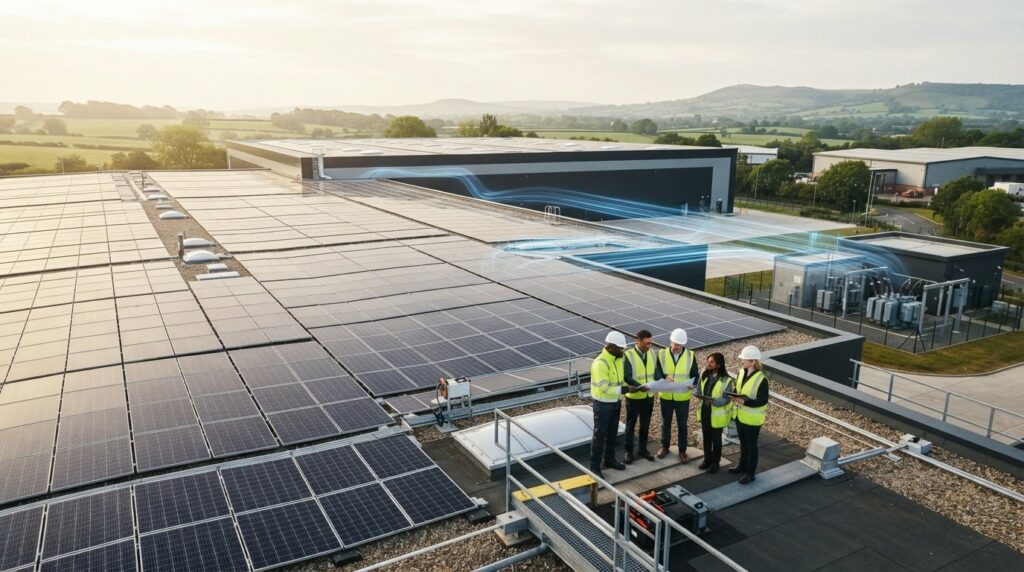
Could your industrial roof be the most underutilised asset on your balance sheet as we approach 2026? While many boardrooms view decarbonisation as a compliance burden, forward-thinking organisations are now prioritising commercial solar panel installation UK as a tactical procurement tool. You’re likely aware that traditional energy markets remain volatile, yet the path to self-sufficiency often feels blocked by G99 grid application delays and complex planning requirements for large-scale arrays.
We understand that high initial CAPEX and uncertainty regarding export tariff longevity can make even the most ambitious projects feel stalled. This guide provides a roadmap to securing energy independence, moving beyond simple ‘green’ goals to achieve measurable fiscal stability. You’ll learn how to navigate the technical and financial complexities that turn solar PV into a high-yield investment rather than a speculative expense.
We’ll examine how to bypass regulatory bottlenecks, optimise ROI, and integrate solar assets into a broader utility management framework. By following this methodical approach, your business can reduce grid reliance and fix energy costs for over 20 years, ensuring your infrastructure is ready for the demands of the next decade.
Key Takeaways
- Understand how onsite generation serves as a strategic hedge against National Grid volatility to secure fixed energy costs for the long term.
- Evaluate the fiscal differences between direct CAPEX ownership and zero-upfront Power Purchase Agreements (PPAs) to protect your balance sheet.
- Streamline your project timeline by understanding the specific requirements for structural surveys and planning permissions for a commercial solar panel installation UK.
- Recognise the role of Tier 1 technical components and inverter efficiency in ensuring the multi-decade durability of your renewable infrastructure.
- Learn to align solar generation with your existing electricity procurement contracts to prevent unnecessary over-capacity charges and optimise utility spend.
The Business Case for Commercial Solar Panel Installation in 2026
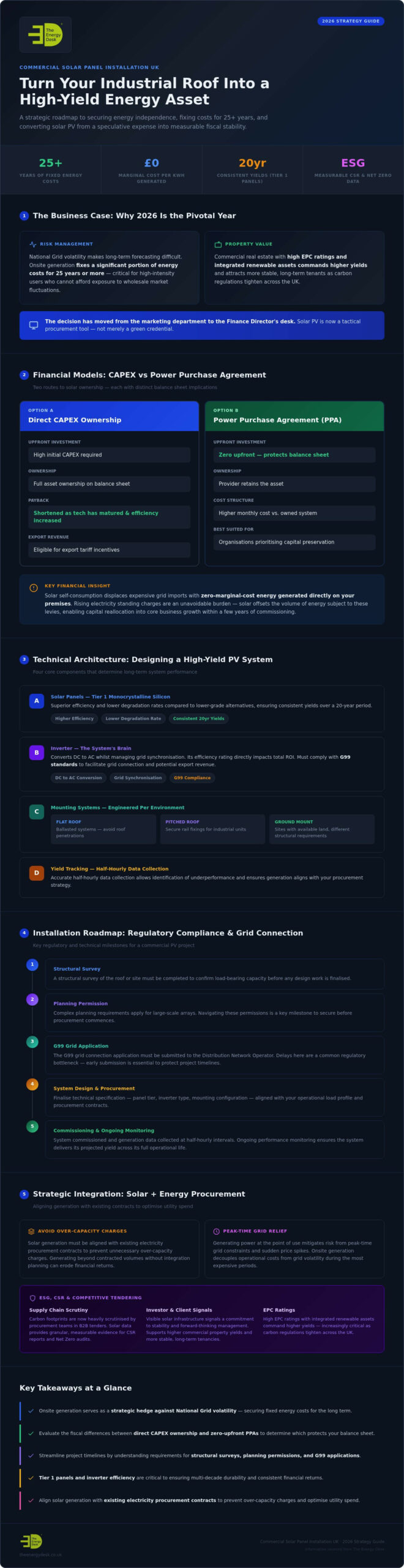
In 2026, the decision to invest in solar PV has moved from the marketing department to the finance director’s desk. Volatility in the National Grid makes long-term forecasting difficult for any large-scale operation. Onsite generation allows a business to fix a significant portion of its energy costs for 25 years or more. This stability is critical for high-intensity users who can’t afford to be exposed to wholesale market fluctuations. The historical growth of solar power in the United Kingdom demonstrates a clear shift toward decentralised, resilient infrastructure that prioritises local generation over grid reliance.
Energy independence is no longer a luxury; it’s a risk management strategy. By generating power at the point of use, firms mitigate the risks associated with peak-time grid constraints and sudden price spikes. As energy markets fluctuate, a commercial solar panel installation UK offers a predictable alternative to traditional supply models. This transition also supports property value. Commercial real estate with high EPC ratings and integrated renewable assets commands higher yields and attracts more stable, long-term tenants as carbon regulations tighten across the UK. To ensure your assets meet the highest environmental standards, you can visit Ekocentric for professional guidance on sustainable building certifications.
Financial ROI and Payback Periods
Typical payback trajectories for industrial-scale systems have shortened as technology has matured and efficiency has increased. Rising electricity standing charges are a growing burden on operational budgets, and solar provides an effective way to offset these unavoidable costs. By generating your own power, you reduce the volume of energy subject to these levies. Solar self-consumption maximises financial returns by displacing expensive grid imports with zero-marginal-cost energy generated directly on your premises. For many firms, these savings allow for the reallocation of capital into core business growth within just a few years of the initial commissioning.
Beyond Carbon: The Marketing and Brand Advantage
Corporate ESG requirements now demand absolute transparency in sustainability reporting. A commercial solar panel installation UK provides granular, measurable data that can be used for annual CSR reports and Net Zero audits. This evidence is vital for securing a competitive advantage in B2B tenders, where supply chain carbon footprints are now heavily scrutinised by procurement teams. Visible infrastructure like solar arrays also signals a commitment to stability and forward-thinking management to investors and clients alike. It integrates seamlessly into a broader business electricity procurement strategy, ensuring that your brand is viewed as a leader in the transition to a low-carbon economy.
Technical Architecture: Designing a High-Yield Commercial PV System
Designing a high-performance system requires more than just filling a roof with panels. A strategic commercial solar panel installation UK relies on Tier 1 monocrystalline silicon panels. These offer superior efficiency and lower degradation rates compared to lower-grade alternatives, ensuring consistent yields over a 20-year period. The inverter acts as the system’s brain, converting DC to AC whilst managing grid synchronisation. Its efficiency rating directly impacts your total ROI. Understanding Ofgem energy regulation and export incentives is vital here, as the inverter must comply with G99 standards to facilitate grid connection and any potential export revenue.
Mounting systems must be engineered for specific environments. Flat roof solutions often use ballasted systems to avoid roof penetrations, whilst pitched industrial units require secure rail fixings. Ground-mount arrays are suitable for sites with available land but require different structural considerations. Accurate yield tracking depends on half-hourly data collection. This precision allows for the identification of underperformance and ensures that generation aligns with your procurement strategy. To ensure your technical design meets your specific operational needs, you can request a technical energy audit to evaluate your site’s potential.
The Role of Battery Storage in Commercial Solar
Battery integration transforms solar from a passive generation source into a dynamic asset. By storing excess energy produced during midday peaks, businesses can shift usage to early evening when grid prices are highest. This significantly increases self-consumption and avoids selling power back to the grid at lower export rates. For industrial sites, batteries also provide an Uninterruptible Power Supply (UPS). This protects sensitive machinery from voltage drops or brief grid outages that could otherwise lead to costly downtime.
Solar PV vs. Solar Thermal for Business
While solar thermal is efficient for heating water, Solar PV is the dominant choice for UK commercial organisations due to its versatility in powering machinery, lighting, and HVAC systems. Hybrid systems are occasionally used in food processing or leisure centres where both heat and power are in high demand. However, the ease of integrating PV into existing electrical infrastructure makes it the standard for a commercial solar panel installation UK. It provides the most flexible route to reducing overall grid reliance across all operational areas.
Navigating Financial Models: CAPEX, PPA, and Export Incentives
Choosing the right funding vehicle is as critical as the technical specification of the array itself. For a commercial solar panel installation UK, the financial model dictates both your immediate cash flow and your 25-year yield. Direct ownership via CAPEX remains the most effective route for organisations with available capital. By funding the project upfront, you retain 100% of the energy savings and any revenue generated through the Smart Export Guarantee (SEG). While SEG rates have evolved by 2026, they still provide a valuable secondary income stream for systems that generate significant surplus during low-demand periods.
For businesses preferring to preserve capital for core operations, asset finance or solar leasing offers a middle ground. These structures allow you to spread the cost over several years, often ensuring that the monthly energy savings exceed the finance repayments. Capital remains preserved. This creates a cash-flow positive installation from day one, allowing the system to effectively pay for itself through utility bill reductions.
Power Purchase Agreements (PPA) Explained
A Power Purchase Agreement (PPA) is often the preferred choice for cash-flow-conscious organisations. Under this model, a third-party investor funds the entire commercial solar panel installation UK, including the ongoing maintenance and insurance. In return, your business agrees to purchase the electricity generated by the system at a predetermined rate, which is typically significantly lower than standard grid prices. These contracts usually span 10 to 25 years. They provide long-term price certainty. It’s an ideal solution for firms that want the decarbonisation benefits of solar without the balance sheet impact of a major capital purchase.
Tax Incentives and Capital Allowances
Tax mechanisms within the UK regime continue to offer ways to accelerate the payback period for renewable investments. The Annual Investment Allowance (AIA) allows many businesses to deduct the full value of qualifying plant and machinery, including solar PV, from their profits before tax. This can result in substantial immediate tax savings. Specific green tax breaks may also apply depending on your current corporate structure and energy intensity. Consulting with energy procurement specialists, who act as the bridge between hardware installers and energy suppliers, ensures that your solar project is integrated into your fiscal planning as effectively as it is into your electrical infrastructure.
The Installation Roadmap: Regulatory Compliance and Grid Connection
Moving from financial approval to the physical deployment of a commercial solar panel installation UK requires a methodical approach to logistics and regulation. The first critical step is a comprehensive structural survey. Industrial roofs, particularly older steel-frame or asbestos-clad units, must be assessed for their ability to support both the static load of the panels and the dynamic wind loads they will encounter. Failure to verify structural integrity can lead to catastrophic insurance complications or long-term damage to the building fabric.
Quality assurance is maintained through adherence to MCS (Microgeneration Certification Scheme) and RECC (Renewable Energy Consumer Code) standards. These certifications ensure that the equipment and the installation process meet stringent UK safety and performance benchmarks. Working with certified professionals protects your investment and is often a prerequisite for accessing export tariffs or securing asset finance. To streamline this complex process, you can authorise a professional consultancy to manage your grid connection application and technical compliance.
Understanding G99 and G100 Grid Applications
Securing permission from the District Network Operator (DNO) is frequently the most time-consuming phase of a project. Any system exceeding 3.68kW on a single-phase supply or 11.04kW on a three-phase supply falls under G99 regulations. This requires an “Apply and Wait” procedure where the DNO assesses whether the local infrastructure can handle the additional load. If the local grid is constrained, G100 export limitation technology may be required. This hardware restricts the amount of power sent back to the grid during peak generation, allowing larger arrays to be installed without triggering expensive grid reinforcement costs.
Planning Permission and Building Regulations
Most non-domestic commercial solar panel installation UK projects fall under Permitted Development Rights, provided they meet specific criteria regarding height and proximity to the roof edge. However, these rights are often restricted for listed buildings or sites located within Conservation Areas. In such cases, full planning permission is mandatory. Beyond planning, all works must comply with Building Regulations, specifically regarding electrical safety and fire protection. Part P standards and IET wiring regulations must be strictly followed to ensure the system is safe for long-term operation and compliant with commercial property insurance requirements.
Strategic Integration: Aligning Solar with Your Energy Procurement
Solar PV should never be treated as a standalone asset. To maximise its value, it must be integrated into a wider business electricity procurement strategy. This alignment ensures that onsite generation is used to displace the most expensive units of grid power. It also allows for the methodical balancing of grid supply contracts. Many firms face excessive over-capacity charges because their agreed supply capacity doesn’t reflect their actual demand once solar is live. A commercial solar panel installation UK provides the data needed to recalibrate these contracts, ensuring you only pay for the grid capacity you truly require.
Accurate measurement is the only way to verify the success of your infrastructure investment. By utilising commercial utility bill validation, businesses can conduct a forensic audit of their energy spend. This process measures actual solar yields against grid savings, identifying any discrepancies in billing or system performance. The Energy Desk acts as a strategic partner throughout this transition, providing the oversight needed to move from a grid-reliant model to one of managed energy independence.
Solar and the Multi-Site Portfolio
Managing energy across a multi-site portfolio requires a data-driven approach. Not every building in an estate will be suitable for a commercial solar panel installation UK. Some may have structural limitations, whilst others may have superior solar potential due to roof orientation. Centralising this information through business energy portfolio management allows for a unified view of consumption and generation. This visibility is essential for meeting corporate ESG targets and ensuring capital is deployed where it will generate the highest ROI.
Synergy with EV Charging and CHP
Solar generation offers significant synergies with other low-carbon technologies. Powering a corporate EV fleet with onsite solar ensures that your transition to electric transport is genuinely zero-emission. It also avoids the volatility of public charging prices. Additionally, solar provides an excellent seasonal balance for those considering a CHP system installation for businesses. While CHP is highly efficient for providing base-load power and heat, solar generation peaks during the summer months when heat demand typically falls. Developing an integrated renewable energy roadmap ensures your organisation maintains a stable, cost-effective power supply regardless of seasonal variations.
Securing Your Energy Future in 2026
Navigating the transition to onsite generation requires a disciplined approach to both technical architecture and financial modelling. A successful commercial solar panel installation UK is no longer just a sustainability goal; it’s a vital component of a resilient utility strategy. By fixing energy costs for the next two decades, your organisation can bypass grid volatility and ensure long-term fiscal stability. It’s essential to move beyond standalone hardware and integrate these assets into your broader procurement framework to avoid unnecessary capacity charges.
The Energy Desk provides the expert oversight needed to manage this complexity. With over 20 years of energy consultancy experience, we offer independent advice and end-to-end project management. We handle everything from the initial G99 grid application to final commissioning. Our team ensures your solar project delivers the measurable decarbonisation and ROI your stakeholders expect. Take the first step toward energy independence and request your free commercial energy audit and solar feasibility study today. We look forward to helping you optimise your operational infrastructure for the years ahead.
Frequently Asked Questions
Do I need planning permission for commercial solar panels in the UK?
Most commercial solar panel installation UK projects fall under Permitted Development Rights. This means you often don’t need full planning permission, provided the system meets specific criteria regarding height and roof edge proximity. However, you must apply for full permission if your building is listed, located in a conservation area, or if the installation exceeds certain size thresholds. It’s essential to verify your site’s status with the local planning authority before commencing any works.
How much does a commercial solar panel installation cost for a UK business?
Total costs depend on system capacity, the technical specifications of the components, and the complexity of your roof’s structural requirements. We don’t provide fixed price estimates because every industrial site has unique operational demands. While direct CAPEX requires an upfront investment, many organisations now utilise Power Purchase Agreements (PPAs) to install solar with zero initial cost. The most accurate way to determine your commitment is through a professional feasibility study and energy audit.
How long do commercial solar panels take to pay for themselves?
Payback periods have shortened significantly as grid electricity rates and standing charges have increased. Most industrial systems now achieve a return on investment within a few years, though the exact timeline depends on your onsite self-consumption levels. By using the power you generate directly, you displace expensive grid imports and protect your margins. Systems that are integrated into a broader procurement strategy typically see the fastest financial recovery due to optimised utility spend.
What is a G99 application and why is it necessary for commercial solar?
A G99 application is a formal request to your District Network Operator (DNO) to connect a generation system to the national grid. It’s mandatory for any installation exceeding 3.68kW on a single-phase or 11.04kW on a three-phase supply. This process ensures the local network can handle the additional load safely. Securing this approval is a vital step for a commercial solar panel installation UK to ensure your infrastructure is legally compliant and grid-synchronised.
Can I install solar panels on a leased commercial property?
You can install solar on leased premises, but you must obtain formal consent from the landlord. Many businesses now use “Green Leases” to define how the energy savings and maintenance responsibilities are shared between the owner and the tenant. Alternatively, a PPA can be structured so that the tenant buys the generated power at a lower rate without owning the hardware. This often increases the property’s EPC rating and long-term asset value for the landlord.
What happens to my solar generation on cloudy days in the UK?
Solar panels don’t require direct sunlight to function; they generate electricity using diffuse light on overcast days. While the total output is lower than in peak summer sun, modern Tier 1 monocrystalline panels are designed to be highly efficient in the UK’s typical weather conditions. To manage these natural fluctuations, many organisations integrate battery storage. This allows them to store excess power generated during brighter periods for use when generation drops or during expensive evening peaks.
How do I sell excess solar energy back to the grid as a business?
Businesses sell surplus energy through the Smart Export Guarantee (SEG) or via bespoke export contracts with energy suppliers. You must have an MCS-certified system, a half-hourly export meter, and a DNO-approved G99 connection to qualify. The revenue generated from exports provides a useful secondary income stream, though maximising onsite self-consumption remains the most effective way to improve ROI. Working with an independent consultancy helps you identify the most competitive export rates available.
What maintenance is required for a commercial solar PV system?
Commercial PV systems are generally low-maintenance because they have no moving parts, but regular oversight is essential for peak performance. We recommend an annual professional inspection to check electrical connections, mounting integrity, and inverter health. Periodic cleaning may be necessary if your site is in a high-pollution or coastal area where debris can accumulate. Digital monitoring systems allow for real-time tracking, ensuring any drop in yield is identified and rectified immediately by your technical team.