


With vehicle manufacturers now facing penalties of up to £15,000 per non-compliant van to meet the 24% zero-emission registration target for 2026, the pressure on your fleet to electrify is at an all-time high. It’s likely you’re already feeling the weight of this transition. Many organisations worry that a comprehensive business EV charging infrastructure will lead to astronomical grid upgrade costs or compromise daily operational power. Balancing the demands of a growing electric fleet with your existing energy overheads is a complex challenge that requires more than just hardware installation.
This guide simplifies the process, promising to help you master the technical and financial hurdles of commercial electrification. You’ll discover how to utilise the £500-per-socket Workplace Charging Scheme grant whilst bypassing expensive DNO reinforcements through active load management. We’ll explore the strategic shift towards high-speed DC charging and explain how a professional energy audit serves as the foundation for reducing charging overheads by up to 85% compared to public networks. From forensic procurement to future-proofed network design, we’ll ensure your transition to net-zero remains both compliant and cost-effective.
Key Takeaways
- Learn how to leverage the 2026 Workplace Charging Scheme to secure up to £20,000 in grant funding whilst ensuring compliance with updated Building Regulations.
- Discover the technical requirements for a scalable business EV charging infrastructure, including how to navigate DNO capacity limits without triggering expensive grid reinforcements.
- Identify the optimal balance between AC destination charging for staff and high-speed DC units for back-to-base fleet operations to maximise operational efficiency.
- Establish a robust five-year electrification roadmap starting with a forensic energy audit to align your charging needs with existing site capacity.
- Understand the fiscal benefits of integrating smart energy procurement and on-site generation to reduce long-term charging costs by up to 85%.
The Evolving Landscape of Business EV Charging Infrastructure in 2026
In 2026, business EV charging infrastructure is no longer a peripheral facility for the modern enterprise. It represents a mission-critical asset that integrates high-voltage power supply, intelligent hardware, and sophisticated management software. The transition from internal combustion engines to electric vehicles (EVs) has moved past the early adoption phase, becoming a fundamental pillar of corporate logistics and operational continuity. Companies now view charging as an essential operational requirement rather than a discretionary employee benefit. A simple “plug and play” approach lacks the resilience needed for commercial scales, where charging downtime directly impacts service delivery and revenue. Managing these systems effectively requires a strategic oversight of grid capacity and real-time energy demand.
Regulatory Drivers and Compliance for UK Firms
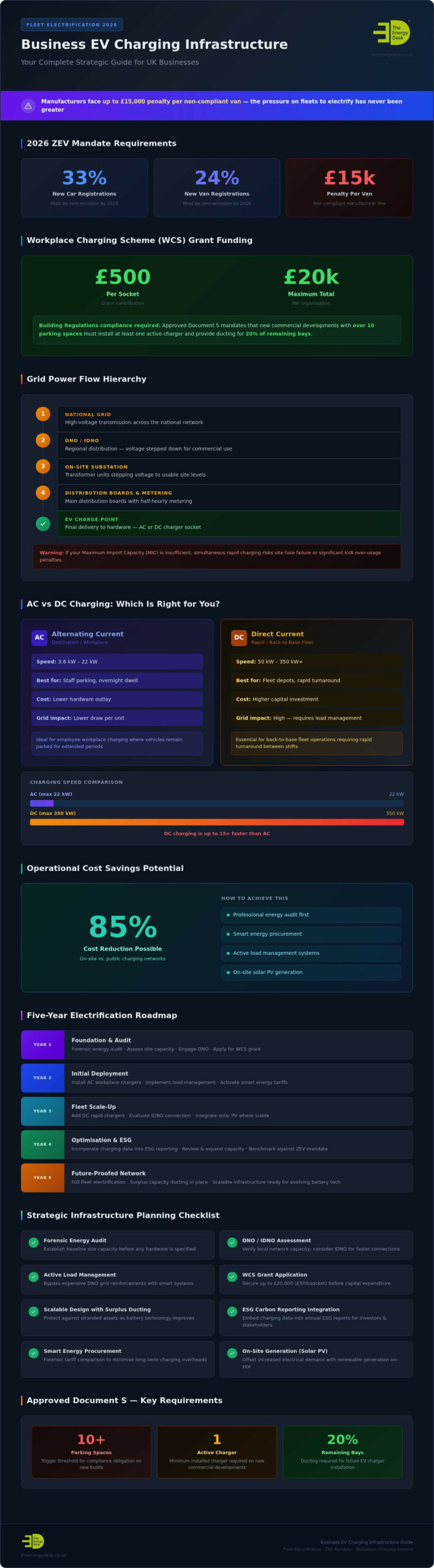
Compliance is now a legal mandate for any organisation managing a physical site. Under Approved Document S of the Building Regulations, new commercial developments with over 10 parking spaces must install at least one active charger and provide ducting for 20% of the remaining bays. The UK’s Zero Emission Vehicle (ZEV) mandate adds further pressure to this landscape. By 2026, vehicle manufacturers are legally required to ensure 33% of new car registrations and 24% of new light commercial van registrations are zero-emission. This supply-side shift forces corporate procurement teams to accelerate their infrastructure plans to support an inevitable fleet transition. Additionally, firms must now integrate charging data into their annual ESG reports, providing transparent carbon footprinting for investors and stakeholders.
The Business Case for Scalable Infrastructure
Scalability is the most fiscally responsible strategy for 2026. Installing AC and DC charging infrastructure with surplus capacity prevents the need for disruptive and expensive groundworks in the future. This foresight enhances commercial real estate value, making properties significantly more attractive to high-quality tenants who require established charging networks for their own fleets. Strategic planning also protects against the risk of “stranded assets” where underpowered chargers become obsolete as vehicle battery technology improves. Investing in robust infrastructure also aligns with the broader business case for commercial renewable energy UK, as on-site generation, such as solar PV, can be used to offset the increased demand on the building’s primary electrical supply.
Technical Architecture: Power Supply, Grid Connections, and Load Management
Success in deploying business EV charging infrastructure depends on understanding the “upstream” electrical path. Power doesn’t just appear at the socket; it follows a precise journey from the National Grid through regional Distribution Network Operators (DNOs), who step down the voltage for commercial use. For most firms, the power flow follows this hierarchy:
- High-voltage transmission via the National Grid.
- Regional distribution managed by a DNO or IDNO.
- On-site substation and transformer units.
- Main distribution boards and half-hourly metering.
- Final delivery to the EV charge point hardware.
If your current Maximum Import Capacity (MIC) is insufficient for the simultaneous demand of multiple rapid chargers, you risk blowing site fuses or incurring significant kVA over-usage penalties. Managing this technical architecture requires a proactive approach to utility management rather than simple hardware installation.
Navigating Grid Capacity and New Connections
Determining site capacity is the first technical hurdle. A DNO assessment identifies if the local network can handle your projected load, but standard DNO queues are often lengthy due to the legacy “first-come, first-served” model. Independent Distribution Network Operators (IDNOs) offer a strategic alternative. They’re licensed to build and own local network extensions, often providing faster connection timelines and “asset adoption” payments that offset initial capital expenditure. According to IEA global electric vehicle charging trends, managing these grid impacts through diversified connection strategies is becoming a standard requirement for high-power depot infrastructure. Under the reformed “First Ready, First Connected” (TMO4+) regime, speculative applications are being stripped out, making it essential to have a shovel-ready plan. To ensure your project remains on track, it’s wise to commission a professional utility connection audit to evaluate these competitive options.
Dynamic Load Balancing and Energy Storage
Dynamic Load Management (DLM) is the software layer that monitors real-time building consumption. When total demand nears the site’s safety limit, DLM automatically throttles the power delivered to each charger. This ensures that essential operational machinery or office lighting remains powered whilst vehicles continue to charge at a reduced rate. For sites with severe capacity constraints, integrating on-site battery storage allows you to “shave” peak demand by discharging stored energy during high-usage windows. This infrastructure also integrates seamlessly with other on-site generation, such as a CHP system installation for businesses, providing a resilient and cost-effective energy mix. By using stored or self-generated power, firms can often bypass the six-figure costs associated with physical substation reinforcements.
Evaluating Charging Models: AC vs DC and Fleet vs Workplace Requirements
Selecting the right hardware for your business EV charging infrastructure requires a precise understanding of vehicle dwell times and duty cycles. Alternating Current (AC) charging, typically ranging from 7kW to 22kW, is the standard for long-dwell scenarios where vehicles remain stationary for six hours or more. Conversely, Direct Current (DC) rapid and ultra-rapid charging (50kW to 150kW+) is essential for mission-critical fleets requiring quick turnaround times between shifts. Balancing these two models is often the most cost-effective way to meet diverse operational needs without over-specifying your electrical supply.
To ensure long-term flexibility, firms should prioritise hardware using the Open Charge Point Protocol (OCPP) 2.0.1. This standard prevents vendor lock-in, allowing you to switch software providers without the need to replace physical pedestals. Aligning your hardware choice with the UK electric vehicle infrastructure strategy ensures your site remains compatible with future smart-grid requirements and bidirectional charging capabilities. High-quality hardware also reduces maintenance overheads; whilst public networks face a 99% reliability mandate, private fleet operators should demand similar Service Level Agreements (SLAs) to prevent operational bottlenecks.
Workplace vs Fleet Charging Infrastructure
Workplace charging prioritises cost-efficiency and employee retention. Dual-socket AC pedestals are the most practical choice here, especially as the 2026/27 Benefit-in-Kind (BiK) rate for electric company cars remains highly competitive at 4%. These units allow staff to replenish batteries during the working day using the £500-per-socket Workplace Charging Scheme grant. For fleet depots, however, the focus shifts to high-power DC hubs. These installations require strategic physical layouts, including wider bays for light commercial vehicles (LCVs) and robust cable management systems to ensure site safety. Accessibility is another vital factor; ensure that at least one bay is designed to accommodate drivers with limited mobility to maintain full compliance with inclusive design standards.
Software and Back-Office Management Systems
A Charge Point Management System (CPMS) provides the necessary oversight for energy consumption and user access. These platforms automate the complex task of billing, distinguishing between private and business mileage to simplify tax reimbursement. This data is also vital for meeting half hourly metering requirements UK, ensuring that EV energy costs are accurately captured and validated against your primary utility bills. By integrating smart software, you can schedule charging during off-peak windows to capitalise on lower tariffs whilst maintaining a full audit trail for mandatory carbon reporting.
The Strategic Infrastructure Planning Framework
Deploying a robust business EV charging infrastructure requires a methodical approach that treats charging as a utility project rather than a simple hardware purchase. A failure to plan often leads to “stranded assets” or excessive kVA capacity charges that erode the ROI of electrification. Success follows a five-step sequence that aligns technical requirements with fiscal oversight:
- Conduct a forensic energy audit to establish your baseline power profile.
- Define a five-year roadmap based on projected vehicle numbers and duty cycles.
- Secure grid capacity through either DNO or IDNO connection routes.
- Tender for hardware and software that meets strict OCPP standards.
- Align the final implementation with a comprehensive business electricity procurement review.
This structured framework ensures that your transition remains financially viable and operationally resilient, preventing the common pitfalls of piecemeal installations.
Phase 1: The Forensic Energy Audit
A forensic audit is the essential starting point for any scalable project. You must understand your site’s peak demand patterns before adding the significant load of an EV fleet. Often, organisations have “hidden” capacity within their existing utility contracts that can be repurposed for charging, potentially avoiding the need for expensive grid reinforcements. By utilising commercial utility bill validation, firms can often identify historical overcharges or incorrect tariff applications. Recovering these funds provides a capital boost that can be reinvested directly into the infrastructure project. This audit establishes the actual “headroom” available whilst ensuring your main site fuses remain protected during peak operational hours.
Phase 2: Procurement and Tendering
Once the power baseline is established, the procurement phase begins. Writing a technical specification that prioritises interoperability is essential to prevent future obsolescence. You should evaluate the Total Cost of Ownership (TCO) rather than just the initial installation price. TCO accounts for software licensing, reactive maintenance, and energy losses over the equipment’s lifespan. Engaging energy procurement consultants allows you to benchmark hardware performance and negotiate favourable supply contracts simultaneously. This dual approach ensures your chargers are powered by the most cost-effective tariffs available, protecting your long-term margins. To begin your infrastructure journey with a professional assessment, book a free energy audit with The Energy Desk.
Optimising Your EV Infrastructure with The Energy Desk
The Energy Desk (TED) functions as a strategic ally, bridging the gap between hardware installation and sophisticated utility procurement. Whilst many providers focus solely on the physical pedestal, TED recognises that a sustainable business EV charging infrastructure requires deep integration with your site’s broader power profile. By managing the technical complexities of grid connections and substation upgrades, we allow your internal teams to focus on core fleet operations. This holistic approach ensures that your charging load is integrated into a robust commercial energy risk management strategy, protecting your organisation from volatile wholesale price spikes and kVA capacity penalties.
End-to-End Project Management
TED acts as a single point of professional contact, coordinating the efforts of DNOs, IDNOs, hardware installers, and energy suppliers. We ensure that the increased demand from your EV network is placed on the most competitive flexible or fixed-rate tariffs available in the market. Our expertise in utility connections prevents the project delays often associated with complex grid reinforcements. Beyond the installation phase, we provide ongoing oversight through business energy portfolio management. This ensures that as your fleet grows, your energy contracts are adjusted to maintain maximum cost-efficiency and compliance with net-zero mandates.
Securing Your Free Energy Audit
The foundation of any successful infrastructure project is accurate data. The Energy Desk provides a free energy audit to de-risk your transition to electric transport. This initial assessment identifies your current spare capacity, evaluates existing main fuse ratings, and pinpoints areas where bill validation could recover capital for your project. By establishing this baseline, we prevent the common error of over-specifying equipment or triggering unnecessary grid upgrade costs.
Our methodical process moves logically from this initial audit to forensic bill validation, ensuring every kilowatt-hour consumed by your fleet is accurately tracked and billed. This level of oversight is essential for maintaining fiscal responsibility in a high-demand environment. To begin your transition to a resilient business EV charging infrastructure with a partner that understands the intersection of hardware and energy markets, request your free energy audit from The Energy Desk today. Our consultants will provide the clarity and technical expertise needed to build a resilient, future-proofed charging network.
Securing Your Competitive Advantage Through Strategic Electrification
Successful deployment hinges on more than just hardware selection; it requires a methodical alignment of site capacity, smart load management, and strategic energy procurement. By transitioning from a “plug and play” mindset to a utility-first framework, organisations can bypass the six-figure reinforcement costs often demanded by DNOs. Implementing a scalable business EV charging infrastructure ensures your fleet remains operational whilst meeting the strict 2026 ZEV mandate targets and ESG reporting requirements.
With over 20 years of UK energy consultancy expertise, The Energy Desk provides independent advice across all major hardware and energy providers. As specialists in managing complex DNO and IDNO utility connections, we navigate the technical hurdles on your behalf to prevent project delays. Our methodical approach ensures that your charging network is powered by the most competitive tariffs, protecting your long-term operational margins. Request a free energy audit to plan your EV infrastructure and de-risk your transition to a zero-emission fleet. Taking this proactive step today ensures your organisation is fully prepared for the infrastructure demands of tomorrow.
Frequently Asked Questions
How much extra power does my business need for EV charging?
The amount of additional power depends on your vehicle count and the charging speeds required. A standard 7kW AC socket adds relatively low load, whilst a single 50kW DC rapid charger can consume a significant portion of a site’s available capacity. It’s essential to calculate your peak demand against your current Maximum Import Capacity (MIC). A professional audit helps identify if your existing supply can support your roadmap without triggering expensive substation upgrades.
What is the difference between a DNO and an IDNO for EV projects?
A Distribution Network Operator (DNO) is the regional monopoly responsible for the electrical grid in your area. Conversely, an Independent Distribution Network Operator (IDNO) is a private entity licensed to build and own local network extensions. For EV projects, IDNOs are often more flexible and can provide faster points of connection. They also offer “asset adoption” payments, which are financial rebates that can help offset the initial capital expenditure of your business EV charging infrastructure.
Are there still government grants available for business EV infrastructure in 2026?
Yes, the Workplace Charging Scheme (WCS) remains active and has been extended until 31 March 2027. As of April 2026, the grant provides £500 per socket, covering up to 75% of the total purchase and installation cost. Organisations can claim for up to 40 sockets across all sites, reaching a maximum grant value of £20,000. This funding is a primary mechanism for UK firms to reduce the upfront costs of their electrification projects.
Can I install EV chargers if my business is in a leased property?
You can install charging points in leased premises, but you generally require written consent from the landlord for any structural or electrical modifications. Under Approved Document S of the Building Regulations, landlords of new or majorly renovated commercial buildings with over 10 parking spaces are now legally mandated to provide at least one active charger. For existing leases, installing infrastructure often increases the property’s value, making it a persuasive proposition for landlords and leaseholders alike.
How does dynamic load management save my business money?
Dynamic load management (DLM) saves money by preventing your site from exceeding its agreed Maximum Import Capacity (MIC). Instead of paying for expensive grid reinforcements, the DLM software monitors building consumption and automatically throttles charger output during peak periods. This technology ensures you avoid costly kVA over-usage penalties whilst allowing you to install more charging points than your raw power supply would otherwise permit. It effectively maximises your existing utility assets.
What happens if our EV charging demand exceeds our current agreed supply capacity?
If demand exceeds your agreed capacity, you risk tripping the main site fuses or incurring significant financial penalties from your DNO. To manage this, you must either apply for a capacity increase or implement mitigation strategies like battery storage and load balancing. Increasing your MIC often leads to higher standing charges, so it’s vital to validate your actual requirements through an audit before committing to a permanent increase in your supply contract.
Do I need a separate meter for my business EV charging stations?
Whilst a separate fiscal meter isn’t always a legal requirement for power supply, it’s highly recommended for accurate data collection. Dedicated metering allows for precise bill validation and simplifies the process of tracking energy costs for ESG reporting and tax purposes. Many firms use sub-metering or smart Charge Point Management Systems (CPMS) to distinguish between fleet energy usage and general building consumption, ensuring that business mileage reimbursements are handled with forensic accuracy.
How can I integrate solar panels with my workplace EV infrastructure?
Solar PV systems can be integrated with your business EV charging infrastructure to provide “behind-the-meter” renewable power. This reduces your reliance on the grid and can lower your charging costs to between 5p and 8p per kWh, compared to public network rates of 54p or higher. By combining solar generation with battery storage, you can store energy during the day and discharge it into your fleet overnight, significantly improving the overall ROI of your renewable energy investment.