
With wholesale gas prices surging by 30% in a single month during September 2026, the financial pressure on UK industrial and commercial operations has reached a critical point. You likely recognise that staying competitive requires a radical shift in how you generate and manage power; however, the high capital expenditure of new infrastructure often feels like an insurmountable barrier. Balancing the need for immediate efficiency against the constraints of a rigid balance sheet is a challenge that many British boardrooms currently face.
This guide explores how modern commercial CHP system financing UK models allow you to modernise your facility without the traditional upfront cost. You’ll discover how to fund high-efficiency infrastructure through tailored funding options that balance capital expenditure with long-term energy savings. We will examine the latest 2026 tax incentives, including the permanent full expensing scheme and the 92% Climate Change Levy discount for eligible businesses. This approach ensures your energy strategy remains robust against market volatility whilst meeting 2026 carbon targets through a proactive, methodical transition to onsite generation.
Key Takeaways
- Evaluate the shift from traditional CAPEX to modern Energy-as-a-Service models; this allows for immediate cash-flow positivity without significant upfront investment.
- Understand how to leverage permanent full expensing and the £1 million Annual Investment Allowance to maximise tax relief on your new energy infrastructure.
- Discover the critical role of CHPQA certification in unlocking a 92% discount on the Climate Change Levy for electricity and 89% for natural gas.
- Learn why an independent energy audit is the essential first step in securing commercial CHP system financing UK and identifying high-ROI opportunities.
- Identify how to transfer operational and financial risks to third parties whilst modernising your utilities to meet stringent 2026 carbon reporting standards.
Navigating the Commercial CHP Landscape in 2026
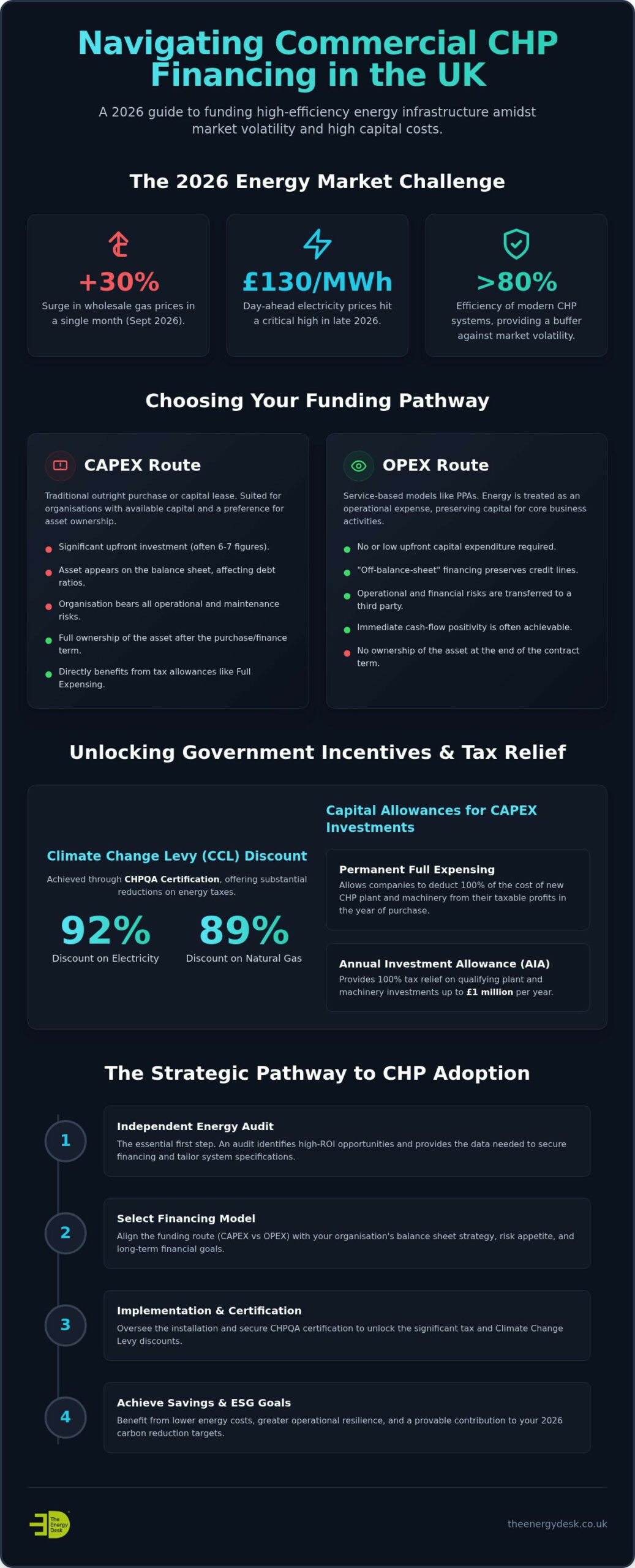
The UK’s energy strategy in 2026 focuses on a dual-track approach: grid decarbonisation and industrial efficiency. While the national grid continues to green, Combined Heat and Power (CHP) remains a cornerstone for sectors with high thermal demand. Modern systems achieve efficiency ratings over 80%, providing a critical buffer against the extreme volatility of the external market. In late 2026, day-ahead electricity prices hit £130/MWh, whilst gas reached 170p/therm. This price environment makes onsite generation not just an environmental choice but a vital fiscal necessity for energy-intensive industries.
The Business Case for Onsite Generation
Relying solely on the National Grid exposes your operations to peak-time charges and transmission costs that continue to rise. By generating power at the point of use, you bypass these levies and secure your industrial processes against grid instability. This decentralised approach is vital for maintaining uptime in manufacturing, food processing, or healthcare settings. Beyond immediate cost control, onsite generation directly supports corporate ESG targets by maximising the primary energy value of every therm of gas consumed. It’s a pragmatic way to bridge the gap between current operational needs and 2026 carbon reduction targets.
Identifying the CAPEX Challenge
Commercial-grade units require a level of investment that can often reach six or seven figures. For many UK organisations, committing this much liquidity to a single project is difficult when capital is needed for core expansion. High upfront costs often sit heavy on corporate balance sheets, affecting credit ratings and debt-to-equity ratios. It’s why “off-balance-sheet” solutions, such as Discount Energy Purchase (DEP) models, have become the preferred choice for UK Finance Directors. These structures allow you to treat energy as an operational expense rather than a capital burden, preserving your cash for other areas of the business.
Securing the right commercial CHP system financing UK involves balancing these high upfront costs against the guaranteed long-term savings. With typical payback periods sitting between one and three years, the financial logic remains robust, even in a high-interest environment. However, the route to procurement has evolved. The focus has shifted from outright ownership to service-led models that align monthly repayments with the actual energy savings achieved. This evolution ensures that infrastructure modernisation doesn’t compromise your operational cash flow or hinder other strategic investments. By choosing a flexible funding route, you can insulate your business from market shocks whilst upgrading your utility infrastructure for the long term.
Primary Financing Models for UK CHP Systems
Selecting the right structure for commercial CHP system financing UK requires a deep understanding of your organisation’s long-term utility strategy. You must align the finance term with the unit’s operational lifespan, which typically spans 10 to 15 years. This ensures the equipment pays for itself multiple times over before replacement is required. Given that the typical payback period for a CHP system is between one and three years, the choice of model often comes down to how you prefer to manage your balance sheet and operational risk.
Asset Finance and Lease Purchase
Hire purchase and leasing provide a clear path to equipment use without the immediate cash drain of a full purchase. Lease purchase allows you to treat the unit as a capital asset whilst spreading costs over several years. It’s helpful to check the latest UK Government Incentives for CHP to see how these capital investments interact with current tax relief schemes. Repayments can often be structured to mirror your facility’s seasonal energy consumption. This means higher payments coincide with periods of maximum energy savings, keeping your cash flow predictable. While this route involves more balance sheet visibility than a service-based contract, the eventual ownership of the asset can offer superior long-term financial returns once the finance term concludes.
Power Purchase Agreements (PPA) and ESAs
For firms prioritising risk mitigation, the Energy Services Agreement (ESA) is a highly effective “pay-as-you-save” model. In this scenario, a third-party provider funds, installs, and maintains the plant. You simply buy the heat and power generated at a pre-agreed rate through a Power Purchase Agreement (PPA). This rate is typically set significantly lower than standard grid tariffs, providing immediate, guaranteed savings from day one.
The primary advantage here is the total transfer of operational and financial risk. If the system stops generating, the provider loses revenue, not you. This creates a strong incentive for the third party to ensure maximum uptime and efficiency through proactive maintenance. It’s an ideal route for organisations that don’t want to manage complex utility infrastructure or carry the debt on their books. To see which of these commercial CHP system financing UK options fits your operational profile, you can start with a free energy audit to map out your potential savings. This data-driven approach ensures the chosen model supports your fiscal goals for the next decade.
CAPEX vs OPEX: Which Funding Route Suits Your Organisation?
In the current 2026 fiscal climate, the decision to invest in onsite generation isn’t just a technical one; it’s a fundamental balance sheet strategy. Choosing the right commercial CHP system financing UK model depends on your organisation’s appetite for risk and its long-term capital allocation plans. While interest rates have found a new baseline, the pressure to modernise infrastructure whilst maintaining liquidity remains a primary concern for British Finance Directors. The choice between capital expenditure (CAPEX) and operational expenditure (OPEX) will dictate your facility’s financial agility for the next decade.
When to Choose a CAPEX-Led Approach
A CAPEX-led approach is often the most cost-effective route for organisations with robust cash reserves and a desire for total asset control. By purchasing the system outright, you eliminate the interest margins and service fees associated with third-party funding. In 2026, this route is particularly attractive due to the permanent status of “full expensing” in the UK tax system. This allows companies to deduct 100% of the cost of qualifying plant and machinery from their profits in the year of purchase. Combined with the £1 million Annual Investment Allowance (AIA), the immediate tax relief can significantly offset the initial outlay. If you have a skilled internal engineering team to manage maintenance and oversight, the long-term return on investment (ROI) is typically higher, as you retain 100% of the energy savings from day one.
The Rise of the OPEX-Centred Model
Conversely, the shift towards service-based commercial CHP system financing UK has accelerated as businesses prioritise rapid decarbonisation and capital preservation. An OPEX-centred model, such as an Energy Services Agreement (ESA), allows you to upgrade your utility infrastructure without any upfront cost. This is ideal for firms that need to allocate capital toward core business activities, such as product development or market expansion, rather than energy plant. Under this model, the technical performance risk sits entirely with the provider. If the system fails to meet efficiency benchmarks or requires major repairs, the financial burden doesn’t fall on your business. This risk transfer is increasingly valuable as UK carbon reporting standards tighten, ensuring your facility meets 2026 targets without the operational headache of managing complex machinery.
Calculating the break-even point for your CHP investment requires a holistic view of more than just the hardware. You must factor in the current Climate Change Levy (CCL) rates, which as of April 2026 sit at £0.00801 per kWh for natural gas and electricity. A CAPEX model might reach break-even within 24 to 36 months, whereas an OPEX model provides immediate, albeit smaller, cash-flow positivity. Balancing these factors ensures that your energy strategy supports your broader corporate objectives whilst providing a resilient shield against the ongoing volatility of the UK energy market.
Government Incentives and the UK Regulatory Framework
The landscape for commercial CHP system financing UK has shifted significantly following the closure of the Industrial Energy Transformation Fund (IETF) to new applications in July 2025. With no direct successor fund announced, government support is now primarily delivered through the tax system. This makes understanding capital allowances essential for any board-level investment decision. Full expensing is now a permanent fixture of the UK tax system, allowing companies to deduct 100% of the cost of qualifying new plant and machinery from their profits in the year of purchase. For projects under the £1 million threshold, the Annual Investment Allowance (AIA) provides a similar immediate deduction, whilst a new 40% first-year allowance for main-rate plant and machinery was introduced on 1 January 2026 to further incentivise infrastructure modernisation.
The Importance of CHPQA Certification
The Combined Heat and Power Quality Assurance (CHPQA) scheme remains the definitive benchmark for onsite generation. Certification is not merely a technical badge; it’s the primary mechanism for unlocking substantial fiscal benefits. Without CHPQA accreditation, your system won’t qualify for exemptions from the Climate Change Levy (CCL). As of 1 April 2026, the CCL rate for natural gas and electricity is £0.00801 per kWh. For businesses holding a Climate Change Agreement (CCA), this certification enables a 92% discount for electricity and an 89% discount for natural gas. Commercial lenders often mandate CHPQA status as a condition of finance, as the resulting tax savings significantly improve the project’s cash-flow profile and debt-servicing capacity.
Carbon Reporting and Financial Penalties
Efficient onsite generation is now intrinsically linked to your Streamlined Energy and Carbon Reporting (SECR) performance. By generating power at the point of use, you reduce your organisation’s Scope 2 emissions, which directly influences the “green” financing rates available from modern lenders. In 2026, financial institutions increasingly offer preferential interest rates to projects that can provide verified carbon reduction data. Conversely, failing to modernise inefficient utilities leaves your business exposed to rising carbon taxes and the financial penalties of non-compliance. Integrating a high-efficiency CHP system ensures your facility remains compliant with 2026 carbon targets whilst providing a transparent audit trail for your ESG reporting.
Maximising these incentives requires a precise understanding of how current regulations intersect with your specific energy profile. To ensure your project captures every available tax break and discount, you can book a free energy audit to build a data-backed business case. This methodical assessment is the first step in securing a financing package that aligns with the latest UK regulatory standards.
Securing Your CHP System with The Energy Desk
Identifying the right route for commercial CHP system financing UK requires more than just a list of lenders; it requires a deep technical understanding of how onsite generation interacts with your specific energy profile. Since 2003, The Energy Desk has operated as an independent consultancy, specialising in bridging the gap between complex engineering requirements and robust financial procurement. We don’t just provide a list of options. We act as a strategic ally, ensuring that the technology you install is perfectly scaled to deliver the maximum return on investment for your facility.
Our process begins with a free, comprehensive energy audit. This isn’t a surface-level estimate. It’s a forensic analysis of your half-hourly data, thermal requirements, and current procurement contracts. This data forms the foundation of a business case that commercial lenders can trust. By presenting a verified savings profile, we help you secure more favourable finance terms, whether you’re pursuing a CAPEX-heavy purchase or a risk-free Energy-as-a-Service model. We ensure the financial structure reflects the technical reality of your site.
From Audit to Installation: Our Process
Moving from a data-backed proposal to a live system involves complex logistical oversight. Our team manages the entire transition, including the critical negotiation of utility connections and the setup of MOP contracts. We coordinate with internal engineering teams and external providers to ensure the physical installation integrates seamlessly with your existing infrastructure. This methodical approach reduces the risk of operational downtime and ensures that your system begins generating savings from the moment it’s commissioned. We take responsibility for the technical design and the financial procurement, allowing your board to focus on core business growth.
Ongoing Management and Bill Validation
Securing the finance is only the first step; maintaining the performance of the asset is what ensures long-term fiscal success. We provide an integrated bill validation service that cross-references your CHP’s output with your energy invoices. This verifies that the projected savings are actually being realised and identifies any discrepancies in supplier charges. Our independent status means we aren’t tied to a single manufacturer or supplier, which allows us to provide unbiased, data-driven insights to optimise your system’s performance.
We continue to manage your relationship with energy suppliers, overseeing DC/DA services and ensuring your facility remains compliant with the latest carbon reporting standards. This level of oversight is essential for protecting your investment and ensuring your commercial CHP system financing UK remains cash-flow positive throughout the entire term of the agreement. Our focus is on precision, stability, and the long-term management of your utility costs.
Future-Proofing Your Industrial Energy Strategy
Transitioning to high-efficiency onsite generation is a strategic move to insulate your business from the ongoing volatility of the UK energy market. By selecting the most appropriate commercial CHP system financing UK model, you can balance the immediate tax benefits of permanent full expensing against the risk-free appeal of service-led agreements. Whether your board prioritises total asset ownership or operational flexibility, the 2026 regulatory landscape provides a clear path for those ready to modernise their utility infrastructure.
Success in this complex market requires a partner who understands both the engineering requirements and the economic drivers of energy. Since 2003, The Energy Desk has operated as an independent specialist, offering the expertise needed to manage everything from initial infrastructure design to comprehensive bill validation. We ensure your system delivers its promised ROI through forensic data analysis and methodical procurement management. Request your free energy audit from The Energy Desk today to begin building a robust, data-backed business case for your facility. Taking this proactive step ensures your organisation remains resilient, compliant, and cost-efficient for the decade ahead.
Frequently Asked Questions
What is the most popular way to finance a commercial CHP system in the UK?
The most common routes for commercial CHP system financing UK are asset finance and Energy Services Agreements (ESAs). Asset finance appeals to firms wanting eventual ownership and tax benefits, whilst ESAs are favoured for total risk transfer. Both models allow businesses to align repayments with the energy savings generated. This ensures the project is cash-flow positive from the outset, making it a sustainable choice for industrial infrastructure.
Can I get a CHP system with zero upfront capital expenditure?
You can secure a high-efficiency system with zero upfront capital expenditure through a Discount Energy Purchase (DEP) or a Power Purchase Agreement (PPA). In these service-based models, a third-party provider funds the entire installation and commissioning process at their own expense. You simply pay for the heat and electricity generated at a pre-agreed rate. This approach is ideal for organisations that prefer to keep capital available for core business operations.
How does a Power Purchase Agreement (PPA) work for onsite CHP?
A Power Purchase Agreement for onsite CHP involves a third-party provider owning and maintaining the equipment on your site. You agree to purchase the electricity and heat it produces at a fixed, discounted price for a set term, usually 10 to 15 years. This model eliminates the technical risk for your business. If the system doesn’t perform as expected, you don’t pay for the energy you haven’t received.
Are there any government grants available for CHP systems in 2026?
There are no direct government grants available for new CHP projects in 2026 following the closure of the Industrial Energy Transformation Fund (IETF) in July 2025. Support has shifted to tax-based incentives. Businesses can now utilise permanent full expensing or the £1 million Annual Investment Allowance to deduct costs from taxable profits. These mechanisms provide significant financial relief for organisations pursuing a CAPEX-led approach to energy infrastructure.
What is the typical ROI period for a commercial CHP system?
The typical payback period for a commercial CHP system currently ranges between one and three years. This rapid ROI is driven by the significant efficiency gains of cogeneration, which can reduce total energy costs by up to 40%. The exact timeline depends on your facility’s thermal demand and current grid tariffs. Conducting a free energy audit is the most accurate way to calculate the specific break-even point for your site.
How does CHPQA certification affect my financing options?
CHPQA certification is a critical factor in commercial CHP system financing UK because it validates the system’s efficiency. This certification unlocks exemptions from the Climate Change Levy (CCL), which as of April 2026 is £0.00801 per kWh for gas and electricity. Lenders view certified projects as lower risk because the tax savings improve the project’s debt-coverage ratio, often leading to more competitive interest rates and better lending terms.
What happens to the maintenance costs in a financed CHP agreement?
Maintenance responsibilities depend entirely on the chosen financing structure. In a CAPEX or hire purchase model, the business is typically responsible for ongoing operational costs and repairs. Conversely, in a PPA or ESA, the third-party provider covers all maintenance, monitoring, and parts. This total transfer of operational risk ensures the provider is incentivised to maintain maximum system uptime to protect their own revenue stream from energy sales.
Can I integrate solar PV with my CHP financing package?
You can certainly integrate solar PV into a broader energy financing package. Many UK businesses now opt for multi-technology solutions that combine CHP with solar and EV charging infrastructure to maximise decarbonisation. Financing providers often prefer these integrated projects as they offer a more resilient energy profile. We can help you design a hybrid system that balances consistent CHP output with the variable generation of onsite solar assets.