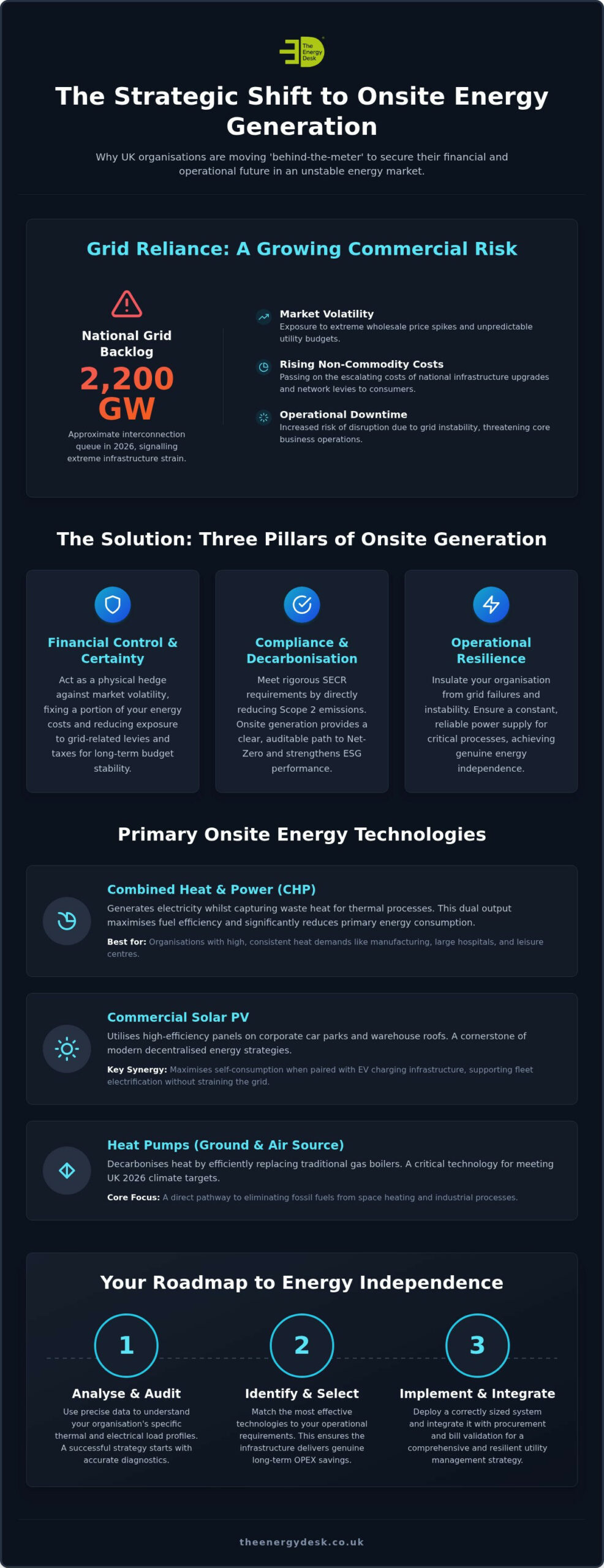
What if your organisation’s most significant operational risk wasn’t market competition, but the very cable connecting your facility to the national grid? Most directors agree that the era of cheap, predictable utility costs is over. With the national interconnection backlog reaching approximately 2,200 GW in 2026, relying solely on external infrastructure has become a precarious gamble. This is why onsite energy generation for companies has transitioned from a sustainability “nice-to-have” to a core financial hedge.
You don’t have to remain at the mercy of unpredictable price hikes or the fear of operational downtime. By developing a bespoke onsite strategy, you can insulate your organisation from grid volatility whilst simultaneously meeting rigorous SECR reporting requirements. This guide explores how a methodical combination of professional procurement and infrastructure, such as CHP systems or solar solutions, delivers long-term price certainty and genuine energy independence. We will outline the strategic steps required to achieve a net-zero future without compromising your fiscal responsibility or operational resilience in an increasingly unstable energy market.
Key Takeaways
- Understand why onsite energy generation for companies has evolved into a critical financial hedge against grid volatility and the escalating costs of carbon in 2026.
- Identify the most effective technologies for your facility, from Solar Solutions to CHP systems, by matching infrastructure to your specific thermal and electrical loads.
- Analyse the shift from CAPEX to long-term OPEX savings and learn how generating your own power fundamentally improves your commercial electricity procurement position.
- Implement a strategic roadmap that uses precise data to ensure your energy system is sized correctly for your actual operational requirements.
- Recognise the value of an independent consultancy that integrates procurement, bill validation, and generation to provide a comprehensive utility management strategy.
The Case for Onsite Energy Generation for Companies in 2026
Onsite energy generation for companies refers to the deployment of decentralised power assets directly at the point of consumption. It’s energy produced where it’s used. In 2026, this approach is frequently discussed within a Distributed Generation Overview, where power is generated locally rather than transmitted across vast distances from central plants. This shift is essential for controlling overheads as grid instability and carbon pricing become central business risks.
The current energy landscape is defined by extreme wholesale market fluctuations. For most UK organisations, the transition from viewing onsite power as a sustainability project to a mandatory financial risk management strategy is now complete. By generating power “behind-the-meter”, businesses bypass large sections of the transmission network. This directly reduces standing charges and avoids the escalating costs associated with national infrastructure upgrades that are passed on to consumers.
Mitigating Grid Volatility and Non-Commodity Costs
Grid-supplied energy exposes your organisation to the full force of wholesale market spikes. Onsite assets provide a physical hedge. They allow companies to fix a portion of their energy costs based on the technology’s lifecycle rather than the daily market rate. This strategy is particularly effective at reducing grid-related levies, including peak-time penalties and Triad charges. Non-commodity costs are the portion of the energy bill not related to raw energy usage. By generating power onsite, you effectively shrink the volume of energy subject to these additional taxes and network maintenance fees. It’s a methodical way to reclaim control over your utility budget.
Decarbonisation and Corporate Compliance
Corporate responsibility carries a legal weight that didn’t exist in previous years. Under Streamlined Energy and Carbon Reporting (SECR), organisations must disclose their energy use and carbon emissions with absolute precision. Reducing Scope 2 emissions, which are the indirect emissions from purchased electricity, is a priority for stakeholders who demand transparent ESG performance. Transitioning to onsite energy generation for companies helps solidify the business case for commercial renewable energy UK by providing a clear, auditable path to net-zero. It turns a compliance burden into a competitive advantage. This proactive approach to resource management resonates with investors and clients who value long-term stability over quick fixes.
Primary Technologies for Commercial Onsite Power
Selecting the right mix for onsite energy generation for companies requires a disciplined analysis of your specific load profiles. In 2026, the industry standard has moved toward microgrids. These integrated systems combine multiple generation sources with battery storage to ensure constant resilience and optimise cost-efficiency. This ensures your facility remains operational even during grid instability whilst reducing your reliance on expensive peak-time imports.
Combined Heat and Power (CHP) for Industrial Use
For organisations with high, consistent heat demands, CHP systems are often the most efficient choice. They generate electricity whilst capturing waste heat to provide thermal energy for industrial processes or space heating. This technology is particularly effective for manufacturers, leisure centres, and large hospitals. For a more technical breakdown, consult our Combined Heat and Power (CHP) UK guide. It outlines how these systems can significantly reduce your primary fuel consumption by utilising energy that would otherwise be lost to the atmosphere.
Commercial Solar PV and EV Infrastructure
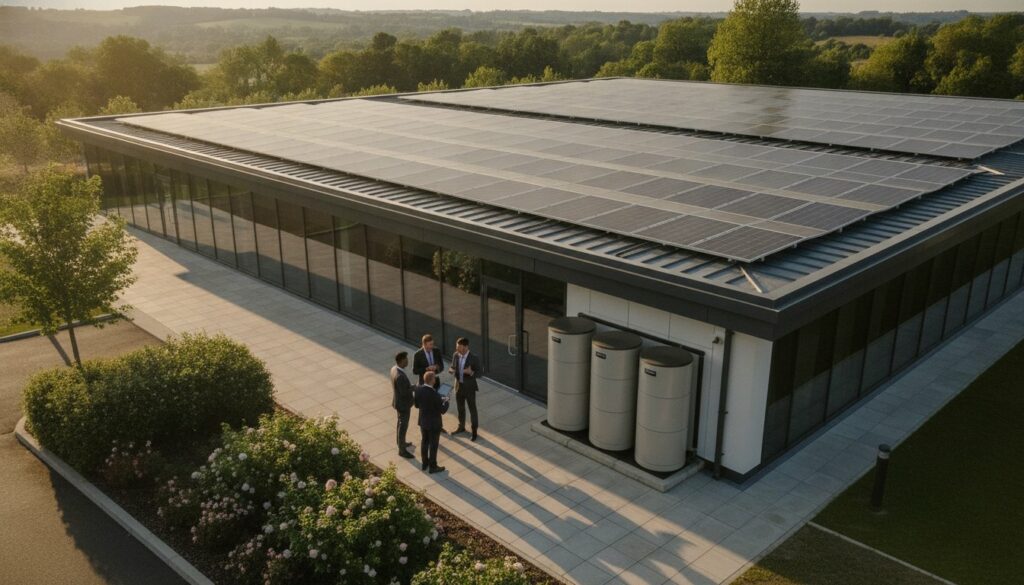
Commercial Solar PV remains a cornerstone of onsite energy generation for companies. Modern panels offer higher conversion efficiency, making corporate car parks and warehouse roofs prime real estate for generation. The synergy between solar and EV infrastructure is significant. By using onsite power to fuel business EV charging networks, you maximise self-consumption. This avoids the lower financial returns of exporting excess energy to the National Grid and supports the growing electrification of your corporate fleet without straining your existing grid connection.
Heat Pumps and Energy Efficiency Tech
Decarbonising heat is a critical priority for 2026. Ground and air source heat pumps are increasingly replacing traditional gas boilers in commercial settings as part of broader net-zero transitions. However, hardware is only part of the solution. Methodical energy efficiency audits and smart sensors must identify waste before any generation assets are installed. This proactive approach ensures you don’t over-specify expensive hardware for energy that shouldn’t be consumed in the first place. Conducting a professional energy audit is the first step in sizing these systems correctly to match your actual operational needs.
Financial Feasibility and Grid Integration Strategies
Evaluating the financial viability of onsite energy generation for companies requires a shift from simple payback calculations to a comprehensive lifecycle analysis. In 2026, the primary focus is balancing initial capital expenditure (CAPEX) against long-term operational expenditure (OPEX) reductions. Whilst hardware costs for battery storage and solar components have stabilised, the true return on investment (ROI) is found in the avoided costs of grid volatility and carbon levies. A strategic approach ensures that these assets serve as a physical hedge against market instability.
A critical, often overlooked factor is how onsite assets alter your profile for business electricity procurement. If your organisation installs significant generation capacity without reviewing its supply contract, you risk triggering ‘Take or Pay’ clauses. These contractual obligations force you to pay for a minimum volume of grid energy even if your onsite assets produce enough to cover your needs. Integrating generation into your commercial energy risk management strategy ensures that your physical assets and your financial contracts work in tandem rather than in opposition.
Synchronising Generation with Procurement
Installing onsite power doesn’t eliminate the need for the grid; it changes the nature of the relationship. You must manage the ‘residual load’, which is the remaining power required from the grid when your onsite assets aren’t producing at peak capacity. Failing to synchronise these elements can leave you exposed to punitive out of contract energy rates if your usage patterns change so drastically that your current supplier terminates the agreement. Proactive renegotiation allows you to secure better terms for the smaller, more volatile volume of energy you still need to purchase.
Funding and Incentives for UK Organisations
UK organisations can leverage various tax incentives, including capital allowances for energy-saving plant and machinery, to offset the initial costs of infrastructure. For companies preferring to avoid upfront CAPEX, Power Purchase Agreements (PPAs) and ‘Generation as a Service’ models offer a route to onsite energy generation for companies with zero initial investment. Virtual power plants enable companies to aggregate their distributed assets and trade excess capacity back to the grid during peak demand windows. These models turn a cost centre into a revenue-generating asset whilst maintaining your focus on core business operations.
A Strategic Roadmap for Implementation
Implementing onsite energy generation for companies isn’t a simple hardware purchase; it’s a multi-phase infrastructure project. Success depends on a methodical approach that aligns your physical assets with your actual consumption patterns. Navigating the planning permissions and the Distribution Network Operator (DNO) application process is often the most time-consuming phase. You must secure grid connection agreements early to avoid project delays. Without this foresight, even the most advanced solar or CHP systems can sit idle whilst waiting for regulatory approval.
Step 1: The Forensic Energy Audit
Before choosing hardware, you need a precise map of your organisation’s energy “fingerprint”. This involves analysing half-hourly data to distinguish between your consistent baseload and variable peak demand. Accurate sizing is impossible without this level of detail. It’s also the point where you should perform commercial utility bill validation. Ensuring your historical data is accurate prevents you from specifying a system based on erroneous billing or undetected leaks. You don’t want to build a generation strategy on a foundation of wasted energy.
Step 2 & 3: Feasibility and Technology Selection
Once you understand your demand, compare different technology mixes. A combination of Solar and Heat Pumps might suit an office complex, whereas Solar and CHP could be better for a high-heat manufacturing site. You’ll need a structural assessment for roof-mounted solar and an electrical capacity check to ensure your current switchgear can handle the new load. Your ROI calculation must be comprehensive. It should factor in insurance, ongoing maintenance, and the potential for “Generation as a Service” models to preserve your internal capital.
Step 4 & 5: Procurement Alignment and Installation
Tendering for the installation requires strict adherence to UK safety standards and technical compliance. As the system goes live, you must update your business energy portfolio management strategy. This ensures your grid supply contracts are adjusted to reflect your new, lower import requirements. Final commissioning should include the integration of monitoring software. This provides real-time tracking, allowing you to prove the performance of your assets against your original business case. To begin this process with a professional assessment, you can book a free energy audit with our consultancy team today.
The Energy Desk: Your Strategic Partner in Decentralised Energy
Choosing a partner for onsite energy generation for companies requires a shift in perspective. Many hardware-exclusive vendors focus solely on the sale of a specific asset, such as a solar array or a CHP unit. At The Energy Desk, we operate as an independent consultancy. This means our primary objective isn’t to sell a specific piece of equipment, but to identify the most cost-effective solution for your unique operational profile. Our 20 years of industry experience allow us to look beyond the hardware and analyse how decentralised energy fits into your broader fiscal strategy.
We manage the entire lifecycle of your energy infrastructure. This includes everything from initial feasibility studies and Distribution Network Operator (DNO) applications to the final commissioning of the system. By leveraging our national network of specialised installers and engineers, we ensure that every project meets the highest UK safety and performance standards. You aren’t just buying a system; you’re securing a long-term strategic ally dedicated to your organisation’s energy resilience.
End-to-End Energy Management
A significant risk for many firms is the lack of coordination between their grid supply and their onsite assets. We bridge this gap by managing both your commercial gas and electricity procurement alongside your generation projects. This holistic view ensures that your grid contracts and onsite systems work in harmony rather than creating contractual friction. We also integrate bill validation and data monitoring to confirm that your investment is performing as expected. It’s a partnership built on transparency and continuous optimisation rather than a one-off transaction.
Next Steps for Your Organisation
The journey toward energy independence begins with data. To support UK organisations in this transition, we offer a free, no-obligation energy audit. This forensic review identifies immediate efficiency gains and provides a clear preliminary feasibility discussion for onsite energy generation for companies. Before our consultation, it’s helpful to gather your most recent half-hourly data and any existing supply contracts. This allows our team to provide precise insights tailored to your facility’s specific load requirements. Contact The Energy Desk today to start your onsite generation journey and protect your organisation from the volatility of the national grid.
Securing Your Energy Independence in an Unstable Market
The transition toward decentralised power is no longer just a sustainability objective; it’s a fundamental requirement for operational resilience. By integrating onsite energy generation for companies with a sophisticated procurement strategy, you can insulate your organisation from the volatility of the national grid. Success requires more than just hardware. It demands a forensic understanding of your load profiles and a proactive approach to contract management to ensure your physical assets and financial agreements remain in total alignment.
As an independent UK consultancy established in 2003, The Energy Desk provides the expertise needed to manage complex industrial energy infrastructure. We offer full end-to-end management, from forensic bill validation and strategic procurement to the installation of CHP systems and Solar Solutions. Our methodical approach ensures that every project is sized for maximum efficiency and long-term cost-efficiency. Request your free energy audit from The Energy Desk today to begin optimising your utility strategy. Taking control of your energy future is the most effective way to guarantee stability and achieve your net-zero targets in 2026 and beyond.
Frequently Asked Questions
What are the most cost-effective onsite energy generation options for UK companies?
The most cost-effective onsite energy generation for companies depends on their specific utility profile. Commercial Solar PV is highly effective for organisations with significant roof space and daytime electricity demand. Combined Heat and Power (CHP) systems offer exceptional value for industrial sites, hospitals, and leisure centres that require consistent thermal energy. By capturing waste heat, CHP provides a dual benefit that traditional grid supply cannot match.
How much can a business save by generating its own energy onsite?
Savings vary based on your organisation’s consumption patterns and the chosen technology mix. Most companies reduce their electricity import costs by 20% to 50% through onsite assets. Beyond the raw energy cost, you also avoid significant non-commodity charges, such as transmission and distribution fees. These levies often account for a substantial portion of a commercial bill, making onsite generation a powerful tool for long-term fiscal control.
Do we need planning permission for commercial solar panels or CHP units in the UK?
Many commercial solar installations fall under permitted development rights, meaning full planning permission isn’t always required. However, there are exceptions for listed buildings, conservation areas, or systems that exceed specific size thresholds. CHP units may require planning approval depending on their location and any external flue requirements. It’s essential to conduct a professional feasibility study to confirm the specific regulatory requirements for your site before commencing work.
Can we sell excess energy generated onsite back to the National Grid?
Organisations can sell surplus electricity back to the National Grid through mechanisms like the Smart Export Guarantee (SEG). For larger installations, entering into a Power Purchase Agreement (PPA) with an energy supplier or another corporate entity often provides a better financial return. This allows you to monetise your excess capacity whilst supporting the wider grid’s stability during peak demand periods, turning a utility cost into a potential revenue stream.
How long does it typically take to see a return on investment (ROI) for onsite generation?
The payback period for onsite energy generation for companies typically ranges between five and ten years, though this timeframe is shortening as grid prices remain volatile. Factors such as available tax incentives, capital allowances, and the specific technology utilised will influence the final ROI. Utilising “Generation as a Service” or PPA models can also eliminate the need for upfront capital, allowing your organisation to see immediate operational savings from day one.
What happens to our onsite energy supply during a grid power cut?
Most grid-connected systems will automatically shut down during a power cut to protect engineers working on the lines. To maintain supply during an outage, your system must be configured for “island mode” and integrated with battery storage. This setup allows your facility to operate independently of the national grid, providing the operational resilience necessary to prevent costly downtime during periods of grid instability or local network failures.
How does onsite generation affect our existing business energy contracts?
Onsite generation will fundamentally change your import profile, which can impact your existing supply agreements. If your usage drops significantly, you might trigger “Take or Pay” clauses or volume tolerance penalties in your current contract. It’s vital to align your procurement strategy with your generation project. Our consultancy team specialises in renegotiating these contracts to ensure your grid supply remains cost-effective alongside your new onsite assets.
Is onsite energy generation suitable for companies that rent their premises?
Tenant companies can still benefit from onsite power through collaborative agreements with their landlords. “Generation as a Service” models allow for the installation of equipment with zero upfront cost to either party, with the tenant paying for the generated power at a lower rate than the grid. Landlords often see the value in installing solar or CHP systems to increase the property’s EPC rating and attractiveness to future high-value commercial tenants.