


If your facility is still relying solely on the national grid while wholesale gas prices have climbed by 30% in a single month, are you actually in control of your production margins? Understanding the full range of CHP system benefits for manufacturing is no longer optional for those facing volatile prices and strict SECR carbon reporting requirements. You likely feel the constant pressure of rising costs impacting your bottom line, alongside the risk of grid reliability issues causing unexpected downtime. It’s an environment where traditional energy procurement is no longer enough to maintain a competitive edge.
This strategic guide will show you how to transform your facility’s energy efficiency, slash primary energy spend, and secure a clear path to industrial decarbonisation. We’ll examine the latest 2026 fiscal incentives, such as the British Industry Supercharger and updated CHPQA standards, to show you how to improve energy resilience. By the end of this article, you’ll have a professional roadmap for utility management. We’ll cover everything from initial energy audits to the practical application of high-efficiency cogeneration in a modern manufacturing setting.
Key Takeaways
- Learn why cogeneration is essential in the 2026 energy landscape to mitigate the impact of volatile wholesale gas and electricity prices on industrial margins.
- Understand the mechanical efficiency of industrial CHP units and how optimising your facility’s heat-to-power ratio can significantly reduce primary energy consumption.
- Explore the direct CHP system benefits for manufacturing, including typical primary energy cost reductions of 20-30% and enhanced protection against grid-based brownouts.
- Discover how integrated energy systems simplify compliance with SECR and ESOS reporting requirements whilst securing a clear roadmap for industrial decarbonisation.
- Find out why a comprehensive energy audit and ongoing bill validation are critical first steps to ensuring your CHP investment delivers maximum ROI.
The Manufacturing Energy Crisis: Why CHP is Essential in 2026
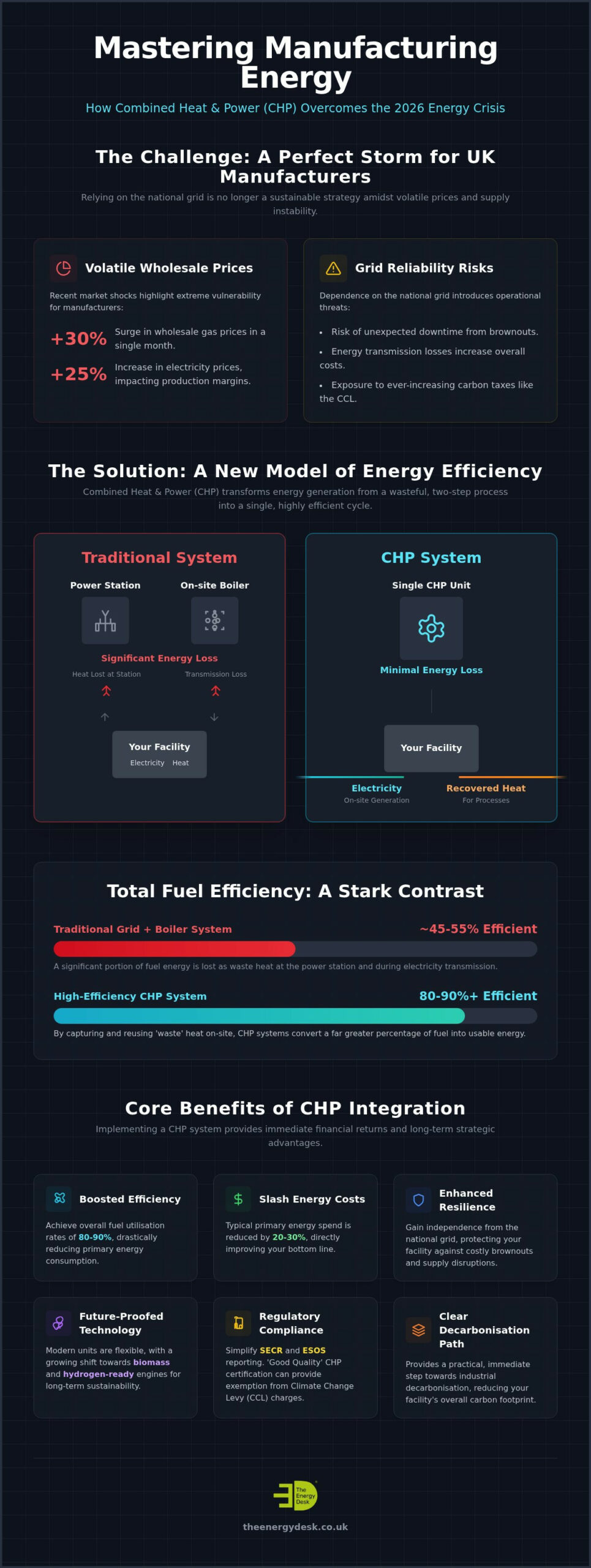
UK manufacturers are currently facing a perfect storm of energy volatility. By September 2026, wholesale gas prices surged by 30% within a single month, whilst electricity prices followed with a 25% increase. These fluctuations aren’t just minor overheads; they’re direct threats to production margins. Relying solely on the national grid and traditional boiler systems leaves your facility vulnerable to price spikes and potential supply instability. Transitioning to a decentralised energy model is no longer a luxury for the forward-thinking; it’s a strategic necessity for survival.
What is a CHP System for Manufacturing?
At its core, What is Cogeneration (CHP)? It’s the simultaneous production of electricity and useful thermal energy from a single fuel source. In a standard manufacturing setup, electricity is bought from the grid and heat is generated by separate boilers. This is inherently wasteful, as power stations typically vent huge amounts of heat into the atmosphere. A CHP unit reverses this logic by capturing that ‘waste heat’ and repurposing it for industrial processes, space heating, or steam production. One of the primary CHP system benefits for manufacturing is this dramatic leap in thermal efficiency, often reaching overall fuel utilisation rates of 80% to 90%.
Modern units are also designed with future-proofing in mind. Whilst many plants currently utilise gas-fired engines, there’s a growing shift toward biomass and hydrogen-ready units. This flexibility allows businesses to maintain operational resilience whilst preparing for tighter carbon regulations. By generating power at the point of use, you eliminate the transmission losses associated with the national grid and gain a level of energy independence that is vital in the current economic climate.
The Cost of Inefficiency in Modern Production
Traditional grid-plus-boiler setups are becoming financially unviable for heat-intensive plants. The ‘spark spread’, which is the difference between the price of electricity and the cost of the gas used to generate it, remains a critical metric for industrial profitability. With day-ahead electricity prices trading at £130/MWh and gas at 170p/therm in late 2026, the case for on-site generation is stronger than ever. If you continue to use gas only for heat whilst paying a premium for grid electricity, you’re essentially paying twice for your energy needs.
The CHP system benefits for manufacturing extend beyond simple unit costs. Inefficient systems also attract higher Climate Change Levy (CCL) charges. As of April 2026, CCL rates for both gas and electricity have aligned at 0.801p per kWh. Without the exemptions provided by ‘Good Quality’ CHP certification via the CHPQA programme, these taxes add a significant burden to your annual spend. Moving away from standalone boilers to an integrated cogeneration strategy is the most direct way to reclaim these lost margins and protect your facility from the ongoing energy crisis.
How CHP Systems Maximise Industrial Efficiency
Modern industrial efficiency is defined by how effectively a facility uses every unit of fuel. In a standard setup, heat and power are treated as separate streams, leading to significant energy rejection. One of the primary CHP system benefits for manufacturing is the ability to unify these streams through a mechanical process that turns waste into a resource. By integrating a cogeneration unit directly into your production line, you can achieve total system efficiencies that far surpass the capabilities of the national grid.
The Cogeneration Process: From Fuel to Finished Product
The heart of any industrial CHP unit is the prime mover, typically a high-performance reciprocating engine or a gas turbine. As the prime mover burns fuel to generate mechanical energy, an alternator converts this into electricity for your plant. Simultaneously, heat exchangers recover thermal energy from the engine’s exhaust gases and cooling circuits. This captured heat is then transferred to your facility as steam or hot water, providing the thermal energy required for processes like pasteurisation, drying, or chemical reactions. According to the U.S. Department of Energy on CHP, these systems can reach efficiencies of 65% to 75%, though modern UK installations often exceed 80% through advanced recovery techniques.
For sectors with cooling requirements, such as food production or pharmaceuticals, tri-generation offers an even more sophisticated solution. By adding an absorption chiller to the circuit, the system uses the recovered heat to produce chilled water. This modular approach allows businesses to scale their energy infrastructure as production demand grows, ensuring the system remains an asset rather than a fixed limitation.
Matching System Capacity to Manufacturing Demand
The success of a CHP installation depends on the ‘heat-to-power’ ratio, which is the relationship between the thermal and electrical energy your plant consumes. To maximise ROI, the system must be sized for ‘baseload’ matching. This ensures the unit runs at a consistent, high output for the maximum number of hours per year. If your heat demand fluctuates, thermal storage tanks can act as a buffer, storing excess hot water for use during peak production periods. This prevents the system from cycling on and off, which maintains mechanical longevity and peak efficiency.
High-Efficiency Cogeneration is defined as a cogeneration process that provides primary energy savings of at least 10% compared with the references for separate production of heat and electricity. Meeting this standard is essential for accessing fiscal incentives and ensuring your facility meets 2026 environmental benchmarks. To determine the ideal capacity for your site, it’s advisable to request a professional energy audit to map your current consumption profiles against potential savings.
The Core Benefits: Financial Savings and Operational Resilience
The most immediate fiscal advantage of cogeneration is the direct reduction in operational overheads. CHP system benefits for manufacturing are most visible in the bottom line, where facilities typically see a primary energy cost reduction of 20% to 30%. This isn’t just about fuel efficiency; it’s about bypassing the expensive network charges that characterise standard energy bills. By generating power at the point of use, you reclaim control over your facility’s financial health.
Direct Financial Impact and ROI
On-site generation significantly reduces your dependency on traditional business electricity procurement. When you produce your own power, you avoid various non-commodity costs, such as Transmission Network Use of System (TNUoS) and Distribution Use of System (DUoS) charges. These fees have risen steadily, making grid-supplied power increasingly expensive for heavy industry. For high-utilisation manufacturing sites, these ‘avoided costs’ lead to exceptionally short payback periods. Most plants find that the capital investment is recovered through operational savings within three to five years, depending on the specific spark spread and heat demand.
Peak shaving provides an additional layer of protection. During periods of high tariff rates or grid stress, your CHP unit can increase output to offset the need for expensive grid power. This proactive management protects you from the pricing volatility discussed in earlier sections and ensures that production remains profitable even when energy markets are at their most erratic.
Operational Security in an Uncertain Grid
Reliability is paramount in an era of increasing grid instability. Brownouts and voltage fluctuations are growing concerns for UK manufacturers in 2026, often leading to ruined batches and equipment damage. A correctly configured CHP system provides a vital standby power capability. If the national grid fails, your system can continue to support critical processes, preventing the catastrophic costs associated with production downtime. According to the Combined Heat and Power Alliance, this resilience is a cornerstone of modern industrial strategy, ensuring that your plant remains operational whilst others are forced to halt.
Environmental and social governance (ESG) ratings also benefit from this transition. Cogeneration lowers your facility’s total carbon footprint by using fuel more effectively than separate heat and power sources. This improved efficiency is a major asset for SECR compliance and enhances your standing with investors who prioritise sustainable manufacturing practices. It’s a strategic move that secures both your immediate cash flow and your long-term site viability.
Navigating Implementation: Compliance and UK Regulations
Compliance in 2026 requires more than just meeting minimum environmental standards; it demands a proactive approach to reporting and efficiency. As the UK moves closer to its interim carbon targets, manufacturing leaders must navigate a complex landscape of mandatory schemes. One of the significant CHP system benefits for manufacturing is how it simplifies this regulatory burden by providing a clear, measurable path to lower emissions. When your facility generates its own power, you’re not just saving money; you’re securing the data needed to satisfy increasingly stringent government audits.
The Role of CHP in Carbon Reporting
High-efficiency CHP systems displace carbon-intensive grid electricity, which directly lowers your Scope 2 emissions figures. This is a critical advantage for businesses subject to Streamlined Energy and Carbon Reporting (SECR). By producing electricity on-site and capturing waste heat, you reduce the total primary energy required for your processes. This efficiency is also a major asset during Energy Savings Opportunity Scheme (ESOS) audits, where CHP often serves as the primary recommendation for industrial heat users.
Tracking these improvements requires precision. Implementing commercial utility bill validation ensures your reported carbon reductions match your actual consumption data. To maintain compliance, manufacturing leaders should follow this regulatory readiness checklist:
- Register for the updated CHPQA portal hosted on GOV.UK as of March 2026.
- Ensure your system meets ‘Good Quality’ certification to remain eligible for Climate Change Levy (CCL) exemptions.
- Verify eligibility for the British Industrial Competitiveness Scheme (BICS) following its October 2026 launch.
- Align your energy data with the latest SECR reporting templates to avoid penalties.
Future-Proofing with Renewable Fuels
The transition toward Net Zero 2050 has led to a shift in how industrial energy infrastructure is designed. Modern CHP units are no longer restricted to natural gas. Many are now ‘Hydrogen-Ready’, capable of running on hydrogen blends or switching entirely to biomethane as these fuels become more accessible. This flexibility allows you to invest in infrastructure today whilst retaining the ability to decarbonise further as the UK gas grid evolves. By choosing a fuel-flexible prime mover, you protect your facility against the risk of stranded assets and ensure long-term operational viability.
If you’re unsure how these regulations impact your specific site, it’s essential to consult with a specialist who understands the 2026 landscape. You can contact The Energy Desk to arrange a comprehensive regulatory audit and explore how a tailored CHP solution fits your wider energy procurement strategy.
Strategic CHP Integration with The Energy Desk
Successfully implementing a cogeneration project requires more than just technical installation; it demands a strategic alignment with your facility’s long-term operational goals. To unlock the full CHP system benefits for manufacturing, you must treat on-site generation as a core component of your wider utility strategy. The Energy Desk provides the end-to-end expertise required to transition from a grid-dependent model to a resilient, decentralised energy centre. Since 2003, we’ve helped UK businesses navigate the complexities of the energy market with a methodical, results-driven approach.
The TED Audit: Identifying the Opportunity
The journey toward energy independence begins with a comprehensive energy audit. Unlike generic assessments, our data-led approach forensically analyses your heat and power profiles to ensure the system is sized for maximum ROI. We don’t just look at your machinery; we scrutinise your existing utility contracts to identify hidden inefficiencies that might undermine your savings. This analytical mindset is essential for justifying the capital expenditure, providing a clear business case based on verified consumption data rather than optimistic estimates.
Our national coverage across the UK allows us to perform these audits with a deep understanding of regional grid constraints and local utility connections. By identifying the precise ‘spark spread’ at your site, we can project accurate payback periods and operational savings. This thoroughness ensures that every piece of information is carefully considered, mirroring a professional consultation that leads to a dependable infrastructure solution.
A Holistic Approach to Energy Management
Working with a specialised consultant offers a distinct advantage over dealing directly with a single-brand manufacturer. Our independence allows us to source the best technology for your specific needs whilst integrating it into a wider business energy portfolio management plan. This holistic view ensures your CHP unit works in synergy with other solutions, such as commercial gas procurement and bill validation, to create a balanced and cost-effective energy mix. It’s about building a suite of services that work together to protect your bottom line.
Post-installation, we maintain a proactive role in your energy oversight. Through continuous monitoring and performance tracking, we ensure that the predicted savings are actually realised and accurately reported for SECR and ESOS compliance. Our approach to CHP system installation for businesses is designed to provide stability and fiscal responsibility for the long term. If you’re ready to secure your production margins against the market volatility of 2026, Contact The Energy Desk for a free energy audit today.
Securing Your Production Future with On-site Generation
The 2026 energy landscape demands a shift from passive procurement to active on-site generation. By integrating cogeneration into your facility, you gain more than just immediate cost savings; you establish a strategic hedge against the market volatility that has recently seen wholesale gas prices surge. The CHP system benefits for manufacturing extend across your entire operation, from improving grid resilience to simplifying the complex data requirements of SECR and ESOS compliance.
The Energy Desk has operated as an independent energy consultancy since 2003, providing national coverage and technical expertise for industrial sectors. Our methodical approach ensures that your infrastructure investment is backed by forensic auditing and long-term management. To determine how cogeneration can protect your margins and advance your decarbonisation roadmap, request your free energy audit from The Energy Desk today. Transitioning to a decentralised energy model is the most effective way to ensure your facility remains competitive and compliant in an uncertain utility market. We look forward to helping you optimise your industrial energy strategy.
Frequently Asked Questions
What is the typical lifespan of a manufacturing CHP system?
Most industrial CHP systems have an operational lifespan of 10 to 15 years for reciprocating engines and up to 20 years for gas turbines. Achieving these marks requires a disciplined maintenance regime and regular servicing of the prime mover. Ongoing monitoring ensures that mechanical components don’t degrade prematurely under heavy loads. The Energy Desk provides professional management services to oversee this longevity and protect your infrastructure investment.
How much space is required for a commercial CHP installation?
Space requirements vary significantly based on the unit’s electrical and thermal capacity. A small containerised unit might only occupy the footprint of a single parking bay, whereas larger industrial systems require dedicated internal plant rooms or external acoustic enclosures. Modular designs allow for flexible placement near existing utility connections. We assess your site’s physical constraints during our initial energy audit to ensure the system integrates without disrupting your production workflows.
Can a CHP system run on renewable fuels like biomethane?
Yes, modern industrial units are often fuel-flexible and can operate on 100% biomethane or hydrogen blends. This flexibility is a key part of the CHP system benefits for manufacturing as it allows for future-proofing against shifting carbon regulations. Transitioning to renewable fuels helps businesses achieve Net Zero targets whilst maintaining the same high levels of efficiency and on-site resilience as traditional gas-fired units.
Is my manufacturing site suitable for a CHP system?
Suitability depends on having a consistent, simultaneous demand for both heat and electricity. Facilities that operate 24/7 or have high-temperature process requirements, such as food processing or chemical plants, typically offer the best ROI. We use a data-led approach to map your consumption profiles over a 12-month period. If your heat-to-power ratio is balanced and stable, your site is likely an ideal candidate for on-site cogeneration.
How does a CHP system affect my ESOS or SECR reporting?
A high-efficiency CHP system directly reduces your reported Scope 2 emissions by displacing carbon-intensive grid electricity. This improvement is a major asset for SECR compliance and often forms a central recommendation in ESOS audits. Because the system uses fuel more effectively than separate sources, your total carbon footprint decreases. The Energy Desk specialises in aligning these technical savings with your mandatory regulatory reporting to ensure full compliance.
What happens to the CHP system if the national grid goes down?
If your system is configured with ‘island mode’ capability, it can continue to operate independently of the national grid. This provides a vital standby power source for critical manufacturing processes, preventing the catastrophic costs of production downtime. Without this specific configuration, standard units may shut down for safety reasons during a grid failure. We discuss these resilience options during the design phase to protect your long-term operational security.
Does a CHP system replace my existing boiler entirely?
Not usually. A CHP unit is typically sized to meet your ‘baseload’ heat demand, whilst your existing boilers remain as back-up or to provide additional heat during peak periods. This integrated approach ensures you always have a reliable thermal supply. By using the cogeneration unit as the primary heat source, you maximise the CHP system benefits for manufacturing by ensuring the engine runs at peak efficiency for the maximum number of hours.
What is the difference between a CHP system and a standard generator?
A standard generator only produces electricity and vents its waste heat into the atmosphere as an unused byproduct. In contrast, a CHP system captures that thermal energy and repurposes it for your industrial processes or space heating. This makes cogeneration significantly more efficient and cost-effective for daily use. Whilst generators are primarily for emergency backup, a CHP system is a strategic tool for continuous primary energy production and cost management.