
Did you know that failing to renew your utility agreement can inflate your electricity costs by as much as 80% compared to a negotiated fixed-term contract? Many UK organisations are currently paying out of contract energy rates without even realising it, often because they lack the time to decipher complex supplier invoices. It’s frustrating to watch your overheads climb due to punitive pricing structures that offer zero protection against market volatility. You deserve budget certainty for the 2026 financial year, and that starts with regaining control over your procurement strategy.
This guide provides a clear, methodical path to identify these hidden costs and transition to a more stable fiscal position. We’ll show you how to conduct a forensic audit of your current bills and follow a strategic process to secure competitive rates. By the end of this article, you’ll have the professional oversight needed to eliminate waste and ensure your utility management is both efficient and cost-effective. We’ve designed this roadmap to help you secure immediate cost reductions while building a resilient energy strategy for the years ahead.
Key Takeaways
- Identify the critical differences between deemed and out of contract energy rates to avoid paying up to 80% more than a negotiated fixed-term agreement.
- Perform a forensic bill validation to spot warning signs like “Variable Business Rate” or “Standard Variable” that indicate your organisation is being overcharged.
- Follow a strategic 5-step process to terminate punitive terms and collect the consumption records required for a more competitive energy contract.
- Leverage professional procurement oversight to manage renewals proactively and secure budget certainty for the 2026 financial year.
Understanding Out of Contract Energy Rates and Deemed Terms
When a fixed-term business energy agreement expires without a new contract being signed, the supplier moves the account onto default pricing. These are known as out of contract energy rates. While the physical supply of gas or electricity remains unchanged, the fiscal impact is immediate and severe. Suppliers are legally permitted to charge significantly higher prices because they are supplying energy without a committed term or volume forecast from the customer.
One advantage of these terms is the lack of a notice period. Unlike fixed-term contracts that often require 30 to 90 days’ notice to terminate, businesses on default rates can usually switch to a new provider or contract immediately. This flexibility is the only “silver lining” in an otherwise costly situation. It allows for a rapid exit once you identify the issue.
Out of Contract vs. Deemed Rates: What is the Difference?
It’s vital to distinguish between these two terms to understand your legal position. Out of contract rates apply when you have proactively terminated your existing agreement but failed to set up a new one before the end date. Conversely, deemed contracts occur when you move into a new premises and start using energy without ever having signed an agreement with the incumbent supplier. This often happens during site acquisitions or when moving into a new office centre.
In both scenarios, the price premium is substantial. In 2026, research indicates that these rates can be up to 80% higher than standard market rates. This is because the supplier has not hedged energy for your specific needs, leaving them exposed to the daily fluctuations of the wholesale market. Without a contract, the supplier has no guarantee of how long you’ll stay, which increases their operational risk.
Why Suppliers Use Punitive Pricing Models
Suppliers apply these high rates to mitigate the financial risk of “rolling” monthly volume commitments. Without a fixed contract, a supplier cannot accurately predict how much energy they need to purchase in advance. This uncertainty, coupled with the continued market volatility seen throughout 2026, forces providers to pad their default rates to protect their margins. It’s a protective measure for them, but a budget-killer for you.
This pricing structure affects every element of Understanding Your Energy Bill, from the unit price per kilowatt-hour (kWh) to the daily standing charges. For instance, out of contract gas rates in mid-2026 have seen standing charges rise to over £3.40 per day for some businesses. These costs quickly accumulate, making forensic bill validation a priority for any organisation looking to stabilise its utility spend. Proactive management is the only way to avoid these punitive structures.
The Financial Impact: Why Variable Business Rates Cost More
Transitioning from a fixed-term agreement to a Variable Business Rate (VBR) is often a silent transition that carries a heavy price tag. Unlike domestic bills, which benefit from a price cap, business invoices on default terms are fully exposed to market fluctuations. When you analyse an invoice for out of contract energy rates, the most striking change is the disconnect between wholesale market trends and the unit price you are charged. Suppliers often inflate these rates to cover the administrative burden and the risk of providing energy without a volume commitment.
Consider the impact on standing charges. Since 2021, these daily fees have risen steadily as network operators recover costs from previous market failures. On a standard contract, these might be manageable; however, on default terms, they can escalate significantly. For example, June 2026 data shows out-of-contract gas standing charges averaging £3.41 per day, a cost that erodes the profit margins of SMEs and large industrial sites amongst the UK’s competitive landscape.
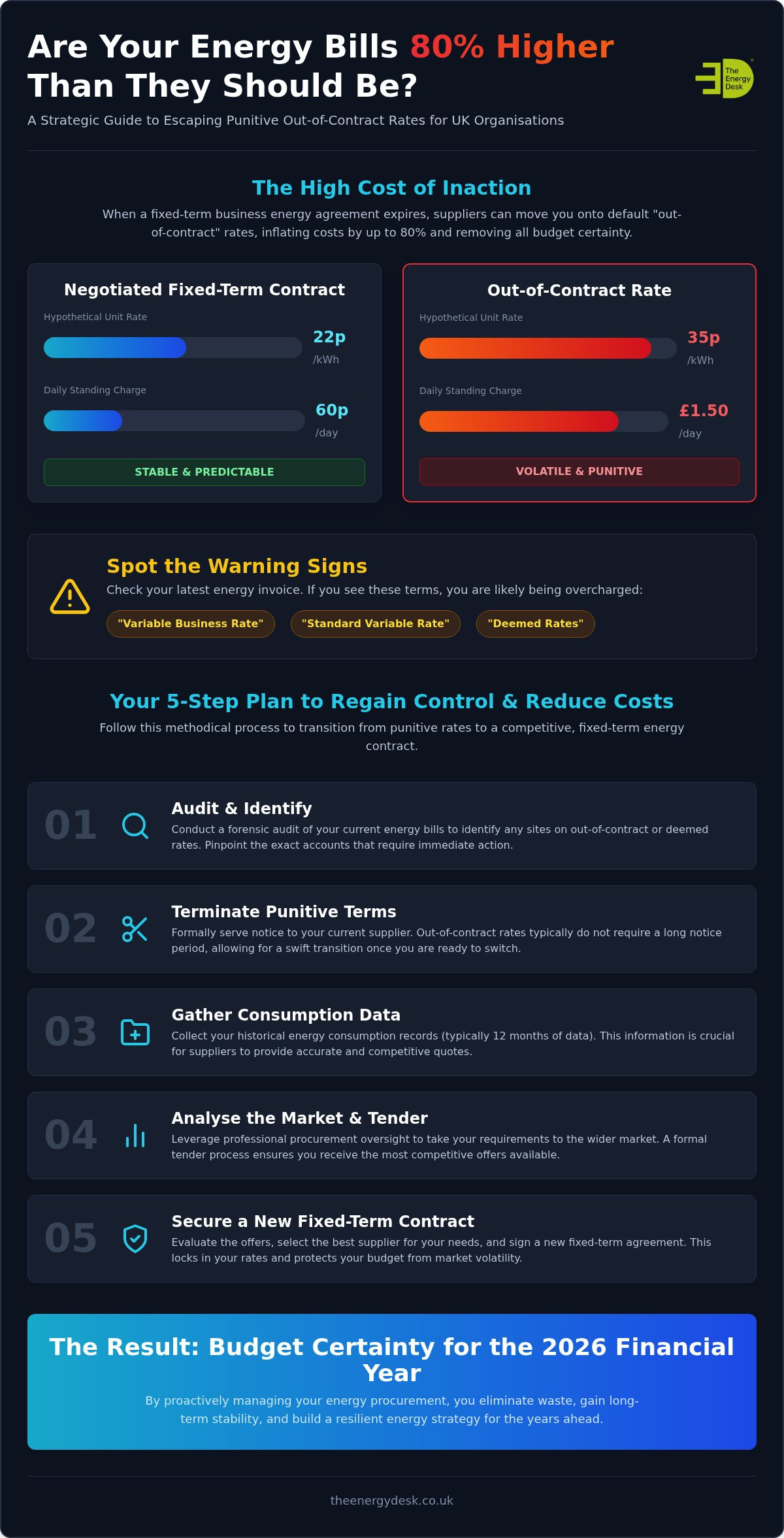
To illustrate the scale of the issue, look at this hypothetical 12-month comparison for a mid-sized office:
- 12-Month Fixed Rate: 22p per kWh unit rate with a 60p daily standing charge.
- Out of Contract Rate: 35p per kWh unit rate with a £1.50 daily standing charge.
Over a year, this discrepancy can lead to thousands of pounds in wasted expenditure. You might find that a forensic bill validation reveals exactly how much of your budget is being diverted into these avoidable premiums.
Budget Volatility in the 2026 Energy Market
Variable rates make accurate financial forecasting nearly impossible for corporate boards. Because these prices can change with minimal notice, a business might set a budget in January only to find it’s obsolete by March. Many organisations suffer from a “lag effect” where they don’t realise their contract has lapsed until the first inflated invoice arrives weeks later. This delay often results from Ofgem’s rules on deemed contracts which allow suppliers to apply these rates automatically. Implementing a strategy for commercial energy risk management is the most effective way to eliminate these traps and maintain fiscal control. Understanding the latest business energy procurement UK strategic trends and outlook for 2026 is equally essential, as non-commodity charges now account for up to 64% of a typical electricity bill, fundamentally changing how organisations should approach their purchasing decisions.
Hidden Charges in Default Energy Terms
Default terms often include inflated “pass-through” costs that are less transparent than the base unit rate. These include third-party charges for grid maintenance and balancing that suppliers may mark up on non-contracted accounts. Furthermore, because businesses are charged a 20% VAT rate on energy, every penny added to the base rate proportionally increases your tax liability. The Climate Change Levy (CCL) also scales with your usage, compounding the financial penalty of higher unit prices. Ultimately, out of contract rates can double a monthly utility spend without warning, turning a manageable overhead into a critical financial drain.
Auditing Your Energy Portfolio: Spotting the Warning Signs
Identifying out of contract energy rates requires more than a cursory glance at the total amount due; it demands a systematic review of the line items within your invoice. Suppliers rarely highlight that you’ve lapsed onto default terms in bold text. Instead, you must look for specific terminology such as “Variable Business Rate,” “Deemed,” or “Standard Variable.” These labels serve as immediate red flags that your organisation is no longer protected by a negotiated tariff. Utilising a robust system for commercial utility bill validation is the most effective way to catch these errors early, ensuring that overcharges don’t go unnoticed for months.
The Forensic Bill Validation Process
To begin a forensic audit, cross-reference your actual meter readings with the invoiced units. If your bill is based on estimates whilst you have a smart meter or AMR device, it’s a sign of administrative misalignment. You should also scrutinise the daily standing charges. As established, these fees often spike when a contract ends. Large organisations managing multiple MOP contracts are particularly vulnerable to “contract slippage.” This happens when the underlying meter lease or data collection agreement is out of sync with the energy supply contract, creating gaps in oversight that suppliers are quick to exploit.
Managing Multi-Site Portfolio Risks
Portfolio complexity is a major driver of utility waste. During corporate acquisitions, “orphan sites” often slip through the cracks, rolling onto expensive default rates because the new parent company hasn’t integrated the site into its central procurement strategy. Maintaining a centralised data hub is essential for effective business energy portfolio management. This oversight allows you to track contract end dates across dozens or hundreds of locations simultaneously. Without this central control, out of contract energy rates can quietly drain your operational budget across multiple locations. A single missed renewal can cost a large business thousands in a single month. Proactive auditing ensures that every meter under your control is accounted for and correctly contracted.
How to Switch: A 5-Step Plan to Escaping Punitive Rates
Escaping the financial drain of out of contract energy rates requires a disciplined, five-step transition plan. It’s not merely a matter of finding a cheaper quote; it’s about restructuring your procurement to ensure long-term stability. Follow this methodical process to regain control:
- Step 1: Terminate Deemed Status – Notify your current supplier of your intent to switch. For those on deemed terms, there’s typically no notice period or exit fee, allowing for an immediate departure once a new contract is in place.
- Step 2: Data Collection – Secure 12 months of historical consumption records or half-hourly data. Suppliers cannot provide accurate pricing without understanding your specific load profile.
- Step 3: Market Tender – Conduct a comprehensive market-wide tender. Comparing multiple providers ensures you aren’t just moving from one poor deal to another.
- Step 4: Negotiate Value-Add Terms – Look beyond the unit rate. Negotiate terms that include forensic bill validation and proactive monitoring to prevent future slippage.
- Step 5: Finalise the Switch – Confirm your “Live” date with the new provider. Once the transfer is complete, the punitive billing from your old supplier must legally cease.
Gathering Your Consumption Data
Accurate data is the foundation of successful business electricity procurement. Without precise usage records, suppliers will pad their quotes to account for uncertainty. By utilising smart meter or AMR data, you can prove your exact usage patterns to prospective providers. This transparency often results in lower risk premiums because the supplier can hedge more effectively. A professional consultant can organise this data into a structured tender pack, making your business more attractive to tier-one suppliers.
Negotiating Your New Energy Contract
In the 2026 market, businesses must choose between the certainty of fixed-price agreements and the potential rewards of flexible, market-tracking contracts. Indicative electricity unit rates for new contracts in August 2026 range between 20p and 23p per kWh; this is significantly lower than the 35p average seen on deemed terms. It’s vital to ensure your new agreement includes clauses that prevent an automatic roll-back onto default rates at the end of the term. Locking in these rates now provides the budget certainty required for the upcoming financial year. If you’re ready to secure these savings, The Energy Desk can manage the entire tender process on your behalf.
Strategic Procurement: Securing Long-Term Energy Stability
Achieving long-term energy stability requires a shift from reactive fire-fighting to proactive strategic management. Relying on out of contract energy rates is often a symptom of a procurement strategy that lacks professional oversight. By partnering with energy procurement consultants, your organisation gains a dedicated buffer between your operational budget and the volatility of the wholesale market. These experts manage the entire lifecycle of your utility contracts, ensuring that you’re never again exposed to the punitive default pricing discussed in previous sections.
The Role of an Energy Consultant
Independent experts provide value that goes far beyond simple price comparisons. Because they maintain deep relationships across the industry, consultants can often access “off-market” rates that aren’t available to businesses approaching suppliers directly. This access is crucial in the 2026 market, where tier-one suppliers are increasingly selective about the profiles they take on. A free energy audit serves as the essential first step in this partnership. It identifies immediate savings by catching historical overcharges and highlighting meters that have slipped onto variable terms.
Ongoing monitoring is another critical component of this service. Instead of waiting for a bill to arrive, a consultant tracks your usage in real-time, identifying spikes or anomalies before they become “bill shocks.” This level of oversight is especially beneficial for large industrial sites where even a minor percentage increase in unit rates can lead to five-figure monthly losses. It’s about maintaining a constant state of optimisation rather than a one-off fix.
Future-Proofing Your Energy Strategy
To truly insulate your business from market shocks, you must look toward onsite infrastructure. Integrating renewable solutions, such as CHP systems or solar installations, reduces the total volume of energy you need to purchase from the grid. This lowers your exposure to out of contract energy rates by making your business more self-sufficient. When you generate your own power, the impact of a missed renewal or a supplier’s price hike is significantly dampened.
Regular forensic audits should remain a permanent fixture of your corporate governance. These reviews ensure that your suppliers are adhering to the agreed contract terms and that no new “orphan sites” have appeared following acquisitions. The Energy Desk has provided this level of methodical oversight since 2003, specialising in forensic bill validation and strategic procurement for organisations across the UK. If you’re concerned about your current utility spend, contact The Energy Desk today for a forensic review of your rates and secure your organisation’s financial future for 2026 and beyond.
Regain Control of Your Energy Expenditure
Transitioning away from out of contract energy rates is a critical step for any organisation seeking budget certainty in the 2026 financial year. By identifying the specific terminology of default pricing and implementing a methodical switching plan, you can eliminate the significant premiums often applied to uncontracted supply. Forensic bill validation remains your most potent tool for uncovering historical overcharges and preventing future contract slippage across your portfolio.
As an independent consultancy established in 2003, The Energy Desk provides national UK coverage and specialises in forensic bill validation across all commercial sectors. We act as your strategic ally, simplifying the complexities of the technical market to ensure you only pay for the energy you consume at the most competitive rates available. Our expertise ensures your procurement strategy is proactive rather than reactive.
Take the first step toward permanent cost optimisation today. You can request a free forensic energy audit from The Energy Desk to identify and eliminate punitive out of contract rates. Regaining fiscal control is entirely within your reach when you have professional oversight and a disciplined approach to utility management.
Frequently Asked Questions
How much higher are out of contract energy rates compared to fixed rates?
Out of contract energy rates are typically between 20% and 80% more expensive than negotiated fixed-term agreements. In 2026, whilst a fixed electricity unit rate might average 22p per kWh, businesses on default terms often pay 35p per kWh or more. These punitive prices are designed to protect suppliers from market volatility when they have no volume commitment from the customer. Switching to a contract provides immediate protection against these high variable costs.
Do I need to give notice to leave an out of contract energy rate?
You generally don’t need to provide a notice period to leave an out of contract energy rate. Because there is no active, signed agreement in place, you are free to switch to a new supplier or a fixed deal at any time. This flexibility is the primary advantage of default terms. It allows for a rapid exit once you identify that your organisation is being overcharged on variable business rates.
What is a “Deemed Contract” and how did my business end up on one?
A deemed contract applies when you move into a new commercial premises and begin using electricity or gas without signing a formal agreement with the existing supplier. It also occurs if a previous tenant’s contract expires and you continue to use the supply. Suppliers are legally permitted to place you on these default terms until you either negotiate a new contract with them or switch to a different provider.
Can I claim back money if I was overcharged on out of contract rates?
You can potentially claim back funds if a forensic bill validation reveals administrative errors or incorrect meter readings. Whilst suppliers are legally entitled to charge higher out of contract rates, they must still bill you accurately for the energy used. If your audit identifies that you were placed on default terms despite having a valid contract, or if taxes like VAT were miscalculated, you can pursue a refund for the overcharged amount.
Will my energy supply be cut off if my fixed-term contract ends?
No, your energy supply won’t be cut off simply because your fixed-term contract has expired. Instead, your current provider will automatically move your account onto their default out of contract energy rates. This ensures continuity of supply whilst the supplier charges a higher premium for the lack of a long-term commitment. To avoid these inflated costs, it’s essential to arrange a renewal or a new contract before the expiry date.
How do I find out when my current business energy contract expires?
You can find your contract expiry date by checking your most recent energy invoice or logging into your supplier’s online portal. Most business bills are required to state the end date of the current fixed-term period. If this information isn’t clear, you can contact your supplier directly or appoint a consultant to perform a portfolio audit. Maintaining a central record of these dates prevents your sites from rolling onto expensive variable terms.
What information do I need to switch from out of contract rates to a fixed deal?
To facilitate a switch, you need a recent copy of your energy bill, your Meter Point Administration Number (MPAN) for electricity, or your Meter Point Reference Number (MPRN) for gas. You should also provide 12 months of historical consumption data or half-hourly records. This information allows suppliers to provide accurate quotes tailored to your specific usage profile. Having these details ready ensures a methodical and efficient transition to a more cost-effective agreement.
Why are standing charges higher on out of contract energy terms?
Standing charges are higher on default terms because suppliers include a significant risk premium for managing an account with no fixed end date. Since 2021, network operators have also increased their costs, which suppliers pass on more aggressively to non-contracted customers. On out of contract terms, these daily fees can be double or triple the rate of a fixed deal, acting as a further financial penalty for failing to secure a long-term agreement.