

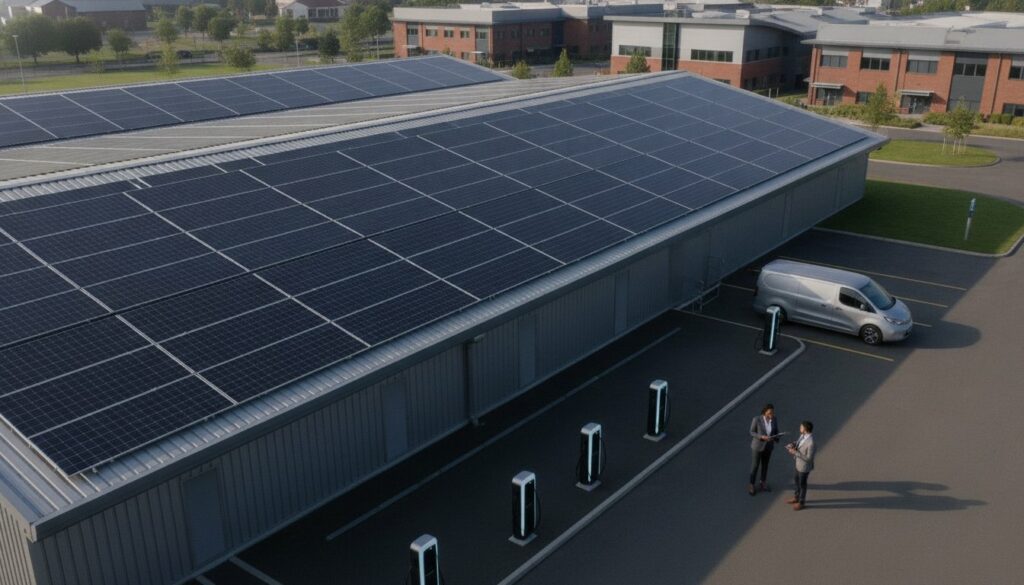
Did you know that the UK’s commercial solar sector expanded by 35% in 2025 alone? With national solar capacity projected to reach 20.85 GW by the end of 2026, the adoption of commercial renewable energy solutions has transitioned from a niche ESG goal to a core requirement for fiscal stability. Many firms now recognise that waiting for market volatility to subside is no longer a viable strategy for maintaining a competitive edge.
You’re likely feeling the pressure of rising Climate Change Levy rates and the December 2026 half-hourly metering mandate, all whilst trying to protect your bottom line. Balancing complex infrastructure upgrades with daily operational demands is a methodical task that requires expert oversight and strategic planning. This guide demonstrates how to integrate onsite generation and strategic procurement to secure energy independence and reduce operational costs. We will explore the practical rollout of EV charging infrastructure and the latest technology trends to ensure your organisation remains resilient and profitable in a changing landscape.
Key Takeaways
- Understand why energy security has become a board-level priority and how to transition from volatile fossil fuel markets to renewable stability.
- Learn to evaluate the ROI of onsite solar PV and CHP systems to transform your unused roof space into a revenue-generating asset.
- Discover how to future-proof your commercial site with integrated commercial renewable energy solutions, including EV charging and battery storage, ahead of the 2030 ICE phase-out.
- Compare CAPEX and OPEX financial models, such as Power Purchase Agreements (PPAs), to secure renewable energy without significant upfront capital.
- Identify the critical first steps for implementation, starting with a comprehensive energy audit and forensic bill validation to protect your margins.
The Strategic Shift: Why Commercial Renewable Energy Solutions are Essential in 2026
The UK energy market has reached a critical pivot point. For decades, industrial and commercial entities operated within a framework defined by the price of natural gas and coal. However, the closure of the UK’s final coal-fired power station in September 2024 signalled the end of the fossil fuel era. In 2026, the adoption of commercial renewable energy solutions is no longer a peripheral environmental initiative; it’s a fundamental requirement for fiscal health and long-term viability.
Volatility remains the primary threat to the corporate bottom line. Board-level discussions have shifted from simple cost-cutting to comprehensive risk mitigation. By integrating onsite generation, firms can shield themselves from “out of contract” rates and the unpredictable price spikes that characterised the early 2020s. Firms that successfully implement commercial renewable energy solutions often see a direct correlation between their energy strategy and their market resilience. A decarbonised profile also improves corporate valuations, as major supply chains now demand stringent ESG compliance as a prerequisite for securing high-value contracts.
Beyond Net Zero: Energy Security and Price Stability
Energy security is the ability to maintain operations whilst avoiding market volatility. Achieving this requires a shift from reactive procurement to proactive energy management. By investing in onsite generation assets, such as solar PV or CHP systems, businesses establish a degree of energy independence that the grid alone cannot provide. This transition ensures that production schedules and operational costs remain predictable, regardless of geopolitical shifts affecting global gas prices. The UK renewable energy landscape has matured to the point where these technologies offer a levelised cost of electricity far below standard grid tariffs, providing a stable foundation for industrial growth.
Regulatory Pressures and 2026 Decarbonisation Targets
The legislative environment in 2026 has become significantly more demanding. Following the increase in Climate Change Levy (CCL) rates in April 2026, the financial penalties for maintaining inefficient, carbon-heavy infrastructure have intensified. Businesses must also adapt to the December 2026 half-hourly metering mandate, which requires more granular data management and transparent reporting. Traditional business energy procurement UK strategies must now evolve to include green assets and flexible contracts. Inaction is increasingly expensive. Between rising carbon taxes and the risk of stranded assets, the cost of delaying a renewable transition often outweighs the initial capital expenditure required for modernisation.
Evaluating Onsite Generation: Solar PV and Combined Heat and Power (CHP)
Selecting the right technology is a methodical process that depends on your site’s specific physical and operational profile. Whilst solar PV is a versatile option for many, industrial sites with high heat requirements often find greater efficiency in Combined Heat and Power (CHP). Integrating these commercial renewable energy solutions with traditional business electricity procurement creates a balanced portfolio, significantly reducing reliance on the grid where average costs remain between 25p and 29p per kWh for large enterprises. By generating power at the point of use, you eliminate the transmission and distribution charges that typically inflate utility bills.
Commercial Solar PV: Maximising Assets
Solar PV remains the most accessible entry point for UK firms looking to convert underutilised roof space or land into revenue-generating assets. Assessing site suitability involves a disciplined review of roof orientation, structural integrity, and local grid capacity. Systems are particularly effective at mitigating daytime peak demand, which is often when grid electricity is most expensive. In 2026, the typical operational lifespan of a commercial solar PV system is between 25 and 30 years, providing a long-term hedge against inflation. For organisations that prefer to avoid capital outlay, Corporate Power Purchase Agreements (PPAs) offer a route to install these systems using third-party funding, allowing you to pay only for the energy you consume at a predefined rate.
The Role of CHP in Industrial Heat and Power
For manufacturing and processing plants, heat is often as critical as power. CHP system installation for businesses allows for the simultaneous generation of electricity and usable thermal energy from a single fuel source. This technology can reduce carbon emissions by up to 30% and energy costs by approximately 20% compared to separate grid power and boiler heat. Modern CHP units are increasingly compatible with renewable gas sources, ensuring they remain a viable part of the transition to net zero. This synergy between heat and power generation is essential for sectors like chemicals, food and drink, and pharmaceuticals, where thermal demand is constant. To determine which technology mix will deliver the most efficient return for your specific infrastructure, it’s advisable to begin with a professional energy audit to map your consumption patterns accurately.
Infrastructure and Future-Proofing: EV Charging and Battery Storage
The transition toward electric mobility is no longer a futuristic concept; it’s an immediate infrastructure requirement. As the 2030 deadline for the phase-out of new internal combustion engine (ICE) vehicles approaches, UK firms must evolve their premises to support high-capacity charging. Integrating robust commercial renewable energy solutions ensures that this increased electrical load doesn’t compromise site stability or lead to prohibitive “Maximum Demand” penalties. Preparing your site now prevents the reactive, and often more expensive, upgrades that will be forced by fleet electrification in the coming years.
Electrifying the Fleet: Business EV Charging Infrastructure
Scalability is the cornerstone of a successful EV rollout. Whether managing a commercial fleet or providing employee charging, the infrastructure must grow alongside demand. Smart charging technology is essential here, as it allows for intelligent load balancing across the site. This prevents the need for expensive grid connection upgrades by distributing power during periods of lower consumption. Businesses can also realise new revenue streams by monetising these chargers for third-party or visitor use, turning a necessary utility into a self-sustaining asset. With the UK’s EV charging market projected to grow at a CAGR of 30.34% through 2034, early investment in infrastructure provides a significant competitive advantage in the logistics and service sectors.
Battery Storage: Balancing Demand and Reducing Peak Charges
Battery energy storage systems (BESS) represent the critical link in modern energy management. These systems allow businesses to capture energy from onsite solar PV or buy from the grid when prices are at their lowest off-peak rates. This stored energy is then deployed during peak periods, a process known as peak shaving. This strategy is vital for mitigating high Distribution Use of System (DUoS) and Transmission Network Use of System (TNUoS) charges that often penalise industrial users during high-demand windows.
The adoption of storage aligns with the UK’s national energy strategy, which emphasises the role of private investment in creating a flexible, resilient grid. Beyond cost savings, battery storage provides a critical layer of operational resilience. In the event of a grid brownout or outage, stored energy can maintain essential services, preventing costly production downtime. Systems that were operational leading up to April 2026 earned an average of £73,145 per MW per year through grid balancing services, demonstrating that storage is both a defensive and offensive financial tool. By combining storage with commercial renewable energy solutions, firms achieve a level of autonomy that traditional procurement alone cannot provide.
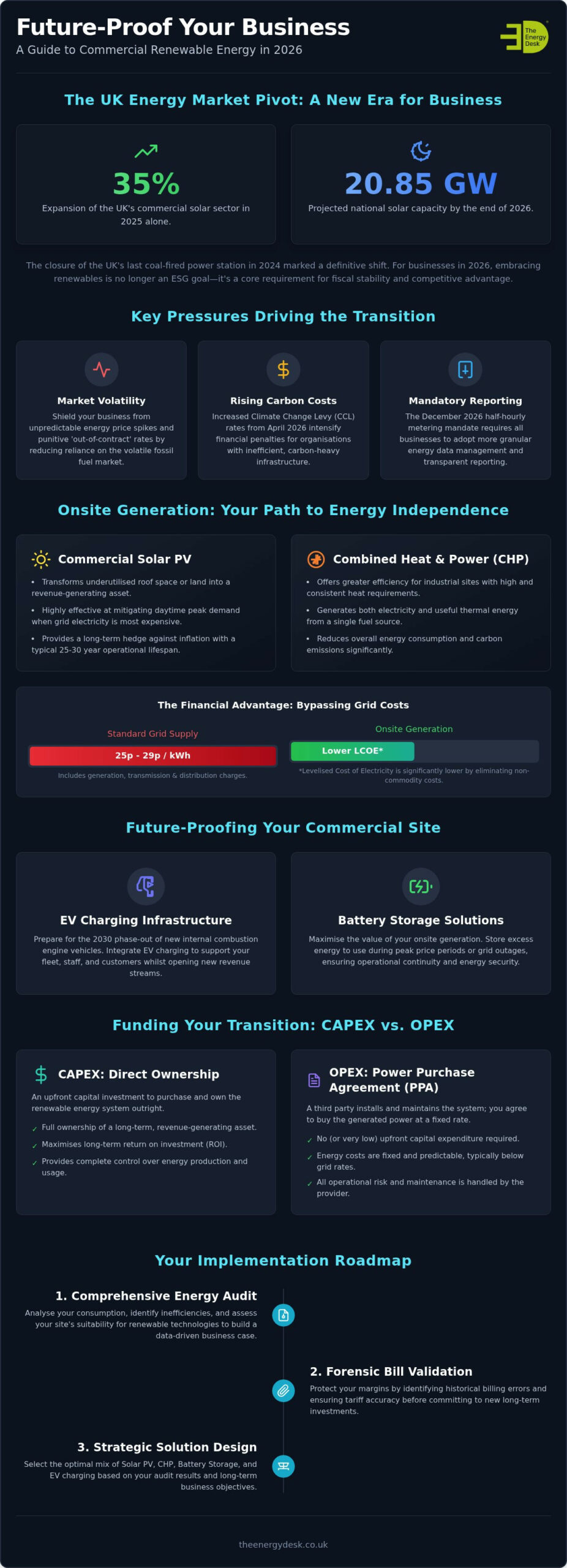
The Financial Framework: ROI, Funding, and Power Purchase Agreements (PPAs)
The transition to onsite generation involves more than just physical infrastructure; it requires a disciplined financial strategy. UK firms generally choose between two primary models: capital expenditure (CAPEX) or operational expenditure (OPEX). Whilst CAPEX allows for full asset ownership and maximum long-term savings, it’s the OPEX model, primarily delivered through Power Purchase Agreements (PPAs), that enables businesses to deploy commercial renewable energy solutions with zero upfront capital.
Corporate PPAs: Securing Long-Term Renewable Supply
A Power Purchase Agreement is a long-term contract between an energy generator and a commercial buyer. Onsite PPAs involve installing assets directly on your premises, whereas offsite models involve purchasing power from a remote renewable farm via the grid. A PPA acts as a fixed-price hedge against future energy inflation, providing the budget certainty that traditional variable tariffs lack. In August 2026, UK PPA prices saw a 4.9% increase, yet they remain a competitive alternative to volatile wholesale markets.
Effective commercial energy risk management is essential when negotiating these contracts. Unlike standard procurement, renewable agreements often span 10 to 25 years. This requires a methodical approach to credit risk, volume balancing, and price floor protections. Many organisations overlook these complexities, focusing solely on the “green” credentials rather than the underlying fiscal stability and long-term price risk mitigation.
Calculating ROI and Navigating Capital Expenditure
For firms opting for CAPEX, the Annual Investment Allowance (AIA) remains a vital tool. In 2026, businesses can claim 100% first-year tax relief for qualifying solar panel expenditures up to £1 million. With the current corporation tax rate at 25%, this significantly accelerates the payback period, which typically ranges between three and six years for commercial solar PV installations. These tax incentives don’t just reduce the initial burden; they transform renewable assets into high-performing financial instruments.
The return on investment for these systems often sits between 14% and 20%, far outperforming traditional cash investments or standard property yields. However, securing board approval requires a robust business case for commercial renewable energy UK. This document must account for energy price forecasts, the rising cost of the Climate Change Levy, and the December 2026 half-hourly metering mandate. Strategic financial planning ensures that your energy transition is a managed investment rather than an uncontrolled cost. To explore which funding model aligns with your operational goals, contact our consultancy team for a comprehensive audit.
Implementation Strategy: Integrating Renewables into Your Energy Portfolio
The successful rollout of commercial renewable energy solutions requires a transition from hardware installation to holistic energy oversight. Many firms make the mistake of treating solar PV or CHP as standalone projects. In reality, these assets must be integrated into a broader procurement strategy to ensure that onsite generation actually translates into net savings. This process begins with a methodical energy audit, which identifies consumption patterns and infrastructure limitations before any capital is committed.
Managing the implementation whilst maintaining operational continuity is a primary concern for industrial leaders. A phased approach allows for the integration of new assets without disrupting production schedules. By aligning the installation of onsite generation with planned maintenance windows, businesses can modernise their infrastructure with minimal downtime. This disciplined approach ensures that the transition to a hybrid energy model is both seamless and fiscally responsible.
The Importance of Forensic Audits and Bill Validation
Before investing in new technology, businesses should ensure their current spending is accurate. Forensic commercial utility bill validation often uncovers historical overcharges or “hidden” savings that can be redirected to fund renewable projects. Once onsite assets are live, ongoing validation is critical to ensure your supplier is correctly accounting for exported power and reduced grid demand.
This level of scrutiny is a core component of business energy portfolio management. In a hybrid world where power comes from both the grid and onsite assets, the complexity of billing increases. Managing this transition requires a disciplined approach to data. It’s not enough to generate green energy; you must verify that every kilowatt produced is delivering the expected fiscal return and that your “out of contract” exposure is eliminated.
Partnering with Independent Energy Consultants
The UK market is saturated with suppliers and brokers, many of whom have ties to specific technology providers. Choosing energy procurement consultants over simple brokers provides access to an independent perspective. A consultant acts as a strategic ally, managing the entire lifecycle from initial audit to final installation and ongoing management.
This partnership allows your firm to access a broader range of technology partners and PPA providers, ensuring the solution fits your specific site rather than a supplier’s sales targets. By centralising the oversight of procurement, onsite generation, and EV infrastructure, you reduce the risk of fragmented, inefficient systems. Professional management ensures that your energy strategy remains resilient against market shifts and regulatory changes. To begin your transition with a methodical review of your current consumption, contact The Energy Desk for a free energy audit.
Securing Long-Term Energy Independence and Fiscal Stability
The transition to a hybrid energy model is no longer a matter of corporate social responsibility; it’s a fundamental requirement for strategic risk management. By combining onsite generation with intelligent storage and EV infrastructure, UK firms can decouple their operational costs from the volatility of wholesale gas and electricity markets. This guide has outlined how the integration of these technologies, supported by robust financial frameworks like PPAs, creates a path toward genuine energy autonomy.
The Energy Desk has provided independent consultancy for over two decades, positioning us as seasoned experts in industrial CHP and solar integration. We understand that success depends on precise data, which is why we incorporate forensic bill validation to identify historical overcharges and recover lost capital. Implementing commercial renewable energy solutions requires a methodical partner that manages the entire lifecycle from procurement to installation. Book your free commercial energy audit with The Energy Desk to ensure your organisation is future-proofed against the regulatory and financial shifts of 2026. Taking a proactive approach today secures your competitive edge for the decade ahead.
Frequently Asked Questions
What are the most cost-effective commercial renewable energy solutions in 2026?
Solar PV and Combined Heat and Power (CHP) remain the most cost-effective commercial renewable energy solutions in 2026. Onsite solar generation costs between 5p and 8p per kWh, which is significantly lower than the average grid electricity cost of 25p to 29p per kWh for large enterprises. For heat-intensive industries, CHP systems offer high efficiency by generating power and thermal energy simultaneously. These technologies provide the fastest return on investment and essential long-term price stability.
How much can a business save by installing commercial solar PV?
Savings vary by site, but the return on investment for commercial solar PV systems in 2026 typically sits between 14% and 20%. Most UK businesses achieve a full payback on their initial investment within three to six years. Beyond direct energy savings, firms benefit from 100% first-year tax relief through the Annual Investment Allowance on qualifying expenditures up to £1 million. This combination of lower bills and tax incentives significantly protects your operational profit margins.
Can my business sell excess renewable energy back to the grid?
Yes, UK businesses can monetise surplus electricity by selling it back to the National Grid through export tariffs or Power Purchase Agreements (PPAs). This process requires a half-hourly export meter and a formal agreement with a licensed energy supplier. Whilst the primary financial benefit comes from avoiding expensive grid purchases, export revenue provides a secondary stream that improves the project’s overall ROI. It’s essential to verify grid connection capacity before planning large-scale exports.
Do commercial renewable energy projects require planning permission?
Many roof-mounted solar installations fall under Permitted Development Rights, meaning they don’t require full planning permission. However, restrictions apply to listed buildings, conservation areas, and systems exceeding specific size thresholds. Ground-mounted arrays and large-scale CHP systems usually require formal local authority approval. You should always consult with a professional advisor or your local planning office to ensure compliance before starting any significant infrastructure work. This prevents costly delays and ensures your project meets all regulatory standards.
What is a Corporate Power Purchase Agreement (PPA) and how does it work?
A Corporate Power Purchase Agreement (PPA) is a long-term contract between a business and an energy generator to purchase renewable power at a predefined price. This model allows firms to secure energy security without the upfront capital costs of installing their own hardware. The generator manages the asset whilst the business pays a fixed rate for the electricity produced. It’s a strategic tool for hedging against market volatility over a 10 to 25-year period, providing long-term budget certainty.
How long does it take to install a commercial CHP system?
The timeline for a commercial CHP installation typically ranges from six to twelve months, depending on the project’s complexity and grid connection requirements. This period includes the initial feasibility audit, system design, procurement of components, and the physical integration into your existing thermal and electrical infrastructure. Because these are complex engineering projects, maintaining operational continuity during the transition requires methodical planning and oversight from experienced consultants to avoid production downtime and ensure a seamless system integration.
Will my existing commercial electricity contract allow for onsite generation?
Most standard commercial electricity contracts allow for onsite generation, but you must review your specific terms for Take or Pay clauses or volume tolerance limits. If your new renewable assets significantly reduce your grid demand, you might fall below your contracted minimum consumption, leading to financial penalties. It’s often necessary to renegotiate your procurement strategy alongside your renewable rollout to ensure your supply contract remains flexible and aligned with your new, reduced grid consumption profile.
Are there grants available for business EV charging infrastructure in 2026?
In 2026, the UK government continues to support the transition to electric mobility through various incentives, including the Workplace Charging Scheme. This grant provides eligible businesses with support towards the upfront costs of purchasing and installing EV charge points. Additionally, firms can benefit from capital allowances that allow for the deduction of the full cost of charging equipment from taxable profits. You should check the latest GOV.UK guidance for current eligibility criteria and funding caps to maximise your available support.