


What if your energy budget wasn’t a best-guess estimate but a calculated strategic asset? Most UK financial directors agree that unpredictable wholesale market swings and complex standing charges make financial planning feel like a gamble. Relying on outdated spreadsheets often leads to unexpected deficits when the market shifts. Learning how to forecast business energy costs effectively is no longer just a procurement task; it’s a fundamental requirement for protecting your company’s operational margins.
This 2026 strategic guide provides a methodical framework to move beyond guesswork. You’ll master a dual-track approach that combines internal consumption audits with precise external non-commodity cost projections. We’ll examine how to account for shifting renewable levies and TNUoS charging windows to create a reliable budget. By the end of this article, you’ll have the clarity needed to choose between fixed and flexible contracts with confidence, reducing your risk of overspending whilst ensuring long-term fiscal stability.
Key Takeaways
- Understand why 2026 market dynamics require a strategic shift away from simply reviewing previous utility bills to protect your corporate margins.
- Discover how to forecast business energy costs by accurately weighting commodity wholesale prices against increasingly complex non-commodity charges and levies.
- Access granular consumption insights via Half-Hourly data and professional MOP contracts to provide a data-driven foundation for your utility budget.
- Follow a structured methodology to calculate your Weighted Average Cost of Energy and apply projected non-commodity percentages for the 2026/27 period.
- Leverage your forecasting framework to determine whether fixed or flexible procurement contracts offer the most effective protection against future market volatility.
Understanding the Fundamental Principles of Business Energy Forecasting
Business energy forecasting is a disciplined financial planning process; it’s not a simple administrative task. In the 2026 market, relying on the previous year’s expenditure is insufficient for accurate projections. Changes in grid infrastructure and global supply chains mean that historical costs no longer serve as a direct proxy for future spend. Understanding how to forecast business energy costs effectively involves synthesising internal consumption data with external market trends to build a resilient fiscal strategy.
A distinction must be made between budgeting and forecasting. Whilst a budget represents a financial target or a limit on spend, a forecast is a data-driven prediction of what the actual costs will be. This predictive model forms the backbone of commercial energy risk management. It allows businesses to identify potential overspends before they occur, providing the opportunity to adjust operational activity or procurement tactics to protect profit margins.
Why Historical Accuracy is the Foundation of Future Projections
Reliable data starts with a granular review of past consumption patterns. These patterns dictate your future volume requirements, which are the primary variable in any cost model. Seasonality plays a critical role here; a business with high winter heating requirements will have a vastly different risk profile than a data centre requiring constant cooling. Using energy forecasting principles, we can see that ‘estimated’ bills are the primary enemy of accuracy. If your baseline data is based on supplier estimates rather than actual meter readings, your entire forecast will be fundamentally flawed. Professional audits often reveal that these discrepancies lead to significant budgetary gaps that only emerge at the end of a financial year.
The Role of Market Intelligence in 2026
External factors heavily influence the final figure on your utility statements. Geopolitical events continue to impact UK wholesale gas prices, creating ripples that affect every commercial contract. Similarly, the increasing reliance on renewable generation introduces electricity price volatility, as supply fluctuates with weather conditions. Wholesale market sentiment is a key forecasting variable that must be monitored daily to capture optimal procurement windows. By combining these external insights with your internal usage profile, you create a forecast that is both realistic and actionable for your board of directors.
Analysing Commodity and Non-Commodity Cost Drivers
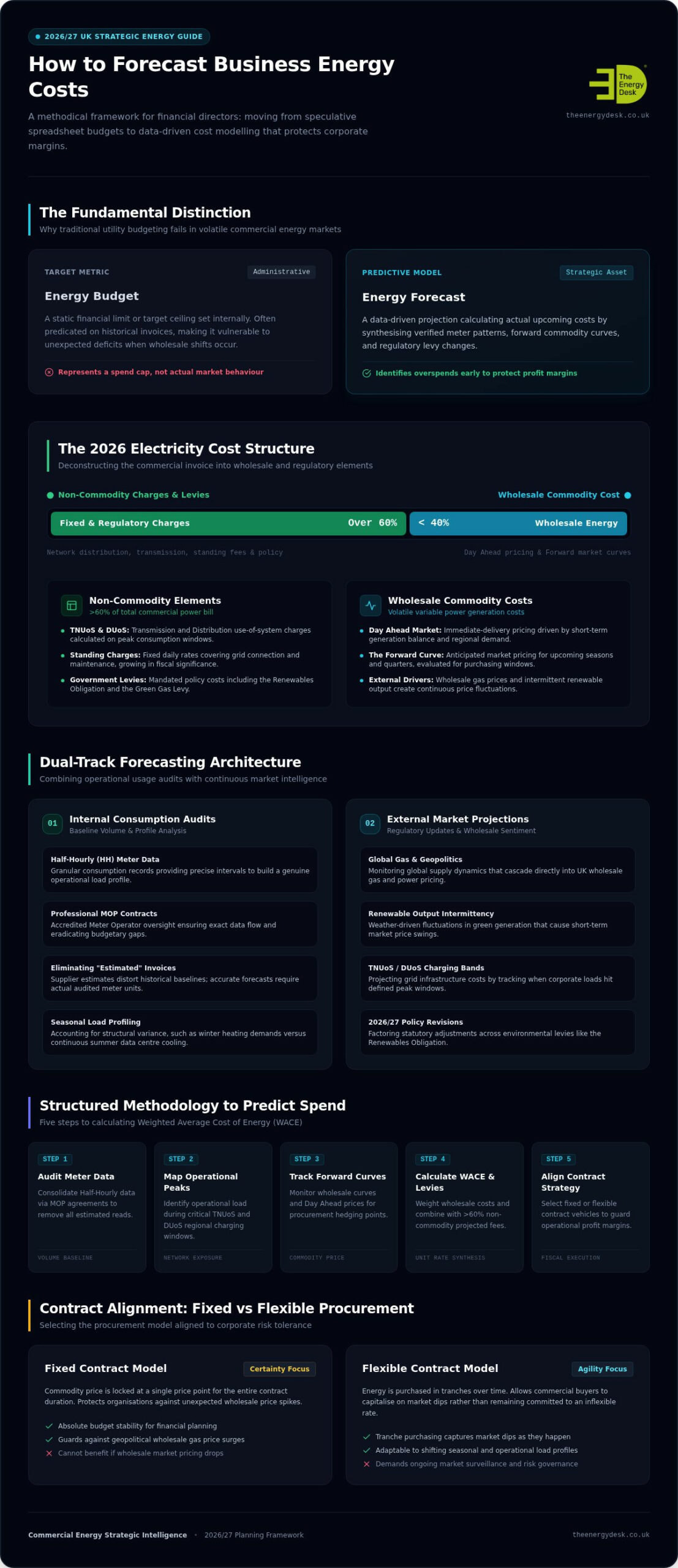
To understand how to forecast business energy costs, you must first deconstruct your bill into its two primary components: the wholesale commodity cost and the non-commodity elements. Historically, the commodity price, which is the cost of the energy itself, dictated the majority of the final spend. However, in the current 2026 market, non-commodity costs have risen to represent over 60% of a typical commercial electricity statement. This shift makes it essential to track regulatory changes as closely as you track market prices.
Wholesale Commodity Costs: The Variable Element
Wholesale prices remain the most volatile part of the equation. These costs fluctuate daily based on global supply dynamics and national demand. When building a forecast, you’ll encounter “Day Ahead” pricing, which reflects the immediate market, and the “Forward Curve,” which predicts prices for future delivery periods. Businesses that opt for flexible procurement can buy energy in tranches. This strategy allows you to lock in prices when the market dips rather than being tied to a single price point for the duration of your contract.
Non-Commodity Costs: The Fixed and Regulatory Elements
Non-commodity costs are comprised of network charges and government levies. Transmission (TNUoS) and Distribution (DUoS) charges are calculated based on your peak usage during specific windows. If your operations coincide with these peak times, your costs will rise significantly. Additionally, government-mandated levies like the Renewables Obligation and the Green Gas Levy are projected to see adjustments throughout 2026. Reviewing non-domestic energy price datasets provides a benchmark for these policy costs against industry averages.
Standing charges are also becoming a more significant factor in the total forecast. These fixed daily fees cover the cost of maintaining the physical connection to the grid and have seen steady increases as infrastructure projects expand. Understanding these fixed elements is vital for accurate long-term budgeting.
VAT and Climate Change Levy (CCL)
Taxation forms the final layer of your energy spend. Most businesses pay a standard VAT rate of 20%, though qualifying organisations like charities may access a reduced rate of 5%. The Climate Change Levy (CCL) is an additional tax applied per kWh to encourage energy efficiency. It’s essential to verify that these are applied correctly to your account. Using commercial utility bill validation ensures your historical data is accurate, preventing you from basing future forecasts on past billing errors. If you’re concerned about the impact of these levies on your margins, our team can help you audit your historical statements to identify potential exemptions or reductions.
Gathering and Organising Your Consumption Data
Precision is the hallmark of professional utility management. To determine how to forecast business energy costs with any degree of certainty, you must move beyond the totals on your monthly invoices and examine your Half-Hourly (HH) data. This granular information provides a timestamped record of exactly when your business draws power from the grid. Accessing this level of detail is typically managed through a Meter Operator (MOP) contract, which ensures your meter is maintained and your data is transmitted accurately for analysis.
Identifying your “base load”, the minimum amount of energy your business requires to function, versus your “peak load” is vital for accurate budgeting. High peak usage often triggers higher DUoS and TNUoS charges, as we explored in the previous section. One common mistake is relying on a single month’s data to project an annual spend. Seasonal variations in the UK, such as increased lighting and heating requirements during winter months, can skew a short-term sample. This often leads to a significant underestimation of your total annual liability.
Accessing Data from Smart Meters and Data Collectors
Professional data management involves the use of DC/DA (Data Collection and Data Aggregation) services. These entities are responsible for retrieving data from your meter and processing it for billing purposes. You can request a “consumption extract” from your current provider, which usually arrives as a CSV file. For more detailed Ofgem business energy guidance on your rights regarding data access and meter standards, you can consult the regulator’s framework. Once you have this extract, organise it into a centralised energy management spreadsheet to track trends over several years rather than months.
Identifying Anomalies and Operational Changes
A forecast is only as good as its awareness of future operational shifts. If you’re planning factory shutdowns or significant business growth in 2026, these must be hardcoded into your projections. Energy efficiency measures will reduce your future volume needs, whilst installing new infrastructure like EV charging points or solar PV arrays will fundamentally alter your consumption profile. Accounting for these variables ensures your strategy for how to forecast business energy costs remains grounded in your actual business trajectory rather than historical inertia. Using this data allows you to build a model that anticipates change rather than reacting to it after the costs have already been incurred.
A Step-by-Step Methodology for Predicting Future Energy Spend
Once you’ve organised your consumption data and understood the various cost drivers, you can implement a structured methodology to build your financial model. Learning how to forecast business energy costs requires a transition from passive observation to active calculation. This process ensures that your utility budget is a reflection of current market realities rather than optimistic assumptions. This methodical approach is a cornerstone of effective business energy portfolio management, allowing for greater oversight of long-term fiscal commitments.
- Step 1: Calculate the Weighted Average Cost of Energy (WACE). Determine the average price paid for all energy tranches across your total volume to establish a baseline commodity rate.
- Step 2: Apply the projected non-commodity cost percentage. For the 2026/27 period, these charges often exceed the commodity cost. Integrate these as a percentage of your total unit rate based on your specific meter type.
- Step 3: Factor in the Climate Change Levy (CCL) and VAT. Ensure these statutory costs are applied per kWh and on the total bill value respectively, noting any exemptions your business may hold.
- Step 4: Create three scenarios. Build Conservative, Likely, and Aggressive models. This prepares your finance team for various market outcomes, from stable pricing to extreme volatility.
Calculating the Volume x Rate Equation
To forecast the commodity cost, multiply your projected annual kWh consumption by the forward market unit rate. This calculation must be weighted to account for seasonal price differences; winter energy is typically more expensive due to increased demand. It’s also vital to account for “take or pay” clauses in your contracts. These clauses penalise businesses that consume significantly less than their forecasted volume, so your consumption projections must be as accurate as possible to avoid unnecessary surcharges.
Building in a Risk Margin for Market Volatility
Even the most detailed forecasts can be disrupted by external events. Including a 5-10% contingency buffer in your 2026 budget is essential for maintaining financial stability amongst shifting wholesale prices. You should monitor the market continuously and adjust your forecasts quarterly to reflect real-time data. Using “what-if” analysis for major market disruptions allows you to stress-test your budget against worst-case scenarios, ensuring your margins remain protected regardless of market movement.
If you require assistance in building these complex financial models, you can contact our consultancy team for a professional consumption audit and bespoke forecasting report.
Strategic Procurement: Turning Forecasts into Financial Stability
A robust forecast is only valuable if it informs a tangible procurement strategy. By mastering how to forecast business energy costs, you can determine which contract structure aligns with your financial objectives for 2026. This data allows you to move away from reactive purchasing and towards a proactive model where energy is treated as a manageable overhead rather than an unpredictable burden. Professional energy procurement consultants play a vital role here, validating your internal projections against broader market trends to ensure your strategy is realistic.
Timing your market entry is essential for protecting your margins. Using your forecast to identify optimal renewal windows helps you avoid the financial trap of out of contract energy rates, which can be significantly higher than negotiated terms. Additionally, integrating onsite generation solutions such as Solar PV or CHP systems into your plan provides a layer of “known” energy costs. These technologies reduce your reliance on the volatile wholesale market, making your long-term forecasting significantly more predictable.
Fixed-Price vs Flexible-Price Strategies
Your forecast should dictate whether a fixed or flexible contract is appropriate. If your projections suggest a period of sustained market inflation, locking in a fixed-price contract allows you to secure a consistent unit rate for the duration of the term. This provides maximum budgetary certainty. Conversely, a flexible strategy allows you to capitalise on market dips by purchasing your energy in tranches. This approach suits businesses with a higher risk appetite and the internal capacity to monitor market movements. Matching your contract type to your specific risk profile is a fundamental step in achieving fiscal stability.
The Value of Ongoing Bill Validation
Forecasting is an iterative process that requires accurate baseline data. If your actual utility bills contain errors, your future projections will be fundamentally flawed. You must set up a feedback loop where you regularly compare your actual spend against your forecasted spend. This comparison allows you to refine your methodology and identify operational inefficiencies that might be driving costs higher than expected. Constant oversight ensures that your energy strategy remains agile and effective throughout the financial year.
To ensure your 2026 strategy is built on a foundation of precise data, you can contact The Energy Desk for a free audit. This professional review will help you validate your historical consumption and start your forecasting process with accurate, verified information.
Securing Long-Term Fiscal Resilience for 2026
Mastering how to forecast business energy costs is the first step toward transforming your utility spend from a volatile risk into a predictable operational expense. By integrating granular consumption data with a deep understanding of non-commodity cost drivers, your business can build a resilient financial framework. This methodology allows you to navigate market fluctuations with confidence, ensuring that your procurement decisions are driven by data rather than speculation. Strategic oversight today prevents the budgetary deficits of tomorrow.
The Energy Desk brings over 20 years of UK energy consultancy expertise to your financial planning. As specialists in forensic bill validation, we provide independent advice across all major UK suppliers to ensure your baseline data is accurate. Our team is ready to help you stress-test your projections and identify the most efficient contract structures for your specific consumption profile. Protecting your margins starts with a single, data-driven conversation about your operational goals.
Request a Free Energy Audit and Forecast Consultation from The Energy Desk to begin your journey toward a more stable and cost-effective energy future. Take control of your utility management today to ensure your business remains competitive throughout 2026 and beyond.
Frequently Asked Questions
How far in advance should a business forecast energy costs?
You should aim to forecast your energy costs at least 12 to 24 months in advance of your current contract’s expiry. This proactive timeline allows your finance team to identify optimal market entry points and avoid the volatility of short-term price spikes. By establishing a long-term outlook, you can better evaluate whether a fixed or flexible procurement strategy aligns with your projected consumption and risk appetite for the upcoming 2026/27 financial year.
What are the biggest risks to business energy price stability in 2026?
Geopolitical instability and its impact on wholesale gas supplies remain the primary risks to price stability in 2026. Additionally, the UK’s increasing reliance on intermittent renewable generation can lead to greater intraday price volatility. Regulatory shifts in non-commodity charges, such as updated TNUoS and DUoS charging windows, also present a significant risk. These elements often fluctuate independently of wholesale prices, making it essential to monitor both market sentiment and policy changes to protect your margins.
What is the difference between commodity and non-commodity costs?
Commodity costs refer to the wholesale price of the actual gas or electricity your business consumes. In contrast, non-commodity costs encompass the various additional charges required to deliver that energy to your site. These include transmission and distribution fees, government-mandated levies like the Renewables Obligation, and standing charges. Whilst wholesale prices are often the focus, non-commodity elements now frequently represent over 60% of a total commercial electricity statement in the UK, requiring careful analysis during forecasting.
How do I forecast energy costs if my business is expanding?
When your business is expanding, you must adjust your baseline consumption data to reflect projected growth in operational volume. Start by calculating the energy intensity of your existing processes and apply this to the additional square footage or machinery planned for 2026. Understanding how to forecast business energy costs during expansion also requires factoring in new infrastructure, such as EV charging points, which can significantly alter your peak demand profile and lead to higher network charges.
Can I use historical bills if I do not have half-hourly data?
You can use historical bills as a starting point, but they lack the granular detail provided by half-hourly data. Forecasting based on monthly totals often misses the impact of peak usage times, which directly influences your network charges. Relying on paper invoices can also be problematic if they are based on supplier estimates rather than actual readings. For a more precise outlook, we recommend establishing a MOP contract to access actual consumption extracts for your 2026 projections.
Why is my energy forecast different from my actual budget?
Your energy forecast and budget often differ because they serve distinct financial functions. A budget is typically a fixed financial target or limit set by your board, whilst a forecast is a dynamic prediction based on real-time market data and consumption patterns. Discrepancies usually arise from unexpected wholesale market swings, changes in operational activity, or billing errors. Regular bill validation is essential to align these two figures and identify exactly where actual spend deviates from your original model.
How does the Climate Change Levy (CCL) affect my forecast?
The Climate Change Levy (CCL) is a government-mandated tax charged per kWh of energy used, and it must be factored into your total unit rate. It is designed to encourage energy efficiency amongst UK businesses and significantly impacts the final cost of your forecast. You should verify whether your organisation qualifies for reduced rates or exemptions, particularly if you operate in an energy-intensive sector. Neglecting to account for annual CCL adjustments can lead to significant budgetary shortfalls during 2026.
Should I include VAT in my business energy cost projections?
Yes, you should always include VAT in your energy cost projections to ensure your cash flow analysis remains accurate. Most UK businesses pay a standard rate of 20%, though some qualifying organisations, such as charities or those with very low consumption, may be eligible for a 5% reduced rate. Learning how to forecast business energy costs accurately involves confirming your specific VAT status and ensuring it is applied to both the commodity and non-commodity portions of your future bills.