
Did you know that nearly 48% of large commercial organisations in the UK identify errors on their energy invoices? For many firms, these technical anomalies represent a significant drain on annual capital that often goes unnoticed. If you suspect your supplier’s billing doesn’t align with your actual consumption, you’re right to be concerned. Learning how to recover business energy overcharges is a strategic financial exercise that can claw back between 3% and 5% of your total annual expenditure.
It’s frustrating to manage complex billing structures that seem designed to hide discrepancies, especially when you lack the internal time to audit years of historical data. This guide provides the forensic roadmap you need to challenge these inaccuracies and secure the funds your business is owed. We’ll examine the 2026 regulatory landscape, including the 6-year statutory limitation for claims and how recent Supreme Court rulings on secret broker commissions have opened new avenues for recovery. By following these methodical steps, you can correct future billing cycles and ensure your utilities are managed with absolute precision.
Key Takeaways
- Identify why nearly half of large UK organisations find billing errors and how to spot technical anomalies in your own utility invoices.
- Follow a forensic 5-step framework to recover business energy overcharges by auditing up to six years of historical data.
- Recognise the limitations of standard accounting software and the critical role half-hourly data plays in validating technical line items.
- Implement automated bill validation as a standard operational procedure to prevent future inaccuracies and protect your bottom line.
- Utilise the expanded Energy Ombudsman jurisdiction and current back-billing regulations to secure binding financial redress for unresolved disputes.
The Prevalence of Commercial Energy Overcharges in the UK
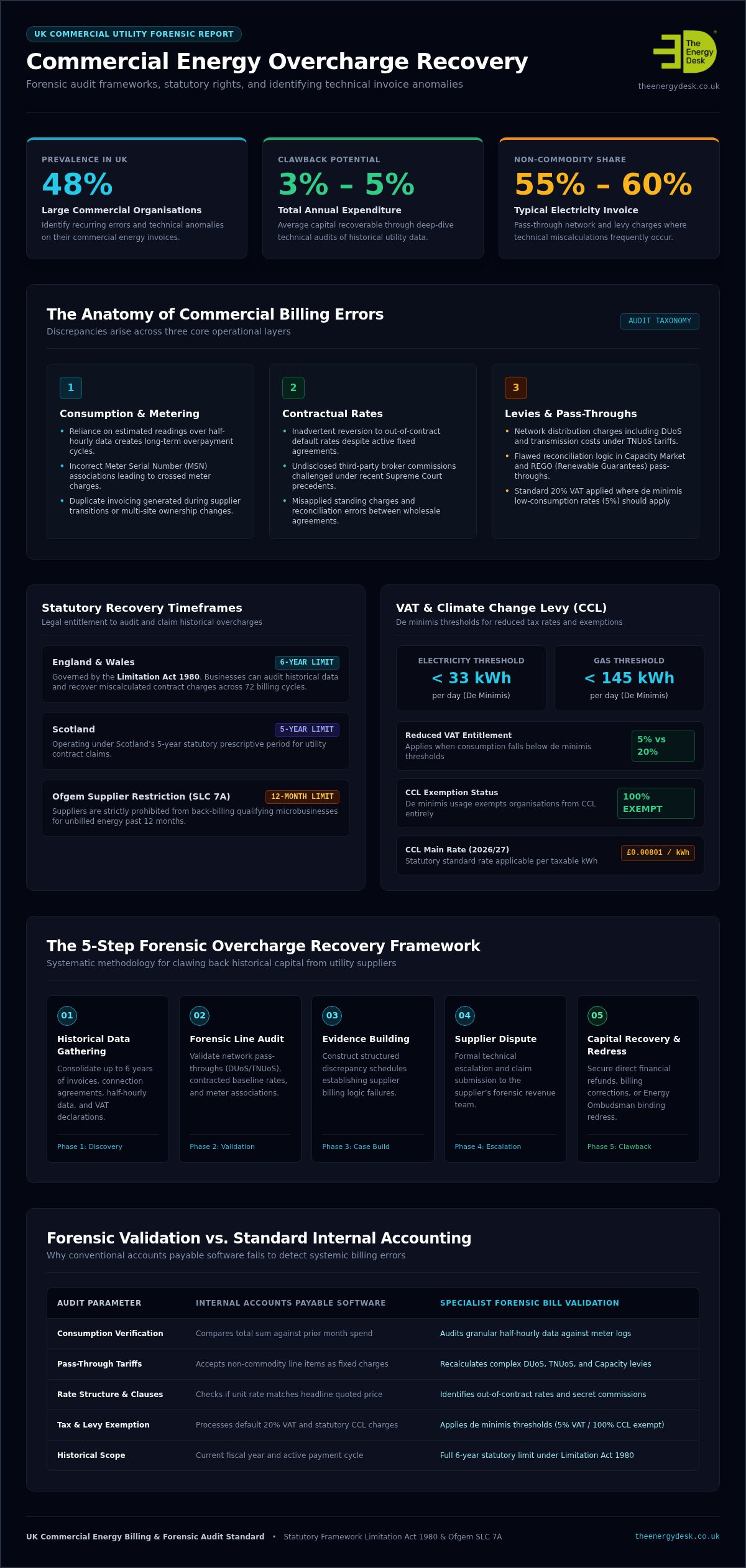
Commercial energy overcharges aren’t merely administrative oversights. Research indicates that up to 48% of large commercial organisations identify errors on their energy invoices. These discrepancies generally fall into three categories: incorrect consumption volume, misapplied contract rates, or errors in regulatory levies like the Climate Change Levy (CCL). In the UK, the business energy market is notoriously complex. Billing engines must juggle wholesale commodity costs alongside non-commodity charges that fluctuate frequently, creating a high margin for technical failure.
Small discrepancies might seem negligible on a single monthly invoice. However, when these errors persist across a multi-site portfolio, they accumulate into a significant capital drain. Forensic audits often reveal that historical utility errors account for 3% to 5% of total annual energy expenditure. A forensic recovery programme differs from a simple refund request because it involves a deep-dive technical audit. It identifies systemic faults that standard accounting software isn’t designed to detect. To recover business energy overcharges effectively, you must treat the process as a financial investigation rather than a customer service dispute.
Why Business Bills are More Complex Than Domestic
Commercial utility management involves layers of complexity that domestic consumers never encounter. Large organisations often manage multiple meters across various sites, increasing the margin for administrative error. Unlike domestic bills, commercial invoices include pass-through charges such as DUoS (Distribution Use of System) and TNUoS (Transmission Network Use of System). These non-commodity costs currently represent roughly 55% to 60% of a typical electricity bill. If a supplier relies on estimated readings rather than half-hourly data, it creates long-term overpayment cycles that can remain hidden for years.
The Legal Right to Recover Overpaid Funds
UK businesses have robust legal protections to reclaim their money. Under the Limitation Act 1980, companies in England and Wales have up to six years to audit historical data and claim back contractually miscalculated charges. In Scotland, this prescriptive period is five years. Whilst Ofgem billing regulations prevent suppliers from chasing microbusinesses for unbilled energy past 12 months under Standard Licence Condition 7A, the right for a business to recover its own overpayments extends much further.
Proving systemic billing faults requires structured evidence. You need historical data, including connection agreements and VAT declarations, to build a successful case. This historical context is vital. Without it, you cannot demonstrate to a supplier exactly where their billing logic failed. By taking a proactive stance, you can recover business energy overcharges and secure the long-term financial stability of your utility budget.
Identifying Common Technical and Contractual Billing Errors
Identifying the specific triggers that allow you to recover business energy overcharges requires a move beyond simple meter reading checks. Contractual rate errors are common. Suppliers may inadvertently revert a business to expensive out-of-contract rates despite a valid agreement being in place. Additionally, incorrect Meter Serial Number (MSN) associations often lead to crossed meters. This means you could be paying for a neighbour’s consumption without realising it. These administrative failures are often systemic. They require a line-by-line audit to uncover.
Duplicate billing is another frequent issue. It often occurs during supplier transitions or site ownership changes. A billing system might generate two invoices for the same period under different account numbers. Pass-through errors involving Renewable Energy Guarantees of Origin (REGO) or the Capacity Market can also inflate costs if the supplier’s reconciliation logic is flawed. Establishing a foundation through strategic energy procurement ensures your contracts are set up correctly from day one, reducing the risk of these errors.
Regulatory and Levy Overcharges
Taxation errors represent a significant portion of recoverable funds. By default, 20% VAT is applied to commercial invoices. However, if your consumption falls below the de minimis threshold of 33 kWh per day for electricity or 145 kWh for gas, you qualify for the reduced 5% rate. This status also grants a 100% exemption from the Climate Change Levy (CCL). For the 2026/27 tax year, the CCL main rate is £0.00801 per kWh for both gas and electricity. Organisations with Climate Change Agreements (CCAs) are entitled to substantial discounts, yet these are frequently ignored by supplier billing systems. Recent UK government business energy protections have aimed to increase transparency, but the burden of proof for historical overpayments remains with the consumer.
Network and Capacity Charges
Technical overcharges often stem from network-related costs. Following Ofgem’s Targeted Charging Review (TCR), residual network charges are categorised by capacity bands. Many businesses pay for an Authorised Supply Capacity (kVA) that far exceeds their actual peak load. This over-provisioning results in unnecessary standing charges and potential penalties for reactive power. Reactive power charges signal equipment inefficiency. They often appear as obscure line items that internal accounting teams overlook. Duplicated standing charges are another risk, particularly for multi-site portfolios where legacy meters haven’t been correctly decommissioned. Forensic analysis can identify these mismatches and provide the data needed to downsize capacity and reclaim overspent capital.
Forensic Bill Validation vs. Internal Accounting
Standard enterprise accounting software is designed for general ledger accuracy, not technical utility validation. Whilst your internal finance team may be proficient at matching invoices to purchase orders, they often lack the specialised tools required to recover business energy overcharges hidden within complex data sets. General AP systems cannot verify whether a supplier has applied the correct DUoS time-band or if a kVA capacity charge aligns with your actual peak load. Forensic bill validation goes beyond surface-level arithmetic to scrutinise the underlying logic of every line item against real-time market data and contractual obligations.
The Limitations of Standard Bill Checking
Most internal teams operate without access to comprehensive industry-specific rate libraries. This makes it nearly impossible to verify the accuracy of pass-through costs or non-commodity levies that change annually. A common failure point is the lack of cross-referencing between invoices and DC/DA energy services. Without direct access to your Data Collector’s raw files, you cannot prove that a supplier’s estimated consumption figures are inflated. These estimates often distort financial reporting for months, leading to significant budget variances that general accounting software simply cannot flag.
The Power of Forensic Auditing Tools
Professional auditing platforms scan thousands of data points instantly. They identify subtle patterns, such as out of contract rate spikes or incorrect VAT applications, that would take a human auditor weeks to find. Forensic validation is a multi-layered check against contract terms, meter data, and market regulations. This level of oversight is essential for historical auditing, especially when searching for patterns across multiple years of invoices. Under the Limitation Act 1980, businesses in England and Wales have a six-year window to reclaim funds, whilst the period in Scotland is five years.
Identifying these systemic errors often reveals that 20% of commercial invoices contain technical or contractual inaccuracies. If a supplier reaches a deadlock during a dispute, you can escalate the case through the Energy Ombudsman dispute resolution framework. The cost-benefit analysis of professional energy consultancy is clear. The potential to recover business energy overcharges usually far outweighs the audit costs, transforming your utility management from a reactive expense into a proactive financial strategy.
The 5-Step Framework to Recover Your Business Energy Overcharges
Recovering thousands in overpaid utility costs requires a disciplined, methodical approach. Informal phone calls to supplier helplines rarely yield results for complex commercial disputes. Instead, you need a forensic 5-step framework designed to overcome supplier resistance and secure a full rebate. This structured methodology ensures that every technical anomaly is documented and presented in a format that supplier billing departments cannot easily dismiss.
Step 1: Comprehensive Data Collection. Start by gathering at least six years of historical invoices and original contract terms. Even if you’ve switched suppliers, you maintain a legal right to access your consumption data. Step 2: Technical Analysis. Cross-reference your invoices against half-hourly data and regulatory levy rates. This identifies the specific triggers, such as misapplied CCL discounts or excess kVA capacity, that allow you to recover business energy overcharges. Step 3: Formal Dispute Submission. Submit a forensic evidence pack to the supplier’s specialist billing team. This pack must clearly outline the technical grounds for the claim to avoid immediate rejection. Step 4: Supplier Negotiation. Manage the dialogue through to a resolution. If a supplier reaches a deadlock or fails to respond within eight weeks, escalate the matter. Step 5: Settlement Verification. Once a settlement is agreed, verify that the funds are correctly applied via credit note or direct payment and ensure future billing cycles are corrected.
Gathering the Necessary Evidence
To build a robust case, you must secure original renewal notices and connection agreements. Supplier dispute departments require structured data that mirrors their own internal settlement logic. If you lack these records, a professional audit can help retrieve historical consumption files from independent data collectors. Organising this data chronologically allows you to pinpoint exactly when a billing error began, which is vital for calculating the total value to recover business energy overcharges.
Negotiating with Energy Suppliers
Suppliers often use stalling tactics, such as requesting redundant information or claiming that billing is within industry tolerances. Recognising these patterns is essential for a successful outcome. If the supplier refuses to acknowledge a technical error after eight weeks, the Energy Ombudsman can provide a binding resolution for eligible businesses. Always clarify whether the settlement will be a credit against your account or a direct cash payment to your business bank account. Direct payments are often preferable for maintaining healthy cash flow.
To begin your recovery process, request a free energy audit to identify potential billing errors today.
Strategic Prevention: How to Stop Overcharging Before It Happens
Whilst the ability to recover business energy overcharges retrospectively is a powerful financial tool, the ultimate objective for any organisation should be the total elimination of future billing errors. Moving from a reactive recovery mindset to a proactive management strategy requires a fundamental shift in how utility data is handled. Implementing automated bill validation as a standard operational procedure ensures that technical anomalies are flagged before payment is even authorised, protecting your cash flow from the outset.
A robust foundation for accuracy begins with strategic energy procurement. This process ensures that your contract terms, VAT status, and capacity requirements are correctly established from day one. Failing to monitor contract end dates often results in a transition to expensive out of contract energy rates, which can double your unit costs overnight. By leveraging the expertise of energy procurement consultants, you gain ongoing oversight that standard internal accounting teams simply cannot provide.
The Role of Technology in Bill Accuracy
Smart metering and Automated Meter Reading (AMR) technology serve as your first line of defence against estimation errors. As the UK energy market progresses through the final stages of Market-wide Half-Hourly Settlement (MHHS) migration in 2026, the reliance on granular data has never been higher. Real-time energy monitoring allows you to catch discrepancies within the same billing month, rather than waiting for a retrospective audit years later. For multi-site organisations, centralising utility data into a single source of truth is essential. It eliminates the risk of duplicated standing charges and ensures that every meter serial number is correctly associated with its respective site.
Partnering with The Energy Desk for Long-Term Protection
The Energy Desk acts as a strategic ally, simplifying the technical complexities of the B2B energy market. Our methodology involves validating every invoice against 25 distinct data points before payment is approved. This disciplined approach not only helps you recover business energy overcharges from the past but also secures your infrastructure for the future. Our independent consultancy status ensures that our focus remains entirely on your operational success and cost-efficiency.
Identifying immediate recovery opportunities is the first step toward professional utility management. We provide a comprehensive energy audit to help you understand your current exposure and identify historical billing failures. Contact The Energy Desk today or call 03330 151 221 to begin your forensic recovery process and secure long-term protection for your business capital.
Securing Your Financial Future Through Utility Oversight
Managing commercial energy costs effectively requires more than just paying invoices on time. It demands a forensic approach to data that identifies hidden technical errors and regulatory miscalculations. By leveraging the 6-year statutory limitation period, your organisation can recover business energy overcharges that standard accounting software often misses. Transitioning from reactive bill checking to proactive validation ensures that your capital remains within the business rather than being lost to supplier billing failures.
The Energy Desk brings over 20 years of industry expertise to every investigation. As specialists in forensic bill validation with national UK coverage, we simplify technical complexities to protect your bottom line. It’s time to take control of your utility expenditure and ensure every pound spent is accurate. Request your free forensic energy audit from The Energy Desk today to begin your recovery journey. We’re ready to help you secure the funds your business deserves and establish a foundation of long-term efficiency.
Frequently Asked Questions
How far back can a business claim for energy overcharges?
Businesses in England and Wales can reclaim overcharges for up to six years under the Limitation Act 1980. For organisations based in Scotland, the prescriptive period is five years according to the Prescription and Limitation (Scotland) Act 1973. This window allows for a comprehensive historical audit of technical and contractual errors. It’s vital to act within these statutory limits to ensure that your right to recover business energy overcharges remains legally enforceable.
What is the average amount a business can recover from energy billing errors?
While total recovery values vary based on consumption volume, forensic audits typically reveal that historic utility errors account for 3% to 5% of a company’s total annual energy expenditure. For large-scale industrial users or multi-site portfolios, this often translates into multi-thousand or even seven-figure recovery opportunities. These funds are usually recovered through a combination of technical line-item corrections and historical contract reconciliations across the six-year audit window.
Can I recover overcharges if I have already switched to a new supplier?
You can absolutely recover overpaid funds even if you have already switched to a new supplier. Your legal right to audit historical billing data and reclaim contractually miscalculated charges remains valid for the full statutory period. Switching suppliers doesn’t extinguish the previous provider’s obligation to rectify billing errors or refund overcollected levies and commissions identified during a forensic audit. Accessing historical data is still possible through independent data collectors.
What documents do I need to start an energy overcharge recovery claim?
To initiate a claim, you should gather at least six years of historical invoices and your original contract terms. Other essential documents include renewal notices, connection agreements, and VAT declarations. If you lack these records, a professional audit can often retrieve consumption data directly from independent data collectors. Having a structured evidence pack is crucial for overcoming supplier resistance and proving systemic billing faults during the formal dispute process.
How long does the energy recovery process typically take?
The duration of the recovery process depends on the complexity of the technical errors and the supplier’s responsiveness. Typically, a forensic audit takes a few weeks, after which a formal dispute is submitted. Suppliers have a standard eight-week window to provide a final response or deadlock letter. If the case requires escalation to the Energy Ombudsman, the entire process could take several months to reach a final, binding resolution.
Is a forensic energy audit expensive for a mid-sized company?
A forensic energy audit is a cost-effective exercise, particularly as The Energy Desk offers a free initial audit to identify potential recovery opportunities. This low-friction entry point allows mid-sized companies to assess their exposure without upfront financial risk. The subsequent recovery of overpaid funds usually far outweighs any associated consultancy fees, transforming utility management into a proactive strategy that strengthens your business’s overall cash flow and operational efficiency.
What happens if the energy supplier refuses to acknowledge the overcharge?
If a supplier refuses to acknowledge a valid overcharge, you can escalate the dispute to the Energy Ombudsman. Eligible small and mid-sized businesses can access this free, independent service to secure binding financial awards of up to £20,000 for non-domestic disputes. For larger claims or complex legal breaches, such as undisclosed broker commissions, professional consultancy can guide you through the appropriate judicial channels to ensure a successful recovery of your overpaid capital.
Can overcharges occur on both gas and electricity accounts?
Overcharges frequently occur on both gas and electricity accounts. While electricity bills often contain technical errors related to kVA capacity and DUoS time-bands, gas invoices are prone to miscalculated volume corrections and incorrect Climate Change Levy applications. A comprehensive strategy to recover business energy overcharges must examine both fuel types to ensure that every regulatory exemption and contractual rate is applied accurately across your entire multi-site or single-site portfolio.