


A meter can be working properly while the data reaching your energy supplier is incomplete or unclear. That’s why DC DA energy services matter: they help make meter data usable, whilst Meter Operator (MOP) services focus on the meter itself.
If you’re unsure who collects your consumption data, who checks it or how it reaches your supplier, you’re not alone. These roles are easy to confuse, but unclear responsibilities or unreliable readings can make it harder to understand bills and report on energy use. The key distinction is simple: a Data Collector retrieves and processes meter data, a Data Aggregator prepares it for relevant supplier and market processes, and a MOP provides meter-related operational services.
This guide explains those responsibilities in plain English and shows how DC and DA services differ from MOP support. You’ll also learn what to check in your metering and energy contracts, how to investigate gaps or inconsistencies in your data, and what to do if it’s unclear who is responsible. That gives you a clearer basis for reviewing your current arrangements and deciding whether they meet your business’s needs.
Key Takeaways
- DC DA energy services help move meter data through collection, checking and preparation, whilst MOP services focus on the meter.
- Check your contracts and appointment records to confirm which organisations handle each role at every site.
- Investigate missing readings, unexplained estimates and inconsistent records before assuming the meter or bill is at fault.
- Map your meters and data needs first, then compare support based on access, reporting, issue escalation and contract clarity.
- Clear ownership of meter data can help your business make better-informed decisions about its energy arrangements.
What are DC DA energy services, and why does business meter data need them?
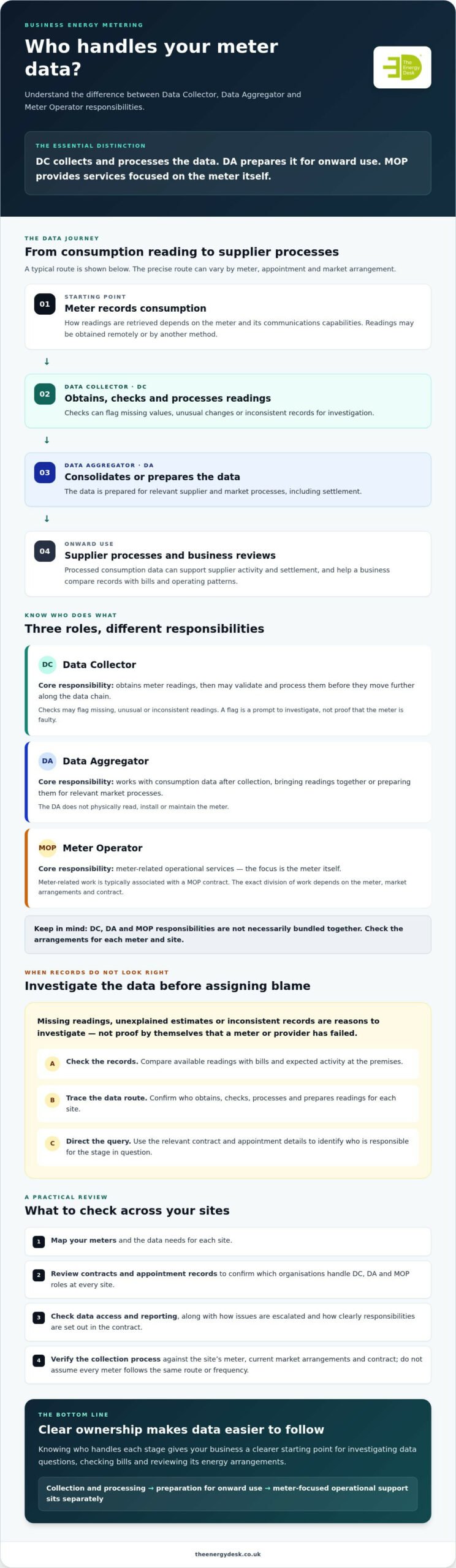
DC, DA and MOP often appear together in business metering arrangements, but they describe different responsibilities. A Data Collector (DC) gathers and processes meter readings; a Data Aggregator (DA) consolidates or prepares consumption data for relevant supplier and market processes; a Meter Operator (MOP) deals with the meter itself. The precise division of work depends on the meter, market arrangements and contract.
In short, DC services handle the collection and processing of meter data, whilst DA services prepare that data for onward use. Clear records can support supplier processes, help businesses check bills and provide a better basis for monitoring energy use. Gaps or unexpected estimates are reasons to investigate the readings and confirm who is responsible, not proof by themselves that a provider or meter has failed.
What does a Data Collector do?
A DC obtains meter readings through the applicable metering process, then may validate and process them before they move further along the data chain. Checks can flag missing, unusual or inconsistent readings for investigation. The Data Collector (DC) role is described in relation to UK electricity settlement, including its connection with the DA role. The equipment, reading method and precise service scope can differ between sites and arrangements.
What does a Data Aggregator do?
A DA works with consumption data after collection, bringing readings together and preparing them for relevant market processes, including settlement. Depending on the arrangements, this may involve checking or consolidating records. The DA does not physically read, install or maintain the meter. Those functions sit elsewhere in the metering arrangements, with meter-related work typically associated with a MOP contract.
These roles matter because meter data can support supplier billing and settlement processes, while businesses can use it to review patterns of consumption. If a bill contains an estimate or records don’t match expected usage, knowing where the data came from and who handles each stage helps you direct your query. However, don’t assume every site follows the same process or that DC, DA and MOP responsibilities are bundled together. Check the relevant contracts and appointment details for each meter.
In practice, DC DA energy services form part of a chain: readings are collected, processed and passed on in line with the applicable arrangements. Establishing who owns each step gives your business a clearer starting point for resolving data questions and reviewing its metering support.
How DC and DA services move business energy data from meter to market
Meter data usually passes through several stages before it can support supplier processes or your own energy reviews. In a typical arrangement, the meter records consumption, a Data Collector obtains and checks the readings, a Data Aggregator consolidates or prepares the data, then it is made available for relevant supplier and settlement processes. The precise route can vary by meter, appointment and market arrangement, so check how it works for each site.
From meter reading to validated consumption data
Readings may be retrieved remotely or by another method, depending on the meter and its communications capabilities. The DC processes the readings and can check for issues such as missing values, unexpected changes or records that don’t fit the expected pattern. A flagged reading is a prompt to investigate, not proof that the meter is faulty.
The data can then be passed to a DA, which may consolidate or prepare it for onward use. The parties involved and the timing or frequency of collection can differ. In particular, verify any claims about half-hourly data collection against the site’s meter, current market arrangements and contract. Don’t assume every business meter follows the same process.
How data supports billing and energy management
Once processed, consumption data can support supplier activity and settlement, and give your business a record to compare with bills and operating patterns. For example, if a site’s reported usage changes sharply, comparing the data with activity at the premises may help identify a genuine shift or a discrepancy that needs checking.
Data services don’t guarantee lower bills or automatically correct an invoice. If a bill contains an unexplained estimate or doesn’t appear to match the available readings, check the relevant records and ask the responsible parties to investigate. Commercial utility bill validation can also be relevant when reviewing charges alongside consumption information.
A data problem may originate at different points: the meter may not record as expected, communications may interrupt transmission, an appointment or account detail may be incorrect, or the billing process may need review. Trace the issue through the chain before deciding what needs to change. Clear DC DA energy services arrangements can help your business understand who handles each stage and where to direct questions. To review your support options, explore business DC/DA services.
DC vs DA vs MOP: which business energy service handles each responsibility?
DC, DA and MOP roles are connected, but appointing one provider doesn’t necessarily cover every metering responsibility. Use the comparison below as a guide, then check the arrangements recorded for each meter. Exact duties can depend on the meter, supplier, market setup and contract wording.
| Role | Primary function | Typical focus | Questions to ask |
|---|---|---|---|
| Data Collector (DC) | Collects and processes meter readings under the applicable arrangements. | Data completeness, validation and handling of readings. | Who obtains the readings, and how are gaps or unusual values flagged? |
| Data Aggregator (DA) | Consolidates or prepares consumption data for relevant supplier and market processes. | Organising collected data for onward use, including settlement processes where applicable. | Who prepares the data, and where is it sent? |
| Meter Operator (MOP) | Provides meter-related operational services as set out in the relevant arrangements. | The meter and its operation, rather than the handling of consumption data. | What meter work is included in the contract, and who should be contacted about a meter issue? |
How is a Data Collector different from a Meter Operator?
A DC handles meter data. A MOP’s work concerns the meter itself, with specific responsibilities defined by the applicable agreement and site setup. For example, a question about a missing reading may need to go to the party responsible for data collection, while a physical meter concern may involve the MOP. Review your Meter Operator (MOP) contracts and appointment records to confirm the boundaries of each service.
Do businesses need separate DC and DA arrangements?
Not necessarily. The setup depends on the meter, supplier and relevant market arrangements, so businesses shouldn’t assume they can select or change each role independently. Some responsibilities may be arranged together, while others may be recorded separately. Before making changes, confirm which organisations are appointed for each meter and what your contracts say about scope, term and any change process.
As a practical check, match each site’s meter details to its supplier and metering records. Ask who collects readings, who handles data preparation, who manages meter-related work and where to raise a query. Clear answers help expose gaps between agreements and avoid treating DC DA energy services as a substitute for MOP support, or vice versa.
How to review your DC DA energy services and spot data problems
Start by checking what’s in place before requesting a change. A clear record of each site, meter and appointed service provider can help you direct questions to the right organisation and distinguish a data issue from an invoice query.
What should you check in contracts and appointment records?
Review your energy and metering contracts alongside appointment records. Note the named roles, responsible organisations, contract dates and contact routes. Check that site details and meter identifiers match across documents, bills and supplier records. If the wording is unclear or records conflict, ask the relevant supplier or service provider to confirm the current arrangement before making changes.
- List each site and its meter identifiers.
- Record the appointed DC, DA and MOP, where applicable.
- Check contract dates, service scope and how to raise a query.
- Keep recent bills and available meter-data records together for comparison.
Which signs may indicate a metering-data issue?
Missing readings, repeated estimates, irregular gaps or consumption records that differ from your internal monitoring are useful prompts to investigate. They don’t prove a meter or service has failed. Compare records for the same site and period, and note when the discrepancy appears. If it remains unexplained, contact the responsible supplier or agent and retain the documents and correspondence.
Before raising a query, gather the site and meter details, relevant dates, bills, available readings or data records, and a concise description of what seems inconsistent. Ask which party owns the next step and when you should expect an update. This gives the supplier, agent or energy adviser a specific issue to review.
Keep data-quality checks separate from invoice checks. A missing or unexpected reading concerns the data trail; a charge that appears incorrect needs to be checked against the bill and contract. Commercial utility bill validation may help with invoice review, but it doesn’t replace investigating the source of a data discrepancy.
If your DC DA energy services responsibilities or data records are unclear, discuss your business metering requirements with The Energy Desk.
Choosing DC DA energy services: practical next steps for your business
The right support depends on your sites, meters and operational needs. Before comparing providers, build a clear picture of what you have and what you need the data to do. A structured review can help you identify gaps without changing arrangements prematurely.
- Map your sites and meters. List each site, meter identifier, supplier and any known metering appointments.
- Confirm current roles. Check contracts and appointment records to establish who handles each responsibility, and note any unclear service boundaries.
- Define your data needs. Consider who needs access, how often you review consumption, and what information supports your internal reporting.
- Compare support against those needs. Review the proposed scope, data access, reporting, issue escalation routes and contract terms.
This gives you a practical basis for comparing DC DA energy services. A suitable arrangement should make clear which sites and roles are covered, how data can be accessed, how concerns are raised and who is responsible for responding. Check how the proposal fits with existing MOP, supplier and bill-validation arrangements rather than assessing it in isolation.
Questions to ask a DC/DA service provider
Ask which sites and service roles the proposal covers, what meter or account information is needed, and how missing or unusual data is investigated and communicated. Clarify who you contact if an issue remains unresolved. Also ask how the proposed arrangement fits with your existing MOP contract, supplier processes and invoice checks. Confirm any market-specific details against your metering setup and written agreements.
When should you seek specialist support?
Consider getting advice if you can’t establish who owns a service, if records don’t match across sites, or if recurring data gaps remain unresolved. The Energy Desk provides DC/DA services alongside MOP contracts and commercial bill validation as part of its business energy and metering support. It acts as an adviser, not a direct energy supplier. Confirm service scope and responsibilities against your particular arrangements.
Prepare your site and meter list, relevant contracts, recent data records and any questions you’ve already raised. This helps keep a discussion focused on your business requirements. Contact The Energy Desk to discuss your DC/DA requirements.
Put clearer metering support in place
Reliable energy data starts with knowing who handles each stage. DC and DA services manage the collection and preparation of meter data, whilst MOP services relate to the meter itself. Responsibilities can vary by site and contract, so check your appointments and records before changing arrangements.
Use your review to identify what your business needs from its data, confirm how issues are escalated and ensure the service scope is clear. Well-organised records also give you a stronger starting point when investigating missing readings or bill discrepancies.
The Energy Desk provides DC/DA services alongside MOP contracts and bill validation, with business energy support nationally across the UK. To discuss how your current setup fits your requirements, contact The Energy Desk about your business DC/DA requirements or call 03330 151 221.
Frequently Asked Questions
What does DC mean in business energy services?
DC means Data Collector, the role responsible for collecting and processing meter readings under the applicable metering arrangements. This may include checking readings for missing or unusual values before the data moves through the relevant process. The exact method and scope depend on the meter and agreement, so check your appointment records to see which organisation handles the role at each site.
What does DA mean in energy metering?
DA means Data Aggregator. The DA works with collected consumption data, consolidating or preparing it for relevant supplier and market processes, including settlement where applicable. It’s a data-handling role, not a service that physically reads or maintains the meter. The precise tasks can vary with market arrangements and contracts, so confirm the DA’s scope for your meters rather than relying on the job title alone.
What is the difference between DC, DA and MOP services?
A DC collects and processes readings, a DA consolidates or prepares consumption data for onward use, and a Meter Operator (MOP) provides meter-related operational services under its agreement. These roles are related but aren’t interchangeable, and one appointment doesn’t necessarily cover every responsibility. Check your contracts and records to establish who handles data, who manages the meter and where to direct questions about a discrepancy.
Does every business need separate DC and DA services?
No. Whether DC and DA responsibilities are arranged separately depends on the meter, supplier and market setup. Some arrangements may group responsibilities, while others identify different appointed parties. Don’t assume your organisation can independently choose or change every role. Review the appointment records for each meter and check contract wording first. If the arrangement is unclear, ask the supplier or relevant service provider to confirm it.
How can I check whether my business energy meter data is accurate?
Compare available meter readings or consumption records with the same periods on your bills and internal monitoring. Look for missing readings, unexplained estimates, gaps or usage that differs from expected site activity. These are prompts to investigate, not proof of a faulty meter. Note the dates and meter identifiers, keep copies of relevant records, then ask the responsible supplier or agent to explain any unresolved mismatch.
What is Market-wide Half-Hourly Settlement and does it affect my business?
Market-wide Half-Hourly Settlement (MHHS) is a change to how electricity consumption data is used for settlement in Great Britain, moving towards half-hourly data across the market. The transition is under way, with suppliers required to migrate customers’ meters by 7 May 2027. The practical effect for your business depends on its meter and supplier arrangements. Ask your supplier how the transition applies to your sites and contracts.
Can The Energy Desk help with DC DA energy services?
Yes. The Energy Desk lists DC/DA services alongside MOP contracts and bill validation as part of its support for business customers. Confirm the exact service scope and responsibilities against your meters and existing arrangements. The company provides business energy support nationally across the UK and acts as an adviser, not a direct energy supplier. Share your site details and questions to discuss what support may fit your requirements.