

What if the invoice total looks wrong, but the explanation is buried in the half-hourly data? Knowing how to read a half-hourly electricity bill means tracing the figures from meter intervals through your contract rates and charges, rather than checking only the final amount. That can be difficult when an invoice combines usage data, industry charges and metering details.
A difference isn’t automatically a billing error. It may come from the rate applied, the meter setup or a charge that needs checking against your contract and supporting records.
This guide explains the main sections and terms on a business electricity bill, then shows how to compare half-hourly consumption, rates and charges with meter and contract records. You’ll also learn which discrepancies to investigate and when bill validation or metering support may help you reconcile the figures.
Key Takeaways
- Learn how to read a half-hourly electricity bill by tracing consumption through the applicable contract rates and invoice charges.
- Check invoice dates, MPAN and meter details before comparing billed kWh with available interval data.
- Understand why standing, network and tax charges may not change with each half-hourly reading.
- Use your contract and supporting meter records to investigate estimates, data gaps or charges that don’t reconcile.
- Know when to seek supplier clarification or consider bill validation and metering support for recurring or complex discrepancies.
What a half-hourly electricity bill shows about your business usage
A half-hourly electricity bill is a business invoice supported by meter data recording consumption in 30-minute intervals. It shows energy used in kilowatt-hours (kWh) and the charges applied under the supply contract. The half-hourly description refers to the data intervals, not necessarily to a separate invoice format or a line-by-line record of every interval.
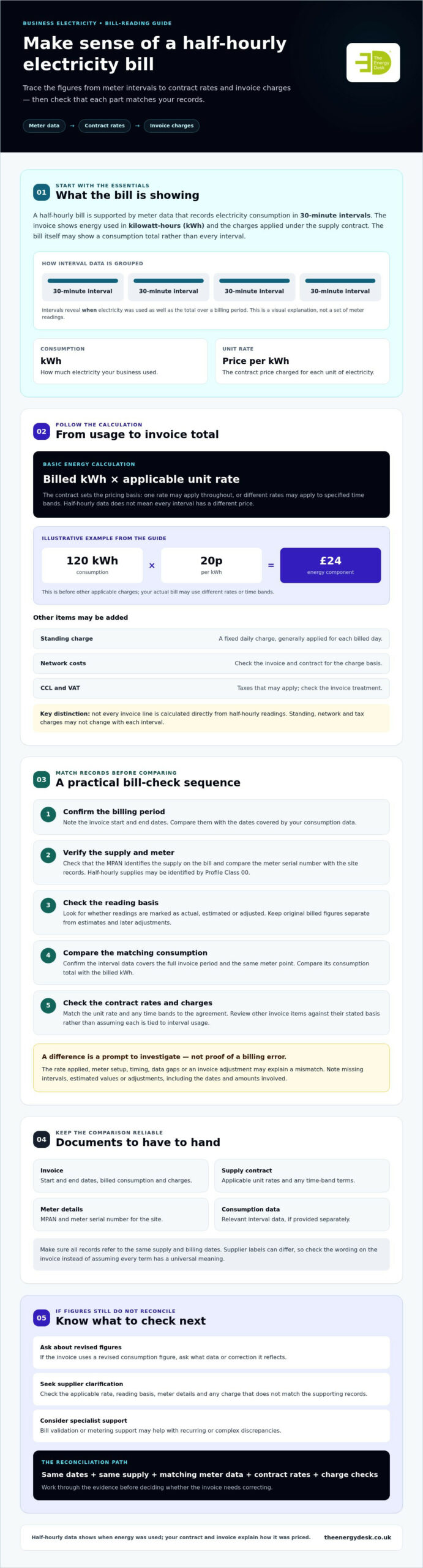
Keep two figures distinct: kWh measures how much electricity your business used, whilst the unit rate is the price charged for each kWh. For example, 120 kWh at an illustrative rate of 20p per kWh equals £24 for the energy component, before other applicable charges. Your actual bill may use different rates or time bands, depending on the contract.
What makes a half-hourly meter different?
Interval readings show when electricity was consumed as well as the total used over a billing period. This helps you connect patterns of demand with the usage figures on an invoice, although the detail shown can vary. Find the supply’s Meter Point Administration Number (MPAN) on your records. MPAN information identifies the electricity supply and can include a profile class; half-hourly supplies may be identified by Profile Class 00.
The meter arrangement, contract and supplier’s bill format all affect the information provided. Some invoices show a consumption total, whilst interval-level data may need to be obtained separately. Don’t assume a bill without a visible list of 30-minute readings isn’t supported by half-hourly data.
Which documents and details should you have to hand?
Before working out how to read a half-hourly electricity bill, gather the invoice, supply contract, meter details and available consumption data for the same period. Check that the documents refer to the same supply and billing dates. These checks help prevent you comparing a correct invoice figure with records for another meter or period.
- Billing period: note the invoice start and end dates.
- MPAN: use it to confirm which electricity supply the bill covers.
- Meter serial number: compare it with the meter details held for the site.
- Reading basis: check whether the invoice identifies readings as actual, estimated or adjusted.
- Consumption data: have the relevant interval data available, if provided separately.
Labels can differ between suppliers, so check the wording on the invoice rather than assuming each term has a universal meaning. Keep original billed figures separate from estimates and later adjustments. This makes it easier to identify which data the invoice calculation relies on.
How half-hourly electricity usage becomes charges on the invoice
The basic energy calculation is billed kWh × applicable unit rate. The invoice then adds other relevant items, which may include a standing charge, network costs, taxes and VAT. The contract determines how consumption is priced: one unit rate may apply throughout, or different rates may apply to specified time bands. Half-hourly data shows when electricity was used, but it doesn’t mean every interval has a different price.
Elexon’s Half Hourly Meter glossary entry explains the metering term. For billing, establish which consumption period and pricing terms the invoice uses. Not every line is calculated directly from interval readings, so check the contract and the invoice’s stated basis before linking a charge to a particular usage pattern.
How to match consumption data with the billed period
Compare the invoice start and end dates with the dates covered by your half-hourly data. Confirm that both refer to the same meter point, and check whether the consumption total covers the full billing period. A data file for a different date range or supply won’t provide a reliable comparison.
Look for missing intervals, estimated values or adjustments, and note the dates and amounts involved. If the invoice uses a revised consumption figure, ask what data or correction it reflects. Record the issue rather than assuming a difference is an error: timing, meter records and invoice adjustments can all affect the comparison.
What common bill terms mean
- Billed consumption: the kWh quantity charged for the invoice period. Check it against the matching meter data.
- Unit rate: the contract price per kWh, sometimes varying by time band. Compare the rate and applicable time periods with your agreement.
- Standing charge: a fixed daily charge, generally applied for each billed day rather than calculated from half-hourly usage.
- CCL and VAT: the Climate Change Levy is a tax on energy use where applicable. VAT treatment can depend on the supply and circumstances, so check the invoice’s tax lines and basis.
- DUoS, TNUoS and capacity-related charges: network or capacity items whose labels, calculation and applicability can vary. Compare them with the contract and bill notes rather than treating them as unit-rate charges.
Check each line against its stated calculation, period and contractual basis. If charges remain unclear, commercial bill validation may help assess whether the invoice aligns with your usage records and agreed terms.
Why a half-hourly bill total may not match a simple usage calculation
Half-hourly data doesn’t mean every charge on your invoice changes every 30 minutes. Your usage may be recorded in intervals, but the bill can combine consumption-based energy charges with fixed charges, network items, taxes and adjustments. The calculation depends on your contract and how each line is billed.
Metered consumption charges are based on recorded electricity use; fixed or separately calculated charges may follow a different basis. That’s why multiplying total kWh by one unit rate may not reproduce the full invoice total. To understand how to read a half-hourly electricity bill, check each line against its stated period, calculation and contractual basis.
Which charges are linked to consumption and which may not be?
| Invoice item | Possible basis | What to check |
|---|---|---|
| Energy | Billed kWh multiplied by the applicable unit rate, which may vary by time band. | Compare the consumption, rate and time periods with the contract and meter data. |
| Standing charge | A fixed charge applied for the billed period, rather than a charge for each interval of use. | Check the daily rate and number of days invoiced against the contract and dates. |
| Network-related charges | May be linked to consumption, capacity or another specified basis. The method and presentation can vary. | Review the bill breakdown and contract for the charge’s calculation and applicability. |
| Taxes, including CCL and VAT | Applied according to the relevant tax treatment and invoice calculation. | Check the taxable amounts, rates and any stated exemptions or adjustments. |
Don’t assume every supplier presents network or pass-through charges in the same way. A line may cover a different period from the energy charge or appear as a separate adjustment. Use the invoice notes and contract to identify what applies to your account.
How to interpret differences between data and invoice totals
Before raising a dispute, check that the invoice and data cover the same dates and meter point. Confirm the units and applicable rates and time bands, then look for estimated readings, corrections or adjustment lines that could explain the difference. A later data update may also affect a billed figure, depending on the supplier’s process and invoice basis.
Where available, compare the invoice with consumption records from the supplier or appointed data service. Keep a concise record of the discrepancy, including the relevant dates, meter identifier, figures and invoice line. Ask the responsible supplier or agent for a written explanation and retain their response with the supporting records.
How to check a half-hourly electricity bill step by step
Use a consistent process to trace invoice figures back to the supply, meter data and contract. If you’re working out how to read a half-hourly electricity bill, keep the records together and note what you’ve checked. This makes differences easier to explain and follow up.
A practical reconciliation checklist
- Confirm the invoice period and supply. Check the billing start and end dates, supply address and MPAN against your business records.
- Verify the meter identity. Compare the meter serial number on the invoice or meter records with the equipment serving the supply. If you manage several meters, confirm you’re checking the right one.
- Match the consumption data. Compare billed kWh with interval data covering the same dates and meter point. Note missing intervals, estimated values or data that covers only part of the billing period.
- Check the contract rates. Compare the unit rates and any time bands on the invoice with the agreed terms for the billing period. Check for a contract change or rate variation if the dates cross a changeover.
- Review other charges separately. Check standing charges, applicable taxes, network items and adjustments against the invoice breakdown and contract. Don’t treat these as part of the consumption calculation unless the bill identifies them that way.
Start with the supply identifiers and dates. A correct calculation against the wrong meter or billing period won’t confirm that the invoice is accurate.
What to do when you find a discrepancy
Before contacting the supplier, record the invoice reference, affected dates, meter identity and the specific figure you can’t reconcile. Explain what you expected to see and why, then attach relevant interval records or readings. Ask for the calculation basis and a written explanation of any estimates, missing data or adjustments.
Keep a dated record of your questions, the supplier’s responses and any revised calculations or corrected invoices. This gives you a clear history if the issue continues or needs further review. For recurring discrepancies, multiple meters or a charge structure you can’t verify, independent bill validation can help assess the invoice against the available records and contract.
If you can’t confidently reconcile your business electricity charges, request commercial bill validation to help review the invoice and supporting information.
When bill validation or metering support can help your business
Start with a supplier query if you’ve found one clear discrepancy and can support it with an invoice reference, relevant dates and meter data. A written explanation may resolve a question about a rate, reading or adjustment. Further review can be useful when figures repeatedly fail to reconcile, several meters or sites are involved, or the charge structure remains unclear after you’ve checked the contract and bill.
Knowing how to read a half-hourly electricity bill gives you a useful first check, but it may not explain every issue in the metering and billing arrangements. Bill validation examines charges against available invoices, contracts and consumption records. It can help identify items that need clarification; it doesn’t guarantee savings, a refund or recovery of charges.
When to seek bill validation or data support
Consider a more detailed review if the same unexplained difference appears across invoices, if bills cover multiple meters, or if you can’t establish which data or calculation a charge relies on. Gather the relevant invoices, contract terms, meter details, consumption files and supplier correspondence. Clear supporting evidence helps a reviewer distinguish a billing question from a data or contract issue.
Metering responsibilities may involve different appointed parties. A Meter Operator (MOP) is associated with the meter and its operation, whilst Data Collector and Data Aggregator roles relate to consumption data and its handling. The exact arrangements and terminology can depend on your supply setup, so check your contract and current appointment records to confirm who does what. If you need context on meter operator responsibilities, consult a suitable MOP contracts guide.
Choosing the next step for your organisation
- Self-check: Appropriate for a straightforward invoice where the supply details, period, usage and rates are easy to compare with your records.
- Ask the supplier: A practical next step for an isolated, clearly evidenced discrepancy. Include the affected dates and figures, and request the calculation basis in writing.
- Seek independent validation or metering support: Consider this for repeated discrepancies, multiple supplies, complex adjustments or uncertainty about which party holds the relevant data.
The Energy Desk lists bill validation and metering-related services, including MOP contracts and DC/DA services, for UK businesses. Procurement and bill checking are separate tasks: procurement concerns contract arrangements, whilst validation examines whether charges align with the records and terms available for review. Confirm the scope of any support before proceeding, particularly if you need a specific data or metering issue investigated.
Make your next bill check more straightforward
To understand how to read a half-hourly electricity bill, match billed consumption to the relevant meter data, then check rates and other charges against the contract. Remember that interval data doesn’t mean every invoice charge is calculated every 30 minutes. Comparing the same dates and supply details can help you identify questions worth raising.
If a discrepancy remains unclear, keep the supporting records and request an explanation from the supplier. Repeated issues, several meters or complex charge structures may call for a more detailed review. Bill validation and energy procurement are distinct tasks, but reviewing the bill can help inform wider decisions about your energy arrangements.
The Energy Desk lists bill validation and energy auditing among its business services. Request a free business energy audit or call 03330 151 221 to discuss your requirements.
A consistent checking process and well-organised records can make it easier to understand each invoice and follow up on questions.
Frequently Asked Questions
What is a half-hourly electricity bill?
A half-hourly electricity bill is a business invoice supported by consumption data recorded in 30-minute intervals. The interval data shows when electricity was used as well as the total billed consumption, but the invoice may not display every reading. Half-hourly metering describes the data intervals, not a separate bill layout. The supply details, contract and supplier determine how readings and charges appear on the invoice.
How do I calculate electricity charges from half-hourly meter readings?
Multiply the billed kWh by the applicable unit rate, then account for other relevant invoice charges. If your contract uses different rates for different time bands, total the kWh in each band and apply its corresponding rate. For example, 100 kWh at an illustrative rate of 20p per kWh gives an energy charge of £20 before other items. Check the contract and invoice for the exact rates and calculation basis.
Why does my electricity bill not match my half-hourly usage data?
A difference may arise because the invoice and data cover different dates or meter points, or because readings are estimated, adjusted or updated later. The full bill may also include standing charges, network costs, taxes and other items that aren’t calculated directly from kWh. Compare like-for-like periods and supply identifiers first, then check the invoice breakdown and contract. If the reason remains unclear, ask the supplier for a written explanation.
What charges appear on a UK business half-hourly electricity bill?
A business bill may include energy charges based on kWh and contract rates, a standing charge, and applicable network-related charges such as DUoS or TNUoS. Tax lines can include the Climate Change Levy (CCL) and VAT, depending on the supply and its treatment. The exact items and calculation methods vary by contract and supplier. Check each line’s description, billing period and stated basis rather than assuming all charges follow consumption.
Can a half-hourly electricity bill include estimated readings?
Yes. An invoice may identify consumption as estimated if actual interval data wasn’t available or processed when the bill was prepared. The supplier may later use updated data to adjust the billed figures, so check for estimate labels, revised readings or adjustment lines on subsequent invoices. Compare the dates and meter point with your available records, and ask the supplier which data was used if the basis isn’t clear.
How can I check whether my business electricity bill is accurate?
To check how to read a half-hourly electricity bill, start by matching the invoice period, supply address, MPAN and meter details to your records. Compare billed kWh with interval data for the same dates, then verify unit rates and time bands against the contract. Review standing charges, taxes, network items and adjustments separately. Keep a dated record of discrepancies, evidence and supplier responses so you can track any correction.
Who should I contact about an incorrect half-hourly electricity bill?
Contact the supplier first about a specific billing discrepancy, providing the invoice reference, affected dates, meter details and relevant readings or interval data. Ask for the calculation basis and response in writing. If the issue concerns metering or consumption data, check your records to identify the appointed party responsible for that function. For repeated or complex discrepancies, consider independent bill validation; The Energy Desk lists bill validation and metering-related services for UK businesses.