
For most UK organisations, a commercial solar PV installation is no longer a sustainability “nice-to-have” but a critical pillar of long-term fiscal risk management. You likely recognise that relying solely on the volatile wholesale energy market exposes your operations to unpredictable overheads. Between navigating complex DNO approval timelines and deciphering whether a PPA or a Capex model offers the best ROI, the path to onsite generation often feels unnecessarily opaque. It’s a challenge that requires a methodical approach to infrastructure and procurement rather than just a hardware purchase.
This comprehensive 2026 guide simplifies those complexities, providing a step-by-step roadmap for technical, financial, and regulatory success. You’ll learn how to secure energy independence and achieve measurable carbon reductions whilst protecting your bottom line. We will examine the latest grid connection protocols, compare funding structures, and show you how to integrate solar into a wider strategy of professional utility management. By the end of this article, you’ll have the clarity needed to transform your roof space into a high-performing strategic asset.
Key Takeaways
- Understand how onsite generation serves as a strategic hedge against energy market volatility and rising grid standing charges.
- Learn the critical factors in site feasibility to determine whether roof-mounted or ground-mounted systems offer the best structural and geographic fit for your facility.
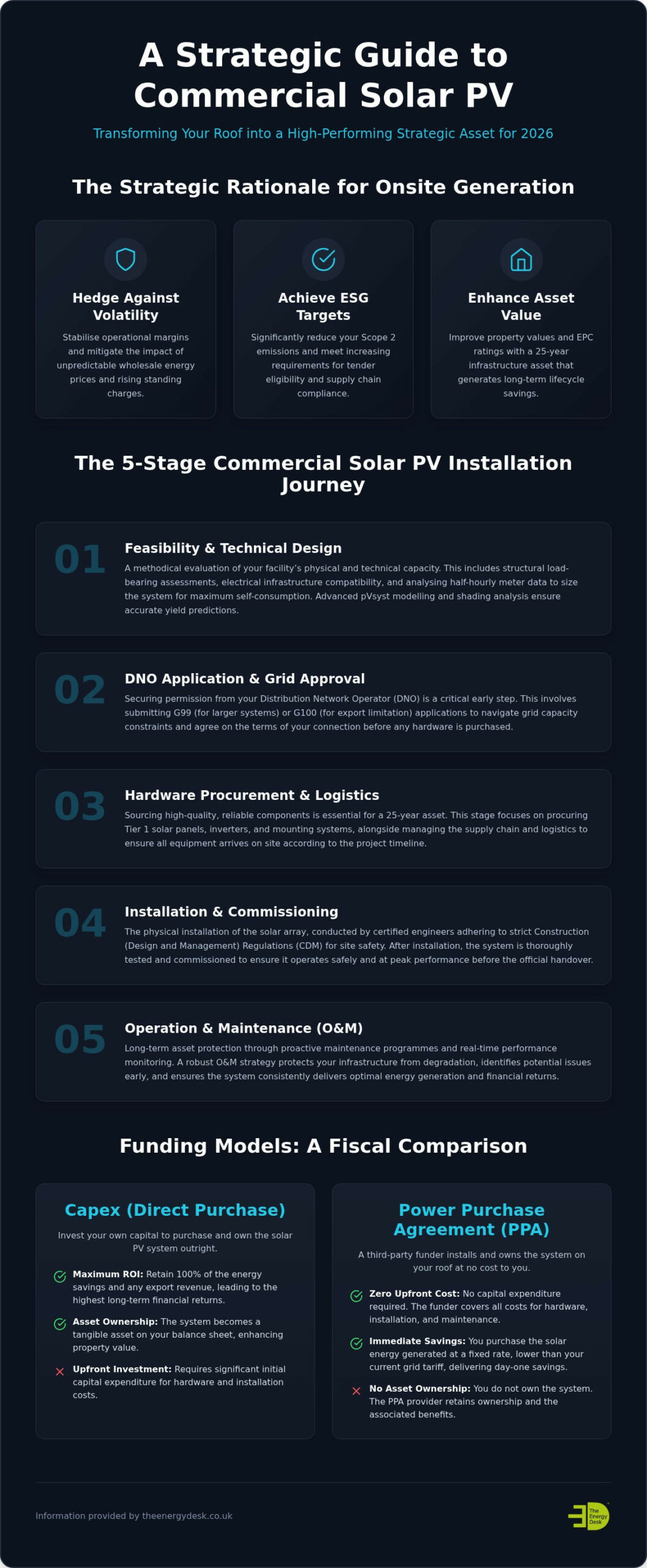
- Navigate the five essential stages of a commercial solar PV installation, including DNO approvals, Tier 1 hardware procurement, and CDM safety regulations.
- Evaluate the fiscal impact of different funding models by comparing the maximum ROI of Capex investments against the zero-upfront-cost benefits of Power Purchase Agreements (PPAs).
- Identify how proactive operation and maintenance (O&M) programmes and real-time monitoring protect your infrastructure from degradation and ensure long-term efficiency.
The Strategic Rationale for Commercial Solar PV in 2026
For UK organisations, the energy landscape in 2026 is defined by two factors: volatility and the necessity for fiscal predictability. A commercial solar PV installation serves as a formidable hedge against these variables. While grid energy prices remain susceptible to global geopolitical shifts, onsite generation provides a fixed-cost baseline that stabilises operational margins. This isn’t merely about sustainability. It’s a calculated move to mitigate the impact of rising standing charges and wholesale price spikes that have historically eroded corporate profits.
Aligning renewable infrastructure with corporate ESG (Environmental, Social, and Governance) targets has moved beyond marketing. It’s now a requirement for tender eligibility and supply chain compliance. By generating power at the point of use, you significantly reduce your Scope 2 emissions. This supports the broader business case for commercial renewable energy UK, where the primary objective is to transform energy from an uncontrollable overhead into a managed strategic asset.
Energy Independence and Risk Management
Reducing grid reliance during peak tariff periods is essential for businesses with high daytime demand, such as manufacturing or cold storage facilities. Integrating solar into a diversified energy portfolio ensures you aren’t entirely dependent on a single, external source. This proactive approach to risk management allows for more accurate long-term budgeting and provides:
- Protection against grid capacity constraints and local network limitations.
- Mitigation of ‘Red Zone’ DUoS charges during periods of high demand.
- Enhanced operational continuity during periods of grid instability.
Financial Incentives and Long-Term Value
A commercial solar PV installation is a 25-year asset that offers lifecycle savings far exceeding the initial investment. This transition from ‘pay-as-you-go’ energy to ‘owned’ energy infrastructure creates a tangible improvement in your balance sheet. Beyond direct savings, installation often enhances property values and improves EPC ratings. This is vital for commercial sites facing stricter legislative requirements regarding building efficiency. Investing in hardware today secures your energy costs for the next two decades, providing a level of financial foresight that grid procurement alone cannot match. It effectively turns your roof into a revenue-generating asset that shields your business from future market fluctuations.
Feasibility and Technical Design: Surveying Your Site
A successful commercial solar PV installation begins long before hardware arrives on site. It requires a methodical evaluation of your facility’s physical and technical capacity. A professional survey isn’t just about measuring roof space; it encompasses structural load-bearing assessments, electrical infrastructure compatibility, and geographic orientation. Designing a system without these data points risks operational inefficiency or, in some cases, structural failure.
Choosing between roof-mounted and ground-mounted systems depends on your available space and long-term operational needs. Roof arrays are typically more cost-effective as they utilise existing structures, whereas ground-mounted systems offer easier maintenance access and optimal positioning if your roof space is obstructed or unsuitable. To ensure the highest ROI, we analyse your half-hourly meter data to size the system for maximum self-consumption. This data-led approach ensures you don’t over-invest in capacity that your business cannot use onsite.
Precision is maintained through advanced pVsyst modelling and shading analysis. These tools allow engineers to predict annual yields with high accuracy by accounting for nearby obstructions, such as trees or neighbouring buildings, that could diminish performance. This level of detail is essential for creating reliable financial projections that stand up to board-level scrutiny.
Navigating Grid Constraints and DNO Applications
In 2026, grid capacity remains a significant hurdle for large-scale projects. You must secure permission from your Distribution Network Operator (DNO) via G99 or G100 applications before committing to hardware purchases. G99 is the standard requirement for larger systems, while G100 regulates export limitation schemes. If your local network is constrained, the DNO may limit the amount of power you can send back to the grid. In such scenarios, integrating battery storage becomes a vital part of the technical design to prevent wasted generation.
Structural Integrity and Planning Permission
Assessing structural integrity is a non-negotiable step for any rooftop project. Large-scale arrays add significant weight and increase wind-loading stress on the building’s frame. Most commercial projects fall under Permitted Development Rights, allowing for a faster timeline. However, listed buildings or sites within conservation areas usually require full planning permission. It’s often beneficial to consult an energy infrastructure specialist to audit your site’s suitability and navigate these regulatory requirements during the early design phase.
The Commercial Solar PV Installation Journey: A 5-Stage Guide
Executing a commercial solar PV installation requires disciplined project management. It’s a complex engineering project that must integrate seamlessly with your existing infrastructure. To ensure successful delivery, we follow a methodical five-stage process designed to mitigate risk and guarantee long-term performance.
- Stage 1: Detailed Design and Procurement – Following the initial survey, CAD drawings are finalised and Tier 1 hardware is procured. We focus on Bloomberg-rated Tier 1 modules to ensure bankability and warranty security.
- Stage 2: Health and Safety Planning – All projects must comply with Construction Design and Management (CDM) 2015 regulations. This involves appointing a principal designer and contractor to manage onsite risks effectively.
- Stage 3: Onsite Construction – This phase covers the physical deployment, including scaffolding, mounting system installation, and DC/AC wiring.
- Stage 4: Commissioning and Testing – Engineers perform rigorous testing, including G99 witness testing with the DNO, to verify that the system is safe to energise and connect to the grid.
- Stage 5: Handover and Monitoring – The final stage includes the delivery of the Operation and Maintenance (O&M) manual and the activation of digital monitoring dashboards for real-time oversight.
Managing Operational Disruptions During Install
Minimising the impact on your daily business activities is a primary objective. We phase the installation to avoid interfering with high-traffic periods or critical delivery windows. Coordination with facility managers is essential for planned electrical shutdowns, which are kept as brief as possible. Site safety is maintained through secure storage for high-value components and clearly demarcated work zones to protect your staff and visitors whilst work is carried out.
Compliance, Certification, and Quality Control
Adherence to the latest IET wiring regulations and MCS (Microgeneration Certification Scheme) standards is mandatory. MCS certification is particularly vital if you intend to claim export payments under the Smart Export Guarantee (SEG). Upon completion, you receive a full pack of as-built documentation and electrical safety certificates. These records are essential for insurance purposes and future building surveys. Maintaining these high standards ensures that your commercial solar PV installation remains a safe, high-performing asset for its entire 25-year lifespan.
Funding Models: Comparing PPAs, Asset Finance, and Direct Purchase
Selecting the optimal financial vehicle for your commercial solar PV installation is as critical as the technical design itself. Your choice determines the project’s internal rate of return (IRR) and how the asset impacts your balance sheet. Direct purchase (CAPEX) remains the most effective route for organisations with available liquid capital. It offers the shortest payback period and the highest total lifecycle savings because you own the generation from day one. If preserving working capital is a priority, asset finance or leasing allows you to spread the cost over several years. This model often results in a cash-flow positive scenario where the monthly energy savings exceed the finance repayments. It ensures that the project pays for itself through reduced utility bills from the first month of operation.
A procurement-led approach is essential here. Installation is only half the battle; you must also consider how the remaining grid energy is sourced. By integrating onsite generation with a professional procurement strategy, you can optimise the cost of the power you still need to buy from the grid. This holistic view prevents a common mistake where businesses focus solely on the hardware cost without considering the wider impact on their utility management portfolio.
Deep Dive into Power Purchase Agreements (PPAs)
A Power Purchase Agreement (PPA) is a zero-upfront-cost solution where a third-party developer funds, installs, and maintains the array. Your organisation agrees to purchase the generated electricity at a predetermined rate, which is typically significantly lower than standard grid tariffs. These contracts usually run for 10 to 25 years and include clear exit clauses or buy-out options. PPAs have become the preferred choice for large-scale industrial decarbonisation because they allow businesses to meet ESG targets without taking on additional debt. This energy-as-a-service model shifts the operational risk to the developer, as they are responsible for the system’s performance and maintenance for the duration of the term.
Tax Benefits and Capital Allowances
The UK’s Full Expensing regime provides a powerful incentive for solar investment. It allows companies to deduct 100% of the cost of qualifying plant and machinery from their taxable profits in the year of purchase. This can result in a substantial reduction in corporation tax liability, effectively subsidising a portion of the installation cost. Additionally, whilst a commercial solar PV installation can improve property value, it is essential to consider the impact on business rates. Many renewable improvements currently benefit from specific exemptions designed to encourage green infrastructure. Excess energy not consumed onsite can be sold back to the grid via the Smart Export Guarantee (SEG), adding a secondary revenue stream to your financial model. To determine which funding structure aligns with your fiscal objectives, you can speak with our procurement and infrastructure experts for a detailed feasibility and financial audit.
Post-Installation: Monitoring, Maintenance, and Energy Procurement
A successful commercial solar PV installation is a 25-year asset that requires proactive oversight to maintain its peak performance. Once the system is energised, the focus shifts from engineering to long-term asset management. Implementing a structured Operation and Maintenance (O&M) programme is essential to protect your investment. Whilst solar hardware is generally reliable, environmental factors and electrical wear can lead to incremental efficiency losses if left unaddressed.
Real-time monitoring dashboards provide the necessary visibility to identify issues such as string failure, panel degradation, or inverter faults before they impact your bottom line. Integrating this generation data into your wider commercial utility bill validation process ensures that your onsite generation is correctly credited against your grid consumption. For organisations with high baseload requirements, exploring CHP system installation for businesses can complement solar by providing stable thermal and electrical power during winter months when solar yields are naturally lower.
Optimising Your Remaining Grid Energy Procurement
Your grid energy requirements change significantly after you commission a large-scale solar array. It’s vital to adjust your electricity procurement contracts to reflect your reduced grid dependency. Failing to do so can leave you paying for agreed capacity (kVA) that you no longer require. Professional bill validation is critical to ensure your supplier is accurately billing you for the net energy used. You must also develop a strategy to manage energy peaks that occur during overcast periods or night shifts, ensuring that your remaining grid contracts are as cost-effective as possible.
Maximising ROI Through Smart Export and Storage
Generating power is only the first step; how you manage the surplus determines your ultimate ROI. Negotiating competitive business export tariffs ensures that any energy not consumed onsite is sold back to the grid at the best possible rate. Many UK organisations are now finding a strong business case for adding Battery Energy Storage Systems (BESS). These systems allow you to capture excess midday solar generation and discharge it during peak tariff windows, effectively shifting your green energy to when it’s most valuable. This infrastructure also future-proofs your site for the increasing demand of EV charging integration, allowing you to support a fleet transition without requiring expensive grid upgrades. Understanding the full commercial EV charger installation process alongside your solar strategy ensures both technologies share grid capacity efficiently and deliver maximum combined ROI.
Securing Your Organisation’s Energy Future
A commercial solar PV installation is a transformative investment that shifts your energy strategy from reactive procurement to proactive generation. By addressing technical feasibility early and navigating the complexities of DNO approvals, you create a foundation for decades of fiscal stability. True ROI comes from integrating solar into a wider framework of bill validation and optimised grid energy management. This methodical approach ensures your facility remains competitive and compliant with evolving ESG standards whilst protecting your operational margins. A comprehensive business carbon footprint reduction UK strategy that incorporates onsite solar generation is increasingly essential for organisations navigating the Climate Change Levy and UK Emissions Trading Scheme obligations.
The Energy Desk has been an independent energy consultancy since 2003, providing national UK-wide project management for complex infrastructure projects. Our team specialises in managing intricate grid applications and diverse funding structures to ensure your transition to renewables is seamless. It’s vital to treat onsite generation as a strategic asset rather than a standalone purchase. To get started, you can request a free energy audit and solar feasibility assessment from The Energy Desk. Take control of your utility costs today and build a more resilient, sustainable business for the future.
Frequently Asked Questions
Do I need planning permission for a commercial solar PV installation in the UK?
Most commercial solar projects fall under Permitted Development Rights, meaning you don’t usually need full planning permission. However, this is subject to specific conditions, such as the system not protruding more than 200mm from the roof slope. If your building is listed or situated in a conservation area, you must apply for full consent. We recommend checking with your local authority or an infrastructure specialist to confirm your site’s specific status before proceeding.
How long does a typical large-scale commercial solar installation take to complete?
A typical large-scale project takes between three and six months from initial feasibility to final commissioning. Whilst the physical onsite construction might only last two to four weeks, the preparatory stages are more time-consuming. Securing DNO approvals and procurement of Tier 1 hardware often accounts for the majority of the timeline. Detailed project management ensures that these phases overlap efficiently to minimise the total duration and prevent operational delays.
What is the typical ROI for a business solar project in 2026?
The ROI for a business solar project in 2026 generally ranges between five and eight years, though this varies based on your self-consumption rates and funding model. High daytime energy users see the fastest returns as they displace expensive grid power with free onsite generation. When you factor in the 25-year lifespan of the asset, the long-term fiscal benefits are substantial. It’s a methodical way to lock in low energy costs for decades.
Can commercial solar panels generate enough electricity on cloudy days in the UK?
Yes, commercial solar panels generate electricity on cloudy days by utilising diffuse light rather than just direct sunlight. Whilst peak output occurs during clear conditions, modern high-efficiency modules are designed to perform effectively in the UK’s temperate climate. You can expect your system to produce significant power throughout the year, although yields will naturally be lower in winter. Integrating battery storage can help bridge gaps by storing surplus energy generated during brighter periods.
What is a G99 application and why is it required for my solar project?
A G99 application is a formal request to your Distribution Network Operator (DNO) to connect a large-scale generating system to the grid. It’s required for any commercial solar PV installation exceeding 16A per phase to ensure the local network can handle the additional load. You must secure this approval before purchasing hardware, as the DNO may impose export limitations or require specific protection settings to maintain grid stability and safety.
How much maintenance do commercial solar panels require annually?
Annual maintenance requirements are relatively low but essential for protecting your 25-year asset. We recommend a proactive Operation and Maintenance (O&M) programme that includes annual electrical testing, inverter health checks, and periodic panel cleaning to remove debris or bird droppings. Real-time monitoring allows you to identify performance dips immediately, ensuring that minor faults don’t escalate into costly downtime. This methodical oversight ensures the system operates at its maximum designed efficiency.
Is my roof suitable for a solar PV array, and what if it needs repairs?
Most commercial roofs are suitable, but a professional structural survey is mandatory to assess load-bearing capacity. If your roof requires repairs or is nearing the end of its lifespan, it’s often more cost-effective to address these issues before the solar array is installed. Mounting systems can be tailored for various materials, including trapezoidal metal, standing seam, or flat roofs. Ensuring the underlying structure is sound prevents the need for expensive removals later.
How does commercial solar PV integrate with my existing business energy contract?
Solar generation integrates seamlessly with your existing energy contract by acting as your primary power source during daylight hours. Your building automatically consumes solar power first, only drawing from the grid when demand exceeds generation. This requires a professional commercial solar PV installation to include smart metering. You must also notify your supplier to ensure your billing is adjusted and that you are correctly credited for any surplus energy exported under a Smart Export Guarantee (SEG).