
With UK natural gas prices rising by 61.79% compared to last year, many organisations are finding their overheads spiralling out of control. It’s a challenging environment where complex jargon and hidden standing charges often mask the true cost of supply. You likely feel the pressure of securing budget certainty while fearing you might lock into a high rate just before a potential market dip. Comparing multiple suppliers is a time-consuming task that few busy professionals have the capacity to prioritise.
This strategic guide explains how to leverage market data and procurement expertise to secure the most competitive commercial gas rates for your organisation. You’ll learn how to achieve lower unit rates and reduced administrative burdens through a structured approach to business gas contract negotiation. We will examine current 2026 market trends, the impact of the new RIIO-3 price control, and the practical steps needed to ensure your energy strategy remains robust against future volatility. By the end of this article, you’ll have a clear framework for navigating the procurement process with confidence and precision.
Key Takeaways
- Understand why the 2026 market volatility makes proactive procurement essential to avoid the high costs of “Deemed” or “Out of Contract” rates.
- Learn how to utilise forensic consumption data and your organisation’s credit profile to maximise your leverage during a business gas contract negotiation.
- Discover the specific advantages of fixed versus flexible contract structures and which model provides the best budget stability for your operational requirements.
- Identify the optimal timeline for initiating a formal tender process to ensure you capture the most favourable rates before your current agreement expires.
- Explore how partnering with a specialist consultancy provides access to off-market rates and removes the administrative burden of supplier comparison.
The Critical Importance of Strategic Gas Contract Negotiation
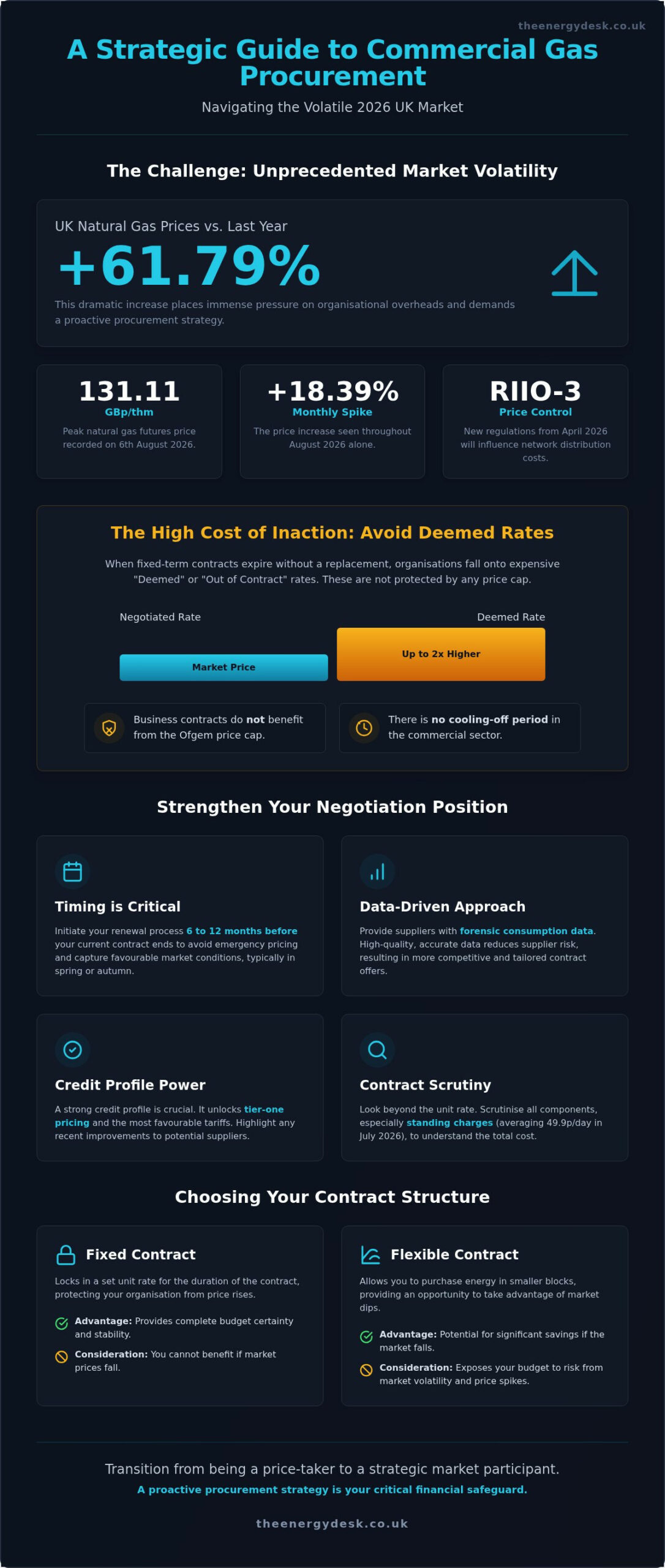
The UK energy market in August 2026 is defined by extreme volatility. With natural gas futures reaching 131.11 GBp/thm on 6 August 2026, the financial stakes for commercial consumers have never been higher. Relying on passive renewals or rolling contracts is a high-risk strategy that can lead to immediate budgetary distress. Wholesale prices have risen by 61.79% compared to the same period last year, meaning a lack of preparation can result in six-figure increases for large-scale operations. Efficient Energy procurement is no longer a routine administrative task; it’s a critical financial safeguard. Effective business gas contract negotiation allows your organisation to transition from being a price-taker to a strategic market participant.
Negotiation impacts your bottom line far beyond the headline pence-per-kWh rate. It provides a platform to address non-commodity costs and align your energy supply with corporate ESG targets. As regulatory pressure for decarbonisation intensifies, your gas contract serves as a foundation for broader efficiency initiatives. A well-structured agreement ensures you aren’t just buying fuel, but managing a volatile commodity with precision and foresight.
Avoiding the Pitfalls of Deemed Rates
Many organisations inadvertently fall onto “Deemed” or “Out of Contract” rates when a fixed-term agreement expires without a replacement. These tariffs are significantly more expensive than negotiated rates because suppliers charge a heavy premium to cover the risk of an unsecured customer. Unlike domestic energy, business gas contracts don’t benefit from the Ofgem price cap. This means suppliers can set rates at their own discretion, often resulting in unit prices that are double the market average.
To maintain fiscal control, you must initiate the renewal process 6 to 12 months before your current contract ends. There’s no cooling-off period in the commercial sector; once a contract is signed or a rollover window is missed, your organisation is legally bound. Securing a new agreement well in advance protects you from the sudden 18.39% monthly price spikes seen throughout August 2026. A proactive approach ensures you’re never forced to accept emergency pricing due to an administrative oversight.
Strategic Objectives for Your Next Contract
Successful negotiation requires clear objectives that balance immediate savings with long-term budget certainty. You should scrutinise every component of the quote, particularly the standing charge. For medium-sized businesses, standing charges averaged 49.9p per day in July 2026, but these figures vary wildly between suppliers. Identifying hidden costs within these fixed elements is essential for total cost transparency.
Your strategy should also account for the new RIIO-3 price control starting in April 2026, which will likely influence network distribution costs. Aligning your procurement with long-term efficiency goals, such as integrating CHP systems or forensic bill validation, ensures that your contract supports your operational success. By focusing on the total annual cost rather than just the unit rate, you create a robust framework that withstands market fluctuations whilst supporting your organisation’s financial health.
Key Elements that Influence Your Negotiation Leverage
Successful business gas contract negotiation is built on high-quality data rather than simple price comparison. Suppliers operate on thin margins and high risk; the more certainty you provide regarding your consumption, the more competitive their offers become. Your credit score is a primary factor here. A strong credit profile allows access to the most favourable tariffs, whilst a lower score may result in restricted options or requirements for security deposits. If your credit rating has improved recently, ensure this is highlighted to potential suppliers to unlock tier-one pricing.
Market timing remains a decisive factor in your leverage. In August 2026, UK natural gas prices rose to 131.11 GBp/thm, marking an 18.39% increase in just one month. Striking during periods of low volatility, typically in the spring or autumn, can yield better results than negotiating during winter peaks. For industrial users, understanding the distinction between firm and interruptible contracts is vital. Volume tolerance clauses, such as “take-or-pay” agreements, require precise forecasting to avoid penalties if your actual consumption deviates from your contracted estimates. A free energy audit can help identify these nuances before you enter formal discussions.
Utilising Half-Hourly Data for Precise Quotes
Suppliers crave granular information to price their risk accurately. By employing DC/DA services, you can provide half-hourly data that demonstrates exactly how and when your organisation uses gas. This level of detail allows you to negotiate bespoke time-of-use rates, rewarding your business for consuming energy during off-peak periods. Historical data acts as a proof of a low-risk profile, reassuring underwriters that your projected volumes are reliable and manageable. Using granular data transforms your negotiation from a generic request into a data-driven business case.
The Power of Bill Validation
Forensic bill validation is a powerful tool for building leverage. By auditing historical invoices, you can identify overcharges caused by supplier errors, incorrect meter classes, or misapplied VAT and Climate Change Levy (CCL) rates. The CCL rate for gas increased to £0.00801 per kWh on 1 April 2026, making even small percentage errors financially significant. Recovering these funds provides immediate capital that can be reinvested into your next contract or used to fund infrastructure improvements. Ensuring your meter class matches your actual requirements prevents you from paying inflated standing charges that don’t reflect your usage reality.
Evaluating Contract Structures: Fixed, Flexible, and Bespoke
The choice of contract structure is the most impactful decision in any business gas contract negotiation. While the unit rate often receives the most attention, the underlying framework determines how your organisation absorbs market shocks. You must choose between the certainty of a fixed agreement and the potential rewards of a flexible approach. Understanding natural gas market fundamentals helps in deciding which structure aligns with your risk appetite and operational requirements.
It’s vital to distinguish between pass-through and fully inclusive contracts. Pass-through agreements may offer a lower initial unit rate, but they leave you exposed to fluctuating third-party costs like distribution and transmission fees. Fully inclusive contracts wrap these costs into a single rate, providing total budget certainty. For industrial users, bespoke agreements may also include specific “take-or-pay” thresholds. These clauses require you to pay for a minimum volume of gas even if you don’t use it, making precise forecasting essential for avoiding unnecessary expenditure.
When to Choose a Fixed-Price Agreement
Fixed-rate contracts are the preferred choice for SMEs and organisations with tight operational margins. These agreements lock in the unit price and standing charge for a set duration, typically 12, 24, or 36 months. In a market where wholesale prices have spiked by 61.79% year-on-year, this stability is invaluable. A 12-month contract offers agility if you expect prices to drop, whereas a 36-month term provides long-term protection against sustained inflation. You should ensure the contract is “fully inclusive” to protect against increases in non-commodity costs, such as the Climate Change Levy, which rose to £0.00801 per kWh in April 2026.
The Mechanics of Flexible Gas Buying
Flexible procurement is generally reserved for large-volume users, often those consuming over 5 GWh annually. Instead of locking in a price on a single day, you buy gas in “tranches” throughout the contract term. This method allows you to take advantage of wholesale dips while protecting against peaks. Success here depends on a robust energy risk management strategy; you aren’t just buying gas, you’re actively managing a commodity portfolio. It requires a proactive partner to monitor the market and execute trades when conditions are optimal. This structure provides the highest potential for savings but carries the risk of exposure if the market trends upward unexpectedly.
A Step-by-Step Strategy for Successful Negotiations
A successful business gas contract negotiation requires a methodical timeline that begins long before your current agreement ends. Waiting until the final month is a tactical error that limits your options and forces you into a defensive position. We recommend initiating the process at least six to twelve months in advance. This window allows you to monitor market fluctuations and execute a contract during a period of relative stability, rather than being at the mercy of the wholesale price on a single day. A structured approach ensures you have the time to resolve any historical billing discrepancies before committing to a new supplier.
Analysing the Total Cost of Ownership (TCO) is more important than simply chasing the lowest unit rate. In July 2026, standing charges for medium-sized businesses averaged 49.9p per day, but these can vary significantly between providers. With the RIIO-3 price control coming into effect on 1 April 2026, network distribution costs are expected to rise to fund infrastructure upgrades. You must ensure your negotiation accounts for these non-commodity increases to avoid unexpected budget variances mid-contract. To begin your journey with a clear understanding of your current costs, you can request a free energy audit from our specialist team.
The Tendering Phase
To secure the best value, you must issue a formal tender to a wide panel of commercial suppliers. This process should go beyond the “Big Six” to include independent providers who may offer more aggressive pricing for specific sectors or consumption profiles. The goal is to achieve an “apples-to-apples” comparison. This means ensuring that every quote includes the same pass-through elements, standing charges, and contract durations. An independent consultant manages this complexity by filtering out non-compliant bids and presenting you with a transparent shortlist based on your specific operational priorities. For a comprehensive framework to structure this process, our guide to commercial gas tender services and the 2026 business procurement checklist provides a detailed methodology for evaluating supplier bids and exposing hidden non-commodity costs.
Reviewing the Fine Print
The final stage of negotiation involves a forensic review of the contract terms. You must identify your current “objection window”-the specific period during which you can notify your supplier of your intent to switch. Missing this window can lead to an automatic rollover into a more expensive 12-month agreement. Verify that the Supply Number (MPRN) on the new contract matches your physical meter exactly; errors here can cause significant administrative delays or failed transfers. Finally, ensure you understand the termination requirements. Some suppliers require a formal notice period even if the fixed term has naturally concluded, and failing to comply can lock you into high out-of-contract rates.
Why Professional Procurement Support is Essential
The 2026 UK energy market is too complex for a DIY approach. With wholesale prices rising 61.79% year-on-year as of August 2026, the margin for error has effectively vanished. The Energy Desk acts as your strategic ally, providing the technical oversight needed to manage these risks with precision. We provide access to “off-market” rates that suppliers don’t offer to direct customers. These exclusive tariffs often feature more competitive unit rates or reduced standing charges, providing an immediate advantage during your business gas contract negotiation.
Our involvement doesn’t end when the contract is signed. We provide ongoing portfolio management and forensic bill validation to ensure every invoice is accurate. This is particularly vital following the CCL rate increase to £0.00801 per kWh on 1 April 2026. We also help you integrate gas procurement with modern infrastructure solutions like CHP systems and solar arrays. This holistic view ensures your energy strategy supports both financial efficiency and long-term decarbonisation targets. We’ve been a well-established presence in the sector since 2003, valuing long-term management over quick, superficial fixes.
The Value of an Independent Energy Consultant
We organise the entire negotiation process, removing the administrative burden from your internal teams. Our approach is rooted in forensic accuracy and total transparency. By managing the tender across a wide panel of suppliers, we ensure you receive compliant, comparable offers. Industry professionals recognise that independent consultants can often navigate supplier credit requirements more effectively, unlocking tariffs that might otherwise be unavailable to your organisation. For our industrial clients, this strategic oversight has consistently reduced total energy spend by identifying the most efficient contract structures for high-volume consumption.
Take Control of Your Energy Costs Today
The first step toward a more efficient procurement strategy is understanding your current position. We offer a free, no-obligation energy audit that identifies immediate saving opportunities and historical overcharges. This audit serves as the foundation for a data-driven business gas contract negotiation, ensuring you enter the market with a clear mandate. Our team handles the heavy lifting, from initial data collection to final contract execution. We simplify the complexities of a technical market so you can focus on your core operations.
Ready to secure your organisation’s financial future? Book your free business energy audit with The Energy Desk to begin your strategic procurement journey today.
Securing Your Energy Future through Strategic Procurement
Success in the current energy market requires moving beyond reactive renewals. As we’ve explored, precise data collection and early market engagement are the only reliable ways to mitigate the impact of extreme wholesale volatility. By prioritising a forensic approach to your business gas contract negotiation, you protect your organisation from the hidden costs of deemed rates and administrative errors. A well-structured agreement doesn’t just manage costs; it provides the stability needed for long-term financial planning.
The Energy Desk has been a trusted independent consultancy since 2003. We specialise in comprehensive bill validation to identify historical overcharges and provide technical expertise in complex industrial CHP and renewable integrations. Our methodical process ensures that your utility management is both fiscally responsible and strategically aligned with your broader operational goals. We handle the technical complexities so you can focus on your core business objectives.
Don’t leave your budget to chance in a volatile market. Request your free 2026 business energy audit to gain total transparency and secure the competitive rates your organisation deserves. Our team is ready to help you navigate these complexities with confidence and precision.
Frequently Asked Questions
How far in advance should I start negotiating my business gas contract?
You should initiate your business gas contract negotiation at least six to twelve months before your current agreement expires. This extended timeline allows you to monitor market fluctuations and secure a rate when wholesale prices are relatively stable. Waiting until the final few weeks limits your leverage and often forces you to accept whatever rates are available at that specific moment, regardless of market volatility.
What is the difference between a gas broker and an energy procurement consultant?
While a gas broker typically focuses on a simple price comparison, an energy procurement consultant acts as a strategic partner providing long-term management and technical oversight. Consultants provide additional services such as forensic bill validation, infrastructure advice, and risk management strategies. This holistic approach ensures your energy procurement aligns with broader operational goals rather than just finding the lowest headline unit rate.
Can I negotiate my standing charges as well as my unit rates?
You can negotiate both your unit rates and your daily standing charges during the procurement process. Many businesses focus solely on the pence-per-kWh rate, but standing charges account for a significant portion of the total annual cost, especially for smaller sites. Ensuring both components are competitive is essential for achieving the lowest total cost of ownership across your entire utility portfolio during your next business gas contract negotiation.
What happens if I miss my contract renewal date?
Missing your renewal date usually results in your supplier moving you onto “Deemed” or “Out of Contract” rates, which are significantly higher than negotiated tariffs. These rates have no fixed term, allowing you to switch at any time, but the daily cost is often double the market average. It’s vital to track your objection window to prevent these automatic transitions from impacting your operational budget.
Are flexible gas contracts only for very large industrial businesses?
Flexible gas contracts are typically reserved for high-volume users, often with an annual consumption threshold exceeding 5 GWh. These agreements require active management to buy energy in tranches, which isn’t practical or cost-effective for smaller organisations. SMEs generally benefit more from the budget certainty provided by fixed-rate contracts, which protect them from sudden wholesale price spikes and simplify financial forecasting.
How does my business credit score affect gas contract negotiations?
Your business credit score is a primary factor that determines which suppliers will offer you a contract and the specific tariffs available. Suppliers use this score to assess the risk of non-payment. If your organisation has a lower credit rating, you may face restricted options, higher unit rates, or requirements for a security deposit before the supplier agrees to the transfer.
Is it possible to switch gas suppliers if I am currently in a contract?
You generally cannot switch gas suppliers until your current fixed-term contract concludes, as business energy agreements lack the cooling-off periods found in domestic contracts. However, you can secure a new contract with a different supplier months in advance, which will take effect the day your existing agreement ends. This proactive approach ensures a seamless transition without falling onto expensive out-of-contract rates.
What information do I need to provide to get an accurate gas quote?
To receive an accurate quote, you need to provide your most recent energy bill, your Meter Point Reference Number (MPRN), and your annual consumption data. Providing half-hourly data via DC/DA services is even more beneficial, as it allows suppliers to price their risk more accurately based on your actual usage patterns. This level of detail often leads to more bespoke and competitive offers.