


With UK wholesale gas prices for Winter 2026 delivery sitting at approximately 143 pence per therm, the era of simple price-chasing is officially over. You likely recognise that volatile market conditions make long-term budgeting feel like guesswork, particularly when hidden non-commodity charges frequently distort supplier bids. It is a significant drain on internal resources to manage multiple supplier relationships only to find your bottom line remains vulnerable to global LNG market shifts. Securing the best value now requires a methodical approach to commercial gas tender services that prioritises risk management over short-term fixes.
This article provides a comprehensive checklist to help your organisation navigate the complexities of the 2026 energy market and secure the most competitive rates available. We promise a clear framework for evaluating supplier bids that exposes hidden costs whilst ensuring full compliance with the latest Ofgem regulatory impact assessments. We will outline how to transition from reactive purchasing to a strategic procurement model that reduces spend, simplifies oversight, and provides the long-term budgetary stability your business requires to thrive in a challenging utility landscape.
Key Takeaways
- Understand why standard comparison platforms often fail for large-scale industrial sites and why a formalised tender process is essential for securing price stability.
- Learn how to audit your consumption data and manage contract notice periods to avoid punitive out-of-contract rates during the transition.
- Discover how to structure an Invitation to Tender (ITT) for commercial gas tender services that accurately weights price against service quality and technical requirements.
- Identify hidden non-commodity costs by unbundling wholesale prices from standing charges and volatile pass-through fees.
- Explore how partnering with a strategic consultant provides access to an extensive panel of UK suppliers and end-to-end management of complex utility connections.
Why Your Business Needs a Formal Commercial Gas Tender in 2026
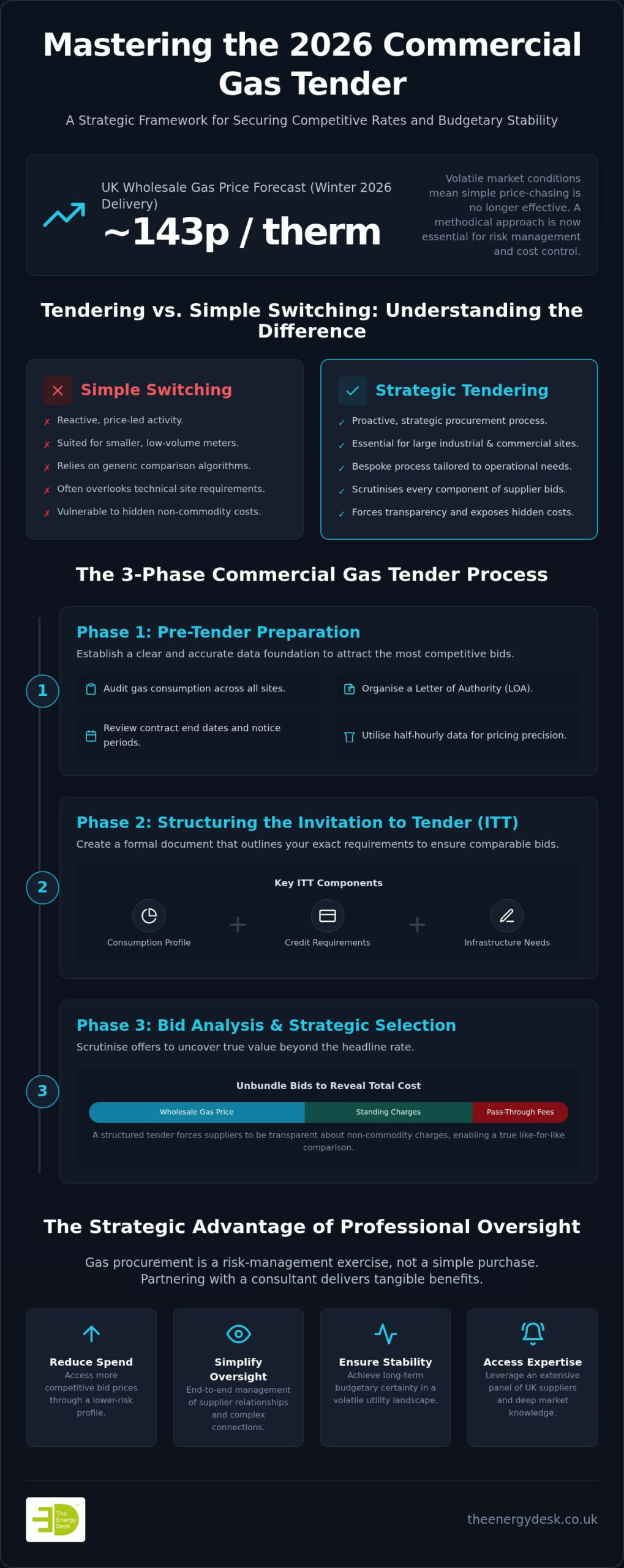
A commercial gas tender is a formal, structured procedure designed to generate competing offers from a wide panel of suppliers. For organisations with significant energy requirements, leveraging professional commercial gas tender services is the only way to ensure every component of a bid is scrutinised. Simple price comparison websites frequently fail large-scale industrial and commercial sites because they rely on generic algorithms. These platforms often overlook the technical complexities of high-volume connections, such as specific volume tolerances or peak demand requirements, leaving businesses exposed to unfavourable terms hidden in the small print.
The energy landscape in 2026 remains challenging. With wholesale gas prices for Winter 2026 delivery reaching approximately 143 pence per therm, businesses can no longer afford a passive approach to procurement. Market volatility, driven by a heavy reliance on Liquefied Natural Gas (LNG) and declining North Sea production, means that a headline unit rate rarely tells the full story. A structured tender process forces suppliers to be transparent. It requires them to unbundle their bids, revealing the non-commodity charges that often make up a significant portion of the total invoice. A comprehensive approach to commercial gas tender services ensures that these variable elements are clearly defined before any contract is signed.
The Difference Between Tendering and Switching
Standard energy switching is typically a reactive, price-led activity suitable for smaller meters. In contrast, tendering is a bespoke strategic process tailored to the specific operational needs of a business. It involves the creation of a detailed Invitation to Tender (ITT) document. This document outlines your exact consumption profile, credit requirements, and any infrastructure needs, such as CHP integration or new utility connections. As an independent consultancy, we act as a strategic ally during this process. We manage the complex relationships with multiple suppliers, filtering out those who cannot meet your technical specifications and ensuring you only evaluate bids that are truly comparable.
The Strategic Advantage of Professional Oversight
Methodical auditing is the foundation of a successful tender. By identifying specific consumption patterns, we can present a lower-risk profile to suppliers, which often results in more competitive bid prices. Forensic bill validation plays a vital role here; it establishes an accurate historical baseline, ensuring you aren’t tendering for more capacity than you actually use. This level of oversight prevents the common mistake of over-ordering, which leads to unnecessary standing charges and “take-or-pay” penalties.
Gas procurement is a risk-management exercise rather than a simple purchase.
Phase 1: Pre-Tender Preparation Checklist
Preparation is the critical first stage of any successful procurement exercise. Before engaging with commercial gas tender services, you must establish a clear and accurate data foundation. Suppliers price their bids based on the risk profile of your consumption. If your data is incomplete or inaccurate, they will include a risk premium that unnecessarily inflates your costs. Utilising professional commercial gas tender services allows you to identify site-specific requirements, such as the need for new meter installations or capacity increases, before the ITT is issued.
Start by auditing your current gas consumption across every site in your portfolio. This involves organising a formal Letter of Authority (LOA). This document allows your consultancy to communicate directly with current suppliers and the National Grid to gather historical usage data. You must also review existing contract end dates and notice periods. Missing a termination window often results in being rolled onto expensive out-of-contract rates. These punitive charges can be significantly higher than market averages and can damage your budget for the entire financial year.
Data Aggregation and Portfolio Management
For industrial sites, relying on monthly meter reads isn’t enough. Half-hourly data collection is essential because it shows exactly when you use gas. This granularity allows suppliers to offer more precise pricing. A full energy audit should be conducted prior to the tender to identify operational waste. There’s little sense in tendering for capacity that you don’t actually need. If you manage a multi-site portfolio, aggregating these into a single tender provides better leverage. It creates a simplified process for obtaining commercial supplies by reducing the administrative burden of managing disjointed contracts.
Establishing Your Procurement Objectives
You need to define what success looks like for your organisation. Are you looking for budget certainty through a fixed-price contract, or do you have the appetite to track market movements with a flexible arrangement? With UK gas production expected to halve by 2030, long-term security is a priority for many. You should also consider your sustainability goals. Many suppliers now offer green gas or carbon offsetting options as part of their bid. Finally, decide on your preferred contract term. Whilst 12-month contracts offer agility, 24 or 36-month terms can provide stability against the volatile pricing trends seen in early 2026. If you’re unsure how to start your data audit, our team can provide a free energy audit to establish your baseline.
Phase 2: Structuring the Invitation to Tender (ITT)
The Invitation to Tender (ITT) serves as the definitive brief for the energy market. It translates your operational requirements into a formal request that suppliers must answer with precision. A poorly structured ITT leads to ambiguous bids that are impossible to compare accurately. By utilising professional commercial gas tender services, you ensure that the scope of work is clearly defined from the outset. This includes deciding whether the contract covers gas supply alone or incorporates technical integration such as metering upgrades, CHP systems, or solar solutions. Clearly defining these parameters prevents “scope creep” and ensures that suppliers provide all-inclusive pricing.
A successful ITT must include a standardised pricing template. This forces every respondent to submit their costs in an identical format, allowing for true “apples-to-apples” comparisons. Without this level of control, one supplier might hide transport fees in the unit rate whilst another lists them separately, creating a false impression of value. Establishing a strict timeline for bid submissions and clarification questions is equally vital. In the volatile 2026 market, where wholesale rates can shift significantly within a single trading day, you need bids that are valid for a specific, actionable window. This methodical approach mirrors the rigor found in the federal procurement process, where structured energy acquisition is used to maintain transparency and fiscal discipline.
Essential Components of a Commercial Gas ITT
Your ITT must provide the Annual Quantity (AQ) data for every meter in your portfolio. This historical consumption profile is the primary factor suppliers use to determine your risk category. You should also outline specific terms and conditions regarding credit cover and payment terms. High-volume industrial users often have unique credit requirements that must be addressed before pricing is finalised. Additionally, specify your needs for account management and Automated Meter Reading (AMR) support. Reliable data flows through AMR are essential for accurate bill validation and long-term consumption monitoring.
Supplier Pre-Qualification
Not every supplier is equipped to handle the complexities of large-scale industrial sites. Pre-qualification involves filtering the market based on financial stability and UK market share. You should verify their track record for managing industrial utility connections and their ability to provide integrated DC/DA services (Data Collection and Data Aggregation). Partnering with commercial gas tender services allows you to access a pre-vetted panel of suppliers who have already demonstrated their reliability. This proactive vetting ensures that you only spend time evaluating bids from organisations capable of meeting your long-term supply security needs.
Phase 3: Bid Analysis and Strategic Selection
Analysis of the returned bids is the most technically demanding part of the procurement process. You must look beyond the headline figure and unbundle the wholesale energy cost from the standing charges and transport fees. In the 2026 market, non-commodity elements are prone to fluctuation. Professional commercial gas tender services provide the expertise to identify “pass-through” charges that suppliers may not have fixed in their initial proposal. These can include costs related to gas system management or regulatory shifts. We stress-test every bid against various market scenarios to ensure your budget remains resilient, even if wholesale prices deviate from the current 143 pence per therm benchmark. This leads into a final negotiation round where we leverage competing offers to secure your Best and Final Offer (BAFO).
Evaluating Fixed vs Flexible Pricing Models
Choosing the right structure depends entirely on your organisation’s appetite for risk. For many SMEs in 2026, fixed-rate contracts remain the preferred choice because they offer absolute budget certainty. However, these contracts always include a “risk premium” where the supplier charges a margin to protect themselves against market spikes. For larger industrial users, flexible procurement is often the more strategic route. This model allows you to trade gas in “clips,” purchasing portions of your total load when the market dips. It requires proactive oversight but avoids the heavy risk premiums associated with long-term fixed bids, potentially lowering your overall spend whilst maintaining supply security. Understanding the full scope of business gas contract negotiation strategies can help you determine which pricing model best aligns with your organisation’s risk tolerance and budget objectives.
Final Compliance and Contract Award
The final step before authorisation involves a forensic review of the contract’s small print. You must pay close attention to volume tolerances and “take-or-pay” clauses. If your production levels fall and your gas consumption drops below a specific threshold, some suppliers will charge penalties for the unused energy. We ensure your contract terms are flexible enough to accommodate operational changes. It’s also vital that the contract alignment matches your business’s fiscal year and budget cycles to avoid accounting discrepancies. Once you are satisfied with the terms, we manage the final switch to ensure there’s no supply interruption. To ensure your next contract is built on a solid financial foundation, speak with our procurement specialists for a detailed bid comparison.
Partnering with The Energy Desk for Expert Gas Tendering
Successfully navigating the 2026 energy market requires more than a one-off procurement exercise. The Energy Desk provides end-to-end management for commercial gas tender services, acting as a strategic ally for industrial and commercial organisations. Our independent status ensures that our recommendations are entirely unbiased, focusing solely on your operational efficiency and fiscal responsibility. We maintain an extensive panel of UK commercial gas suppliers, ranging from major established providers to specialist industrial entities. This ensures your ITT reaches the most competitive corners of the market, providing the leverage necessary to secure favourable terms in a volatile landscape.
Our role extends beyond simply finding a price. We manage the entire lifecycle of the tender, from the initial data gathering and ITT structure discussed in previous sections to the final contract award and switch management. This methodical approach reduces the administrative burden on your internal teams, allowing you to focus on core operations whilst we handle the technical complexities of supplier negotiations and market analysis.
Beyond the Tender: Continuous Energy Management
A contract award is not the end of the procurement lifecycle. Forensic bill validation is a core component of our ongoing support, allowing us to identify and recover historical overcharges that standard audits often miss. In an era where non-commodity charges are increasingly complex, verifying every line item on your invoice is essential for maintaining budget integrity. We also evaluate your broader infrastructure. By integrating CHP systems or renewable solutions, we help you reduce your reliance on the gas grid. Regular portfolio reviews ensure your procurement strategy remains aligned with shifting market conditions, providing a level of oversight that internal teams rarely have the capacity to maintain.
Getting Started with a Free Energy Audit
The first step toward a more resilient energy strategy is understanding your current position. In 2026, a professional energy audit goes beyond simple meter reading; it involves a deep dive into your load profile and site-specific infrastructure. To begin the process, we typically require twelve months of recent billing data and a signed Letter of Authority (LOA). This allows us to gather the technical data points needed to structure your tender accurately. Our methodical approach ensures that when your ITT goes to market, it is backed by verified data that commands the best possible rates from suppliers. Contact The Energy Desk today for your free energy audit to establish your baseline and begin your procurement journey.
Securing Long-Term Stability in the 2026 Gas Market
The 2026 energy landscape demands a move away from reactive switching toward a disciplined, data-led procurement strategy. By following this checklist, your organisation can transition from simple price-chasing to a risk-managed model that protects your bottom line against global market volatility. Effective commercial gas tender services ensure that every bid is unbundled, exposing hidden non-commodity charges and ensuring that volume tolerances align with your actual operational needs. This methodical approach provides the budgetary certainty required to navigate declining North Sea production and shifting LNG dependencies.
As an independent UK consultancy, The Energy Desk offers the expert portfolio management and forensic bill validation services necessary to establish a truly competitive baseline. Our team acts as a strategic ally, providing unbiased recommendations that prioritise your long-term fiscal health over quick, superficial fixes. Don’t leave your utility budget to chance in a volatile year. Request a Professional Commercial Gas Tender Review today to secure your organisation’s energy future with confidence.
Frequently Asked Questions
What is a commercial gas tender and how does it differ from a standard quote?
A commercial gas tender is a formal procurement exercise where multiple suppliers compete for your business based on a detailed Invitation to Tender (ITT). Unlike a standard quote, which provides a single headline rate, a tender involves unbundling costs to reveal the wholesale price, standing charges, and pass-through fees. This structured approach allows for a deeper level of transparency and risk management.
How long does the commercial gas tendering process typically take?
The process typically requires four to eight weeks from the initial data collection to final contract authorisation. This timeline allows for forensic auditing of historical consumption, the distribution of the ITT, and a sufficient window for suppliers to provide accurate bids. In volatile markets like 2026, where wholesale rates shift quickly, having a disciplined timeline is essential for securing actionable offers.
Can The Energy Desk manage tenders for businesses with multiple UK sites?
Yes, we specialise in managing aggregated portfolios for businesses with multiple UK sites. By tendering your entire portfolio as a single entity, you gain significant leverage with suppliers who value high-volume contracts. This centralised approach also simplifies your administration by aligning contract end dates and ensuring consistent terms across all your locations.
What are the benefits of using an energy consultant for gas tenders?
Consultants provide technical oversight and access to a broader panel of suppliers than most businesses can reach independently. By utilising professional commercial gas tender services, you benefit from expert bid analysis that identifies hidden risk premiums and non-commodity charges. Consultants also provide ongoing support, including forensic bill validation to ensure you aren’t overcharged during the contract term.
What is the difference between fixed and flexible gas procurement?
Fixed procurement provides a set unit rate for the duration of the contract, offering absolute budget certainty. Flexible procurement allows larger organisations to purchase gas in “clips” throughout the year, tracking market movements and buying when prices dip. The choice depends on your organisation’s appetite for risk and the complexity of your energy demand.
What documents do I need to provide to start a gas tender?
To begin a formal tender, you need to provide a signed Letter of Authority (LOA) and at least 12 months of historical billing data. This information allows us to gather accurate Annual Quantity (AQ) data from the National Grid. We also require a list of all site addresses and meter numbers to ensure the ITT covers your entire portfolio correctly.
Are there any upfront fees for using commercial gas tender services?
We operate on a transparent model that typically involves commission-based brokerage or professional management fees. We don’t charge upfront fees for our initial energy audits, allowing you to establish a baseline for your commercial gas tender services without immediate financial commitment. All costs are clearly outlined before you enter into any supply agreement.
How often should a business tender its gas supply contract?
You should start the tendering process at least six to twelve months before your current contract expires. This proactive window allows you to monitor the market for favourable entry points and avoids the risk of being rolled onto expensive out-of-contract rates. Early preparation is particularly important for industrial sites with complex technical requirements or those considering CHP integration.