What if your facility’s highest operational expense could be transformed into a revenue-generating asset by the end of the next financial year? For many organisations, the burden of high peak-time costs and restrictive grid capacity feels like an unavoidable tax on growth. It’s a challenge we understand well, as businesses across the country struggle to balance operational demands with the complexities of National Grid services. The adoption of commercial energy storage solutions UK wide is no longer just a trend for the early adopters; it has become a fundamental pillar of strategic utility management.
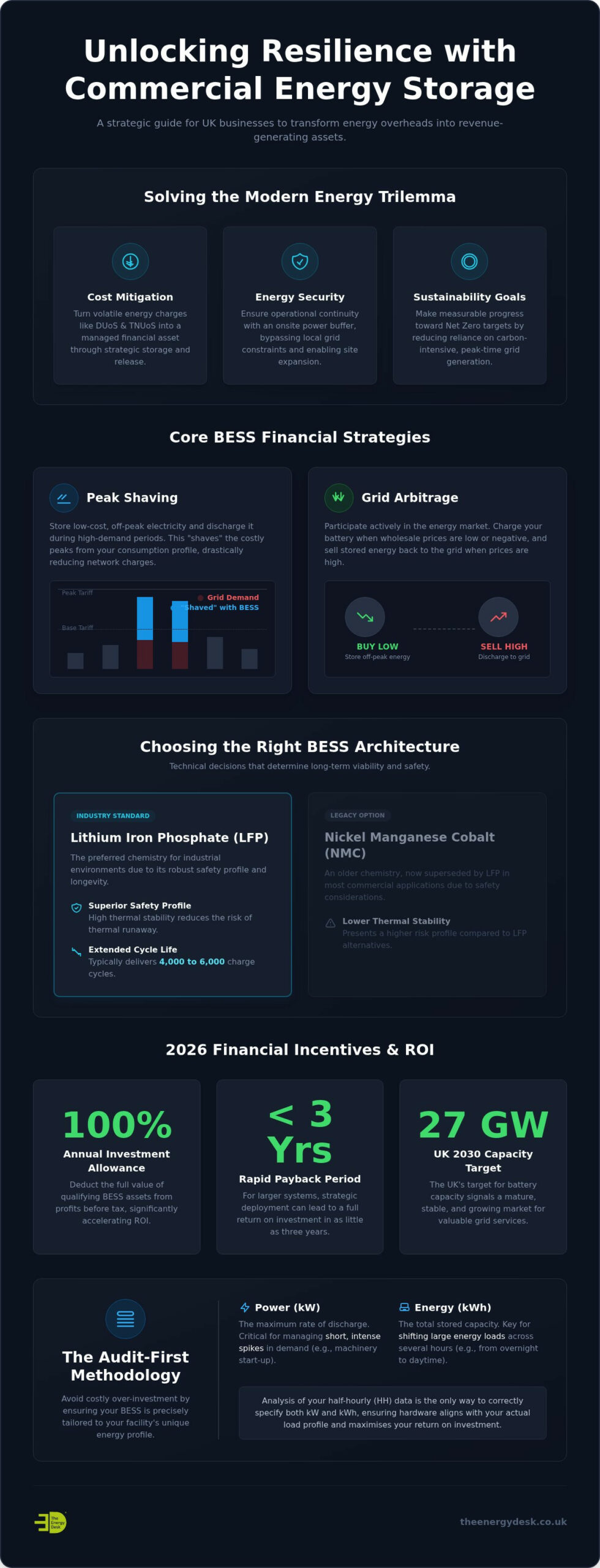
It’s clear that managing the transition toward decentralised power can feel daunting. This guide will show you exactly how commercial battery storage can turn those overheads into a strategic asset through proven methods like peak shaving and grid arbitrage. You’ll learn how to secure your energy independence while making tangible progress toward Net Zero targets. We’ll break down the 2026 fiscal incentives, including the 100% Annual Investment Allowance, and provide a clear roadmap for integrating these systems into your existing procurement strategy to ensure a rapid return on investment.
Key Takeaways
- Understand how peak shaving and grid arbitrage mitigate volatile DUoS and TNUoS charges, turning unpredictable energy costs into a managed financial asset.
- Evaluate the technical merits of Lithium Iron Phosphate (LFP) against alternative chemistries to ensure your chosen architecture meets industrial safety and longevity standards.
- Discover why an audit-first methodology is essential to avoid over-specifying battery capacity and to ensure hardware aligns with your facility’s actual load profile.
- Learn how commercial energy storage solutions UK businesses deploy can bypass local grid capacity constraints, enabling site expansion without the need for costly infrastructure upgrades.
- Identify the 2026 revenue streams and fiscal incentives, such as the Annual Investment Allowance, that can shorten payback periods to as little as three years for larger systems.
The Strategic Case for Commercial Energy Storage Solutions in the UK
The UK energy market has reached a critical inflection point. In 2026, a Battery Energy Storage System (BESS) is no longer a luxury for industrial pioneers but a core requirement for any business seeking fiscal stability. These systems allow organisations to store electricity during low-demand periods and discharge it when costs peak. This shift marks the transition of storage from a simple emergency backup solution to an active financial asset that dictates the success of a company’s energy procurement strategy.
2026 is particularly significant due to the convergence of government targets and market volatility. The UK’s Clean Power 2030 Action Plan has accelerated the requirement for 23 to 27 GW of battery capacity. With the introduction of the cap and floor regime for long-duration storage and the full implementation of the EU Battery Regulation, the regulatory framework is now mature. Investing now allows businesses to mitigate the risk of volatile wholesale electricity prices, which continue to fluctuate based on global supply chains and domestic grid constraints.
Addressing the Energy Trilemma: Cost, Security, and Sustainability
Achieving corporate ESG targets whilst maintaining a healthy bottom line is a delicate balance. The commercial energy storage solutions UK businesses implement provide a direct answer to this trilemma. By reducing reliance on carbon-intensive peak-time generation, companies can demonstrate measurable progress toward Net Zero. Security is equally vital. Storage provides a buffer against local grid instability and capacity constraints that often prevent site expansion. It ensures that operations remain consistent even when the wider network faces stress, providing a level of onsite power reliability that traditional procurement cannot match.
The Role of Storage in Modern Energy Procurement
Traditional fixed-rate deals are becoming less competitive compared to market-responsive strategies. Integrating storage allows for more flexible energy contract negotiations. Instead of being a passive consumer, your business becomes a flexible participant in the market. This flexibility is the foundation of modern commercial energy storage solutions UK wide. At The Energy Desk, we integrate hardware solutions directly with supply contracts. This approach ensures that the battery isn’t just sitting onsite but is actively working to lower standing charges and capture value from grid balancing services. It’s about moving from a rigid utility cost to a dynamic, managed resource that responds to real-time market signals.
Evaluating BESS Architectures: Choosing the Right Solution
Selecting the correct architecture is a technical decision that dictates the long-term viability of your investment. In 2026, Lithium Iron Phosphate (LFP) has emerged as the industry standard for commercial energy storage solutions UK wide. This is largely due to its superior safety profile and a cycle life typically ranging between 4,000 and 6,000 cycles. Whilst Nickel Manganese Cobalt (NMC) was once common, LFP’s thermal stability makes it the preferred choice for industrial environments. The UK energy storage market has matured significantly, offering a range of configurations from containerised outdoor units to indoor modular racks.
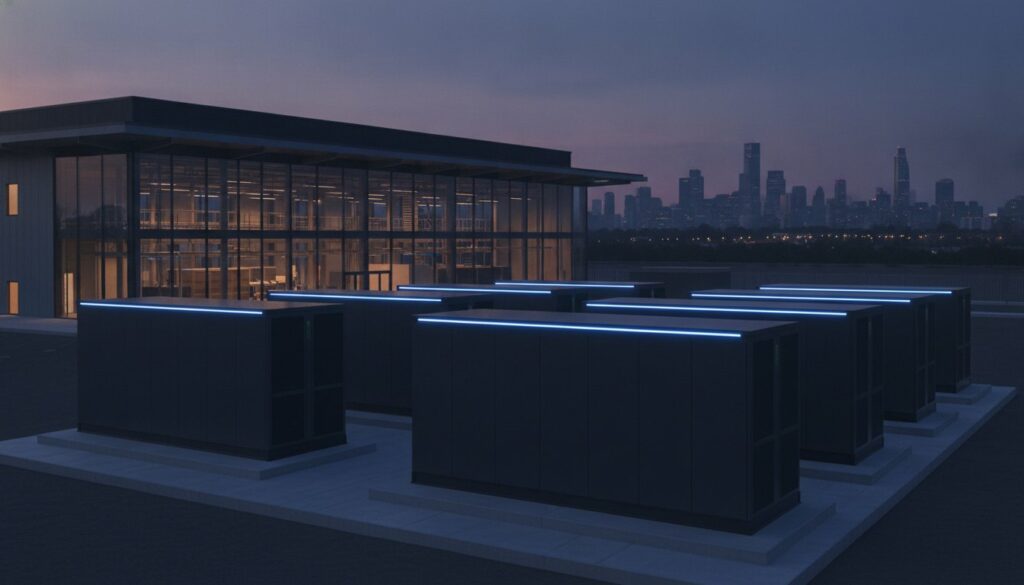
Containerised solutions are often favoured for larger industrial sites with available external space, as they simplify planning and fire safety isolation. Conversely, indoor modular racks are suitable for urban sites with limited footprints. Most businesses will opt for a Behind-the-Meter (BTM) configuration. This setup allows the system to sit on your side of the utility meter, directly reducing your reliance on the grid and lowering your electricity standing charges.
Power vs. Energy: Understanding kW and kWh for Your Site
It’s vital to distinguish between power (kW) and energy (kWh). Power represents the maximum rate at which the battery can discharge, whilst energy represents the total capacity stored. If your goal is to manage short, intense spikes in demand, a high-power system is necessary. However, if you intend to shift loads across several hours, discharge duration is the priority. Matching these specs to your half-hourly (HH) data profile is the only way to avoid over-investment. A bespoke energy audit ensures that the system is sized correctly to maximise your specific ROI.
Integration with Onsite Generation (Solar and CHP)
Battery storage acts as the central hub of your onsite generation. For sites with solar PV, storage allows you to capture excess generation during the day for use during expensive evening peaks. It also enhances the efficiency of Combined Heat and Power (CHP) units by allowing them to run at optimal loads regardless of immediate demand. An intelligent Energy Management System (EMS) is required to coordinate these flows. This level of integration is essential for commercial energy storage solutions UK businesses use when planning to expand their facility or transition to an electric EV fleet, as it manages the increased load without requiring a costly grid connection upgrade.
Financial Modelling: ROI and Revenue Streams in 2026
The financial viability of commercial energy storage solutions UK wide has shifted significantly. In 2026, the ROI is no longer solely dependent on bill savings. It’s now a sophisticated combination of cost avoidance and active revenue generation. Peak shaving remains the primary driver for many industrial sites. By discharging stored energy during peak periods, businesses can drastically reduce Distribution Use of System (DUoS) and Transmission Network Use of System (TNUoS) charges. These “red-band” charges often represent a disproportionate slice of the total utility bill.
Grid arbitrage offers a second layer of value. By purchasing electricity during off-peak windows when prices are low, or even negative, and using that power during expensive peak hours, companies insulate themselves from market volatility. Beyond internal savings, systems can participate in National Grid balancing services like Dynamic Containment. A typical 250 kWh system can generate between £6,000 and £15,000 annually through these frequency response programmes. Additionally, the Capacity Market provides steady revenue for sites capable of providing standby power during times of system stress.
Capital Expenditure vs. Operational Savings
The initial investment for a commercial BESS varies, but the payback periods are becoming increasingly attractive. Larger systems exceeding 250 kWp often achieve full payback within three to five years, delivering an ROI of up to 33%. Smaller 100 kWp systems typically see a return in four to six years. Fiscal incentives are a major factor here. Under current 2026 regulations, businesses can claim 100% Annual Investment Allowance (AIA) on the first £1 million of qualifying expenditure. This allows the full cost to be deducted from taxable profits in the first year, providing an effective tax saving of up to 25% for companies paying the main rate of corporation tax.
Avoiding the Pitfalls of Grid Connection Costs
One of the most significant risks to project viability is the cost of grid connection. Early engagement with the District Network Operator (DNO) is essential. Without a strategic approach, businesses often face “ransom” fees for substation upgrades that can stall a project before it begins. However, storage can actually bypass these requirements. By using a battery to manage peak loads onsite, you can often expand operations without needing a larger grid connection. Our team at The Energy Desk provides specialised assistance with G99 applications and utility connections. We ensure that your infrastructure is sized correctly from the start, preventing the over-specification that often leads to unnecessary capital outlay.
Case Study: Onsite Energy Generation and Storage in Action
High-energy UK manufacturing sites often face a ceiling on their growth due to local grid capacity limits. In one recent implementation, a facility was unable to add a new production line because the District Network Operator (DNO) quoted a prohibitive sum for a substation upgrade. By exploring commercial energy storage solutions UK businesses can bypass these physical infrastructure barriers. This approach allowed the manufacturer to expand without the multi-year delay associated with traditional grid reinforcement.
Our process began with forensic bill validation and a comprehensive energy audit. This initial step is critical; it revealed that the site was suffering from 22% wastage due to inefficient procurement and poor power factor correction. Addressing these fundamentals before hardware selection ensured the storage system was sized for actual demand rather than inflated historical data. It’s a methodical approach that prevents the unnecessary capital expenditure often seen in poorly planned projects.
The final solution involved integrating a 500kW BESS with the site’s existing solar PV array. This configuration allowed the facility to store solar energy that was previously being exported at low rates and discharge it during peak “red-band” windows. The outcome was a 35% reduction in peak demand charges and the opening of new revenue streams through National Grid balancing services. To see how these results can be replicated for your facility, book your free energy audit today.
From Initial Audit to Final Connection
A successful project relies on a steady progression from data analysis to physical connection. The initial energy efficiency audit dictates the true storage requirement, preventing the common mistake of over-specifying hardware. As an independent consultancy, we manage the technical selection process to ensure the BESS is compatible with existing onsite generation like solar or industrial combined heat and power systems. We also handle the complex DNO application and G99 compliance, which are often the primary bottlenecks in UK installations. This oversight ensures the project moves from the planning phase to energisation without unforeseen regulatory delays.
Long-term Performance Monitoring
Installation is only the start of the system’s lifecycle. We use dedicated data collection services to track battery health and monitor the real-time ROI. Because energy market prices evolve, discharge strategies must be adjusted periodically to capture the highest value from grid arbitrage. This proactive oversight ensures the system remains compliant with shifting UK grid codes whilst maintaining its status as a high-performing financial asset. Managing these variables requires a disciplined, analytical mindset that prioritises long-term stability over quick, superficial fixes.
Implementing Your Solution with The Energy Desk
Selecting a partner for commercial energy storage solutions UK requires a focus on impartiality. Unlike manufacturers who are incentivised to sell specific hardware, The Energy Desk operates as an independent consultancy. We’ve been active since 2003, providing a steady hand in a technical market. This independence ensures that the technology we recommend is dictated by your operational requirements and financial objectives rather than a sales quota. We act as your trusted advisor, simplifying the complexities of modern utility solutions whilst maintaining a focus on practical results.
Our “Audit-First” methodology is the foundation of every successful project. Before any hardware is discussed, we conduct a forensic review of your energy consumption. This prevents the common industry pitfall of over-specifying battery capacity. By using actual consumption data, we ensure you don’t pay for storage you don’t need. This methodical approach extends to full project management, where we handle everything from initial design to the final utility connection and DNO application. We manage the entire project lifecycle, ensuring a seamless transition from your current setup to an optimised storage solution.
Strategic Procurement and Contract Alignment
A battery is only as effective as the electricity supply contract it supports. We align your battery’s discharge behaviour with your procurement strategy to maximise the benefits of grid flexibility. With over 20 years of experience in energy brokerage, we negotiate bespoke tariffs that reward you for shifting your load. Post-installation, our ongoing bill validation and energy management services ensure that your system continues to deliver the promised ROI. It’s about moving from a rigid cost to a dynamic, managed resource that responds to market signals whilst maintaining compliance with all UK regulations.
Next Steps for Your Business
The first step toward energy independence is a free energy audit to assess the feasibility of storage for your site. To provide an accurate quote, we’ll help you gather your half-hourly (HH) data to build a precise load profile. This data-led approach removes the guesswork from infrastructure investment and ensures your system is sized for maximum efficiency. You can start this process by contacting the expert team at The Energy Desk on 03330 151 221 to discuss how commercial energy storage solutions UK businesses are adopting can transform your utility management into a strategic financial asset.
Securing Your Organisation’s Energy Future
The landscape of utility management has fundamentally changed. Transitioning your facility from a passive energy consumer to an active market participant is no longer a choice reserved for the distant future. By integrating commercial energy storage solutions UK businesses can effectively neutralise the impact of volatile wholesale prices whilst securing long-term operational resilience. We’ve explored how strategic BESS architectures and forensic financial modelling turn what was once a standing charge into a revenue-generating asset.
Success depends on a methodical approach that starts with data, not hardware. As an independent expert energy consultancy established in 2003, The Energy Desk provides the technical oversight and comprehensive DNO support needed to navigate complex utility connections. Our audit-first methodology ensures your system is sized for maximum ROI, protecting your capital expenditure from the start. This disciplined perspective ensures that your infrastructure remains a high-performing asset for years to come.
Take the first step toward energy independence today. Request a Free Energy Audit and Storage Feasibility Study to discover how your site can thrive in the decentralised energy market of 2026. Your journey toward a more efficient, cost-effective future starts with a single consultation.
Frequently Asked Questions
How long do commercial battery storage systems typically last?
Most industrial systems have an operational lifespan of 10 to 15 years. This duration depends heavily on the battery chemistry and how the system is cycled. Lithium Iron Phosphate cells are typically rated for 4,000 to 6,000 cycles before their capacity drops significantly. Using an intelligent Energy Management System helps extend this lifecycle by maintaining optimal temperature and preventing excessive depth of discharge.
Is planning permission required for containerised battery storage in the UK?
Yes, formal planning permission is usually required for most large-scale installations. While some smaller units might fall under Permitted Development Rights, the majority of commercial energy storage solutions UK businesses deploy involve containerised units that change the site’s external appearance. Local authorities will scrutinise factors such as fire safety, acoustic impact, and the visual integration of the system into the existing industrial landscape.
Can commercial energy storage help my business achieve Net Zero?
Battery storage is a fundamental tool for decarbonisation. It allows your organisation to maximise the self-consumption of onsite renewable generation, such as solar PV or CHP. For those in the technology sector, you can also check out Ethernetics to discover how they are decarbonising data centres and telecoms with advanced energy-saving solutions. By storing excess green energy and discharging it during peak periods, you reduce your reliance on carbon-intensive grid power, providing a clear, data-backed reduction in your Scope 2 emissions and demonstrating tangible progress toward ESG targets.
What is the difference between behind-the-meter and front-of-the-meter storage?
Behind-the-meter systems are installed on your side of the utility meter. Their primary purpose is to serve your site’s load, reduce standing charges, and manage peak demand. Front-of-the-meter systems connect directly to the distribution or transmission network. These are typically larger, grid-scale assets used by developers to provide services to the National Grid rather than to support a specific industrial facility’s daily operations.
How much space is required for an industrial-scale battery system?
Space requirements are dictated by the total capacity and discharge duration. A 250 kWh system can often be housed within a small 10ft container or a dedicated modular rack room. Larger, megawatt-scale systems generally require 20ft or 40ft shipping containers. We evaluate your available footprint during the feasibility study to ensure the chosen architecture fits safely within your site’s constraints without disrupting existing logistics.
Can I use battery storage to avoid upgrading my local grid connection?
Yes, this is one of the most cost-effective applications of storage technology. If your site expansion is limited by your current Agreed Capacity, a battery can bridge the gap. It discharges during periods of high demand to keep your total grid draw below the threshold. This approach allows you to install new machinery or EV charging points without the multi-year delays and high costs of DNO substation upgrades.
By facilitating the installation of EV charging points, businesses can also support staff who choose active, green transport options; to find out more about high-quality electric cycles, you can discover Sherwood E-Bikes Ltd..
How does frequency response revenue work for UK businesses?
The National Grid pays battery owners to help maintain the grid frequency at 50Hz. Your system automatically imports or exports power in sub-second intervals to balance the network. By participating in services like Dynamic Containment, your business earns a monthly revenue stream. This income is generated whilst the battery is idle, provided the system is configured to respond to these rapid market signals from the National Grid.
Will a BESS protect my business during a total grid blackout?
Standard grid-tied systems will shut down during a blackout to ensure the safety of engineers working on the network. However, when designing commercial energy storage solutions UK organisations can specify “island mode” capabilities. This requires additional switchgear and specific inverters that allow the system to operate independently of the grid. This setup provides a reliable Uninterruptible Power Supply (UPS) for your critical site loads during a power failure.