

Is your current energy strategy robust enough to withstand continued market volatility whilst meeting the UK’s tightening Net Zero targets? In 2026, industrial combined heat and power (CHP) has transitioned from a simple efficiency measure into a strategic necessity for operational resilience. We recognise that fluctuating electricity prices and the technical complexity of integrating new hardware with your existing infrastructure can feel like significant hurdles to overcome.
This guide provides the clarity you need to navigate these challenges with confidence. You’ll discover how to evaluate, procure, and optimise industrial combined heat and power systems to slash energy costs and carbon emissions. We’ll outline a clear framework for comparing CHP options, reducing your reliance on the National Grid, and lowering your Climate Change Levy payments. We begin by examining the shift towards hydrogen-ready infrastructure before moving into a methodical procurement strategy designed to secure the best possible long-term results for your site.
Key Takeaways
- Identify onsite generation opportunities by conducting a free energy audit to calculate your facility’s potential “spark spread” and financial viability.
- Evaluate site suitability through a rigorous baseload analysis to ensure your industrial combined heat and power system is sized accurately for simultaneous heat and electricity demands.
- Future-proof your infrastructure by selecting hydrogen-blend ready technologies, such as reciprocating engines or gas turbines, that align with long-term decarbonisation targets.
- Compare procurement routes, including CAPEX-heavy ownership and OPEX-led service agreements, to find the funding model that best protects your operational margins.
- Streamline the complex installation process by leveraging an independent consultant to manage supplier tenders, utility connections, and MOP contracts.
The Strategic Case for Industrial Combined Heat and Power in 2026
Industrial combined heat and power (CHP) represents a fundamental shift from traditional energy procurement to a decentralised, onsite solution. By generating both electricity and thermal energy from a single fuel source, businesses can bypass the inefficiencies inherent in the National Grid. This approach, often referred to as cogeneration, allows facilities to take direct control of their utility costs whilst significantly improving their environmental profile. It’s a critical bridge to decarbonisation, especially as the UK moves toward its 2050 Net Zero targets.
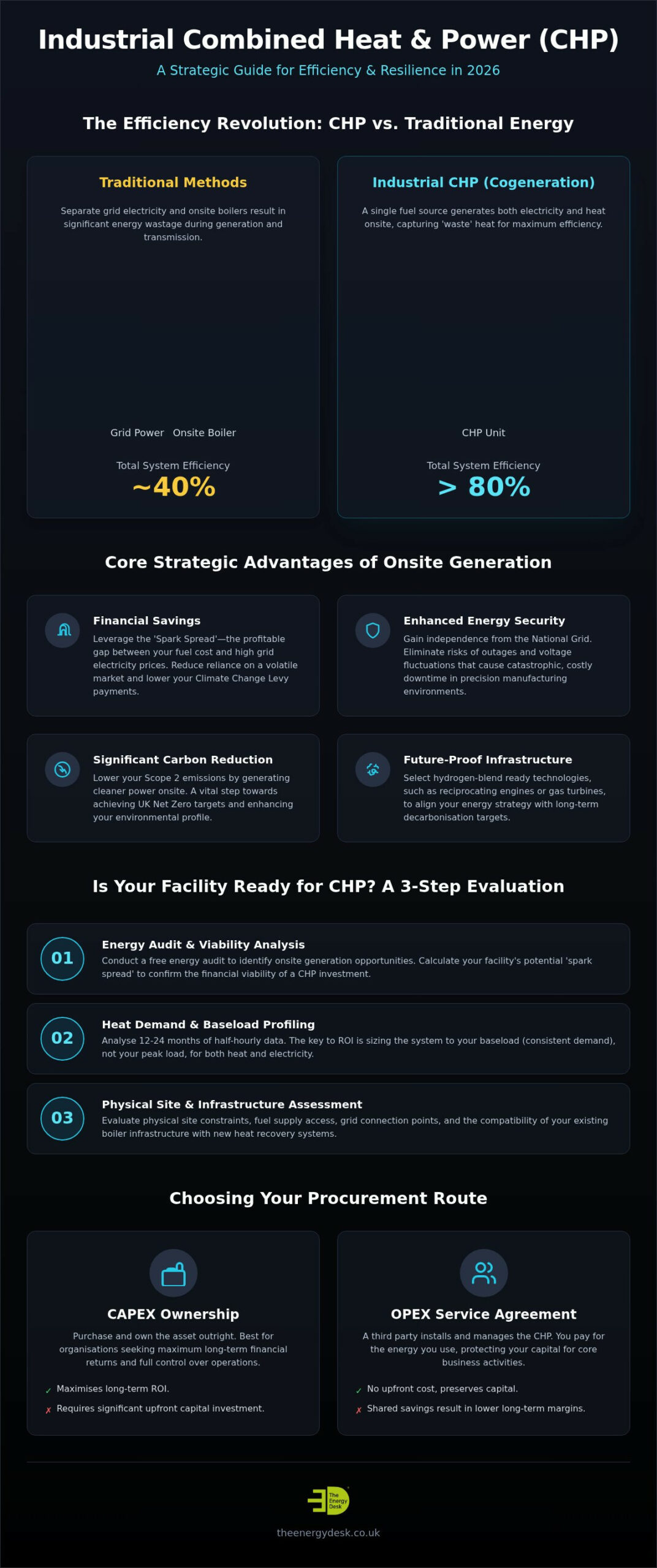
The financial viability of industrial combined heat and power in 2026 is largely driven by the “Spark Spread”. This term describes the difference between the cost of the fuel used to run the CHP unit and the market price of the electricity it replaces. As electricity prices remain sensitive to global market pressures, the ability to generate power at a lower unit cost than the grid price creates a compelling return on investment. Cogeneration systems achieve over 80% total efficiency by capturing waste heat that would otherwise be lost, contrasting sharply with the 40% efficiency typical of separate power and heat sourcing. This efficiency is a major factor in why the global market for these systems is projected to reach USD 32.87 billion by the end of 2026.
Efficiency Gains and Carbon Reduction Targets
Capturing waste heat is the primary mechanism through which CHP delivers its environmental benefits. In industrial settings, this thermal energy is repurposed for process steam, hot water, or drying, directly reducing the load on standalone boilers. This integration is vital for businesses aiming to lower their Scope 2 emissions, as it reduces the volume of carbon-intensive electricity purchased from the grid. To ensure these benefits are recognised, the UK government utilises the CHPQA programme. Under current UK standards, Good Quality CHP is defined as a system that meets the specific energy efficiency and environmental performance criteria required for certification under the UK’s CHP Quality Assurance (CHPQA) programme.
Energy Security and Grid Independence
Relying solely on the National Grid exposes manufacturers to risks beyond just price volatility. Voltage fluctuations and sudden outages can cause catastrophic downtime in precision manufacturing environments. Manufacturing downtime is expensive. Onsite generation provides a stable, reliable baseload of power that operates independently of external grid failures. To further bolster site resilience, many facilities rely on React Fueling for the consistent delivery of fuels required for backup power and industrial machinery. This independence is increasingly valuable as network distribution charges continue to rise. By generating power at the point of use, businesses avoid the escalating costs associated with transporting electricity across the national infrastructure, ensuring that operational margins remain protected amongst shifting regulatory and economic conditions.
Evaluating Site Suitability: Is Your Facility Ready for CHP?
Determining if industrial combined heat and power is a viable fit for your facility requires more than a cursory glance at your utility bills. The system relies on a simultaneous and consistent demand for both heat and electricity to achieve the high efficiencies mentioned earlier. If your heat demand is seasonal or highly erratic, the system may struggle to deliver a favourable return on investment. A successful installation depends on finding that “sweet spot” where your thermal and electrical needs overlap for the majority of the year.
Heat Demand Profiling and Baseload Analysis
Analysing 12 to 24 months of half-hourly data is the standard approach to understanding your site’s consumption peaks and troughs. This data helps identify “thermal sinks” within your processes. These might be constant requirements for steam in food production, hot water for chemical processing, or continuous drying in textile manufacturing. Correctly sizing the system to meet your baseload, rather than your peak load, is the single most important factor for ROI. Over-specifying a unit leads to frequent cycling, which increases mechanical wear and reduces overall efficiency. You can establish your site’s actual requirements by requesting a free energy audit as your first step.
Physical site constraints also play a decisive role when installing industrial combined heat and power systems. You must assess your existing boiler infrastructure to ensure it’s compatible with heat recovery systems. A new CHP unit isn’t a standalone piece of kit; it must integrate seamlessly with your current heating loops. Space is another factor. These units require significant floor area, adequate ventilation, and proximity to both gas mains and electrical distribution boards to keep installation costs manageable.
Utility Connections and Planning Permission
The technical side of procurement involves navigating G99 grid connection applications. This is essential for any system intended to operate in parallel with the National Grid. You’ll also need to consider environmental permitting, particularly regarding emissions and noise abatement if your facility is near residential or sensitive industrial areas. Don’t overlook the gas supply. Industrial CHP units often require higher gas pressures than standard boilers, which might necessitate a dedicated meter installation or a supply upgrade amongst other infrastructure changes. A methodical approach to these permissions early in the process prevents costly delays during the construction phase.
Selecting the Right Technology: Engines, Turbines, and Future-Proofing
Choosing the correct technology is a pivotal decision that dictates the long-term ROI of your industrial combined heat and power investment. The two primary contenders for most industrial sites are reciprocating gas engines and gas turbines. Your choice hinges on the specific thermal grade your processes require and how quickly your demand fluctuates throughout a typical production cycle. Selecting a system that doesn’t align with your heat-to-power ratio can lead to significant operational inefficiencies.
Reciprocating Engines vs. Gas Turbines
Reciprocating engines are often the preferred choice for small to medium-scale applications. They offer high electrical efficiency, typically ranging from 40% to 48%. They’re highly responsive, with start-up times measured in minutes, making them ideal for facilities with variable load profiles. Maintenance for these engines is methodical, requiring regular oil changes and spark plug replacements every 2,000 to 4,000 hours. This technology is particularly effective for sites that prioritising power generation over high-grade steam production.
In contrast, gas turbines are superior for heavy industry where high-grade steam is a constant requirement. Whilst their electrical efficiency is often lower than reciprocating engines, their exhaust temperatures, frequently exceeding 500°C, are perfect for generating high-pressure steam for chemical processing or large-scale manufacturing. Turbines generally have longer operational lifespans between major overhauls. However, these overhauls are more technically demanding and costly than standard engine servicing, requiring a disciplined approach to maintenance planning.
Hydrogen-Ready Systems and the Transition to Net Zero
As we progress through 2026, the shift towards hydrogen-ready infrastructure has become a non-negotiable requirement for new installations. Most modern industrial combined heat and power systems are now designed to operate on hydrogen blends of up to 20% immediately, with clear pathways to 100% hydrogen as the UK’s supply infrastructure matures. This capability protects your asset against future carbon regulations and potential increases in natural gas fuel taxes, ensuring the equipment remains compliant throughout its 15 to 20-year lifespan.
Beyond this, these systems increasingly serve as the anchor for onsite microgrids. By combining CHP with solar PV and battery storage, businesses can create a resilient energy ecosystem that maximises self-consumption and provides a buffer against grid instability. For larger industrial plants, integrating carbon capture and storage (CCS) technology is also becoming a viable method to achieve near-zero emissions. High-availability service contracts are essential here to ensure that these complex, integrated systems maintain peak performance amongst evolving energy market conditions.
The Industrial CHP Buying Guide: Procurement Routes and Funding
Procuring industrial combined heat and power systems requires a strategic choice between capital expenditure and operational service models. Each route has distinct implications for your balance sheet and long-term risk profile. Using an independent energy consultant is often the most effective way to manage this complexity. A consultant oversees a competitive tender process amongst multiple suppliers, ensuring you secure the most favourable terms and technical specifications for your site’s specific needs.
CAPEX vs. OPEX: PPA and Energy Services Agreements (ESA)
A direct capital purchase (CAPEX) allows you to maximise your long-term ROI by taking full ownership of the asset. This model is ideal for businesses with available capital who wish to retain all savings generated by the system. Conversely, OPEX-led models like a Discount Energy Purchase (DEP) or a Power Purchase Agreement (PPA) allow for the installation of CHP with zero upfront cost. In these arrangements, a third party funds and maintains the equipment, selling you the generated electricity and heat at a discounted rate. This transfers all operational and technical risk to the provider whilst still delivering immediate utility savings.
Energy Services Agreements (ESA) represent a sophisticated middle ground, often including performance-linked maintenance contracts. These agreements ensure the provider is financially incentivised to maintain high system availability. If the unit underperforms, the provider bears the cost, protecting your operational margins. For a comprehensive overview of how CHP system installation for businesses can reduce energy costs and carbon emissions under the 2026 regulatory landscape, our dedicated guide provides a clear roadmap. You can also explore the best funding model for your facility by contacting our procurement team for a professional tender management service.
Navigating UK Regulations and Incentives
The financial attractiveness of industrial combined heat and power is significantly enhanced by UK government incentives. The primary mechanism is the CHP Quality Assurance (CHPQA) programme. Certification through this scheme is the prerequisite for accessing various tax reliefs, including exemptions from the Climate Change Levy (CCL) on the fuel used by the CHP unit. Additionally, “Good Quality” CHP installations may qualify for business rates exemptions, further reducing the total cost of ownership. Forensic bill validation ensures that all eligible tax exemptions and incentives are correctly applied to your utility invoices, preventing overpayment on your Climate Change Levy liabilities. Engaging with a specialist who understands these regulatory nuances ensures that no potential savings are overlooked during the procurement phase.
Maximising ROI with The Energy Desk’s Managed CHP Solutions
Achieving the best results from industrial combined heat and power requires more than just high-quality hardware. It demands a managed approach that considers your entire energy ecosystem. At The Energy Desk, we begin every project with an independent audit. This step is essential to ensure the proposed system is technically sound and financially viable before any capital is committed. Our role extends far beyond installation. We manage the intricate details of utility connections and MOP contracts, ensuring your site is fully integrated with the grid and compliant with all technical standards.
A whole-system approach is vital for modern industrial facilities. We don’t view CHP in isolation. Instead, we look at how it interacts with solar solutions and EV infrastructure to create a cohesive energy strategy. By monitoring the “Spark Spread” on an ongoing basis, we ensure your onsite generation remains more cost-effective than grid power. This proactive oversight allows for adjustments as market conditions shift, protecting your ROI over the long term. Our methodical management ensures that every component of your energy infrastructure works in harmony to reduce costs and carbon emissions.
Independent Consultancy vs. Manufacturer-Led Sales
Manufacturer-led sales often come with inherent brand bias. A manufacturer’s primary goal is to sell their specific engine range, which might not always be the optimal fit for your heat-to-power ratio. As an independent consultancy founded in 2003, we provide unbiased advice across the entire market. We leverage our extensive supplier relationships to secure competitive gas and power rates, ensuring the fuel for your CHP unit is as affordable as the electricity it replaces. This independence allows us to select the best technology for your specific site needs without being tied to a single product line.
Next Steps: Request Your Free Industrial Energy Audit
Taking the first step towards energy independence is straightforward. A professional onsite energy audit and feasibility study provides a clear roadmap for your transition to cogeneration. During this process, we also perform forensic bill validation to identify hidden overcharges and ensure your historical billing is accurate. This often recovers significant sums that can be reinvested into your new infrastructure. Contact The Energy Desk to organise your free industrial energy audit and begin the process of optimising your facility’s energy performance.
Securing Your Industrial Energy Future
Adopting industrial combined heat and power is no longer just an efficiency upgrade; it is a strategic move towards long-term operational resilience. By integrating hydrogen-ready technology and conducting a rigorous baseload analysis, your facility can significantly reduce carbon emissions whilst insulating itself from the volatility of the National Grid. We have explored how the right procurement model can transform energy from a passive cost into a managed asset that supports your broader sustainability goals.
Since 2003, The Energy Desk has provided nationwide support for energy-intensive industries as an independent energy consultancy. We specialise in forensic bill validation, utility connections, and MOP contracts to ensure every aspect of your infrastructure is optimised for performance and compliance. Our team is ready to help you navigate the technical and regulatory complexities of the 2026 energy market with precision and expertise.
Take the first step towards a more cost-effective and sustainable operation. Request your free industrial energy audit today to identify your onsite generation potential and secure your site’s utility strategy. We look forward to partnering with you on your journey to energy independence.
Frequently Asked Questions
What is the “spark spread” and why does it dictate CHP viability?
The spark spread is the difference between the price of electricity and the cost of the gas required to generate it. It dictates viability because it represents the gross margin of onsite generation. For industrial combined heat and power to be financially sound, the cost of gas plus operational expenses must be lower than the price of grid-supplied electricity. A wider spread results in a faster return on investment and greater annual savings.
How long does a typical industrial CHP installation take from start to finish?
A standard project timeline usually ranges from 6 to 12 months, depending on site complexity and grid connection requirements. It’s a process that begins with a feasibility study and energy audit, followed by the design and procurement phases. Technical hurdles, such as securing G99 grid applications or upgrading gas meter infrastructure, can influence the duration. Methodical planning and early engagement with utility providers are essential to maintain momentum and avoid unforeseen delays.
Is CHP still a viable technology given the UK’s 2050 Net Zero target?
Cogeneration remains a critical bridge technology for the UK’s transition to Net Zero. Modern systems are increasingly designed as hydrogen-ready, allowing for a seamless shift from natural gas to low-carbon fuels as they become available. By achieving efficiencies exceeding 80%, CHP significantly reduces the total primary energy required compared to separate heat and power sourcing. It’s a solution that directly lowers carbon emissions whilst providing the stable baseload power needed during the grid’s decarbonisation.
What is the minimum heat demand required for a CHP unit to be efficient?
Efficiency is typically achieved when a facility has a consistent thermal requirement for at least 4,000 to 5,000 hours per year. The system relies on capturing waste heat to justify its operation; without a steady “thermal sink” for steam or hot water, the efficiency gains are lost. Sites with 24/7 operations or continuous industrial processes offer the best profiles. Sizing the unit to meet your baseload rather than peak demand ensures the highest possible utilisation rates.
Can industrial CHP systems run on renewable fuels like biogas or hydrogen?
Yes, most contemporary industrial combined heat and power units are compatible with a variety of renewable fuels. Many reciprocating engines can operate on biogas or biomethane with minimal modification, whilst new turbines are being manufactured to accept hydrogen blends. As of 2026, hydrogen-ready systems are becoming the industry standard. This flexibility allows businesses to future-proof their assets against changing carbon regulations and transition to carbon-neutral operations as renewable fuel supply chains mature.
How does a CHP system improve business continuity for manufacturers?
Onsite generation provides a layer of protection against grid instability and voltage fluctuations. In the event of a National Grid outage, a CHP system configured for “island mode” can continue to supply critical loads, preventing costly production downtime. This independence is particularly valuable for precision manufacturing where even minor power quality issues can damage equipment or ruin batches. It ensures that essential thermal and electrical processes remain operational amongst external utility disruptions.
What are the main differences between a gas engine and a gas turbine for CHP?
The primary difference lies in the grade of heat produced and electrical efficiency. Gas engines offer higher electrical efficiency and are better suited for hot water or low-pressure steam requirements, whilst turbines produce much higher exhaust temperatures. This makes turbines superior for generating high-pressure steam in heavy industrial applications. Turbines generally require less frequent but more intensive maintenance compared to the regular service intervals of reciprocating engines; it’s a necessary trade-off between frequency and technical complexity.